DD
MM
YYYY

PAGES

DD
MM
YYYY

spot_img

PAGES

Home Blog Page 3614

Biggest Car Producers by Year

0

The automotive industry is one of the most dynamic and competitive sectors in the world, with millions of vehicles produced and sold every year. But which automakers are the biggest and most successful in terms of production and sales? We will look at the top 15 car producers by year, based on data from the Organization Internationale des Constructeurs d’Automobile’s (OICA) and other sources.

Top 15 car producers in 2022; According to the latest available data, the top 15 car producers in 2022 were:

| Rank | Manufacturer | Vehicles produced.

| 1 | Toyota | 10,060,339 |

| 2 | Volkswagen | 9,846,955 |

| 3 | General Motors | 8,822,399 |

| 4 | Hyundai-Kia | 8,067,557 |

| 5 | Ford | 7,835,519 |

| 6 | Honda | 5,456,857 |

| 7 | Nissan | 4,399,112 |

| 8 | Stellantis | 3,950,617 |

| 9 | Renault | 3,757,049 |

| 10 | BMW | 3,677,820 |

| 11 | Mercedes-Benz | 3,509,072

| 12 | Suzuki | 2,944,988 |

| 13 | SAIC | 2,879,809 |

| 14 | Geely | 2,699,672 |

| 15 | Tesla | 2,369,769 |

Toyota was the largest car producer in the world in 2022, with over 10 million vehicles produced. The Japanese automaker has been the leader for many years, thanks to its popular models such as the Corolla, Camry, RAV4 and Prius. Toyota also owns other brands such as Lexus, Daihatsu and Hino.

Volkswagen was the second-largest car producer in the world in 2022, with nearly 10 million vehicles produced. The German automaker has a diverse portfolio of brands such as VW, Audi, Skoda, SEAT and Porsche. Volkswagen also has joint ventures with Chinese companies such as SAIC and FAW.

General Motors was the third-largest car producer in the world in 2022, with over 8.8 million vehicles produced. The American automaker has a strong presence in North America and China, with brands such as Chevrolet, Buick, Cadillac and GMC. General Motors also owns a stake in SAIC-GM-Wuling.

Hyundai-Kia was the fourth-largest car producer in the world in 2022, with over 8 million vehicles produced. The South Korean automaker has been growing rapidly in recent years, with models such as the Sonata, Elantra, Tucson and Kona. Hyundai-Kia also owns a stake in Genesis.

Ford was the fifth-largest car producer in the world in 2022, with over 7.8 million vehicles produced. The American automaker has a loyal customer base in North America and Europe, with models such as the F-Series, Mustang and Fiesta. Ford also owns a stake in Mazda.

Trends and challenges

The global automotive industry is facing many challenges and opportunities in the coming years. Some of the key trends and issues are:

Electrification: The demand for electric vehicles (EVs) is increasing rapidly around the world, driven by environmental concerns and government incentives. EVs are expected to account for over 30% of global car sales by 2030, according to some estimates. Automakers are investing heavily in developing and producing EVs that are affordable and competitive.

Autonomous driving: The development of autonomous driving technology is advancing at a fast pace, with many automakers and tech companies testing and launching self-driving cars. Autonomous driving has the potential to improve safety, efficiency and convenience for drivers and passengers. However, there are also many technical and regulatory challenges to overcome before fully autonomous cars become mainstream.

Connectivity: The integration of digital technologies and services into cars is enhancing the user experience and creating new business opportunities for automakers and other players. Cars are becoming more connected to each other and to the internet of things (IoT), enabling features such as infotainment systems, navigation systems and remote diagnostics.

Mobility services: The rise of new mobility services such as ride-hailing, car-sharing and subscription models is changing the way people use and own cars. These services offer more flexibility, convenience and affordability for consumers, especially in urban areas. Automakers are adapting to this shift by partnering with or acquiring mobility service providers or launching their own platforms.

Competition: The automotive industry is becoming more competitive and fragmented, with new entrants and challengers from different sectors. These include tech giants such as Google, Apple and Amazon, as well as startups such as Tesla, Nio and Rivian. These players are disrupting the traditional value chain and business models of the industry, offering innovative products and services that appeal to new customer segments.

The automotive industry is one of the most important and influential sectors in the world economy, with a significant impact on society, environment and innovation. The industry is undergoing a major transformation, driven by technological, social and regulatory changes. The top 15 car producers in the world are facing both challenges and opportunities in this dynamic and competitive market. They need to adapt and innovate to meet the changing needs and expectations of customers, while maintaining their competitive edge and profitability.

Access Bank Plans to Expand Operations to Asia in The First Quarter of 2024

0

Nigerian multinational commercial bank, Access Bank, has announced plans to expand its operations to Asia in the first quarter (Q1) of 2024.

Access Bank expansion to Asia, is part of a wider global expansion plan, which includes a strategy to expand more deeply into Francophone Africa, build closer ties with North Africa and Europe.

Speaking on the bank’s recent plan, CEO of Access Bank Dr. Herbert Wigwe expressed concern that Africa could be cut off from the global financial system if they not expand strategically, hence the need for the bank to expand its operations across the global stage.

In his words,

You cannot blame European or American banks who chose not to be here. We blame ourselves if we are not big enough to support our people. We told ourselves that we’ll keep pushing that wall until we make sure we are on the global stage.

“We will be in London, we will be in the US, we will be in Hong Kong, we will be in all of these markets to make sure that our people cannot be disintermediated”.

Wigwe views an Asian bank as supporting overall network effects based on the existing activities of its clients. Above all, he stressed that access to huge pools of capital would not normally be possible in African markets.

He further said that he and his team expect to receive approval from monetary authorities soon. He however declined the Asian country in which the bank would launch in order to avoid preempting local regulators.

Access Bank in a bid to become a notable player in the banking sector, has continued to expand rapidly across the continent over the last half decade. More recently, the bank snapped up the banking operations of Standard Chartered in Angola, Tanzania, Cameroon, Sierra Leone, and the Gambia.

The bank also has a UK subsidiary and operates representative offices in India, China, and Lebanon. Its UK subsidiary also operates a branch in the UAE and Dubai.

In its five-year strategy document, Access Bank plans to expand to 26 countries by 2027, and in at least 3 organizations for Economic Co-operation and Development (OECD) countries supporting trade.

Within two decades, the bank emerged as a leading tier-one financial institution in Nigeria, in line with its disciplined execution of rolling 5-year corporate plans. In the last five years, the bank displayed strong prowess in mergers and acquisitions across the continent. 

It already has a network of more than 700 branches and service outlets, spanning three continents, 17 markets, and 52 million customers. However, its primary focus on trade in the next five years is to leverage its established presence across trade and financial hubs globally.

Access Bank’s mission is to build a strong global franchise focused on serving as a gateway for payments, investment, and trade within Africa and between Africa and the rest of the world, anchored by a robust capital base, a relentless focus on execution; and best-in-class customer service and financial services.

Top 5 Most Funded Nigerian Startups in 2023

0

Despite the slowdown in funding for startups across Africa in 2023, some Nigerian startups were still able to receive a significant amount of funding.

Among the top five most-funded startups in Nigeria for the year 2023, two are fintechs, which is an indication that investors are still keeping tabs on the country’s Fintech ecosystem that has continued to receive a significant portion of funding for startups.

Other startups on the list include one health tech startup, one e-commerce startup, and a mobility fintech company. In total, the top five startups for the year 2023, raised a total of $207 million in funding.

Check Out The List of The Top Five (5) Most Funded Startups in Nigeria For 2023

5.) Nomba ($30 Million)

Occupying the fifth position is Nomba, a Nigerian Fintech startup that raised $30 million in a pre-Series B investment.

The round was led by San Francisco-based Base10 Partners (investors in Nubank, Plaid, and Brex), with participation from Helios Digital Ventures, Shopify, Partech, and Khosla Ventures.

The startup disclosed that it would deliver payment solutions that have been designed for the specific services that businesses provide.

Formerly known as Kudi, Nomba was founded in 2016 by Yinka Adewale and Pelumi Aboluwarin as a chatbot designed to simplify payments.

4.) Helium Health ($30 Million)

Nigerian health-tech startup, Helium Health, in June this year, raised $30 million in Series B funding. 

The funding round was led by AXA IM Alts, with participation from investors, including Capria Ventures, Angaza Capital, Flatworld Partners, LCY Group, WTI, and AAIC.

Helium Health announced that it will use the funding to broaden the market for HeliumCredit, its fintech product that provides digital financing for the healthcare industry in Africa.

Launched as a digital finance platform in 2020, Helium Health empowers healthcare providers in Africa with digital tools, financing solutions, and data partnerships. The startup is on a mission to digitize healthcare across Africa.

3.) Lemfi ($33 Million)

Nigerian global payments company Lemfi, in August 2023, announced the raise of a $33 million Series A round, led by Left Lane Capital, to drive its expansion and product development.

With the funds raised, the fintech startup announced that plans to expand its product offering to Europe, the Middle East, and Asia, as well as innovate new product offerings according to the needs of its users.

Launched in 2020, to enable low-cost remittance payments to Nigeria, Ghana, Rwanda, Kenya, and several African countries, LemFi offers a multi-currency account for immigrants to hold, send, and receive money in both the currencies of their home country and that of their host country. Users can also send money to more than 30 countries. 

2.) Sabi ($38 Million)

Nigerian B2B e-commerce startup Sabi announced the raise of $38 million in series B funding in May 2023. The funding round valued the company’s valuation at $300 million.

Through the funding, Sabi disclosed its aim to serve millions of small- to medium-sized enterprises (SMEs) in Africa by providing technology, tools, and access to products and services.

Launched in 2020, Sabi is Africa’s leading provider of enabling infrastructure powering the distribution of goods and services.

The platform enables and empowers a broad ecosystem of users, allowing merchants, importers, exporters, distributors, and manufacturers to expand their capabilities and grow their businesses using Sabi’s technology rails.

It also leverages technology to assist with sourcing and aggregation, collateral verification and management, and traceability.

With a presence in Nigeria, Kenya, and South Africa, Sabi helps informal businesses scale by providing the required infrastructure needed for their growth.

The startup is dedicated to empowering small businesses and providing the resources and support needed to thrive.

1.) Moove ($76 million)

Occupying the first position is Nigerian mobility Fintech company Moove, which announced the raise of $76 million in funding in August 2023,  to build the largest tech-driven financial services platform for mobility entrepreneurs.

The financing consists of $28 million in equity, $10 million in venture debt from funds and accounts, and $38 million in previously undisclosed funds raised over the past year. 

Moove said the new funding will be used to achieve its objective of profitability over the next 12 months and finance the company’s push into new, larger markets, as well as help it grow in existing locations in Europe, the Middle East, and Africa

Launched in 2020 by Delano and Jide Odunsi, to assist African mobility entrepreneurs in obtaining vehicle financing,

Moove is a revenue-based financing company that provides flexible options for drivers who want to get into the business of ride-hailing or other gig economy services without having to borrow from car owners or take bank loans to finance these cars bought from dealerships.

Drivers sign up on the platform and, once verified, are trained and sign contracts with Moove to access loans to buy or rent cars.

Since its launch, the startup has expanded its operations to several cities across Africa, Europe, the Middle East, and Asia.

YOU ARE YOUR OWN LEGEND

0

‘Men are haunted by the vastness of eternity. And so we ask ourselves, will our actions echo across the centuries? Will strangers hear our names long after we’re gone and wonder who we were? How bravely we fought? How fiercely we loved ? . . .’

The intro-narative to TROY (2004),  https://www.youtube.com/watch?v=D0sy6-MfNVQ (No. 73 in Rankers ‘Epic Films of All Time’)

It’s interesting to look at how time changes.

Once, being a warrior leader was the only path to notoriety. Throughout history, we have seen the priorities for mass recognition cut across inventors, artists, writers, entertainers, political, religious and business leaders, astronauts, musicians, sports persons, social change activists, charity leaders … the list goes on.

Money has always bought influence, and by association, notoriety.

Some people’s names have gone down in history as creators and inventors but frequently, they were not the people that should have been credited.

People who have been in charge of projects are often people who provide leadership, technical cohesion, and deal with stakeholders, the press, and the wider political environment in which challenging projects live.

Robert Oppenheimer was credited with being the ‘Father of the Atomic Bomb’, but while he was definitely in charge of ‘The Manhattan Project’, several accounts exist suggesting defining breakthroughs made by people in his teams, whose names have never been remembered.

There are many stories about the Germans having got there first.

In written and spoken arts, ghost writers are often used. In some cases, work is even stolen without being paid for.

In 1990, an Italian music group ‘Black Box’ released a dance track ‘Ride on Time’. It shook the ground so much, live remix DJs recreate it, even now, more than 30 years later.

But it used unlicensed vocal samples from the 1980 single “Love Sensation” by Loleatta Holloway.

Once, many years ago, I was a leader under an owner in a large Telecoms/ISP company.

Another former leader who had left, was brought back. There were some parallels in solution design between both of our teams.

Several times, when I was discussing ideas with him on the way forward, he went to the owner and promoted the ideas as his own.

On one occasion, he had an architecture produced by his team. I told him it was wrong, and pointed out how it should be, through an amended drawing.  He disagreed. I told him to take it to the owner, (who was also technically well versed in these technologies).

Later that day, the owner called me in, and asked me how can I allow my team to produce such poor work. The other leader has somehow claimed ownership of the print out that was mine, and claimed his own teams work came from me.

I’m not going to get into how this ended.

What is important is that I know what belongs in my own portfolio of greatness. So does he.

We see films made about legends, but do the films really explain who they are as people?

The only thing that becomes attached to a name to give it breath through film, is some semblance of how a Producer Produces, a Scriptwriter Writes, a Director Directs, and Actors Act.

It is not that person.

Many who use a desktop computer at home or work, will be familiar with a pointing and selecting device. Some even use these by preference with laptops and tablets due to speed of movement and precision control. Everyone knows it is called a ‘mouse’, but who even knows it was invented by one Doug Englebart?

With the types of online media that have began from the end of the last millennium, we have new forms of social capital, but being built upon the same principles no different from buying influence with the senate of Rome in days of old.

The concept of paying for a premium service which will get your media in front of more eyes.

Today, many can claim to know Elon Musk as a person, far more can know him in a professional sense, and more still know his likeness and voice. None can say the same for Satoshi Nakamoto, but the question is… in a few hundred years, who will this matter to?

The tombstones of the future lie not in graveyards but in network archives.

But they are still tombstones that fail to convey the private person.

Whether warriors or not, some time we will all die.

Someday, also, there will be no-one of this life, who recalls us as somebody living and breathing.

You can’t walk away from who you are, so you have to work to make that person someone you are ok with.

You can choose whether past deeds bring you torment or solace.

Some may think me naïve, but I won’t subscribe to what another person’s version of success is.

So make peace with a legacy only to yourself.

Satisfy yourself in your final hour, that your brief struggle in boundless time was worth it.

You are your own LEGEND


9ja Cosmos is here!

Get your .9jacom and .9javerse Web 3 domains  for $2 at:

.9jacom Domains

.9javerse Domains

Visit 9ja Cosmos

Follow us on LinkedIn HERE

Background Sourced 25/11/23 from

Wikipedia, Ranker .com , The Guardian, IMDb,  and You Tube


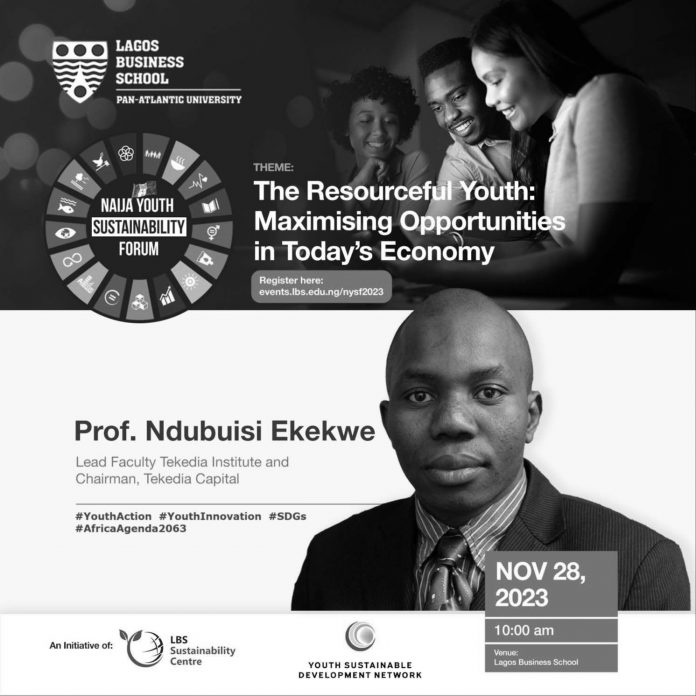
Join Ndubuisi Ekekwe At Lagos Business School’s Naija Youth Sustainability Forum on Nov 28, 2023

0

Good People, I am very excited to announce that I will deliver a special presentation during the Lagos Business School, Pan-Atlantic University’s Naija Youth Sustainability Forum with the theme ‘The Resourceful Youth: Maximising Opportunities in Today’s Economy’.  The venue is LBS, and you’re invited.

Young People, there is abundance in the future, and never doubt the promises of tomorrow. But you have to take ACTION and be resourceful to unlock those promises.  Indeed, across human history, this is still the best time to be a young person because your opportunities are unbounded and unconstrained by geography.

For all the challenges you see, behind are opportunities for you.  We just have to propel with productive #action – and with that, success will become a constant in our careers. Yes, maximize the opportunities in today’s economy, because out of the visions and works of your hands, nations will re-emerge. #MakeItHappen. See you on Tuesday.