DD
MM
YYYY

PAGES

DD
MM
YYYY

spot_img

PAGES

Home Blog Page 3619

FTX Wants to Sell its GBTC Shares and other Trust Assets

0

FTX, one of the largest cryptocurrency exchanges in the world, has announced that it plans to sell its Grayscale Bitcoin Trust (GBTC) shares on the secondary market. GBTC is a popular investment vehicle that allows investors to gain exposure to Bitcoin without holding the actual cryptocurrency. GBTC shares trade at a premium or discount to the net asset value (NAV) of the underlying Bitcoin, depending on the supply and demand dynamics.

According to the motion filed at the bankruptcy court in Delaware, FTX has reached an agreement with a group of investors, led by Paradigm Capital, to purchase some of its trust assets for $150 million. The trust assets include FTX’s stakes in various crypto projects, such as Solana, Serum, and FTX Token. The sale would allow FTX to repay its secured and unsecured creditors, who are owed more than $200 million.

FTX claims that the sale is in the best interest of its stakeholders, as it would provide a quick and efficient resolution of its bankruptcy case. FTX also argues that the sale is fair and reasonable, as it reflects the current market value of the trust assets and was negotiated at arm’s length. FTX says that it received multiple offers from potential buyers but chose Paradigm Capital as the highest and best bidder.

The motion is subject to approval by the bankruptcy court, which will hold a hearing on November 15. If approved, the sale would mark one of the largest transactions involving crypto assets in a bankruptcy context. The sale would also have implications for the crypto industry, as it would demonstrate the viability and liquidity of crypto assets as a form of collateral and payment.

FTX CEO Sam Bankman-Fried said that the exchange acquired about $1.7 billion worth of GBTC shares earlier this year, when the premium was around 10%. However, since then, the premium has turned negative, meaning that GBTC shares are trading below the NAV of Bitcoin. This has resulted in a loss for FTX and other GBTC holders, who are locked in for six months before they can sell their shares.

Bankman-Fried said that FTX is looking for buyers who are willing to pay a fair price for the GBTC shares, which he estimated to be around 0.5% below NAV. He said that FTX is not interested in holding GBTC for the long term, as it prefers to invest in Bitcoin directly or through other products. He also said that FTX is open to selling its GBTC shares to Grayscale itself, if the trust decides to buy back its own shares.

The negative premium of GBTC has been a source of concern for many investors, who fear that it could affect the performance and reputation of the product. Some analysts have suggested that Grayscale should convert GBTC into an exchange-traded fund (ETF), which would allow for more liquidity and arbitrage opportunities. However, Grayscale has not indicated any plans to do so, as it faces regulatory hurdles and competition from other Bitcoin ETFs that have been approved in Canada and Europe.

FTX filed for Chapter 11 bankruptcy protection in the U.S. bankruptcy court of Delaware. This means that FTX is unable to pay its debts and needs to reorganize its business under the supervision of the court. FTX has more than $200 million in liabilities, mainly to its creditors who lent money or provided services to FTX.

Devaluation of Currency through printing is like Hidden Tax

0

One of the most insidious effects of inflation is the erosion of purchasing power. Inflation is the general increase in the prices of goods and services over time, which reduces the value of money. When the government prints more money to finance its spending, it increases the money supply and creates inflationary pressure. This is equivalent to a hidden tax, because it reduces the real income and savings of the people.

Printing money devalues the Currency.

The value of a currency is determined by supply and demand. When there is more money in circulation than the demand for it, the value of each unit of money decreases. This means that it takes more money to buy the same amount of goods and services as before. For example, if a loaf of bread costs $1 today and the government prints 10% more money, tomorrow the same loaf of bread may cost $1.10. This means that the purchasing power of $1 has decreased by 10%.

This is not a one-time effect. As long as the government continues to print more money than the growth of the economy, inflation will persist and accelerate. The more money is printed, the faster the value of the currency declines. This creates a vicious cycle, where the government needs to print more money to pay for its expenses, which causes more inflation, which reduces the value of the money, which requires more printing, and so on.

The devaluation of currency through printing has many negative consequences for the economy and society. Some of these are:

It distorts price signals and resource allocation. Prices are signals that convey information about the relative scarcity and value of goods and services. When prices are distorted by inflation, they lose their meaning and function. This leads to misallocation of resources, inefficiencies, waste, and malinvestment.

It creates uncertainty and instability. Inflation makes it difficult for people to plan for the future, because they do not know how much their money will be worth in the future. This reduces saving and investment, which are essential for economic growth and development. It also increases risk and volatility, which discourages entrepreneurship and innovation.

It redistributes wealth unfairly. Inflation benefits those who receive the newly printed money first, such as the government and its cronies, at the expense of those who receive it last, such as workers and savers. This creates inequality and injustice, as well as resentment and social unrest.

It erodes trust and confidence. Inflation undermines the credibility and legitimacy of the government and its institutions, as well as the trust and confidence of the people in their currency and financial system. This can lead to a loss of faith in the currency, a flight to other assets or currencies, or even a hyperinflationary collapse.

What can be done to prevent or mitigate this problem?

The solution to this problem is simple but not easy: stop printing money. The government should adopt a sound monetary policy that limits the growth of the money supply to match the growth of the economy. This would stabilize the value of the currency and prevent inflation.

Alternatively, if printing money is unavoidable due to fiscal deficits or debt obligations, then there are some measures that can be taken to mitigate its effects:

Indexing wages and contracts to inflation. This would protect workers and creditors from losing their real income and wealth due to inflation.

Implementing anti-inflationary policies. These include raising interest rates, reducing government spending, increasing taxes, or adopting a currency peg or a currency board. Educating people about inflation and its causes and consequences. This would increase public awareness and pressure on the government to adopt responsible fiscal and monetary policies.

How does inflation affect interest rates?

One way that inflation affects interest rates is through the expectations of investors and lenders. If they expect inflation to rise in the future, they will demand higher interest rates to protect their purchasing power. For example, if a lender expects inflation to be 3% next year, they will charge at least 3% interest to break even. If they expect inflation to be 5%, they will charge at least 5% interest to make a profit.

Another way that inflation affects interest rates is through the actions of central banks. Central banks are the institutions that control the money supply and set the benchmark interest rates for the economy. They use monetary policy to influence inflation and economic growth.

For example, if inflation is too high, central banks may raise interest rates to reduce the demand for money and credit and slow down the economy. This can help lower inflation by reducing the pressure on prices. Conversely, if inflation is too low, central banks may lower interest rates to increase the demand for money and credit and stimulate the economy. This can help raise inflation by boosting the spending power of consumers and businesses.

The relationship between inflation and interest rates is complex and dynamic, and it depends on many factors such as economic conditions, market forces, and policy objectives. In general, higher inflation tends to lead to higher interest rates, and lower inflation tends to lead to lower interest rates.

However, there may be exceptions or variations depending on the specific circumstances. For example, if inflation is high but expected to fall, interest rates may not rise as much as inflation. Or if inflation is low but expected to rise, interest rates may not fall as much as inflation.

Understanding how inflation affects interest rates is important for both borrowers and lenders, as well as for anyone who wants to make informed financial decisions. Inflation and interest rates can affect the value of money, the cost of debt, the return on savings, and the profitability of investments. By keeping track of the trends and forecasts of inflation and interest rates, one can plan ahead and adjust their strategies accordingly.

The devaluation of currency through printing is like a hidden tax that harms the economy and society in many ways. It is a short-sighted and unsustainable way of financing government spending that ultimately backfires. The only way to avoid this problem is to stop printing money or to take measures to limit its impact.

Tinubu Adviser Projects The Naira to Further Strengthen to N600/$1

0

Dr. Tope Fasua, a special adviser to President Bola Ahmed Tinubu, has made a bold projection that the Nigerian naira may continue to strengthen and could potentially exchange at N600 to the US dollar in the foreign exchange market.

Fasua shared this forecast at the “Cowries to Cash” lecture and lunch event held in Abuja.

This prediction comes as the Nigerian naira has been appreciating against the US dollar, reaching as high as N901/$1 in the parallel market, marking a notable shift in its value.

However, Fasua also issued a warning to Nigerians against hoarding foreign currencies in the expectation that the local currency will continue to depreciate. He hinted that government policies would surprise those who have such expectations.

Fasua pointed out that there would be significant reorganization in the banking sector to enhance the stability and strength of the naira. He also highlighted the government’s commitment to implementing policies that would support the naira and ultimately result in a stronger currency.

He said: “Some people thought that the naira would continue to lose value. Of course, we can already see what’s going on, and who knows, maybe the naira will strengthen even further to something like N500 or N600/$1.

“For those speculating, praying, and wishing that the currency would become nonsense, I believe that the Central Bank is rolling out the policies and the government that I serve, led by the President, will shock some of them.

“You need to listen to the agenda, the man himself (Tinubu), and you will see that the level at which he is thinking is far ahead of most of us.

“You know, he has some very great ideas coming up. Some of them are what you’ve seen reversing the fall in the value of the naira, but he has also challenged us to review forward many of the targets, for example, the idea that Nigeria’s economy will get to a trillion dollars. He wants to achieve it by 2026.”

Currently, at the official market, the exchange rate between the naira and the US dollar fell to 869.91/$1, indicating a 6.99% decline in the local currency compared to its value at the beginning of the week. This marks the second time the naira has experienced depreciation since the Central Bank of Nigeria initiated efforts to clear some of its FX backlog.

It’s worth noting that while the official market exchange rate showed a decline, the black market reported an appreciation, with the exchange rate quoted at N1050/$1, and peer-to-peer traders quoting around N1062.10/$1.

The situation reflects the dynamic nature of the Nigerian foreign exchange market, with different rates across various segments.

A Complete Guide To Use Creative Suite

0

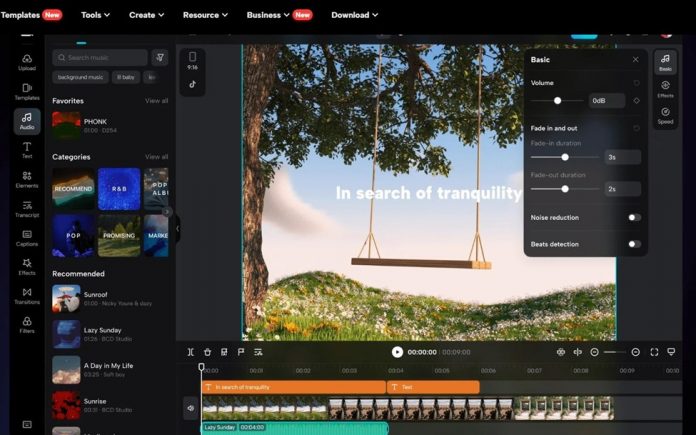
Are you looking for an easy yet in-depth guide to explore this newly emerging all-in-one Creative Suite? You are at the right place. This article will help you dig deep into the CapCut creative suite which is a collection of online editing tools. Its main components include the online photo and video editor, free personal/commercial templates, no watermarks, cloud backup, smart tools, etc. In this article, each of the main components of this incredible creative suite has been discussed in detail. So, let’s have a look at them below!

Main Components of Creative Suite

CapCut Creative Suite is not just a single tool but a combination of tools in one place. In simple words, it is an all-in-one online package where you can make dramatic edits to your photos and videos. The following details about these components can help you gain a better idea about them.

  • Online Video Editor

The top of the main component of this Creative Suite is its video editor which is available online and free. Yes, you can use it without making any payments to this Creative Suite. It doesn’t even ask you to make a one-time subscription payment or anything like that. Besides, you will find all the premium and professional-level video editing tools in this editor. For example, it is enriched with tools such as background remover, background changer, captions generations, and color adjustments.

It also allows you to edit, crop, and resize the video and add different audio or sound effects, video effects, and other elements to the video.

  • Online Photo Editor

The second most important component of this Creative Suite is its photo editor which is also available online. You don’t need to make any downloads to start using this editor for photo editing. Similarly, none of its editing tools requires any payment or subscription. Instead, all the AI tools and features of this online photo editor are free to use for all people.

By using this, you can replace the dull background of your image with an interactive one. You can also optimize the colors of your photo to uplift its visuals and make it aesthetically beautiful. In addition, there are several other impressive features of this online image editor e.g. adding frames, filters, text effects, etc.

  • Templates for Commercial and Personal Use

This Creative Suite also includes a huge variety of templates for commercial and personal use. No matter whether you are an organization, a company, or a single person, these templates are free for you. You can browse through their impressive variety to pick up the one you need. In addition, this Creative Suite also allows you to edit any chosen template for free. Regardless of the template you choose, you can apply many or all of the editing features to it. So, feel free to edit your desired template in any way you want and save it to your device.

  • No Watermark

Upon saving the final results to your device, you will notice that it doesn’t contain any watermarks on it. Yes, this incredible Creative Suite doesn’t take any credit for making transformations to your photos or videos. The absence of watermarks on your transformed photos and videos gives you the full choice to share them anywhere you want. It also gives you full ownership to use or further edit these images or videos in any way you like.

  • Smart Tools

Another impressive component of this Creative Suite is the availability of its smart tools. All these tools (text to speech free converter or image/video Upscaler) are based on AI technology which gives accurate and instant results. There is no room for mistakes as the machine learning algorithms are more accurate and precise in making the desired transformations.

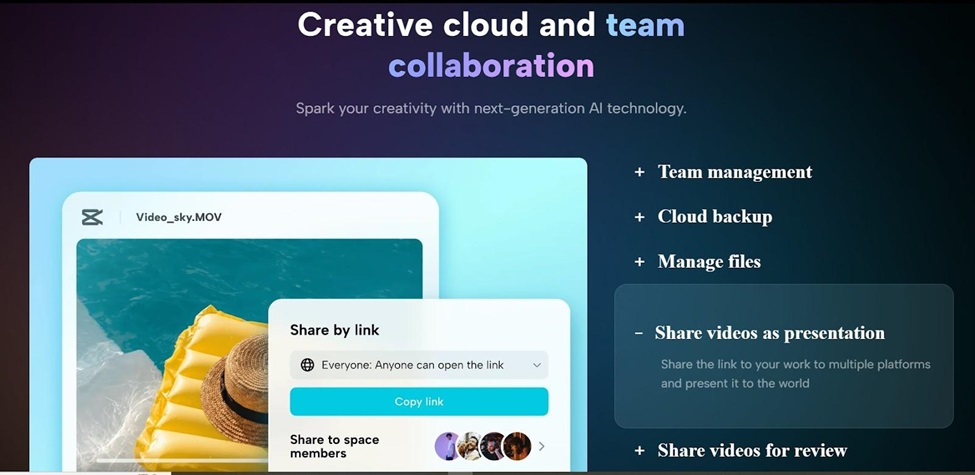
  • Creative Cloud and Team Collaboration

Finally, this amazing Creative Suite comes with the Creative Cloud and team collaboration to spark your creativity. It allows you to interact with your teams by inviting them to this space. Then, you can assign them different roles such as editor, collaboration, owner, etc., and work together. You can also share your videos for review or share them as presentations to present to others.

How to Use CapCut Creative Suite?

If you have not used this incredible Creative Suite before, the following guide will help you a lot. It will lead you through a step-by-step simple process to use this Creative Suite for making dramatic transformations to your photos and videos. So, here are these simple, easy, and quick steps!

  • Step 1: Signup

Just visit the CapCut Creative Suite URL which is https://www.capcut.com/creative-suite and click on the “Signup for Free” button. Enter only the required basic information and avoid putting on your bank account details, credit card details, home address, etc. This editor doesn’t ask you for any of such information. So, refrain from adding anything like this which is not asked in the signup form. After submitting the form and verifying it through your email, sign in to this newly created account.

  • Step 2: Upload

Click on the online video editor and use the upload button to upload any of your videos to this space. There are also some sample videos in this editor that are free to use. If you feel reluctant to use your video first, take any of these sample videos and try the results. Then, upload your video through the upload button or simply by drag and drop feature.

  • Step 3: Transform

When your video is here at the editors’ workspace, start making interactive edits to it. For this purpose, the must-use feature here is to generate the captions for your videos. The editor has an auto-captions generate button that you can use for instant creation of captions. Otherwise, it also allows you to add the captions manually if you want. Besides captions, there are many other impressive features such as changing the background of your video.

You can also add text effects, video effects, transitions, and filters to your video. There are also options to add different interactive and suitable soundtracks behind your videos. Moreover, you can also resize, crop, and trim your video to the desired size. Try exploring tons of professional features at this editor and come up with the most impressive end results.

  • Step 4: Export

In the end, you will have to go to the top right blue colored export button and then click on download. Your video will then start downloading to your device.

Conclusion

Without having adequate knowledge about an editor, you can take the maximum benefits out of it. When you don’t know which tools and features it brings for you, how would you use them in accomplishing your goals? Therefore, it is crucial to learn about editing before you start using it. So, if you are someone who loves editing photos and videos but is in search of the best editor for this purpose, this article is for you. Make sure to read it thoroughly to explore what components this amazing Creative Suite brings for you and how you can use it. Follow the steps discussed above to start using this incredible Creative Suite and cherish yourself through the mindblowing results.

NMDPRA Regulations On Inspection, Enquiries, Governance on Gas Exchanges & Clearing Houses, etc in Nigeria

0

Gas Trading – Inspection, Enquiries & Enforcement In Nigeria

This article is focused on the provisions of the regulations of the Nigerian Midstream & Downstream Petroleum Regulatory Authority (NMDPRA) on gas trading, specifically the topics of inspection, enquiries and enforcement.

What are the provisions of the NMDPRA regulations on market oversight?

– The NMDPRA may cause an investigation into the affairs of a gas exchange or clearing house to maintain market oversight & surveillance as well as to check market integrity.

– An investigation shall be conducted where the authority reasonably suspects that there has been :-

a). Manipulative or attempted manipulative activity.

b). Anti-competition and anti-competitive behaviour.

c). Transactions that are misleading or deceptive, or are likely to mislead or deceive.

d). Unwarranted speculation leading to market volatility.

e). Price distortions.

f). Any form of cartelization.

g). Any form of market abuse.

h). Abuse of dominant position by any market participant.

– The NMDPRA may after investigation issue directives, as it considers appropriate to maintain market oversight & surveillance to check market integrity.

What are the other circumstances requiring intervention by the NMDPRA?

– The NMDPRA may, by an order, give such directives as may be necessary when it is satisfied that any of these circumstances exist or is likely to occur in the market :-

a). Abnormal increases or decreases in the price of gas.

b). Sudden or unreasonable fluctuations or unwarranted changes in the prices of gas and high volatility.

c). Sudden high transaction volumes on a gas exchanges.

– The NMDPRA may, without prejudice to the first paragraph above, by order in writing –

a). Suspend transaction activities for a cooling off period, in case of increased volatility.

b). Suspend transaction of any specific contract in the gas exchange.

c). Increase the margin for contracts transacted on gas exchanges, in a case of high volatility of prices or high speculation.

d). Allow trade only for trade settlement.

What are the provisions of the regulations on the power to demand for information?

– The NMDPRA may demand for any information, documents or records from a gas exchange or clearing house.

What is the provision of the regulations on the power of inspection?

– The authority may at any time undertake inspection, conduct inquiries and audit of any gas exchange or clearing house, or/and any associate or affiliate of such exchange or clearing house.

Do the regulations confer any further power on the NMDPRA regarding interim orders?

– Where during an investigation or intervention, the NMDPRA is satisfied that an act in Contravention of these regulations has been committed or continues to be committed or that such act is about to be committed, the authority can by order, temporarily restrain any person from carrying on such act until the conclusion of such investigation or intervention or until further orders, but such order shall not be made without giving notice and opportunity of being heard to such a person.

The Governance Structure of Gas Exchanges & Clearing Houses in Nigeria

This article will be looking at the provisions of the Nigerian Midstream Downstream Petroleum Regulatory Authority NMDPRA Regulations on the Governance Structure of The Gas Exchange in Nigeria.

What is the governance structure of the exchange under the regulations?

– The governance structure of the gas exchange shall be in compliance with the rules and regulations governing the registration and operation of an exchange as prescribed by the Securities and Exchange Commission (SEC).

What are the provisions of the NMDPRA regulations on disclosure and corporate governance norms?

– The disclosure requirements and Corporate governance norms provided in the regulations shall apply to a gas exchange and a clearing house in addition to those specified by the Securities and Exchange Commission (SEC) for listed companies.

– The board or directors of a gas exchange or a clearing house shall confirm compliance with these regulations in writing on a quarterly basis to the NMDPRA within 2 months from the end of each calendar quarter.

– A gas exchange and clearing house shall disclose to the NMDPRA its resources committed towards strengthening regulatory functions and ensuring compliance with regulatory requirements applicable to the gas exchange or clearing house, as the case may be.

-The fees and charges levied by a gas exchange or a clearing levied by a gas exchange or clearing house shall be placed for review and approval before the oversight committee of such gas exchange or cleaning house.

What is the default remedy mechanism on gas exchanges and clearing houses under the regulations?

– A member may be declared a defaulter by direction or circular of the gas exchange or clearing house, if the member :-

a). Is unable to fulfill its clearing or settlement obligations.

b). Admits or discloses its inability to fulfill or discharge its duties, obligations and liabilities.

c). Fails or is unable to pay within the specified time the damages and the money difference due on a closing-out effected against him under the bye-laws of gas exchange or clearing house.

d). Fails to pay any sum due to the gas exchange or clearing house which may be prescribed by the authority competent for such purpose. 

– In the event a member is declared a defaulter and the member fails to meet Its clearing and settlement obligations, upon crystallisation of claims in accordance with the bye-laws of the gas exchange, or jr claim amount shall be set aside from deposits of the defaulting member and the recovered amount shall be distributed fairly and proportionately among the affected parties including transporter, seller, buyer, pipeline system operator and gas exchange or clearing house, from the deposits of the member or client.

What is the prescribed delivery procedure under the NMDPRA regulations?

– The scheduling and delivery of contracts on the gas exchange shall be in accordance with the network code, pipeline and virtual pipeline system rules.

– Subject to the provision of these regulations, operationalisation of scheduling of transactions through the gas exchange shall be in accordance with the detailed procedure issued by NMDPRA under the network code or virtual pipeline system rules.

– The charges or penalties for defaults shall be in accordance with the network code or other rules issued by the NMDPRA.

What is the grievance redressal mechanism stipulated by the regulations?

– The NMDPRA may call for information on the redressal of any specific complaints and grievances by the gas exchange.

Notable Regulatory Provisions on Gas Trading Licenses & Clearing House Authorizations

This article is focused on the regulatory framework governing gas trading licenses and clearing house authorisations, from license applications to renewals. 

What is the regulatory agency in charge of gas trading and clearing house authorisations?

Gas trading licences and clearing house authorisations are under the jurisdiction of the Nigerian Midstream & Downstream Petroleum Regulatory Authority (NMDPRA). 

What are the provisions of the NMDPRA on the duty to obtain licenses or authorisations?

– A person shall not establish or operate a gas exchange without a gas trading license issued by the NMDPRA in accordance with its regulations.

– A person shall not act as a clearing house for a gas exchange without the prior authorization of the NMDPRA.

– A qualified person under the NMDPRA regulations shall only be entitled to participate in the exchange where the person holds a valid and approximate license or permit issued by the NMDPRA.

What are the provisions of the NMDPRA on applications for licenses or authorisations?

– An application for a gas trading license or clearing house authorisation shall be submitted to the NMDPRA in the form as prescribed in guidelines issued by the Authority, subject to compliance with its regulations.

What are the conditions for granting a gas license?

– An application for a gas trading license in the NMDPRA regulations shall comply with the rules of the Securities and Exchange Commission (SEC) in relation to commodities trading.

– An applicant for a gas trading license shall :-

a). Be a company limited by shares

b). Be demutualised

c). Ensure its directors are fit and proper persons as specified in these regulations

d). Satisfy the requirements relating to the ownership and governance structure specified in these regulations and other appropriate government regulations

e). Satisfy financial & technical capabilities

f). Have the necessary infrastructure for the orderly execution of trade

g). Have an online screen-based trading system

What are the conditions for granting a Clearing house authorisation?

– An applicant seeking authorisation as a clearing house  shall – 

a). Have necessary infrastructure and resources to ensure timely clearing and settlement of trades.

b). Have adequate risk management mechanisms.

c). Have the capacity to establish and publish a settlement procedure including netting, novation and guarantees for settlement of trades in place, as specified by the NMDPRA.

d). Demonstrate the establishment of an applicable settlement guarantee fund to guarantee settlement of trades.

e). Demonstrate a wide network of clearing members and have adequate facility to admit and regulate its members.

f). Have the facility to disseminate information about trades, quantities and quotes in real time.

g). Establish connectivity with the clearing banks, gas exchange and clearing members.

h). Satisfy other conditions as may be specified by the NMDPRA.

What is the extent of the NMDPRA’s power go make inquiries & call for information?

– The NMDPRA may , before granting a gas trading license or clearing house authorisation, make inquiries and require the applicant to furnish such further information or documentation as it may deem necessary.

What is the duration of a license in this regard?

– The validity of a gas trading license shall not exceed 10(Ten) years from the date of issuance unless such license or authorisation is withdrawn or cancelled.

What is the provision of the NMDPRA regarding license or authorisation renewal?

– A gas exchange or clearing house, desirous of renewing its license or authorisation may make an application not later than 12 months before the expiration of the validity period of such license or authorisation, in the manner prescribed by the NMDPRA.