DD
MM
YYYY

PAGES

DD
MM
YYYY

spot_img

PAGES

Home Blog Page 3625

Blockchain raises $110M funding round at lower Valuation

0
Fund, money cash dollar

Blockchain.com, one of the leading platforms for cryptocurrency trading and investing, announced today that it has raised $110 million in a Series C funding round led by DST Global Partners, Lightspeed Venture Partners and VY Capital. The round also included participation from existing investors such as Lakestar, Eldridge, Access Industries and others.

The funding round values Blockchain.com at $4 billion, which is lower than the $5.2 billion valuation it achieved in March when it raised $300 million in a Series B round. The company did not disclose the reason for the lower valuation, but it may be related to the recent volatility and decline in the crypto market.

Blockchain.com said that the new capital will be used to expand its global presence, grow its product offerings and hire more talent. The company claims to have more than 76 million verified users across 200 countries, and to process about 40% of all bitcoin transactions. It also offers other services such as crypto lending, interest accounts, hardware wallets and an institutional platform.

Peter Smith, the co-founder and CEO of Blockchain.com, said in a blog post that the company is “humbled by the support from our investors” and that it is “more committed than ever to our mission of empowering anyone anywhere to control their own money”. He also said that the company is “just getting started” and that it has “many exciting announcements and launches” planned for the future.

Blockchain.com is one of the oldest and most established players in the crypto space, having been founded in 2011 as a bitcoin explorer and wallet provider. Since then, it has evolved into a full-fledged platform that supports multiple cryptocurrencies and offers various services for both retail and institutional customers. The company has also been profitable since 2017, according to Smith.

The latest funding round comes at a time when the crypto industry is facing increased regulatory scrutiny and uncertainty, as well as a significant drop in market value. Bitcoin, the largest cryptocurrency by market cap, has fallen by more than 50% from its all-time high of nearly $65,000 in April to around $30,000 at the time of writing. Other cryptocurrencies have also suffered similar losses.

Blockchain.com was founded in 2011 as a simple Bitcoin block explorer, allowing users to view transactions and blocks on the Bitcoin network. Since then, it has evolved into a comprehensive platform that offers a wallet, an exchange, a lending service, a hardware device, a developer API, and more. Blockchain.com claims to have over 70 million wallets created, over $800 billion in transactions processed, and over 30% of the Bitcoin network activity.

One of the main advantages of Blockchain.com is that it supports multiple cryptocurrencies, not just Bitcoin. Users can store, send, receive, and exchange over 100 different crypto assets, including Ethereum, Litecoin, Bitcoin Cash, Stellar, and many more.

Blockchain.com also supports stablecoins, such as USD Coin (USDC) and Paxos Standard (PAX), which are pegged to the US dollar and offer lower volatility and higher liquidity. Moreover, Blockchain.com allows users to earn interest on their crypto holdings, up to 12% annually, by lending them to institutional borrowers.

Another key feature of Blockchain.com is that it empowers developers to build applications on top of the crypto infrastructure. Blockchain.com provides a robust and scalable API that enables developers to access data and functionality from various blockchains and networks.

For example, developers can use the API to query balances, transactions, addresses, prices, exchange rates, and more. They can also use the API to create and broadcast transactions, verify signatures, generate wallets and keys, and more. Blockchain.com also offers webhooks and websockets for real-time notifications and updates.

Blockchain.com is not only a platform for users and developers, but also for investors. Blockchain.com operates a regulated and secure exchange that allows users to buy and sell crypto assets with fiat currencies or other cryptocurrencies. The exchange supports advanced trading features, such as limit orders, stop orders, margin trading, and derivatives.

Blockchain.com also offers an institutional-grade custody service for high-net-worth individuals and organizations that need to store large amounts of crypto assets with high security and compliance standards.

Blockchain.com has been at the forefront of the crypto ecosystem for over a decade, providing valuable services and products for various stakeholders. However, it also faces some challenges and competition from other players in the market. For instance, Blockchain.com has been criticized for its lack of transparency and accountability regarding its operations and governance.

Some users have reported issues with customer support, verification processes, transaction fees, and withdrawal delays. Furthermore, Blockchain.com has to compete with other platforms that offer similar or better features, such as Coinbase, Binance, Kraken, Ledger, MetaMask, and more.

Despite these challenges, Blockchain.com and its investors seem confident that the long-term prospects of crypto are positive and that the company is well-positioned to capitalize on the growing adoption and innovation in the space. Smith said that he believes that “crypto is at a similar inflection point as the internet was in 1997” and that he expects “the next few years to be transformative for our industry”.


Modes Of Insurance Operations Under Nigerian Law

0

This article instalment will be talking about the modes of operation for insurers in Nigeria as prescribed by the Insurance Act of Nigeria and will be focused on the topics of :-

– Requirements as to the principal office of an insurer in Nigeria.

– The appointment of Chief Executives for insurers in Nigeria.

– Timelines for delivering policy documents under the Insurance Act.

What are the requirements of the act regarding the principal office of an insurer?

– An insurer shall, on the day it is registered to commence business in Nigeria have a principal office to which all communications and notices may be addressed, so that a postal box address or a private mail bag address shall not by itself only be sufficient for the purposes of the foregoing requirement.

– Notice of the location of the principal office or any subsequent charge shall be given within 21 days to the Commission which shall record the same.

– The fact that the address of an insurer is included in its application or in its annual returns or any other return to the commission shall not be taken to satisfy an obligation imposed by the provisions above.

– An insurer’s registered and principal office must be the same.

What does the act say on disqualification from appointment as a director of an insurer?

– No insurer shall appoint or have in its employment a director, Chief Executive, manager or secretary if he :-

a). is or becomes of unsound mind, or as a result of ill health, is incapable of carrying out his duties.

b). is convicted of any offence involving dishonesty or fraud.

c). is not a fit & proper person for the position.

d). is guilty of serious misconduct in relation to his duties.

e). in the case of a person with professional qualifications, has been disqualified or suspended from practicing his profession in Nigeria by the order of any competent authority made in respect of him personally.

What are the provisions of the act on the appointment of Chief executive subject to the approval of NAICOM?

– No insurer shall appoint a person as a Chief Executive whether designated as the Managing Director, Executive Chairman or otherwise if the appointment contravenes the act unless :

a). The insurer has served a written notice on the Commission proposing to appoint that person to the position and containing such particulars as may from time to time be prescribed by the Commission.

b). Such an appointment is approved by NAICOM.

What does the act say on the change of a Chief Executive of an insurer?

– A person who becomes or ceases to be the chief executive of an insurer shall, before the expiration of a period of 30 days beginning with the day on which he does so, notify the insurer in writing and send an advanced copy to the Commission on such matters as may from time to time, be prescribed.

– An insurer shall give written notice to the Commission of the fact that person has become or ceased to be a Chief Executive of the insurance and/or any matter which the person is requested to notify the insurer under the Insurance Act and that notice shall be given before the expiration of the period of 30 days.

What does the act say on timelines for delivering policy documents?

– The policy document evidencing the contract of insurance shall be delivered to the insured party not later than 60 days after payment of the first premium.

What are the applicable penalties under the act in this regard?

– An insurer who contravenes the act in this regard commits an offence and is liable  on conviction to a fine of 5 Million Naira.

Section II

This second article instalment will be focused on the required modes of operations for insurers under the Insurance Act as concerns the topics of – 

– The Approval of New Products.

– Records to be kept by an insurer.

– Records to be kept by a reinsurer.

– Provisions for unexpired risks and claims.

What does the act say on the approval of new products?

– No new product shall be introduced into any class or category of insurance business without the prior approval of the National Insurance Commission (NAICOM).

– The approval or otherwise of the Commission shall be communicated within 30 days of the receipt of the application.

– An insurer who contravenes the provisions of the act in this regard commits an offence and is liable to a fine of 10 Thousand Naira.

What are the records to be kept by an insurer under the act?

– An insurer shall keep and maintain at its principal office the following :-

a). The memorandum and articles of association (MEMART) of the insurer.

b). A record containing the names and addresses of the owners of the insurance business whether known as or called shareholders or otherwise.

c). The minutes of any meeting of the owners of the policy-making executive (whether known as or called the board of directors or otherwise).

d). A register of all policies in which shall be entered in respect of every policy issued, the names and address of the policyholder, the date when the policy was effected and a record of any transfer, assignment or nomination of which the insurer has notice.

e). A register of its assets.

f). A register of investments showing those which are attributable to the insurance funds and those which are not, and also any alteration in their values from time to time. 

– An insurer shall in respect of its life insurance business maintain & keep the following additional records, that is :

a). A register of assured under group policies.

b). A register of loans on policies.

c). A register of cash surrendered values.

d). A register of lapsed and expired policies.

What are the records to be kept by a reinsurer under the act?

– The memorandum and articles of association (MEMART) of the reinsurer.

– Records containing the names and address of the owners of the reinsurer (whether known as shareholders or otherwise). 

– Minutes of any meeting of the owners and the policy making executive (Board of Directors or otherwise).

– A register of all treaties , in which shall be entered in respect of every treaty issued, the name of the cedant , and the date when the treaty was effected.

– A cash book.

– A register of new and existing clients.

What are the records to be kept by a life reinsurer?

– A register of assured under group policies.

– A register of cancelled, lapsed and expired policies.

– A register of claims showing the names of the cedant and when the claim is settled.

What does the act say on the separation of accounts and reserve funds?

– Where an insurer carries on the 2 classes of insurance business, all the receipts of each of those classes of insurance business shall be entered in a separate and distinct account and shall be carried to and from a separate insurance fund with the appropriate name so that in case of life insurance there shall be –

a). The individual life insurance business fund.

b). The group life insurance business and pension fund.

c). The health insurance business.

What are the provisions of the act on unexpired risks and claims?

– An insurer shall in respect of its general business establish and maintain the following provisions applicable in respect of each class of insurance business-

a). Provisions for unexpired risks which shall be calculated on a time apportionment basis of the risks accepted in the year.

b). Provision for outstanding claims.

c). Provision for outstanding claims which shall be credited with an amount equal to the total estimated amount of all outstanding claims with a further amount representing 10% of the estimated figure for outstanding claims in respect of claims incurred but not reported at the end of the year under review.

Section III

This original article instalment will be focused on the provisions of the Insurance Act of Nigeria on the modes of operations for insurers concerning :-

– Contingencies for Insurers

– Life Insurance Business reserves

– Reserves for Reinsurers 

– Solvency margins under the act 

What are the provisions of the act on contingencies?

– An insurer shall establish and maintain contingency reserves to cover fluctuations in securities & variations in statistical estimates.

– The contingency reserves shall be credited with an amount not later than 3% of the total premium or 20% of the net profits (whichever is greater) & the amount shall accumulate until it reaches the amount of the minimum paid-up share capital or 5% of the net premiums (whichever is greater).

What are the reserve requirements of the act for life insurance businesses?

– An insurer shall in respect of its life insurance business maintain the following reserves :-

a). A general reserve fund which shall be credited with an amount equal to the net liabilities on policies in force at the time of the actuarial valuation and an additional 250% of net premium for every year between valuation dates.

b). A contingency reserve fund which shall be credited with an amount equal to 1% of the gross premiums or 100% of the profits (whichever is greater) & accumulated until it reached the amount of the minimum paid-up share capital.

What are the reserve requirements of the act for reinsurers?

– A reinsurer shall establish a general reserve fund which shall be credited with an amount :-

a). Not less than 50% of his insurer’s gross profit for the year where the fund is less than the Authorised share capital of the insurer.

b). Not less than 25% of the reinsurer’s gross profit for the year where the fund is equal to or exceeds the authorised capital of the insurer.

What are the provisions of the act on solvency margins?

– An insurer shall in respect of its business other than its life insurance business, maintain at all times a margin of solvency being the excess of the value of its admissible assets in Nigeria over its liabilities in Nigeria consisting of :-

a). Provisions for unexpired risks.

b). Provisions got outstanding claims.

c). Provisions for claims incurred but not yet reported, and 

d). Funds to meet other liabilities.

– The solvency margin referred to in this provision shall not be less than 15% of the gross premium income less reinsurance premiums paid out during the year under review or the minimum paid-up share capital (whichever is greater).

– Any amount due as liability to reinsurers which are attributable to outstanding premiums in respect of the current year excluded under the preceding paragraph shall be excluded from liabilities.

700 Out of 770 OpenAI’s Employees Threaten to Quit If Altman & Brockman Aren’t Reinstated

0

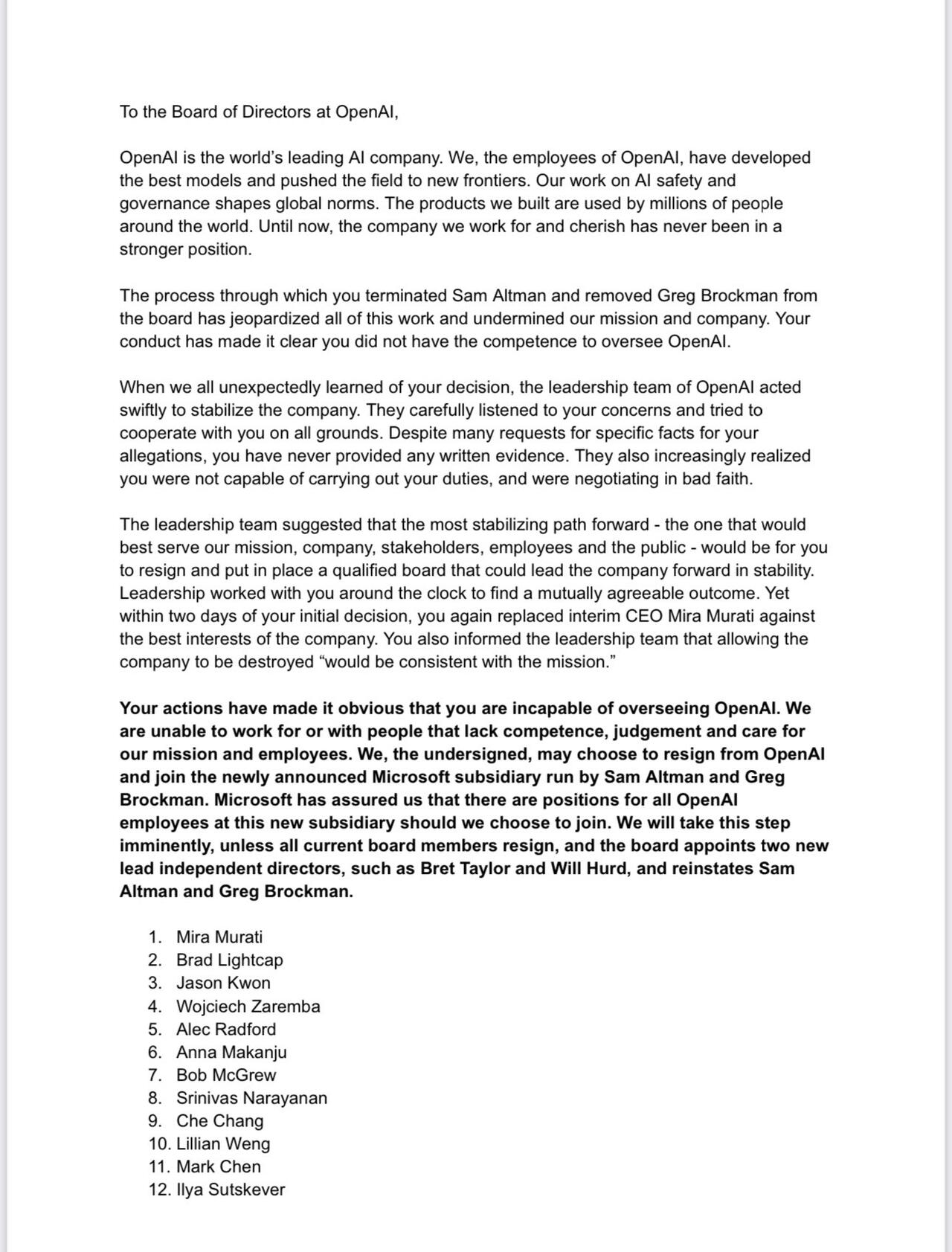
OpenAI, the renowned artificial intelligence research lab, is grappling with a major internal crisis as a majority of its workforce, comprising about 700 out of approximately 770 employees, is on the brink of resigning. 

The uproar stems from the abrupt ousting of CEO Sam Altman and co-founder Greg Brockman, leading to a call for their reinstatement and the resignation of the four-person board responsible for their dismissal.

The disgruntled employees expressed their discontent in a letter that was initially posted online by veteran technology journalist Kara Swisher. The letter said partly, “We are unable to work for or with people that lack competence, judgment (sic), and care for our mission and employees.” 

The employees also raised the stakes, threatening to abandon OpenAI altogether and join a newly announced Microsoft subsidiary led by Altman and Brockman. Their decision is based on purported assurances from Microsoft that positions are available for all OpenAI employees.

Notable signatories to the document include Mira Murati, OpenAI’s chief technology officer, who briefly served as interim CEO, and Ilya Sutskever, a board member allegedly involved in Altman’s sudden firing on Friday. Sutskever expressed remorse on Monday, stating, “I deeply regret my participation in the board’s actions. I never intended to harm OpenAI. I love everything we’ve built together, and I will do everything I can to reunite the company.”

Altman’s removal on Friday caught both his colleagues and Microsoft, OpenAI’s largest shareholder and technology partner, by surprise, according to the employees’ letter. The subsequent attempt to reinstate Altman failed, leading to the appointment of Emmett Shear, co-founder and former CEO of Twitch, as interim CEO.

The unexpected departure of Altman, Brockman, and other top researchers raises concerns about OpenAI’s future, given its status as one of the world’s most valuable tech startups. 

“If the architects and vision and brains behind these products have now left, the company will be a shell of what it once was,” Sarah Kreps, director of Cornell University’s Tech Policy Institute, commented.

Microsoft’s stock rose over 2% on Monday to a record high of $378.82 as investors celebrated the news of Altman and Brockman’s hiring. Analysts, however, view Shear’s appointment as a “tainted move” that has caused internal and external chaos for OpenAI.

OpenAI’s statement on Friday cited Altman’s lack of consistency in communications with the board as the reason for his dismissal. Shear, in a post on X on Monday, announced plans to hire an independent investigator to probe Altman’s ouster and produce a report within 30 days. He acknowledged the mishandling of the removal process and pledged to drive necessary changes, emphasizing that the decision was not due to a “specific disagreement on safety.

The controversy surrounding OpenAI’s mission to safely develop AI smarter than humans, coupled with Altman’s push for more advanced products, is believed to be at the core of the internal turmoil, per CSBNews. New Street Research analysts suggest that regardless of the outcome, the OpenAI that existed before the crisis is effectively over.

While OpenAI remains tight-lipped about the specifics behind Altman’s removal, sources indicate that both Altman and Brockman are open to returning if their demands, including the resignation of board members involved in their dismissal, are met.

As the drama unfolds, uncertainties loom over OpenAI’s future. Speculations range from potential resignations within the board to a mass exodus of staff, leaving the company’s future hanging in the balance.

Argentina Now Has A Bitcoin Friendly President

0

In a historic election, Argentina has chosen a new leader who is openly supportive of Bitcoin and other cryptocurrencies. Javier Gerardo Milei, a former vice president and senator, defeated the incumbent Alberto Fernández by a narrow margin of 51.2% to 48.8%. Duhalde campaigned on a platform of economic reform, social inclusion and digital innovation, promising to make Argentina a global hub for blockchain and crypto development.

Javier Gerardo Milei is not new to the crypto scene. He has been an active investor and advocate of Bitcoin since 2017, when he publicly declared that he had bought some bitcoins as a hedge against inflation and currency devaluation. He has also participated in several crypto events and conferences, where he shared his vision of how Bitcoin can empower individuals and communities, especially in developing countries like Argentina.

Javier Gerardo Milei’s victory is seen as a positive sign for the crypto industry in Argentina, which has been struggling with regulatory uncertainty and high taxes. According to a recent report by Chainalysis, Argentina ranks among the top 20 countries in the world in terms of crypto adoption, with an estimated 2.1 million users and $1.4 billion in transactions in 2020. However, the government has imposed strict controls on foreign exchange and capital flows, limiting the access and use of crypto for many Argentinians.

Argentina’s inflation

Argentina’s inflation is one of the highest in the world, reaching 51.4% in 2020 and expected to surpass 60% in 2023. This has severe consequences for the economy and the living standards of the population, especially the poor and the middle class. In this blog post, we will explore the causes, effects and possible solutions for this chronic problem that has plagued Argentina for decades.

The causes of inflation are complex and multifaceted, but they can be broadly divided into two categories: demand-pull and cost-push. Demand-pull inflation occurs when aggregate demand exceeds aggregate supply, creating excess pressure on prices. Cost-push inflation occurs when the costs of production increase, forcing producers to raise prices to maintain their profit margins. Both types of inflation can be influenced by external factors, such as exchange rate fluctuations, international trade, commodity prices and global economic conditions.

In Argentina, demand-pull inflation has been driven by expansionary fiscal and monetary policies, which have increased public spending and money supply without a corresponding increase in productivity or tax revenues. The government has resorted to printing money to finance its deficits, which has eroded the value of the peso and fueled inflation expectations.

Moreover, the government has implemented price controls and subsidies on essential goods and services, such as utilities, transport and food, which have distorted market signals and created shortages and black markets.

Cost-push inflation has been exacerbated by the devaluation of the peso, which has increased the cost of imported inputs and intermediate goods. Argentina is highly dependent on imports for its industrial and agricultural sectors, as well as for its energy needs.

The depreciation of the peso has also increased the burden of external debt, which is mostly denominated in foreign currency. Additionally, Argentina faces structural problems that hinder its competitiveness and productivity, such as high labor costs, rigid labor laws, inefficient taxation system, low investment levels and institutional weaknesses.

Javier Gerardo Milei has pledged to change that. He has announced that he will introduce a new legal framework for crypto that will recognize it as a legitimate form of money and property, protect the rights and interests of users and investors, and foster innovation and competition in the sector. He has also said that he will lower the taxes on crypto transactions and mining and create incentives for entrepreneurs and startups to launch crypto-related projects in Argentina.

Javier Gerardo Milei’s pro-crypto stance has earned him the support and praise of many prominent figures in the global crypto community, such as Michael Saylor, Jack Dorsey, Vitalik Buterin and Changpeng Zhao. They have congratulated him on his victory and expressed their willingness to collaborate with him on advancing the adoption and development of crypto in Argentina and beyond.

Javier Gerardo Milei’s election marks a historic moment for Argentina and the world. It shows that crypto is not only a technological innovation, but also a political and social force that can influence the outcome of elections and shape the future of nations. It also signals that Argentina is ready to embrace the opportunities and challenges of the digital age and become a leader in the global crypto movement.

Ways To Improve Environmental Footprints at Homes and Offices

0

1. Conduct a Sustainability Audit

The first step towards positive change is self-awareness. Businesses and individuals alike should conduct a sustainability audit to assess their current environmental impact. If you have a business, you must evaluate your energy consumption, waste generation, and resource usage and see how and where you may impact the environment. Understanding your baseline is crucial to identifying areas for improvement and setting realistic sustainability goals. You can also do this even if you don’t have your business, but now you would be making this assessment based on your lifestyle habits.

2. Embrace Renewable Energy Sources

One of the most impactful ways to reduce your environmental footprint is by transitioning to renewable energy sources. Businesses can explore solar panels, wind energy, or green energy providers, while individuals can opt for renewable energy options available in their region and within their purchasing power. This not only lowers carbon emissions but also promotes the growth of sustainable energy industries. Over time, these renewable energy sources are cheaper and better for your bottom line, anyway.

3. Implement Waste Reduction Practices

Both businesses and individuals can significantly contribute to environmental sustainability by minimizing waste. Adopting practices such as recycling, composting, and reducing single-use items can make a substantial difference. Businesses can review their supply chain to identify opportunities for waste reduction, while individuals can cultivate habits like using reusable bags and containers.

4. Promote Sustainable Transportation

Transportation is a significant contributor to carbon emissions. Businesses can encourage sustainable commuting options, such as remote work policies or incentives for using public transportation. Individuals can explore alternatives like carpooling or using electric vehicles if it is available and affordable to them. These choices not only reduce carbon footprints but also contribute to a healthier environment. Not to mention that they save costs too.

5. Invest in Eco-Friendly Technologies

Businesses can integrate eco-friendly technologies into their operations, such as energy-efficient appliances and smart building systems. Individuals can make similar choices at home, opting for energy-efficient appliances and smart home solutions. These technologies not only reduce energy consumption but also often result in long-term cost savings. Partnering with services like Utility Bidder can help businesses optimize their water and energy usage, further enhancing sustainability efforts.

6. Prioritize Sustainable Sourcing

Businesses play a crucial role in influencing sustainable practices throughout the supply chain. Where and how do you source your raw materials? Prioritizing sustainable sourcing of materials and products contributes to a more responsible and eco-friendly ecosystem. Similarly, individuals can make informed choices by supporting brands and products that adhere to sustainable and ethical production practices.

7. Educate and Advocate for Change

Knowledge is a catalyst for transformation. Both businesses and individuals can contribute to a greener future by educating themselves and others about sustainable practices. Businesses can organize workshops, training sessions, and awareness campaigns, while individuals can share information through social media, community events, and personal networks. Advocating for sustainable practices not only creates a ripple effect of awareness but also fosters a culture of environmental responsibility.

Small Steps, Big Impact

Protecting our environment requires a collective effort from businesses and individuals alike. By taking these seven steps, we can make meaningful strides towards a more sustainable and environmentally conscious future.

Each positive action, no matter how small, contributes to the greater goal of preserving our planet for future generations. Whether you’re a business leader or an individual, your choices matter, and together, we can create a world where sustainability is not just a goal but a way of life.