DD
MM
YYYY

PAGES

DD
MM
YYYY

spot_img

PAGES

Home Blog Page 3626

BlockDAG Keynote: Shaping the Future of Blockchain in 2024

0

The unveiling of the BlockDAG keynote has electrified the cryptocurrency community, positioning 2024 as a pivotal year that might transform the blockchain technology scene. BlockDAG‘s (BDAG) keynote, which has rapidly spread across social networks, challenges existing blockchain paradigms by forecasting a revolution in blockchain’s efficiency and scalability. This isn’t merely a strategy outline; it’s an audacious declaration aiming for a $600 million valuation by the end of the year, signifying BlockDAG’s ambition to lead a new digital economic era.

BlockDAG’s Promise: A Challenge to Bitcoin and Kaspa?

The keynote casts BlockDAG as a beacon of innovation, setting it apart within the blockchain ecosystem. By paralleling its trajectory with those of groundbreaking ventures like Bitcoin and Kaspa, BlockDAG showcases its potential for extraordinary growth and development. Bitcoin’s ascent from an obscure idea to a value surge of millions exemplifies the transformative journey BlockDAG envisions. Kaspa and Helium have also demonstrated significant market wins, forecasting the ambitious path BlockDAG intends to tread.

Central to BlockDAG’s strategy is its novel hybrid consensus mechanism—a blend of Directed Acyclic Graph (DAG) and Proof-of-Work (PoW) frameworks—alongside its robust smart contract functionality and intuitive user interface. These innovations pave the way for BlockDAG to potentially outpace the early success stories of Bitcoin and Kaspa, targeting over a 5000% value increase in its presale phase and aiming for even more explosive growth upon full launch.

Charting the Future with BlockDAG’s Strategic Roadmap

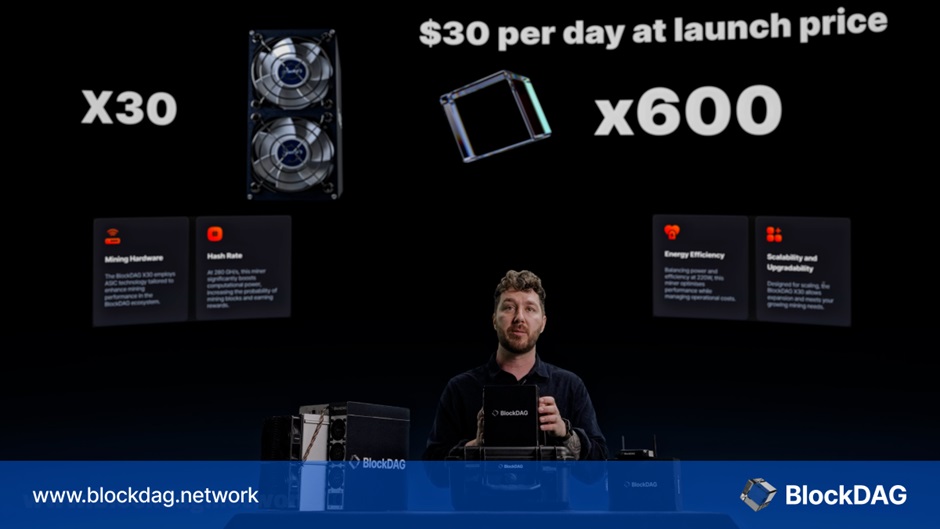
BlockDAG’s keynote not only celebrated its presale triumphs but also articulated a dynamic vision supported by a detailed roadmap. This roadmap underscores a commitment to growth, transparency, and strategic planning, with a launch timeline for its mainnet set within six months. The roadmap illustrates BlockDAG’s ambitious $600M goal, highlighting initiatives to enhance mining technologies, expand merchant and exchange networks, and continuously push blockchain innovation boundaries.

A New Chapter Begins with BlockDAG’s Shibuya Debut

The strategic unveiling of the BlockDAG keynote in Shibuya Crossing, Tokyo, has sparked widespread enthusiasm, drawing a global audience to the BDAG mining opportunity. This well-orchestrated launch has generated significant interest and firmly positioned BlockDAG at the centre of blockchain community discussions, heralding a new chapter in cryptocurrency mining and investment. With its visionary approach and strategic milestones, BlockDAG is setting new standards in the blockchain industry, indicating the start of an innovative era in cryptocurrency.


Invest In BlockDAG Now

Website: https://blockdag.network

Presale: https://purchase.blockdag.network

Telegram:https://t.me/blockDAGnetworkOfficial

Discord: https://discord.gg/Q7BxghMVyu

The Revelation from the Economist Intelligence Unit (EIU) on the Naira and Its Future

0

“For most of this year, the naira will be highly volatile, leading to regulatory erraticism that can affect businesses, especially those holding foreign currency. The CBN lacks the liquidity to support the naira itself; out of US$33bn in foreign reserves, a large share (estimated at nearly US$20bn), is committed to various derivative* deals,” – Economist Intelligence Unit (EIU)

You see the reason why I wrote that people should forget those Wall Street banks which are predicting how the Naira will appreciate. All of them are conflicted because they’re managing Nigeria’s funds while also consulting for Nigeria, dropping mindless opinions. The implication is that they can never write anything that will offend Nigeria as those funds could be moved. In other words, how can you write a bad opinion on a client you are keeping his/her $5 billion?

I will only believe Wall Street banks when they posit and also help Nigeria improve our FDI (foreign direct investment). With that, I will then believe that they’re very confident of the Naira to convince their investing clients to make Nigeria an investment destination. Today, that is not happening and that says it all.

When I was a kid in primary school, then Imo State Governor, Sam Mbakwe, used to show a piece of paper on the television (I was later told that he was explaining the economic status of the state, and why people needed to donate funds to the state for projects). Nigeria’s President should come clean on where things stand in Nigeria. Until he does, he may struggle to fix things. I do hope he does so that from ASUU to NLC, everyone will get the memo.

$20bn of Nigeria’s $33 billion foreign reserves is entangled in derivative deals – EIU

0

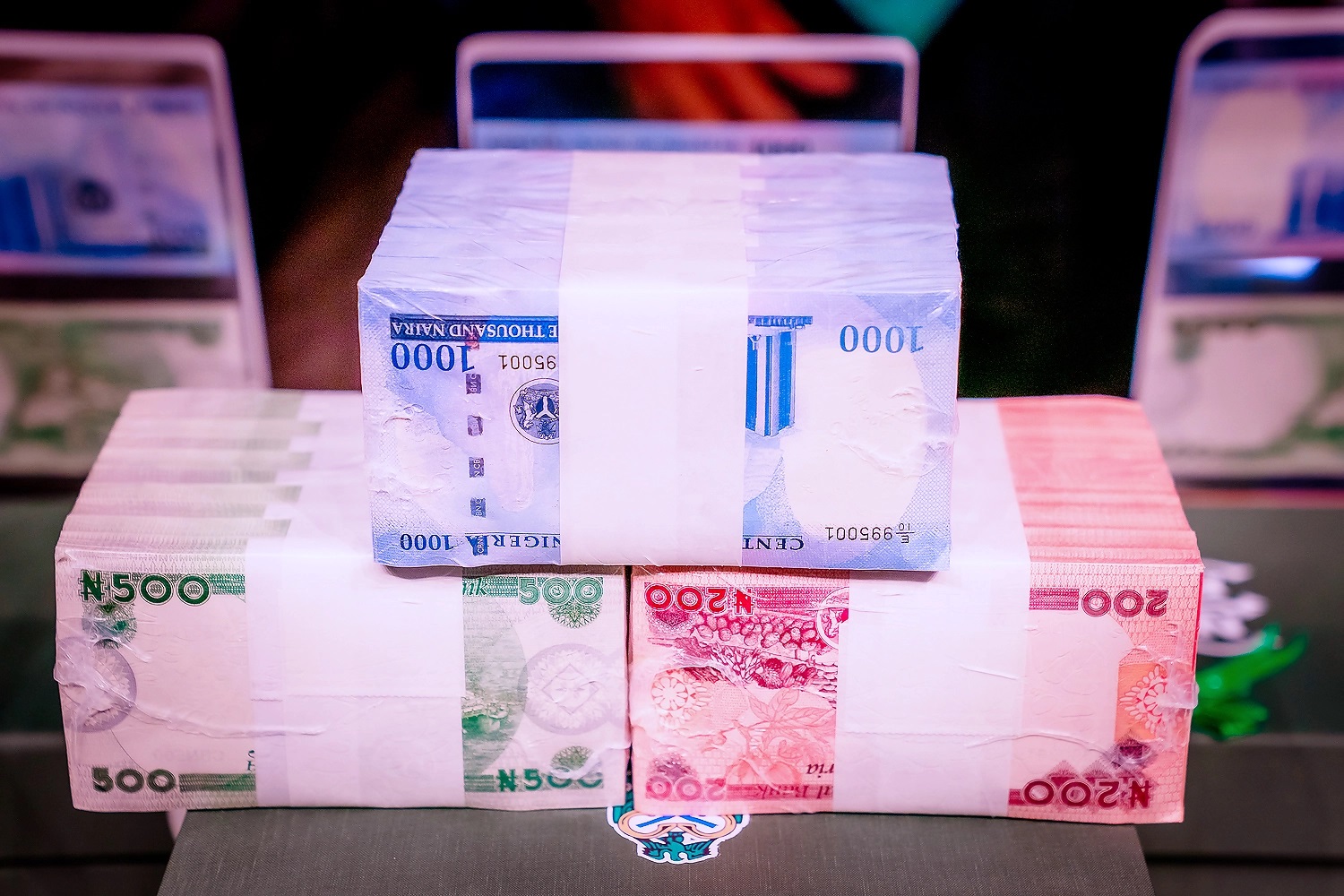
The Central Bank of Nigeria (CBN) is confronting a daunting liquidity crisis, posing a grave threat to the stability of the Nigerian naira and the nation’s economy as a whole.

Findings from a recent report by the Economist Intelligence Unit (EIU), disclosing that approximately $20 billion of the nation’s $33 billion foreign reserves is entangled in derivative deals, underline the severity of the situation. This staggering revelation leaves the CBN with severely constrained resources to boost the naira.

A derivative is a financial contract that derives its value from an underlying asset, commodity, or index. The value of a derivative is based on the performance of underlying market factors, such as interest rates, currency exchange rates, and commodity, credit, and equity prices.

The EIU’s comprehensive Country Report on Nigeria paints a bleak tableau for the naira, forecasting heightened volatility throughout the year. The report sounds an alarm on potential regulatory fluctuations that could severely impact businesses, particularly those reliant on foreign currency reserves.

The heart of the matter lies in the CBN’s liquidity crunch, necessitating recourse to foreign borrowing to resuscitate its reserves and instill confidence in the naira. The EIU’s prognosis suggests that this arduous process might extend until the latter part of 2024, signaling an enduring period of economic turbulence.

“For most of this year, the naira will be highly volatile, leading to regulatory erraticism that can affect businesses, especially those holding foreign currency.

“The CBN lacks the liquidity to support the naira itself; out of US$33bn in foreign reserves, a large share (estimated at nearly US$20bn), is committed to various derivative deals,” the report said, emphasizing the need for Nigeria to seek loans.

Nigeria has already embarked on a trajectory of foreign borrowing, securing substantial loans from eminent financial institutions such as the African Export-Import Bank and the African Development Bank, while concurrently seeking additional financial assistance from the World Bank.

However, the path to financial recuperation remains fraught with formidable challenges, necessitating a concerted and strategic approach to stabilize the currency.

The EIU’s projections offer a nuanced outlook, envisaging a gradual convalescence of foreign reserves spanning the period between 2024 and 2028. Yet, it maintains a cautious stance on the naira’s valuation, citing persistent inflationary pressures and negative real short-term interest rates as critical determinants exerting a downward force on the currency.

Projections ominously indicate a potential nosedive to N2,381/$ by 2028. However, it predicts an end-2024 rate of N1,770/$ and N1,817/$ by the end of 2025.

Despite modest prognoses for short-term recovery, concerns loom large concerning the long-term trajectory of the naira. The report attributes the currency’s inherent fragility to a precarious mix of lax monetary-fiscal policies and the capricious oscillations in global oil prices, which could precipitate a protracted depreciation.

Imminent threats to the naira’s stability emanate from looming restrictions on the repatriation of earnings by oil conglomerates and plausible convertibility constraints. Such regulatory alterations could further exacerbate the currency’s volatility, thereby posing formidable impediments to businesses operating within Nigeria.

The report sheds light on the conundrum facing the CBN, as it grapples with the delicate balance between monetary policy imperatives and the broader economic vision articulated by President Bola Tinubu. The President’s ambitious mandate, encapsulating a fervent desire to double the nation’s GDP by 2031 while simultaneously harboring a palpable aversion to high interest rates, presents formidable obstacles to attracting foreign investment through conventional monetary tightening.

“Deficit monetization and high inflation will undermine the currency. A possibility is that monetary policy will be tightened to a point at which foreign investors view the naira more favorably,” it said.

“The CBN’s independence has been heavily eroded in recent years; because fiscal firepower is so limited, the government will continue to rely on monetary policy to achieve job-creation and development objectives.”

Moreover, the specter of deficit monetization and stubbornly high inflation rates looms large, casting a pall over the efficacy of monetary measures aimed at stabilizing the currency. The encroachment upon the CBN’s autonomy, coupled with the government’s proclivity to rely on monetary mechanisms to fulfill its developmental objectives, further exacerbates the challenges confronting currency stabilization efforts.

Despite the prevailing adversities, recent reforms instituted by the CBN have yielded promising results, reigniting investor enthusiasm in Nigeria. Overseas remittances have surged, catapulting to $1.3 billion in February 2024, compared to a meager $300 million in the preceding month, according to the CBN. Similarly, foreign investors have demonstrated a renewed appetite for Nigerian assets, with portfolio flows surging to $2.3 billion in the early months of 2024, a marked improvement from the previous year.

The recent recalibrations in benchmark interest rates have acted as a potent catalyst, stimulating investor interest in short-term sovereign debt and thereby bolstering foreign exchange inflows. The CBN hiked interest rate by 400 basis points to 22.75% last month.

These positive developments offer a glimmer of hope amidst the prevailing economic uncertainty, albeit against a backdrop of formidable challenges. The path to currency stability remains fraught with obstacles, necessitating judicious and resolute policymaking to safeguard the future trajectory of the naira.

Elon Musk announces plan to make xAI’s Grok open source

0

The owner of social media platform X has announced a plan to make Grok, his artificial intelligence chatbot, open-source, creating the potential of propelling xAI into the limelight.

This move, which will see Grok joining the likes of Meta and Mistral in their commitment to transparency, is likely going to reshape the emerging AI industry, where regulation has been a major topic for long.

Grok, is equipped with features like access to real-time information and unfiltered views that aren’t bound by politically correct norms. It is accessible to subscribers of X’s $16 monthly subscription service.

Musk, a prominent advocate for open-source initiatives, has long championed the sharing of technological advancements. Musk’s influence extends beyond his role at Tesla, where numerous patents have been open-sourced, as he continues to advocate for broader access to cutting-edge technologies. 

Reflecting on Tesla’s stance back in 2014, Musk declared, “Tesla will not initiate patent lawsuits against anyone who, in good faith, wants to use our technology.” 

This ethos of openness has reverberated across various sectors, inspiring similar gestures from other industry leaders. Making Grok open source is seen as a significant stride towards fostering collaboration and innovation within the tech community.

Musk surprisingly announced his decision to make Twitter (X) open source, after acquiring the microblogging platform in 2022. X entered the open-source arena last year by releasing some of its algorithms to the public. 

This wave of openness is believed to have prompted Musk’s criticism of Sam Altman-led OpenAI, an AI company that the Tesla CEO confounded but exited in 2018. Musk sued OpenAI, alleging deviation from the original cause, which was to make the company a non-profit.

“OpenAI, once a beacon of hope for ethical AI development, has strayed from its noble mission,” Musk declared in a statement accompanying the legal filing. “I cannot stand idly by as an organization that I helped nurture and support veers off course, prioritizing profit over the betterment of humanity.”

In response to Musk’s suit, OpenAI said he wanted full control of the company and has lied about their agreement on shifting to for-profit.

On Monday, Musk reiterated his stance, bluntly stating, “OpenAI is a lie.” This remark casts a shadow over the perceived transparency of some AI initiatives, raising questions about the true extent of openness within the industry.

The decision to open-source Grok signifies a paradigm shift in AI development, emphasizing the importance of community-driven innovation over proprietary interests. By sharing the codebase with the public, xAI is not only inviting scrutiny but also inviting collaboration from a diverse range of developers, researchers, and enthusiasts.

Meta and Mistral have set a precedent by making their chatbot codes publicly accessible, fostering an environment where breakthroughs are no longer confined within the walls of corporate secrecy. Now, with Grok poised to follow suit, the momentum toward open collaboration in AI development appears unstoppable.

Industry experts have hailed this move as a significant win for the AI community, noting the potential for accelerated progress and breakthroughs in the field. 

“Every significant new technology that advances human well-being is greeted by a ginned-up moral panic,” said Andreessen Horowitz, whose firm a16z has backed Mistral, whose chatbot is open-source. “This is just the latest.”

In the coming months, the impact of this decision is expected to be felt across the AI industry, inspiring more firms to embrace the principles of transparency and collaboration. With Grok poised to join the ranks of open-source pioneers, the stage appears set for a new era of innovation in artificial intelligence.

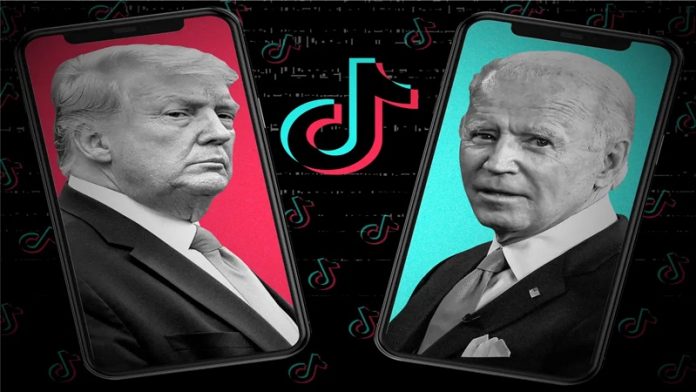
The Big TikTok Repositioning by Biden and Trump

1

Act 1, Scene 1 – The Debate

Biden: “If they pass it, I’ll sign it.” Yes. Biden will sign a bill to ban TikTok if Congress passes it.

Trump: “If China wants anything from [TikTok], they will give it, so that’s a national security risk [that] goes up…But when I look at it, I’m not looking to make Facebook double the size. And if you ban TikTok, Facebook and others — but mostly Facebook — will be a big beneficiary, and I think Facebook has been very busy. I think Facebook has been very bad for our country, especially when it comes to elections”.

Act 1, Scene 2 – The Past

Trump (2020): In 2020, Trump signed an executive order banning U.S. companies from transactions with ByteDance (TikTok parent firm), stating that “data collection threatens to allow the Chinese Communist Party access to Americans’ personal and proprietary information — potentially allowing China to track the locations of Federal employees and contractors, build dossiers of personal information for blackmail, and conduct corporate espionage.” 

Biden (2021): Biden revokes and replaces Trump order that banned TikTok.

Act 2, Scene 1 – Ahead of Election

You need to reevaluate everything to see how to win young voters. If Biden signs a TikTok ban, he loses even before the election as Trump repositions for young people. Yes, in politics, nothing is absolute including an app.