DD
MM
YYYY

PAGES

DD
MM
YYYY

spot_img

PAGES

Home Blog Page 3636

Political Appointments in Nigeria, Cutting Down the Cost of Governance, The Guilty Mind

0

Every company shareholder would prefer to hire a manager or a CEO who will save the company more money and not embark on a spending spree to exhaust the company’s finances, this is just common sense.

There are some spending the Nigerian government has been embarking on lately that are totally unnecessary and frivolous; some although necessary but due to the economic phase the country is in now calls for a pause on it. 

It was even one of the core political manifestos which President Bola Ahmed TINUBU built on during his campaign that he would reduce the cost of governance thereby cutting down the cost the Nigerian government spends on staffing, project execution and other pecks but with the trajectory the presidency have been going since they were inaugurated into power I doubt if that promise was really a promise or just a fluke. 

This government arguably has the highest number of cabinet members in the history of Nigeria having appointed 42 ministers and a lot of other political appointments have been made and they are not stopping yet. Every day someone is appointed a special assistant to the president on xyz or senior special assistant to the president on xyz. You do not need a special intellectual ability to understand that most of these appointments are totally unnecessary; they are dashed out just for political compensation; making sure that the national cake goes around to those who contributed a thing or two for his election, but it is totally insensitive to be doing this at the moment. 

Most of the political portfolios handed over to these recent appointees overlap with portfolios already handed down to other appointees. Jokes are currently making rounds on social media that with the way the presidency is sharing appointments every Nigerian will get an appointment, you will just have to create the portfolio for yourself. Let’s not forget that these appointees are to be paid salaries, allowances and other mouth-watering pecks that come with that office, it is not cheap. 

These are some of the funny appointments the president has made and is yet to make; 

  • Special Assistant on Exports
  • Senior Special Assistant on inflation
  • Coordinating Adviser on productivity
  • Technical Adviser on Remittances
  • Senior Special Assistant on Naira
  • Head of Policy crude oil output
  • Implementation Coordinator Oransanya Report (credit; Kalu Ajah on X). 
  • There are special assistants and senior special assistants to the presidency on everything now.

The presidency really needs to pay attention to their spending habits and take it easy on extravagant spending because Nigeria is broke. Just a few weeks ago, the president went to New York and went alongside tens of his aides and they spent hundreds of thousands of dollars on transportation, accommodation and other logistic costs for that trip alone. 

The legislature that ought to call the executive to order on their spending habit, unfortunately, wants to take a slice of the national cake. The legislators want an official car of over 150 million naira cost per person. This is insane. 

The economy has been nose-diving and has gone from bad to worse due to the political and economic decisions the presidency has taken since they came into power; first, they removed the fuel subsidy, secondly, they embarked on devaluation of the naira, still on that they are expending much on governance. They really need to go back to the drawing board and re-strategize. We do not have the money that you all are chopping like this. You cannot be borrowing to live lavishly because you know that in the next 4 or 8 years you will leave the debt for another person. 

The presidency maybe they have been disconnected from the realities on the ground, but they should pity Nigerians, please cut down the cost of governance, Nigeria is broke, and everyone is suffering. 

The Guilty Mind

In the criminal justice system, the guilty mind is one of the two essential ingredients that must be available before a crime is said to have been committed. Having committed an act which could be criminal in nature is not enough to ground the conviction of the suspect, the prosecutor must prove beyond reasonable doubt that the suspect had the guilty mind or had the intent to carry out the guilty act before conviction for the crime can be granted. This guilty mind is sometimes called “criminal intent” but in the legal register, this is often referred to as the “mens rea”.

The word mens rea is of Latin origin and when loosely translated into English it means “guilty mind”. It is simply the mental state of a defendant who is accused of committing a crime. There must be a litmus test to prove that the guilty mind was present on the accused at the time the crime was committed. 

By the implication of the principle of mens rea, it stipulates that doing something by accident does not qualify as a crime. Therefore, if you mistakenly kill someone by accident, you ought to be convicted of murder but if it cannot be established that you have the prior intention to kill that person you will be charged with a lesser offense which is manslaughter. 

The act itself does not qualify as a crime, it is the intention that counts but there is an exception to this defense of not having the criminal intent to commit the act one of the exceptions is that if you mistakenly do an act and you become nonchalant about it, even if you have no previous intention you will still be held for the full offense. 

There is a case that comes to mind to buttress this exception and it is the case of Fagan v Metropolitan Police Commissioner, (1969). What happened in the case was that Mr Faggan accidentally drove his car onto the feet of a police officer he had no prior intention to ram into the police officer, it happened by accident, in that instance, he has not committed an assault on the policeman since there was no intention to do that. The twist to the story is that Mr Faggan, having noticed that he accidentally rammed into a policeman decided not to immediately remove the car from the body of the policeman. 

At prosecution for assaulting a policeman, Mr Faggan pleaded the defense of lack of the prior intention to commit the crime but the court held that although it has been established that he had no prior intention to commit the offense deciding to leave the car there on the body of the policeman was a combination of act and intention, which meant he was guilty of the offense. 

How to File Crypto Taxes: A Step-by-Step Guide

0

Introduction

In the exciting world of cryptocurrency trading, tax responsibilities might not be the first thing on your mind. However, as the popularity and value of digital assets like Bitcoin has surged, tax authorities are increasingly vigilant about ensuring proper reporting. Immediate Smarter, a renowned online trading platform, understands what a trader needs with respect to tools, resources and education to make informed decisions and get better at crypto trading.

Understanding Your Tax Obligations

Before diving into the nitty-gritty of filing crypto taxes, it’s crucial to grasp the basic principles of how cryptocurrency is taxed. Cryptocurrencies are treated as property by most tax authorities, which means that any gains or losses resulting from their trading are subject to capital gains tax. This applies whether you’re actively trading on platforms or simply holding onto your digital assets.

Step 1: Gather All Your Transaction Records

The first step in filing accurate crypto taxes is to gather all your transaction records. These include every buy, sell, trade, or transfer involving cryptocurrencies. This process might seem daunting, especially if you’ve been active on multiple platforms, but it’s essential for accurate reporting. Make sure to compile records of dates, amounts, transaction fees, and the parties involved.

Step 2: Calculate Your Gains and Losses

With your transaction records in hand, it’s time to calculate your gains and losses. This involves determining the difference between the value of your cryptocurrencies at the time of acquisition and their value at the time of disposition. Whether you’ve made profits or incurred losses, accurate calculations are vital for proper tax reporting.

Step 3: Categorize Your Transactions

Different types of crypto transactions have varying tax implications. For instance, transactions classified as short-term (held for less than a year) are typically taxed at higher rates than long-term transactions. It’s crucial to categorize your transactions correctly to ensure you pay the right amount of taxes. Tools provided by platforms can assist in this process.

Step 4: Report Your Gains and Losses

Once you’ve calculated and categorized your gains and losses, it’s time to report them to the relevant tax authorities. This is usually done by filling out specific forms designed for reporting capital gains and losses. Ensure accuracy and double-check your entries to avoid potential audits or penalties. If you’re unsure about any aspect, consider seeking professional advice or using tax software tailored to crypto reporting.

Step 5: Paying Your Taxes

With accurate reporting completed, the next step is to pay the taxes owed on your crypto gains. Depending on your jurisdiction, you might be required to pay estimated quarterly taxes or settle the full amount when you file your annual tax return. Be sure to understand the deadlines and payment methods specified by your local tax authority.

Step 6: Keep Detailed Records

Maintaining meticulous records of your crypto activities is a year-round endeavor. Regularly update your transaction records, keep track of any changes in regulations, and stay informed about updates from platforms. Comprehensive and organized records will not only make the next tax season smoother but also provide a solid defense in case of any discrepancies.

The Importance of Seeking Professional Help

While this guide provides a clear outline of the steps involved in filing crypto taxes, the complexity of the cryptocurrency landscape can still be overwhelming. If you’re new to trading or dealing with large volumes of transactions, it’s highly recommended to seek professional help. Tax experts with experience in cryptocurrency can provide tailored advice and ensure you’re not missing out on any potential deductions or credits.

Staying Compliant for a Secure Future

In the ever-evolving world of cryptocurrency, staying compliant with tax regulations is a crucial aspect of being a responsible trader. Platforms not only offer a seamless trading experience but also emphasize the importance of tax compliance among their users. By following this step-by-step guide and seeking professional advice when needed, you can navigate the complexities of crypto taxes with confidence. Remember, accurate reporting today ensures a secure and hassle-free financial future tomorrow.

Conclusion

Navigating the world of crypto taxes might seem like a daunting task, but with the right approach and guidance, it can be manageable and even enlightening. As cryptocurrencies continue to gain mainstream acceptance, tax authorities are placing greater emphasis on proper reporting. Following this step-by-step guide, you can ensure that you’re meeting your tax obligations accurately and responsibly. By gathering your transaction records, calculating gains and losses, categorizing transactions correctly, and reporting them accurately, you’re taking a proactive step toward financial transparency.

A Promising Partnership for Data Security and Efficiency

0

Introduction

In the rapidly evolving landscape of technology and innovation, the marriage of blockchain and healthcare is proving to be a pivotal advancement, promising enhanced data security, interoperability, and transparency. As the healthcare industry grapples with challenges related to data breaches, interoperability issues, and administrative inefficiencies, the integration of blockchain technology presents a potential solution. Among the innovative platforms riding this wave of change in the crypto trading sphere is Immediate Momentum platform, an online trading platform. Try now yourself and it also offers a demo account for practice.

Revolutionizing Medical Data Management

One of the most pressing concerns in healthcare is the secure and efficient management of patient data. Traditionally, medical records have been siloed within various healthcare institutions, leading to fragmented information and hampering patient care. However, with the advent of blockchain technology, a decentralized and tamper-proof system emerges, allowing for the secure sharing and access of medical records across different healthcare providers. This revolutionary approach enhances patient privacy and improves the accuracy and timeliness of diagnoses.

Enhancing Data Security

The healthcare industry has been plagued by data breaches and cyberattacks, jeopardizing patient confidentiality and trust. Blockchain’s inherent cryptographic mechanisms and decentralized nature provide a robust defense against unauthorized access and data manipulation. Each transaction is securely recorded in a block, linked in chronological order, and cryptographically hashed, making it nearly impossible for malicious actors to alter information without detection. By integrating blockchain into healthcare systems, sensitive patient data remains encrypted and immutable, bolstering the overall security posture of the industry.

Interoperability: Bridging the Gap

Interoperability has long been a challenge in healthcare, as different systems and databases struggle to communicate seamlessly with one another. This lack of interoperability not only hampers patient care but also contributes to administrative inefficiencies. Blockchain’s standardized and distributed architecture offers a potential solution. Through its transparent and decentralized structure, blockchain facilitates real-time data exchange between different healthcare providers and systems, allowing for streamlined communication and enhanced patient outcomes.

Smart Contracts and Streamlined Processes

Beyond data security and interoperability, blockchain introduces the concept of smart contracts to healthcare. A smart contract is a self-executing contract with the terms of the agreement directly written into code. In the healthcare realm, this translates to automating administrative processes, such as insurance claims processing and billing. By removing intermediaries and automating tasks, blockchain-based smart contracts reduce administrative costs, minimize errors, and expedite transactions. This newfound efficiency benefits both healthcare providers and patients, improving the overall healthcare experience.

Clinical Trials and Research Advancements

Blockchain’s impact on healthcare extends beyond data management and security. The technology has the potential to revolutionize how clinical trials and medical research are conducted. By creating an immutable and transparent ledger of trial data, blockchain ensures the integrity of research findings and minimizes the risk of data manipulation. Furthermore, through tokenization, blockchain can incentivize participation in trials by offering tokens that can be redeemed for services or products. This innovation could accelerate the pace of medical research and bring life-saving treatments to market more swiftly.

Regulatory Implications and Privacy Concerns

While the potential benefits of blockchain in healthcare are profound, the technology also raises regulatory and privacy considerations. The introduction of blockchain necessitates a reevaluation of existing data protection and sharing regulations. Striking a balance between data security and patient privacy is paramount. Additionally, as with any technological advancement, education and training are crucial to ensure healthcare professionals understand how to properly navigate the intricacies of blockchain systems.

The Road Ahead: Blockchain in Healthcare

As the healthcare industry journeys toward a more interconnected and patient-centric future, the integration of blockchain technology offers a promising path forward. The decentralization, security, and transparency provided by blockchain address longstanding challenges in data management, security, and interoperability.

Conclusion

In conclusion, the fusion of blockchain technology and the healthcare sector holds immense potential for transformation. Through its decentralized architecture, data security mechanisms, and smart contract capabilities, blockchain is poised to alleviate longstanding challenges in healthcare. However, as with any technological revolution, careful consideration of regulatory frameworks and patient privacy is essential. As healthcare continues to evolve, the integration of blockchain could prove to be the cornerstone of a more efficient, secure, and patient-centric ecosystem.

The Doctrine of Necessity in the Nigerian Politics and in Law

0

The doctrine of Necessity 

When you mention this phrase “the doctrine of necessity”, what comes to mind of anyone who has been following up on the Nigeria political scene is the incident of February 2010 when the National Assembly took the drastic decision to empower the then Vice President Goodluck Jonathan to become president when then president Yar’adua was away on medical leave but didn’t put the Vice President in charge of affairs. 

The constitutional protocol as provided in section 145 of the constitution stipulates that the president is to transmit a letter to the national assembly informing them of his temporary handover of power to the Vice if the president will be away for a long time but the then president Yar’adua embarked on his medical vacation without following this constitutional protocol and the National Assembly had to step in through the doctrine of necessity and on February 9, 2010, empowered the then Vice President to act as president temporarily pending when the president will be back, unfortunately, the president never came back. 

More on that later but there are other ambits to this doctrine of necessity that will interest you. 

Basically, in politics or governance, the doctrine of necessity is the basis upon which extraordinary (unlawful but necessary) actions of the executive are permitted. Unlawful administrative actions which are designed to restore order or uphold fundamental constitutional principles are considered to be lawful even if such action contravenes established constitutions, laws, norms, or conventions. This means that unlawful acts by an executive can be permitted so as to restore law and order. This means that the doctrine of necessity in governance advocates that when the occasion demands, the law should bend its eyes and permit some unlawful acts of the executive at the time being so as to restore law and order. 

This doctrine is often quoted during wartime or civil unrest. The executive is expected as a response to civil unrest to declare a state of emergency or dusk till dawn curfew thereby restricting citizens’ fundamental human rights so as to restore peace and civility.

In legal jurisprudence, there is another aspect of the doctrine of necessity which advocates that a person is allowed to do some illegal act when the occasion demands and he will not be prosecuted for it.

For instance, killing another human is a crime and it attracts capital punishment in most jurisdictions but killing another person in a “kill-or-be-killed” situation can be an example of the doctrine of necessity. You only killed to defend yourself from getting killed hence your act although unlawful can be permitted in law on the basis of self-defense. 

But there are some clear exceptions to this doctrine of necessity, one of them being that you cannot kill another man just to survive. This means that you cannot kill another man who poses no threat to you solely because your survival depends on killing that fellow. 

Here is an interesting old English case story that treated this exception to the jurisprudential doctrine of necessity. 

Some sailors got lost in the sea. While they spent days sailing around to find their way, all their food got exhausted and they became hungry and sick. The situation then becomes clear that it is either they kill one of them, feed on the corpse to survive or they all die of hunger at the sea. They decided amongst themselves to kill the weakest and sickest amongst them. They did that and fed on the corpse of one of their colleagues. Days later they were found and rescued and they were later charged for the murder of the colleague. They raised the defense of the doctrine of necessity claiming that the occasion demands that they kill and feed on one of them so as to survive instead they all die. The court threw out this defense while holding them for murder and stating that the doctrine of necessity does not permit you to kill another man so that you can live as long as that other man poses no threat to you. All lives are equal and the law expected them all to die instead of killing another person to survive. 

In layman’s terms, the doctrine of necessity advocates the choosing of the lesser evil over the greater evil, ie, when posed with two evils, pick the lesser evil and run with it but there are exceptions to this. 


THREE BITES OF THE CHERRY – BUT WE’RE GOING TWO ROUNDS!

0

BITE 1: NEW FRACTIONAL TOKENIZATION PROGRAM – DIAMONDS IN RUSSIA

Expobank (Russia) is about to embark on a diamond tokenization program under the Federations digital financial asset (DFA) regime.

The protocol involves ‘fractionalization’ and will see each diamond split into 5000 tokens. The first one is a 9 million roubles ($97,500) diamond resulting in tokens worth slightly less than $20 each.

On redemption in November 2026, the repayment amount depends on diamond values using the Alrosa cost calculator.

BITE 2: EUROPEAN COMMISSION PLAYS RESEARCH METHODOLOGY MANIPULATION GAMES AHEAD OF CBDC

X’s Transparency Report shows that the European Commission used ‘microtargeting’ to ensure that their ads canvassing opinion, did not appear to population segments they think would care about privacy.

They used various X member deselection techniques bypassing people interested in Julian Assange;  Eurosceptics (people interested in ‘nexit’, ‘brexit’ and ‘spanexit’ or in Victor Orbán, Nigel Farage, or the German political party AfD).

For unclear reasons, people interested in Christianity were also excluded. After excluding critical political and religious groups, X’s algorithm was set to find people in the remaining population who were indeed interested in the ad message, resulting in an uncritical echo chamber.

This microtargeting on political and religious beliefs violates X’s advertising policy, the Digital Services Act – which the Commission itself has to oversee – and the General Data Protection Regulation.

BITE 3: MIDJOURNEY HAS A NEW ‘STYLE TUNER’.

The image generator, Midjourney, has added a new feature – ‘Style Tuner’.

The tool allows the creation of an individual ‘style’, which can then be selectively applied to other images they want to generate at other times, without having to reflect the style in prompt authoring.

Going into the Midjourney Discord server, the user can simply type “/tune” followed by their prompt to begin the process of tuning their styles.

Midjourney pays to run GPUs (Graphic Processing Units) to support image rendering. Users select from a range of subscription options based on the number of GPU-hours the user needs for work, on a monthly basis.

The ‘style tuner’ feature is expected to be GPU-hour intensive.

BITE 4: STARTUP FOUNDER RESIGNS CEO POSITION ON BLOWBACK FROM INNAPPROPRIATE COMMENTS AIMED AT TECH WOMEN

GiveTree founder and CEO Sam Joel posted a series of offensive comments on LinkedIn.

His comments denigrated a series of high-profile women in Australia’s tech scene, which included Venture capital investor Elaine Stead.

Joel apologised and resigned from the crypto-based charity on Tuesday and has subsequently taken the offending material down.

BITE 5: BITCOIN EXPLODES IN THE GLOBAL MARKET CAP INDEX.

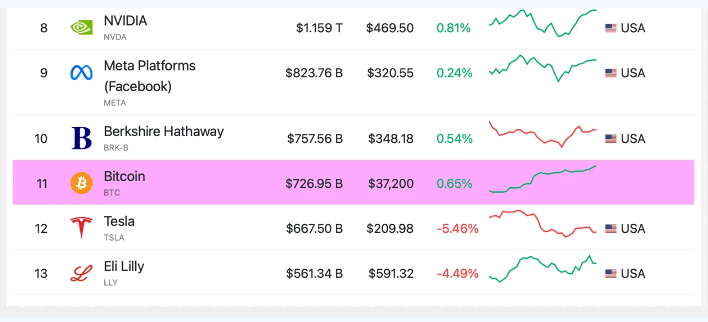
Bitcoin’s market cap has risen to No. 11 in the global market capitalization index. Currently, BTC boasts a market valuation of approximately $726.95 billion, with trading prices hovering just above the $37,000 mark.

The market anticipates that the U.S. Securities and Exchange Commission (SEC) will soon have multiple spot Bitcoin exchange-traded funds (ETFs).

Bitcoin futures exchange-traded funds (ETFs) are pools of bitcoin-related assets offered on traditional exchanges by brokerages to be traded as ETFs. The intent behind these ETFs is to give retail and other investors exposure to cryptocurrencies without needing to own them

A spot Bitcoin ETF brings all the benefits of a futures ETF, such as investing in Bitcoin without using an exchange, paying less in fees than on a crypto exchange, and streamlining the process overall. But a spot ETF invests in Bitcoin on the spot.

Bitcoin is currently sitting just below Berkshire Hathaway and above Tesla on the index.

BITE 6: INVENTOR OF THE FLOATING GATE MOSFET DIES

Professor Simon Sze, the inventor of the Floating Gate MOSFET, a key technology that revolutionized modern computing forever, and so, without which Web 3 would not even exist, died on Monday (6th) at the age of 87.

Simon Min Sze was born in Nanjing, Jiangsu province, China, in 1936 and grew up in Taiwan. After graduating in Taiwan, he did a masters at Washington in 1960 and a doctorate at Stanford University in 1963.

He worked at Bell Labs up to 1990 whereafter he was given a Professorship at National Chiao Tung University.

Sze was also concurrently a Visiting Professor to University of Cambridge, Delft University, Soochow University, Swiss Federal Institute of Technology, and Tokyo Institute of Technology.

Professor Simon Min Sze received many awards in his lifetime and was a fellow of many Associations and Societies. May he rest in peace.

Professor Sze

Get your .9jacom and .9javerse Web 3 domains  for $2 at:

.9jacom Domains

.9javerse Domains

Visit 9ja Cosmos

Follow us on LinkedIn HERE


Background Sourced 11/11/23 from:

cointelegraph.com/news/blackrock-argues-sec-has-no-grounds-to-treat-crypto-futures-and-spot-etfs-differently

youtube.com/watch?v=K96OYpqMD-w

investopedia.com/investing/bitcoin-etfs-explained/

venturebeat.com/ai/midjourneys-new-style-tuner-is-here-heres-how-to-use-it/

dannymekic.com/202310/undermining-democracy-the-european-commissions-controversial-push-for-digital-surveillance

www.afr.com/technology/start-up-founder-resigns-after-offensive-comments-to-women-on-linkedin-20231107-p5eiai

www.ledgerinsights.com/tokenize-diamonds-russia-expobank/

news.bitcoin.com/bitcoin-soars-to-become-11th-largest-global-asset-nearing-berkshire-hathaways-valuation/

eenctu.nctu.edu.tw/en/teacher/p1.php?num=127&page=1