DD
MM
YYYY

PAGES

DD
MM
YYYY

spot_img

PAGES

Home Blog Page 3651

Understanding The “Asset Balance” As Nigeria Watches Bank Balances of Below N500k for 95% of Citizens

0

“In the past eight years, only about 5% of the population have bank accounts with more than half a million in them…The majority was left out, while a small minority enjoyed” – Wale Edun, Nigeria’s finance minister, on Nigerian banking.

With that observation, the government wants to take action: “Highlighting the need for corrective measures, Edun emphasized that the government’s reforms aim to rectify economic imbalances that have favored a small group of elites over the majority of citizens in the past eight years. He noted the importance of redirecting government revenue into the national treasury to address these disparities.”

Yet, there is a need for caution here. Yes, we should not blindly focus on increasing the balances in bank accounts, rather, we should look at how we can formalize people’s assets. In other words, a man who inherited 10 hectares of land but no bank account may be more loaded than someone who has N2 million in a bank balance, if that land has velocity and is tradable.

In other words, how can we redesign Nigeria’s economy to move from money to capital in our policy engineering? The land is dormant, and not in Nigeria’s balance sheet, making it hard to see anything in the “asset balance”, even as the bank account is dry for that man. In other words, Nigeria sees the zero bank balance but has no visibility on the 10 hectares of land, but that does not mean it does not exist.

Nigeria will become a great nation when we shift from money to capital. Yes, NOT unlocking dormant assets will continue to make many “rich” people seem poor in Nigeria. Unfortunately, no state government can do this translation because of many laws in the books, including the Land Use Act which essentially voids capitalisation of undeveloped farmlands at scale, as governments can take possession at will.

Good People, until Nigeria begins to focus on creating systems for capital development over our fixation on money and cash balances, we will continue to struggle. Money is a subset of Capital, and nations which allow Money to rule over them underperform. In Nigeria, we’re pursuing so much money, leaving Capital, and in the process, we are scaling poverty. That poverty is what Mr. Minister saw in the bank accounts but that does not mean those people are indeed poor because today no one sees the unlocked “asset balances” they possibly hold.

Until Nigerian policymakers focus on creating systems for Capital development and evolution over our fixation on Money, we will continue to struggle. Money is a subset of Capital, and companies and nations which allow Money to rule over them underperform. In Nigeria, we’re pursuing so much money, with limited efforts designed to advance Capital, triggering a system where there are many farmlands but no capital market product for farmlands. And without Capital, we scale poverty.

Only 5% of Nigerians have N500k and above in their bank accounts – finance minister

Qatar Declines Nigeria’s Proposal for Business Forum During Tinubu’s Visit, Presidency says visit still holds

0

In what seems to be a diplomatic hiccup for Nigeria, the State of Qatar has rebuffed a proposition by the Nigerian government to host a Business and Investment Forum (BIF) during President Bola Tinubu’s upcoming visit to the Gulf nation on March 2 and 3, 2024.

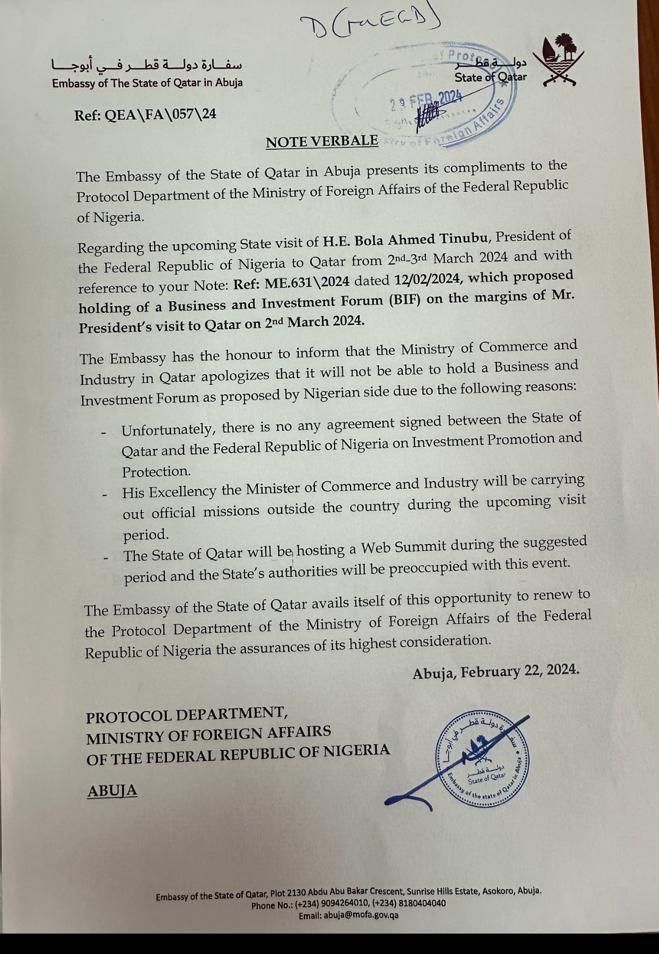
The denial came to light through a leaked response from the Embassy of Qatar in Abuja to a Note Verbale from Nigeria’s Ministry of Foreign Affairs.

Quoting from the leaked document dated February 22, 2024, the Embassy articulated, “Unfortunately, there is no agreement signed between the State of Qatar and the Federal Republic of Nigeria on Investment Promotion and Protection.” It further added that the Minister of Commerce and Industry in Qatar would be on official missions abroad during President Tinubu’s visit.

Moreover, the Embassy indicated that Qatar would be hosting a Web Summit during the proposed timeframe, with its authorities preoccupied with the event.

“The State of Qatar will be hosting a Web Summit during the suggested period and the State’s Authorities will be preoccupied with this event.”

“The Embassy of the State of Qatar avails itself of this opportunity to renew to the Protocol Department of the Ministry of Foreign Affairs of the Federal Republic of Nigeria the assurances of its highest consideration.”

The presidency reacts

However, the Presidency in Abuja has refuted the leaked information, asserting that the state visit by President Bola Tinubu to Qatar remains scheduled between March 2 and March 4.

Mr. Bayo Onanuga, Special Adviser to the President on Information and Strategy, clarified that the leaked memo primarily focused on a private sector-led Business and Investment Forum intended to be held alongside the president’s state visit.

“We are aware of a leaked diplomatic correspondence between the Embassy of the State of Qatar in Abuja and Nigeria’s Ministry of Foreign Affairs regarding President Tinubu’s visit between March 2 and March 3, 2024.

“The leaked diplomatic paper by mischief makers about an investment forum is not in any way a snub on Tinubu by the Qatari government.

“The business meeting is being put together by the Nigerian Association of Chambers of Commerce, Industry, Mines and Agriculture (NACCIMA) and Qatar’s Chambers of Commerce and Industry.

“Business people from Nigeria planned to engage their counterparts from Qatar on commercial and investment opportunities available in both countries,’’ Onanuga stated.

He further elucidated that NACCIMA and Qatari Chambers of Commerce and Industry were collaborating to capitalize on the president’s visit to Doha, aiming to mobilize the business communities from both nations to explore various sectors like oil and gas, manufacturing, agro-business, construction, real estate, ICT, renewable energy, solid minerals, and service sector, among others.

Contrary to the leaked memo, President Tinubu is expected to proceed with his visit to Qatar as planned. During the visit, he is anticipated to engage in high-level bilateral discussions with the Qatari leadership, encompassing diplomatic and economic matters.

“It is incorrect to insinuate that the Qatari authorities have snubbed the Nigerian leader over a business and investment forum which is tangential to the state visit.

“President Tinubu and His Highness Al-Thani are both committed to maintaining and building on the existing cordial and special relationship between Nigeria and the State of Qatar,’’ Onanuga stated.

Recent recalls by German carmakers Volkswagen and BMW in the United States

0

The German car manufacturers Volkswagen and BMW have been ordered to recall hundreds of thousands of cars in the United States due to separate safety issues. The recalls highlight the importance of addressing potential risks promptly to ensure driver safety.

Volkswagen is recalling more than 261,000 vehicles in the U.S. due to issues with a suction jet pump seal inside the fuel tank. The National Highway Traffic Safety Administration (NHTSA) identified this problem, which could increase the risk of fire. The affected vehicles include certain front-wheel drive models:

2015-2020 Audi A3 Sedan.

2019-2020 Volkswagen Jetta GLI.

2018 Golf SportWagen and others.

Dealers will replace the suction pump on these vehicles free of charge, ensuring that drivers can continue to operate their cars safely.

BMW is also facing a recall affecting 79,670 cars in the U.S. The issue lies with the brake system, which could lead to an increased braking distance. Additionally, the ABS (anti-lock braking system) and DSC (dynamic stability control) may not function correctly. To address this, workshops will rectify the problem at no cost to BMW owners.

Both Volkswagen and BMW recognize that safety is paramount. By promptly addressing these issues, they demonstrate their commitment to ensuring their customers’ well-being. The U.S. market is crucial for German car manufacturers, with strong sales figures for both brands last year:

The Volkswagen Group delivered around 993,100 vehicles in North America—an impressive increase of almost 18%. BMW sold 395,741 cars in the USA, representing a 9% growth compared to the previous year.

BMW Issues 79,670-Car Recall over Potential for Brake Malfunction

BMW has initiated a recall covering nearly 80,000 vehicles from the 2023 and 2024 model years. The recall involves a defect in the ABS and stability control systems that could cause power braking assistance to fail, potentially leading to the driver losing control of the vehicle.

According to documents filed with the National Highway Traffic Safety Administration (NHTSA), the BMWs’ integrated brake system “may not function according to specifications.” This could result in extended braking distance or potential loss of vehicle control, increasing the possibility of a crash.

However, even in the event of a malfunction, mechanical braking and the emergency brake remain unaffected by the issue. The emergency brake would automatically activate if there were a loss of braking performance.

BMW has assured that drivers will be alerted through a warning light or message in the instrument cluster if there is a problem with the braking system. Owner notification letters are expected to be mailed on April 5, 2024, and affected vehicle owners can bring their cars to their BMW or Rolls-Royce dealer for free replacement of the integrated braking system.

South Africa Working on Stablecoin Regulation

0

In the dynamic realm of cryptocurrency and digital assets, South Africa has been actively refining its approach to regulation. Last year, both the Financial Sector Conduct Authority (FSCA) and the Financial Intelligence Centre (FIC) classified crypto assets as financial products, initiating the registration process for crypto asset service providers.

Now, in 2024, South Africa is poised to take another significant step by considering stablecoins as a specific type of crypto asset. The Intergovernmental Fintech Working Group (IFWG) in South Africa is at the forefront of these regulatory developments.

Tasked with overseeing fintech advancements in the country, the IFWG has announced plans to develop a comprehensive regulatory framework for stablecoins. This initiative aims to address the growing importance of stablecoins within the financial ecosystem.

The IFWG is a collaborative effort among South African financial sector regulators, including National Treasury, the Financial Intelligence Centre (FIC), the Financial Sector Conduct Authority (FSCA), the National Credit Regulator (NCR), the South African Reserve Bank (SARB), and the South African Revenue Service (SARS). Together, they work to demystify the regulatory landscape, providing clarity and guidance to fintech companies navigating complex compliance requirements.

The IFWG will begin by assessing various use cases for stablecoins. These digital assets, pegged to fiat currencies like the U.S. dollar, offer stability and liquidity advantages over other cryptocurrencies. By exploring their potential implications, South Africa aims to strike a balance between innovation and investor protection.

Innovation thrives when there’s room for experimentation. The IFWG recognizes this and actively creates a safe space for fintech startups and established players alike. Through its Regulatory Sandbox, companies can test innovative products and services without fear of immediate regulatory repercussions. This sandbox approach encourages creativity, accelerates development, and ensures that new solutions align with regulatory standards.

In addition to stablecoins, the IFWG will scrutinize tokenization—a process that involves representing real-world assets (such as securities) on a blockchain platform. By conducting analytical work on tokenization, South Africa seeks to understand its regulatory implications thoroughly. A discussion paper outlining these implications, particularly concerning blockchain-based financial market infrastructure, is expected to be published by December.

While South Africa progresses with its regulatory agenda in the crypto space, an upcoming presidential election scheduled for May 29 adds an element of uncertainty. However, regardless of potential political changes, South Africa remains committed to fostering a conducive regulatory environment that encourages innovation while safeguarding investors.

The IFWG doesn’t stop at demystification and experimentation—it actively advances innovation. By closely monitoring emerging trends and technologies, it identifies opportunities and risks within the financial sector. The IFWG collaborates with industry stakeholders, policymakers, and entrepreneurs to shape policies that foster responsible growth while safeguarding consumers.

Only 5% of Nigerians have N500k and above in their bank accounts – finance minister
0

In a recent interview with Channels TV, Nigeria’s Minister of Finance and Coordinating Minister of the Economy, Wale Edun, revealed startling statistics regarding the financial situation of the country.

According to Edun, only approximately 5% of Nigerians have more than N500,000 in their bank accounts, indicating a significant wealth disparity within the nation.

“In the past eight years, only about 5% of the population have bank accounts with more than half a million in them,” Edun stated. “The majority was left out, while a small minority enjoyed.”

Highlighting the need for corrective measures, Edun emphasized that the government’s reforms aim to rectify economic imbalances that have favored a small group of elites over the majority of citizens in the past eight years. He noted the importance of redirecting government revenue into the national treasury to address these disparities.

“The reforms are corrective measures to mop up the liquidity in the economy that was not tied to production or supply of goods and services,” Edun explained. “These imbalances only benefit a few people in the economy.”

Edun further elucidated the historical context, noting that the preceding years saw a buildup of liquidity, with funds predominantly flowing to a privileged minority while the majority of the population remained sidelined. He reiterated that President Tinubu’s administration is committed to addressing these inequalities through comprehensive microeconomic reforms.

To mitigate the impact of poverty and the high cost of living, Edun announced President Tinubu’s initiative to provide a palliative package ranging from N25,000 to N15 million to households over the next three months. This measure is aimed at alleviating financial strain on vulnerable segments of the population and fostering economic stability.

His statement: “There has been an effort to ensure that the people’s money is not in the hands of a few. And on that point, I must emphasize that when we talk about the last eight years before Mr. President came to power, there was this liquidity built up.

“The Issue was that the funds were going to a few. Only about 5% of the population have bank accounts that have more than half a million in them. So, the majority was left out for eight years. They are on the sidelines while a small minority enjoy.

“That is the major correction being made by Mr. President now. These are the major microeconomic reforms that have been put in place.

“So therefore, government revenue that was outside the federal government consolidated revenue funds have been brought back to the government funds.”

The economic implications

The economic impact of the stark wealth disparity is profound and far-reaching. With only about 5% of Nigerians possessing substantial funds in their bank accounts, the vast majority of citizens are left grappling with meager earnings, which in turn has significant ramifications for the overall economy.

The concentration of wealth among a small elite segment of the population not only exacerbates inequality but also constrains economic growth. Economists note that when a large portion of the populace struggles with low incomes, their purchasing power is limited, leading to reduced consumer spending. This, in turn, dampens demand for goods and services, hampering businesses’ ability to thrive and expand. Ultimately, it stifles economic activity and hampers the nation’s potential for development.

Furthermore, a high population made up of poor people has been described as a recipe for social unrest and instability. This is because, as a significant portion of the population grapples with poverty and financial insecurity, frustration and resentment towards the privileged few who control a disproportionate share of the nation’s wealth can escalate, leading to social tensions and even unrest. Such instability undermines investor confidence and hampers economic progress.

Addressing the meager earnings of the populace and tackling wealth inequality are said to be imperative for fostering inclusive growth and sustainable development in Nigeria. The nation’s decision to distribute N25,000 to N15 million to households over the next three months, as a way of filling the gap has been criticized by experts.

Economists advocate empowering a broader segment of society with financial security and opportunities for economic advancement, which they said is not only morally imperative but also essential for building a robust and resilient economy that benefits all Nigerians.