DD
MM
YYYY

PAGES

DD
MM
YYYY

spot_img

PAGES

Home Blog Page 3678

CBN allocates $20,000 FX supply to BDCs across Nigeria

0

In response to the persistent imbalances observed in Nigeria’s foreign exchange market, the Central Bank of Nigeria (CBN) has initiated proactive steps to bridge the widening gap in exchange rates by supplying Bureau De Change (BDC) operators with dollars daily.

In a recent circular signed by Dr. Hassan Mahmud, the Director of the Trade & Exchange Department, the CBN announced its decision to allocate $20,000 to eligible Bureau De Change (BDC) operators across the nation.

The move is part of a comprehensive strategy aimed at achieving a more market-driven exchange rate for the Naira while mitigating pressures on the parallel market.

Under the directive, the allocated funds will be sold to BDCs at a fixed rate of N1,301/$, mirroring the lower band rate of executed spot transactions at the Nigerian Autonomous Foreign Exchange Market (NAFEM) as of the previous trading day, dated February 27, 2024. This strategic intervention is anticipated to infuse much-needed liquidity into the market, thus stabilizing the Naira’s value.

Additionally, the circular delineates specific guidelines for BDC operators, limiting their margin on foreign exchange sales to end-users to not more than one percent (1%) above the purchase rate from the CBN. This measure aims to curb excessive mark-ups and safeguard consumers from price exploitation.

“The CBN has approved the sale of foreign exchange to eligible BDCs to meet the demand for invisible transactions. The sum of $20,000 is to be sold to each BDC at the rate of N1,301/$—(representing the lower band rate of executed spot transactions at NAFEM for the previous trading day, as at today, 27th February 2024),” the circular highlights. “All BDCs are allowed to sell to end-users at a margin NOT MORE THAN one percent (1%) above the purchase rate from CBN.”

Furthermore, eligible BDCs are required to deposit their Naira payments into designated CBN Foreign Currency Deposit Naira Accounts and furnish confirmation of payment along with other requisite documentation for disbursement at select CBN branches in Abuja, Awka, Lagos, and Kano.

This strategic move by the CBN is aimed at enhancing the efficiency and transparency of the foreign exchange market, fostering a conducive environment for Naira trading. By directly addressing distortions in the retail market, the CBN seeks to promote economic stability and growth.

In addition to these measures, the CBN has implemented various reforms to counter Naira depreciation, including the resolution of FX backlogs, restrictions on forex for foreign education and medical tourism, augmentation of BDCs’ minimum share capital, and measures to deter FX speculation. The central bank said on Tuesday it has cleared an additional $400 million in the nation’s FX obligations, leaving outstanding of about $4 billion.

However, the efforts have failed to tackle the prevailing foreign exchange challenges, which have contributed significantly to the mounting inflation rates in the country. With the nation’s headline inflation at 29.90%, the CBN increased the interest rate once again, to 22.75%, following the Monetary Policy Committee meeting which was concluded on Tuesday.

Consequently, this fresh move by the CBN to supply BDCs with dollars has come with skepticism due to insufficient liquidity of forex. Though the CBN governor Yemi Cardoso said on Tuesday that the Nigerian foreign reserve, from where it is expected to sustain the supply of FX to the BDCs and banks, has risen to $34 billion, there is concern that the recent increase in the fund will not be sustained. This is because of the continuous decline in the nation’s oil output, attributed to oil theft and vandalism of oil installations.

The naira closed at N1,615.94 per dollar in the official (NAFEM) market and N1,630 in the parallel market on Tuesday.
Apple Scraps Electric Car Project, Redirects Efforts Towards Artificial Intelligence

0

In a decision that stunned both employees and industry observers, Apple Inc. announced the termination of its decade-long pursuit to develop an electric car, a project dubbed Project Titan, signaling the end of one of the company’s most ambitious endeavors to date.

The internal disclosure, made on Tuesday, came as a shock to the nearly 2,000 employees dedicated to the project, Bloomberg reports, citing sources familiar with the matter who requested anonymity.

Chief Operating Officer Jeff Williams and Kevin Lynch, a vice president overseeing the project, delivered the news to the team, indicating a shift in focus from automotive ventures to artificial intelligence, according to Bloomberg.

The Special Projects Group (SPG), tasked with the electric car initiative, will now begin the process of winding down, with many employees expected to transition to the artificial intelligence division led by executive John Giannandrea. The transition will see employees pivot towards generative AI projects, aligning with Apple’s strategic priorities in this area.

While the precise impact on the workforce remains unclear, with the potential for layoffs looming, Apple declined to provide further details or comment on the matter when approached. The company, headquartered in Cupertino, California, has traditionally maintained a secretive approach to its projects, and this unexpected shift is no exception.

Investors, however, responded positively to the news, with Apple’s shares climbing approximately 1% to $182.63 by the end of trading in New York, following the Bloomberg report.

The decision to discontinue the electric car project marks a significant departure from Apple’s ambitious foray into the automotive industry, which aimed to revolutionize personal transportation with a fully autonomous electric vehicle.

Project Titan, initiated around 2014, faced numerous challenges from the outset, including leadership changes and shifting strategic directions. Lynch and Williams took the reins of the project following the departure of Doug Field, who subsequently joined Ford Motor Co. Despite years of investment and research, Apple struggled to overcome hurdles, particularly in the realm of self-driving technology, which proved to be a formidable obstacle.

The decision to halt the project reflects broader challenges facing the electric vehicle market, where sluggish sales growth and infrastructure limitations have hindered widespread adoption. Even industry leader Tesla Inc. has encountered headwinds, signaling a slowdown in expansion amid changing market dynamics. According to a forecast by UBS AG, the growth rate of domestic electric vehicle (EV) sales is expected to decelerate to 11% this year, down from an estimated growth rate of 47% in 2023.

Elon Musk, CEO of Tesla Inc., celebrated the news on the X social media platform with a saluting emoji and a cigarette emoji.

In recent weeks, Apple’s senior executives deliberated over the fate of Project Titan, with discussions revolving around potential delays in the car’s release and adjustments to self-driving specifications.

Ultimately, the company opted to pivot its resources towards areas of greater potential, particularly artificial intelligence, which promises long-term profitability and strategic value.

“Apple’s decision to abandon electric cars and shift resources toward generative AI is a good strategic move, we believe, given the long-term profitability potential of AI revenue streams versus cars,” Bloomberg Intelligence analysts Anurag Rana and Andrew Girard said in a note.

While the demise of the electric car project represents a setback for Apple’s automotive ambitions, the company remains committed to innovation in other domains. With substantial investments in research and development, where the company has spent $113 billion over the past five years, Apple continues to explore new opportunities for growth and expansion, including the recent launch of the Vision Pro headset.

Despite the challenges encountered along the way, Apple’s strategic shift to AI underscores its adaptability and resilience in navigating the ever-evolving landscape of technology and consumer preferences. By refocusing efforts on areas of strength and strategic importance, Apple aims to maintain its position as a leader in innovation and technology.

Nigeria’s central bank Increases interest rate by 400 basis points to 22.75%

0

Amidst mounting concerns over Nigeria’s economic stability, particularly the persistent rise in inflation, the Monetary Policy Committee (MPC) of the Central Bank of Nigeria (CBN) convened its inaugural meeting for the year on February 26th and 27th, 2024.

The committee, comprised of twelve members, deliberated on the necessary steps to address the prevailing economic challenges and announced several key decisions aimed at tightening monetary policy.

The decisions are as follows:

Monetary Policy Rate (MPR) Increase: The committee opted to raise the Monetary Policy Rate by 400 basis points, pushing it to 22.75 percent from its previous level of 18.75 percent.

Adjustment of Asymmetric Corridor: The MPC adjusted the asymmetric corridor around the MPR to +100/-700 basis points from +100/-300 basis points.

Increase in Cash Reserve Ratio (CRR): The Cash Reserve Ratio was elevated from 32.5 percent to 45.0 percent.

Retention of Liquidity Ratio: The Liquidity Ratio was retained at 30 percent.

These decisions were motivated by the prevailing inflationary pressures, exchange rate instability, and projections of future inflation trends. The Committee expressed deep concern over the sustained upward trajectory of inflation and emphasized its commitment to curbing this trend.

While acknowledging the trade-off between promoting output growth and combating inflation, the MPC stressed the importance of maintaining low and stable inflation for sustainable economic expansion.

The transition to an inflation-targeting framework was deemed crucial in addressing inflationary pressures, with the committee commending the fiscal authorities for their support in this regard. The committee weighed the options of maintaining the status quo or increasing the policy rate to counter inflationary pressures, ultimately opting for the latter.

Headline inflation surged to 29.90 percent in January 2024, up from 28.92 percent in December 2023, driven by increases in food and core inflation. Factors contributing to inflationary pressures included exchange rate pass-through, escalating energy costs, high fiscal deficits, and security challenges in key food-producing regions. Additionally, global factors such as tight financial conditions and geopolitical tensions posed significant upside risks to domestic inflation.

Despite inflationary concerns, the Nigerian economy exhibited modest growth, with real GDP expanding by 3.46 percent in Q4 2023, driven by improvements in both the oil and non-oil sectors. Projections for 2024 indicated varying growth forecasts by different entities, with the CBN forecasting growth at 3.38 percent, the Federal Government of Nigeria (FGN) at 3.88 percent, and the International Monetary Fund (IMF) at 3.00 percent.

The CBN said on the external front, gross external reserves witnessed an increase to US$34.51 billion as of February 20, 2024, compared to US$32.23 billion at the end of January 2024. This improvement was attributed to reforms in the foreign exchange market and an uptick in oil production, among other factors.

While the MPC’s decision to raise the MPR was applauded by experts, concerns were raised regarding the elevated Cash Reserve Ratio and liquidity ratio.

Financial analyst Kelvin Emmanuel noted that Nigeria’s CRR, currently at 45 percent, significantly surpasses the global benchmark average of 15 percent recommended by the Bank for International Settlements. He warned of potential challenges for banks, including increased non-performing loan ratios, amidst efforts to meet regulatory requirements and improve asset quality.

“Asking the banks to park 45% of all deposits with a quick, current, and operating cash flow ratio at 30% in the same year where you want them to recapitalize their minimum capital requirement and improve their asset quality is quite the stretch. The weighted Non-performing loan book average will definitely rise above 7%,” he said.

Crypto Market Surging in Last Days of February 2024

0

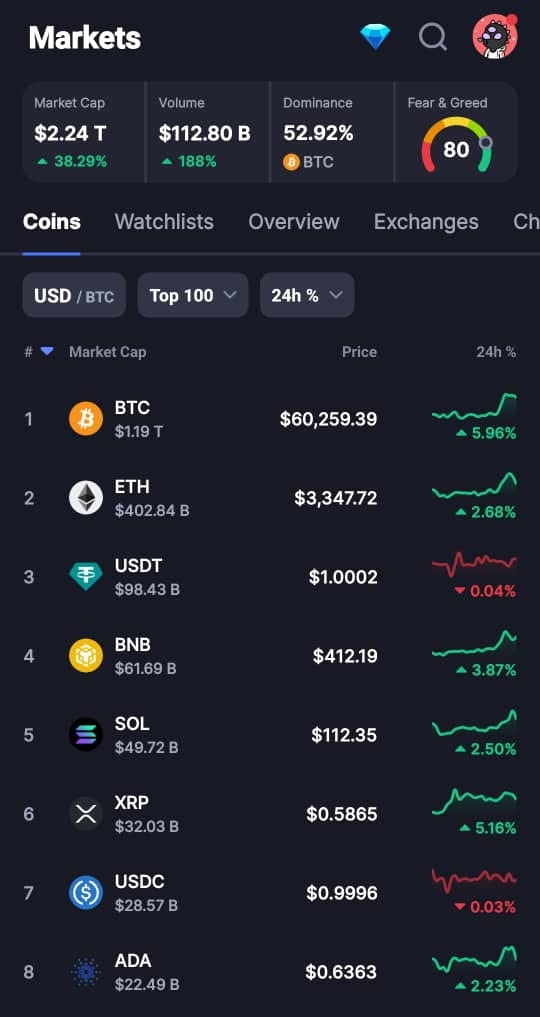
The cryptocurrency market has been firing on all cylinders, with Bitcoin (BTC) leading the charge. On Tuesday, BTC surged above $60,000 for the first time in more than two years, catching traders off guard who had been hoping for a significant pullback to allocate funds into the top crypto. While the rally continued for cryptocurrencies, stocks traded in a holding pattern as investors practiced patience following last week’s run-up to new record highs for the S&P and Dow.

Bitcoin’s Remarkable Rally

Data provided by TradingView shows that Bitcoin bulls extended Monday’s rally into Tuesday trading, pushing BTC to a high of $57,660 in the afternoon—its highest price since December 3, 2021. At the time of writing, Bitcoin trades at $60,259 representing a 10.1% increase on the 24-hour chart.

In 2009, Bitcoin emerged as a novel digital currency. Back then, there were no exchanges like the ones we have today. The BitcoinTalk forum played a crucial role in facilitating early transactions. The first recorded exchange occurred when forum member NewLibertyStandard set up the New Liberty Standard Exchange. Another user, Sirius, exchanged 5050 BTC for a mere $5.02 via PayPal. This pegged the initial Bitcoin price at approximately $0.00099 per BTC.

In 2010, Bitcoin’s price remained below $1 throughout the year. Its highest value was a meager $0.39. However, this was also the year of an iconic event: Laszlo Hanyecz paid 10,000 BTC for two pizzas from Domino’s—a transaction now celebrated as “Bitcoin Pizza Day.”

Several factors are influencing this market sentiment and surging cryptocurrency prices:

Just like any other asset, supply and demand play a significant role in determining crypto prices. When more people want to buy a particular cryptocurrency compared to those who want to sell it, the price tends to rise. Conversely, if more people want to sell than buy, the price theoretically decreases.

Supply dynamics vary across different tokens. Some cryptocurrencies have a fixed supply (e.g., Bitcoin), while others do not (e.g., Ethereum). Market participants often view tokens with fixed supplies as having less selling pressure.

While many crypto protocols do not generate profits like traditional stocks, there are other factors that indicate how “healthy” a protocol is and how fast it is growing. Fundamentals include aspects such as network adoption, development progress, security features, and utility within decentralized applications (dApps).

Market Sentiment refers to how investors perceive the overall market conditions and specific cryptocurrencies. Positive news, regulatory developments, partnerships, or endorsements can boost sentiment. Conversely, negative news or regulatory uncertainty can lead to bearish sentiment.

Technical analysis plays a crucial role in crypto trading. Traders analyze price charts, patterns, moving averages, and other technical indicators to make informed decisions. Technical forces influence short-term price movements.

The Binance’s $26 billion Revelation in Nigeria

0

“We are concerned that certain practices go on that indicate flows, going through a number of these entities and suspicious flows. In the case of Binance, in the last year, $26 billion has passed through Binance Nigeria from sources and users who we cannot identify” –   Governor of Central Bank of Nigeria, Olayemi Cardoso.

“There is a lot that is going on now as a result of collaboration between the different agencies which include the EFCC (Economic and Financial Crimes Commission), the police, and of course the office of the NSA (National Security Adviser), and in due course as we progress and have more information to share, we will certainly share, and suffice to say we are determined to do everything it takes to ensure that we take charge of our market or put it differently.

“Do not allow others to manipulate our market in a way that ends up distortionary and sub-optimizes for all Nigerians. We will not accept it and we will do everything possible to prevent any of these kinds of infractions from taking place”.

Wow – that is a revelation.  Binance moved $26 billion through Nigeria for a company that was banned in a sector that was “banned”? Yes, then, crypto companies were decoupled from the banking system, and yet, Binance was able to move an amount equal to Nigeria’s annual budget? How did that happen?

Poor Naira, now I can understand why you have no friends! Can they move the Central Bank of Nigeria headquarters  to Ovim, Abia State? We have Ojengwa, the local police – all women – who administer “law enforcement” in Ovim. Stubborn young men self-report to Nigerian Police when they know that Ojengwa women are coming because those women are at another level. If CBN is handed over to Ojengwa, who knows??? Lol

Seriously, I call our leaders to Make Naira Great Again because Naira deserves to breathe. I wish them good luck with the right policies.

Forex Crisis: Over $26 Billion Illegal Transactions Passed Through Binance From Unknown Sources in One Year – CBN Governor