DD
MM
YYYY

PAGES

DD
MM
YYYY

spot_img

PAGES

Home Blog Page 3707

Risks of recession in Germany are growing

0

Germany, Europe’s economic powerhouse, is facing significant challenges that have prompted economists to label it the “sick man of Europe.” The country’s famed economic model, which once drove strong growth for over two decades, is now faltering. Let’s delve into the factors contributing to Germany’s economic struggles.

Germany is on track for its first two-year recession since the early 2000s after its economy shrank in 2023 amid the impact of higher energy costs and weaker industrial demand. The German national statistics office said “multiple crises” affecting the economy had contributed to a 0.3% fall in gross domestic product (GDP) in 2023, compared with the previous year, as higher interest rates and elevated living costs took their toll.

Energy Costs and Weaker Industrial Demand: In 2023, Germany’s economy shrank by 0.3%, marking the first contraction since the early 2000s. Higher energy costs and weaker industrial demand played a significant role in this decline. The impact of elevated living costs and higher interest rates took a toll on economic growth.

Long-Term Issues: Beyond circumstantial factors, longer-term structural issues are affecting Germany’s efficiency. Ageing Population: Rapidly ageing demographics pose challenges for sustained growth. Infrastructure Investment: Lack of recent major investment in infrastructure hampers productivity.

Corporate Tax Rates: High corporate tax rates affect competitiveness. Electric Car Market Competition: China’s growing presence in the electric car market threatens German automakers.

Despite recent price declines, prices remained high at all stages in the economic process and put a damper on economic growth. The German economy did not continue its recovery from the sharp economic slump experienced in the pandemic year of 2020.

Germany’s economy was 0.7% higher in 2023 than in 2019, the year before the pandemic began. However, analysts said Europe’s largest economy was on track for another year of stagnant growth in 2024 at best, with a heightened risk of a second consecutive year of negative output.

Carsten Brzeski, the global head of macro research at the Dutch bank ING, said: “There is no imminent rebound in sight and the economy looks set to go through the first two-year recession since the early 2000s. We expect the current state of stagnation and shallow recession to continue. In fact, the risk that 2024 will be another year of recession is high.”

Germany’s dominant industrial base, excluding construction, fell by 2% over the course of the year, as higher energy costs and dwindling demand at home and from abroad weighed on factory output. Reflecting the impact of higher energy bills and borrowing costs on consumers, household consumption fell 0.8% on the previous year, while government spending fell 1.7%.

As well as having one of the worst performances among advanced economies last year, Germany is expected to experience one of the weakest performers in 2024, with EU forecasts published in November predicting growth of 0.8%. Experts said the country’s economy was in “permanent crisis mode” as supply chain frictions, persistent inflationary pressures, weaker global demand for manufactured goods, and higher interest rates weighed on national output.

The IMF has predicted that Germany will be the weakest of the world’s advanced economies, shrinking by 0.1% this year. Rising prices have dampened demand from households and businesses in Europe’s largest economy.

Nigerian Digital Bank Fairmoney in Talks to Acquire Umba in an all-Stock Deal Totaling $20 Million

0

Nigerian digital bank that offers loans to customers, Fairmoney, is currently in talks to acquire one of the fastest-growing neobanks in Africa, Umba, in a $20 Million All-stock deal.

Sources familiar with the deal disclose that acquisition negotiations are still ongoing, however, neither Fairmoney nor Umba has given any detail about the deal.

The move signals FairMoney’s interest in growing its customer base by expanding into more countries. Also, the acquisition will enable FairMoney to expand on Umba’s existing infrastructure.

FairMoney, best known for its lending services in Nigeria, has been looking for more avenues for expansion. Launched as a digital lender in Nigeria six years ago, the startup has also been expanding its product.

Since then, it has added other financial services, such as debit cards, transfers, and payments, with over six million retail customers. FairMoney offers a range of digital financial products including, near-instant digital loans 24/7, investment products, savings, payments, and cards directly via its mobile app.

According to the company, it disclosed that the app is the number 1 most downloaded fintech app in Nigeria. With over 10,000 daily loan disbursements, and over 5 million users enjoying banking, savings, and investment services, FairMoney helps the average Nigerian access finance tools to take control of both their life and their finances.

FairMoney is building the leading mobile bank for emerging markets, bringing financial inclusion to the underbanked people. The startup goal is to rebuild Africa’s money story by offering Tier 1 digital financial services to merchants and consumers alike.

The startup is backed by international investors and has raised a total of $89.9M in funding, to support our development.

On the other hand, Umba is reported to be one of the fastest-growing neobanks in Africa which offers free bank accounts and a suite of financial services including small loans to their customers all from a mobile app.

The digital bank, which was founded by Tiernan Kennedy and former Munster rugby player Barry O’Mahony, offers a transparent and accessible digital financial service alternative to legacy African banks. Customers can spend, pay bills, get loans, and earn cashback all from their phones.

In 2020 as Umba’s growth accelerated during the global pandemic, they needed an identity verification solution that could scale rapidly while preventing fraud. With the goal to build a premier pan-African neobank, they needed to be a step ahead on compliance and work closely with regulators which saw the company partner with SmileID.

Umba provides an ecosystem of connected financial services that allows the customer complete control of their finances all in one App. The startup believes in the power of financial inclusion to drive economic growth.

As a leading digital bank, Umba is  committed to providing innovative solutions that empower both employers and employees to achieve financial stability and reach their full potential.

The digital platform offers seamless access to a wide range of banking services, including account management, payments, loans, savings, and more. Umba leverages technology and data-driven insights to streamline processes and make banking faster, smarter, and more convenient than ever before.

With its extensive network and expertise, the startup is well-positioned to support our customers at every stage of their journey.

The Nigeria’s Evolving Lost Decade

1

First, the elections are over, and that means we can have a conversation on the economic state of Nigeria. I try to use my feed to provide what I think is an unbiased and balanced perspective, for the good of our nation.

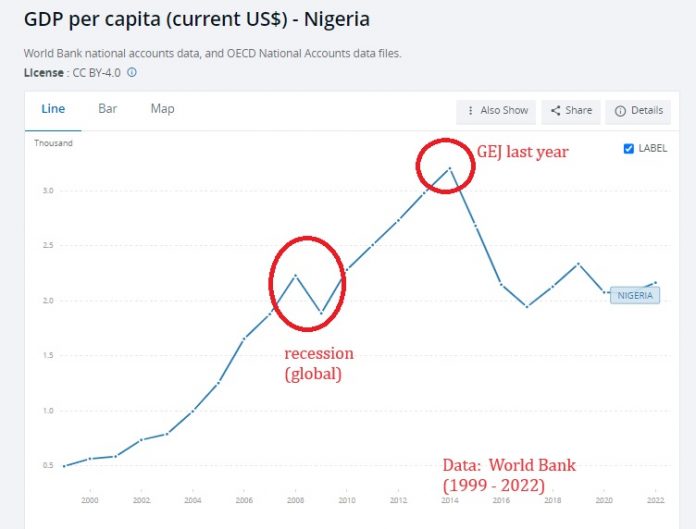
Yes, I maintain that APC is causing Nigeria a lost decade and I have data to make my case. It has nothing to do with any person. I am simply looking at hard data.

Good People, check the plot of Nigeria per capita income since 1999; they stopped the trajectory when they came in. For years, even in the depth of the Great Recession of 2007/ 2008, Nigeria was growing the GNI per capita. But somehow, a team came and the slope froze. This is not to say that PDP was better, but if you look at comparative time periods, PDP has outperformed in all categories.

I posit and I believe this: if GEJ had won reelection in 2015, that curve would not have fallen, and that does imply that Leadership is a key component of Nigeria’s problems. 

If you do not agree with my thesis, share your own data and let us have a debate.

*Data from World Bank

The Lesson from Argentina for Nigeria on Leadership

0

Nations rise and fall on leadership. Companies rise and fall on leadership. One major American technology company recorded 22 consecutive quarterly revenue declines. Then, a new CEO came, and revenue started growing. The nation of Argentina for close to 12 years did not know what it was to balance its books. A new guy came as president, and the nation has balanced a monthly budget within a full month at work:

“In a significant economic development, the Argentine government achieved its first monthly budget surplus in nearly 12 years during January. This milestone comes as new President Javier Milei, a far-right libertarian who took office in December, continues to push for strong spending cuts and fiscal responsibility.

“January marked the first full month in office for President Milei, and it ended with a positive balance for public-sector finances of US$589 million (approximately S$800 million) at the official exchange rate. This surplus includes payment of interest on the public debt. The achievement is noteworthy as it represents the first monthly financial surplus since August 2012 and the first surplus for a January since 2011.”

Good People, elections have consequences in boardrooms and nations’ capitals.

Argentina achieved Balanced Budget in January, first time in Over a Decade

Argentina achieved Balanced Budget in January, first time in Over a Decade

0
TOPSHOT - Argentine presidential candidate for the La Libertad Avanza alliance Javier Milei waves to supporters after winning the presidential election runoff at his party headquarters in Buenos Aires on November 19, 2023. Libertarian outsider Javier Milei pulled off a massive upset Sunday with a resounding win in Argentina's presidential election, a stinging rebuke of the traditional parties that have overseen decades of economic decline. (Photo by Luis ROBAYO / AFP) (Photo by LUIS ROBAYO/AFP via Getty Images)

In a significant economic development, the Argentine government achieved its first monthly budget surplus in nearly 12 years during January. This milestone comes as new President Javier Milei, a far-right libertarian who took office in December, continues to push for strong spending cuts and fiscal responsibility.

January marked the first full month in office for President Milei, and it ended with a positive balance for public-sector finances of US$589 million (approximately S$800 million) at the official exchange rate. This surplus includes payment of interest on the public debt. The achievement is noteworthy as it represents the first monthly financial surplus since August 2012 and the first surplus for a January since 2011.

President Milei has been actively negotiating with the International Monetary Fund (IMF) regarding Argentina’s US$44 billion loan. He has made it clear that achieving a balanced budget is non-negotiable. “The zero deficit is not negotiable,” stated Economy Minister Luis Caputo on February 16.

Milei’s campaign promises include getting rid of the Central Bank and replacing the local currency with the dollar. His right-wing populist stance has resonated with voters who are frustrated with Argentina’s prolonged economic malaise. The country has been reeling from a devastating drought that severely impacted its cash crops.

Currently, Argentina has a 30-month $44 billion loan program with the IMF. Amidst this backdrop, Milei met virtually with IMF officials to discuss his economic vision for the nation. During this hour-long meeting, he assured them that his administration would not default on payments to the multilateral organization or any sovereign debts.

Milei outlined his Liberty Advances party platform, which includes several key points: Fiscal Adjustment. He proposes a significant fiscal adjustment, even more substantial than what the IMF demands. Opening Up the Economy, Milei aims to open Argentina’s economy further.

Labor Law Modernization, he advocates for modernizing labor laws. Deep State Reforms: His team plans to slash spending through comprehensive state reforms. Monetary Reform: Milei wants to end the Central Bank’s role in monetary policy.

Milei, an economist by training, advocates for sharp cuts in spending and a reduction of public debt as steps toward dollarization of the economy. His administration has already implemented significant economic reforms, including a 50% devaluation of the peso, lifting of price controls, and substantial interest rate increases. Despite these efforts, Argentina faces significant economic challenges. The country experienced an inflation rate of 20.6% in January.

Argentina faces significant economic challenges, and its history is marked by cycles of growth and dysfunction. Despite being Latin America’s second-largest country by area and the third-largest economy in the region, Argentina has defaulted on its sovereign debt nine times.

The country has leaned on funding from international institutions and, more recently, from China. The legacy of Peronism, a populist movement founded in the 1940s, has deeply divided Argentina’s political culture.

In recent years, Argentina has grappled with mounting debt, including tens of billions of dollars in loans from the International Monetary Fund (IMF). The election of anti-establishment President Javier Milei in 2023 appears to mark a sharp departure from the status quo.

President Milei has promised drastic economic and political restructuring, emphasizing greater cooperation with the United States and the West. This could include downgrading the Mercosur trade bloc and distancing itself from China, Argentina’s second-largest trade partner.

The economic situation in Argentina is dire. The country has experienced almost 100 per cent inflation in February 2023 — the highest level in 32 years. Galloping inflation has led to a phenomenon economists call ‘‘unanchored expectations,” where prices increase so rapidly that people lose track of what things are worth. Shopping becomes a treasure hunt as consumers compare prices across multiple supermarkets to find the best deals.