DD
MM
YYYY

PAGES

DD
MM
YYYY

spot_img

PAGES

Home Blog Page 3708

Nigeria Announces Plan for Home Delivery of Passports, Beginning Feb 2024

0

The Nigerian Government has announced plans to deliver passports to Nigerians at their chosen locations, including homes and offices, starting from next year.

Minister of Interior Olubunmi Tunji-Ojo shared this information during the opening ceremony of the 2023 University of Lagos International Week held in Lagos. The move aims to streamline and improve the passport application process, making it more convenient and efficient for Nigerians.

The ministry has initiated the automation of the process, which is expected to enhance the overall experience for passport applicants. This development is part of the government’s efforts to modernize administrative processes and provide better services to citizens.

“We have commenced the automation of our end-to-end passport application process, and we have given a timeline from which Nigerians will begin to experience the ‘sweet experience,” he said at the event.

“By implication, Nigerians will not need to wait longer than two weeks before they get their passport.

“By January next year, Nigerians will be able to complete this application process online, and by February next year, with collaboration and partnership with other relevant stakeholders, Nigerians will have their passports delivered to their homes, offices, and other locations of their choice.”

“This, of course, would be extended to our visa application process. We are deploying technology throughout the entire process to make it as seamless as possible. To achieve this, we have set everything into motion to open more visa application centers across the world.

“In this regard, we are also working on strengthening our visa-on-arrival policy. We are working with the Ministry of Foreign Affairs to enforce the principle of the doctrine of reciprocity, and a committee has been set up in the ministry to achieve this,” the minister added.

Tunji-Ojo also spoke about the government’s efforts to harmonize data to foster efficient immigration services. He said the integrity of travel documents would be restored via data harmonization.

“Identity is who we are, what we are, and what we live for. But today, what we have is a duplication of our registration,” he said.

“Arguably, Nigeria is the only country I know that has a BVN for the bank, the international passport, the NIN, SIM card registration for telecos, and so on all of which request your data. The integrity of our travel documents must be restored through the harmonization of our data.”

This announcement follows other steps taken so far by the Tunji-Ojo to sanitize the operation of the Nigerian Immigration Service.

Last week, the minister said as of October 1, all 204,332 passport backlog had been cleared, following the ultimatum he issued to the NIS upon assuming office. Tunji-Ojo who outlined the innovative measures the government is taking to achieve its aim, also directed the NIS to deliver passport applications in two weeks, making the once rigorous process seamless.

“Hopefully by December, people will not need to go to passport offices to snap or take pictures. This is 2023. People will be able to upload their passports photographs online with specifications,” the minister said.

“When you apply for a visa, you do that and we are advancing in that line. Also, your supporting documents should be uploaded online so that when you go to the passport office, but will just be for biometrics and within five minutes you have left there. We don’t want the past situation whereby people spend the whole day at the passport offices. So instead of the offices capturing maybe 400 a day, they will be able to accommodate more people.

“These are some of the innovations we are bringing. Even though we know what the exchange rate is, we are not increasing passport fees. The government of President Tinubu understands the needs of the people. As a person, I do not want anybody to go and stay in a passport office for more than 10 minutes”.

Transforming Retail: AI Video-Based Shopping and Product Discovery | Tekedia Mini-MBA

0

One of Nigeria’s finest AI maestros will be at Tekedia Mini-MBA Live on the topic titled “Transforming Retail: AI Video-Based Shopping and Product Discovery”. The team just launched https://www.cravve.ai/ which makes it possible for you, while watching YouTube, Netflix, etc videos, to pause, click what you see, and their AI will find on the web where you can buy that item. Please go and download the Chrome browser, and discover shopping with the power of AI baked in Lagos.

I am going to school tomorrow and  Mavino Michael will be doing his thing. The Co-Founder and CTO of Edekee, a Tekedia Capital portfolio company, is a math prodigy. I have told him to soft-pedal on his calculus, mathematics, etc. We expect a great lecture, nonetheless.

Tekedia Mini-MBA  >> registration for the next edition has opened; go here and register . This is the #best school.

Nigeria’s Fuel Subsidy is Back

1

As predicted, it came just as we wrote: “Nigeria will either pause the full floating of its currency or return back to fuel subsidy within 6 months. Nigeria’s weakest currency stability point remains that it has to continue importing petrol since it does not have any working refinery. That creates a vicious circle since those importing fuel will mark up prices, to cushion for the next round of import, working to stay ahead of currency deterioration, in a system with no official benchmark.”

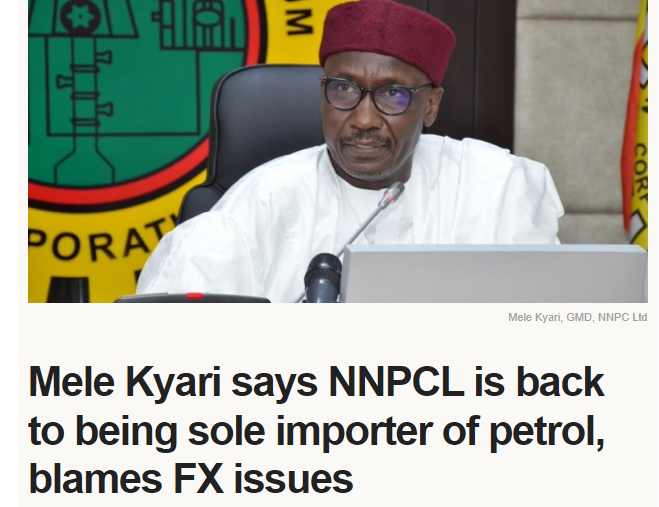
Today, NNPC* said: “We are the only company importing petrol into the country. None of them can do it today. For them, access to foreign exchange is difficult. We create foreign exchange (FX), therefore we have access to FX, while their access to FX is limited.”

Yes, fuel subsidy is back and NNPC* is now the sole importer of petrol into Nigeria. In the Igbo Nation, the elders will say “anaghi eji ukwu abu o ati utiri”  [you do not stretch yourself with both legs engaged at the same time]. Now, we need to return to the first principle and do things thoughtfully.

Provisions of NAFDAC Guidelines For the Global Listing Of Supermarket Items (GLSI) in Nigeria

0

Supermarkets :- Provisions Of The NAFDAC Guidelines For The Global Listing Of Supermarket Items (GLSI)

Effective from 13/12/2021, the National Agency For Food and Drug Administration and Control (NAFDAC) through its guidelines adopted the Global listing scheme which was introduced in 2003 to allow for the importation of specific regulated products (food and cosmetics items) subject to meeting established conditions or requirements. The consideration of this category became necessary because of the large number of items under the scheme and to meet special needs by certain groups or organizations in Nigeria.

This article will thus be focused on the provisions of the NAFDAC Guidelines For Global Listing of Supermarket Items in Nigeria.

Eligibility

This scheme is only open to specific entities operating in Nigeria with established retail outlets where applicable such as: –

  1. Supermarket Operators
  1. Fast Food Chains
  1. Restaurants
  1. Hotels
  1. Embassies
  1. International Organizations

Conditions to get Global Listing Approval

General Rules

– Items to be listed under the Global Listing of Supermarkets shall include Conventional cosmetics regulated by the National Agency for Food and Drug Administration and Control (NAFDAC) sold in supermarkets/stores and such other specialties as required by Hotels and International Organizations e.g., Embassies.

– An applicant shall have an established supermarket (where applicable).

– Already registered items shall not be entertained for listing. Such items should be sourced from local agents, or a ‘letter of no objection’ shall be obtained from the local representatives of these brands.

– Quantity of each item to be imported shall not exceed 2500 cartons per annum. Any entity willing to import more than the approved quantity (2500 cartons) should register such product(s) in line with the relevant extant registration guideline.

– Supermarket operators shall sell the imported items only on retail basis and can only distribute to their own supermarket chain.

– Supermarket operators shall register 2 products per 100 items imported, evidence of product registration will be required for the renewal of Global Listing License after the first two (2) years.

– The importation of products banned by the Federal Government of Nigeria or on NAFDAC ceiling shall not be allowed. 

Categories

Categorization of supermarket operators under the NAFDAC Guidelines are as follows-

  1. Category A (Limited) : 1-100(number of items)
  1. Category B (Limited) : 101-250(number of times)
  1. Category C (Limited) : 251-500(number of items)
  1. Category D (Limited): 501-1000(number of items)
  1. Category E(Limited):1001-5000(number of items)

Documentation

The following shall be submitted by the applicant to the office of the Director, NAFDAC :

– A completed Global Listing Form, “NAFDAC/1005” 

– A Notarized Declaration of indemnity in Favour of the Agency for any liability in case of false documentation/a false submission. 

– An application letter for the Listing of Supermarket items to include: –

  1. Company’s valid Phone number and email address.
  1. Company’s Representative’s valid Phone number and email address.
  1. Letter stating outlet(s) and their location address (es).

– Two (2) copies of Inventory of products to be imported for the year stating the following in the order stated below: –

a).Serial Number

(b)Product Name

(c)Brand of product (Brand Only)

(d)Origin of product (Country)

(e)Product Description

(f)Units/Pack e.g., 10 X 125g

(g)Pack type e.g., can, sachet, bottle

(h)Number of cartons (per item, per shipment or annum)

(i)Total Quantity Expressed in Units (Pack No x No of Cartons).

– Certificate of Analysis for each product shall be made available, where applicable (from the manufacturer or a Government approved analyst from country of origin).

– Certificate of Business Registration/Incorporation in Nigeria.

– Form C07/CAC7.

– Receipt for Application Form purchased.

-Introduction Letter of the authorized person(s) to process the application.

– Confirmation of Membership from National Association of Supermarket Operators of Nigeria (NASON) where applicable.

– One rewritable CD-ROM containing the inventory of items (in excel) to be imported formatted in the order stated above.

Establishment Inspection

– Supermarkets/stores wishing to have items to be listed shall be inspected by NAFDAC after submission of an Application Form and evidence of payment of the appropriate inspection fee.

– The facilities shall be subjected to inspection by the Drug Evaluation and Research (DER) Directorates of NAFDAC to ensure compliance.

Tariff

As advised by NAFDAC.

Additional Items

– Additional items in replacement of unapproved items on the original list can be allowed provided it is within the category paid for.

– However, if the addition of new items exceeds the category paid for, the applicant will be required to pay the balance of the next category.

Labelling

– Labelling shall comply with international regulations for cosmetic products.

– Any product labelled in a foreign language (except those for embassies) shall NOT be considered for listing unless an English translation is included on the label and package insert (where applicable).

Hyper scaling Solution on Ethereum Restaking

0

Ethereum is the most popular smart contract platform in the world, but it also faces some serious scalability challenges. The current proof-of-work consensus mechanism limits the network throughput to about 15 transactions per second, which is far from enough to meet the growing demand for decentralized applications. Moreover, the high gas fees and environmental impact of mining make Ethereum less attractive for users and developers.

One of the proposed solutions to improve Ethereum’s scalability is to switch to a proof-of-stake consensus mechanism, which is expected to happen with the launch of Ethereum 2.0. However, this transition will take time and will not solve all the scalability issues. For instance, proof-of-stake still requires validators to run full nodes and store the entire state of the network, which can become impractical as the network grows.

This is where EigenLayer comes in. EigenLayer is a novel layer-2 scaling solution that leverages the power of restaking to achieve hyperscaling on Ethereum. Restaking is a mechanism that allows users to stake their tokens on a layer-2 network and receive rewards from both the layer-1 and layer-2 validators. This way, users can enjoy the security and decentralization of Ethereum, while also benefiting from the high performance and low cost of EigenLayer.

EigenLayer is designed to be compatible with any layer-1 blockchain that supports smart contracts and staking, such as Ethereum, Polkadot, or Cardano. However, in this blog post, we will focus on how EigenLayer works with Ethereum as an example.

EigenLayer consists of two main components: a layer-2 network and a restaking contract. The layer-2 network is a set of validators that run a Byzantine fault-tolerant consensus protocol called EigenBFT. EigenBFT is based on Tendermint, but with some modifications to improve its efficiency and security. The layer-2 validators process transactions and generate blocks much faster than the layer-1 network, achieving thousands of transactions per second with sub-second finality.

The restaking contract is a smart contract deployed on the layer-1 network that acts as a bridge between the layer-1 and layer-2 networks. The restaking contract allows users to deposit their tokens on the layer-1 network and receive corresponding tokens on the layer-2 network. These tokens can then be used to interact with any decentralized application running on EigenLayer, or to stake them on the layer-2 network and earn rewards from both the layer-1 and layer-2 validators.

The restaking contract also allows users to withdraw their tokens from the layer-2 network and redeem them on the layer-1 network. However, this process requires a waiting period of several days, during which the layer-2 validators submit proofs of their activity to the restaking contract. This is to ensure that no double-spending or fraud can occur on EigenLayer.

In April 2023, the Shapella Upgrade enabled Ethereum Validators to unstake their staked ETH from the blockchain, allowing Validators to exit their positions as a Validator. As DeFi continues to grow, EigenLayer introduces an innovative solution that allows Validators and LSD stakers to reuse their staked assets without the need to unstake them.

EigenLayer offers several advantages over other scaling solutions, such as:

Hyperscaling: EigenLayer can achieve orders of magnitude higher scalability than the layer-1 network, without compromising its security or decentralization. By restaking their tokens on EigenLayer, users can access a wide range of decentralized applications with high performance and low cost.

Interoperability: EigenLayer can connect any layer-1 blockchain that supports smart contracts and staking, creating a cross-chain ecosystem that enables seamless value transfer and collaboration among different networks.

Incentive alignment: EigenLayer aligns the incentives of all participants in the network, including users, developers, validators, and miners. Users can enjoy both the rewards from the layer-1 and layer-2 networks, while also supporting the security and decentralization of both layers. Developers can build scalable and user-friendly applications on EigenLayer, without worrying about gas fees or network congestion.

Validators can earn fees from processing transactions and blocks on EigenLayer, while also contributing to the consensus of the layer-1 network. Miners can benefit from increased demand for their services, as more users join EigenLayer and interact with the restaking contract.

In simple terms, Restaking allows Ethereum already staked by Ether stakers on Ethereum to be reused on a different network – EigenLayer, thus earning more rewards in the process. It’s like a scaling solution for Ethereum. In essence, using staked ETH again to enhance security for different services not only saves money for those who put it in but also makes services more trustworthy.