One of the more overlooked and underappreciated trends in crypto is the omni-bank supertrend. This trend is at the intersection of fintech and crypto and is often dubbed the “omni-banking” revolution.
Omni-banking refers to the convergence of traditional banking services with cryptocurrency. Consider it a super app where users can send, receive, hold, transfer, save, invest, and spend value in any form on one platform. In an omni-bank ecosystem, dollars, euros, yen, cryptos, and stablecoins are all interchangeable money in a single account.
The omni-bank investment thesis has taken a back seat among the investment community, who are focused on DeFi, NFTs, RWAs, and other hot topics. However, consumer demand for a product that offers the speed and freedom of crypto with the familiarity of traditional finance is rapidly growing and could show a snowball effect over the coming years.
1. Inside Digitap’s Omni-Bank: Wallets, FX, and Visa Access
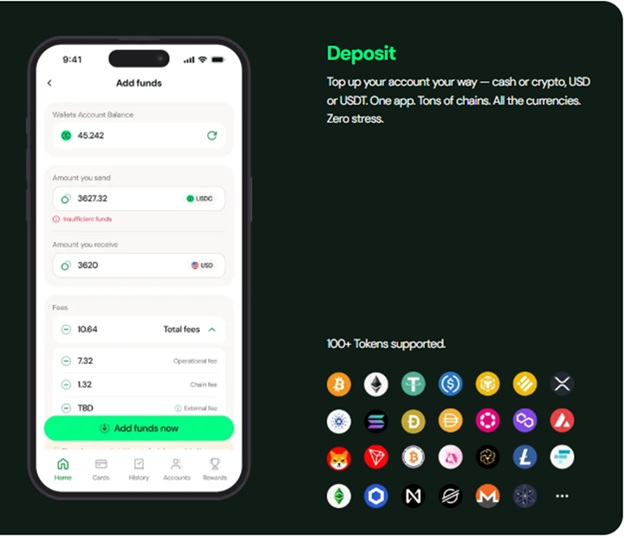
Digitap ($TAP) is one of the projects that best represents the omni-bank supertrend. Marketed as the world’s first crypto omni-bank, Digitap created a platform where all forms of money coexist and interact with each other.
Users can store fiat currency and crypto in a single account, exchange between them instantly, and spend their balance via a Visa-branded Digitap card. This means that users can get paid in a crypto stablecoin, invest part of the proceeds in a crypto like Bitcoin (BTC) or Ethereum (ETH), and use the remaining balance to pay for everyday items via the Visa card.
Digitap’s goal is to make crypto-enabled banking as easy as traditional online banking, which is key to attracting mainstream users. Digitap is early in its journey and is currently undergoing the second round of its presale event.
Currently priced at $0.0159 per token, early investors who bought in the first round have already made a 27% paper profit, and those buying today will make a 22% profit when the price jumps to $0.0194 in the next round.
Still, the current price offers investors a ground-floor opportunity to invest in one of the few crypto presales with real utility. Digitap needs to capture just a fraction of a percent of the trillions of dollars in global payments to succeed.
2. Stellar’s Rails Power Remittances, but Fees Remain Sticky
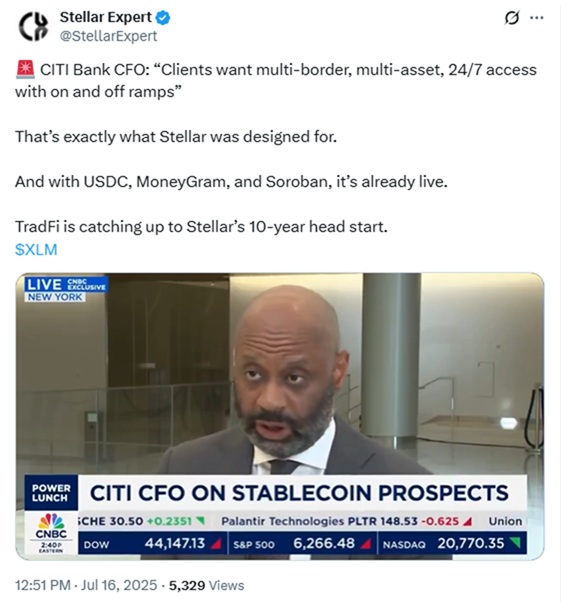
Stellar (XLM) is a crypto veteran project built for financial integration. It is an open-source blockchain designed for fast, low-cost payments and cross-border transactions. Stellar’s network has been selected by traditional financial institutions like MoneyGram to assist in global on- and off-ramps. Stellar is testing upgrades to handle up to 5,000 transactions per second to support enterprise-scale workloads.
Stellar’s proven technology and the 12,000% lifetime gain in its token validate the omni-banking investment thesis. Users can turn cash into digital dollars (Circle’s USDC stablecoin) and vice versa through the MoneyGram mobile app, essentially blending traditional remittances with crypto.
The problem with Stellar’s business model is that it has no say in how a firm like MoneyGram sets fees. Traditional remittance fees cost on average 6.2% of the transfer’s total value. Coupled with high foreign exchange fees for global transfers, consumers can certainly move their money quicker but at too high a cost.
To be clear, this is no fault of Stellar. However, platforms like Digitap, for example, can slash the remittance fee by up to sixfold to a potentially industry-leading sub-1% rate.
3. Tron’s Speed Matters, But Still Falls Short
Tron (TRX) isn’t a pure play “bank” or provider of banking services. However, it has become an industry leader for something very relevant: stablecoin transactions. In the context of omni-banking, stablecoins are vital, as they are digital dollars that people actually use for day-to-day value transfer.
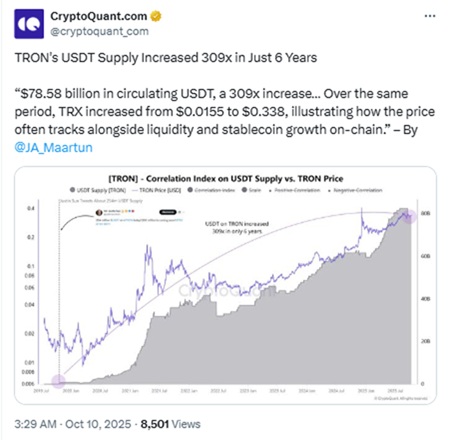
Tron has evolved to become the preferred rail for moving stablecoins worldwide. Over half of Tether’s USDT supply (the largest dollar stablecoin) is used on Tron. Tron also handles more than $23 billion in USDT transactions on a daily basis.
Tron’s network is built for speed and low cost. Transaction fees on Tron come in at a fraction of a cent, while throughput is high at more than 1,000 TPS. This means sending USDT on Tron is near-instant and almost free.
Tron has positioned itself as a major player in the backbone of crypto transactions. But one thing it lacks is the advanced features of a new DeFi app that can handle fiat transactions or be used to pay for everyday items.
Omni-Banking Needs an All-in-One: Where $TAP Fits Today
The concept of omni-banking in crypto refers to breaking down the wall between crypto assets and everyday money. While Stellar and Tron deserve praise for their contribution to making it easier for people to send and receive money, they fall short of an all-in-one crypto and fiat app.
Digitap checks all the right boxes and remains mostly undiscovered among investors. Digitap is certainly making the case to be included in the list of best crypto presales for 2025.
Digitap is Live NOW. Learn more about their project here:
German Chancellor Friedrich Merz hosted Ukrainian President Volodymyr Zelenskyy in Berlin for high-level discussions on bolstering Ukraine’s defense capabilities amid stalled peace negotiations with Russia.
During a joint press conference, Merz explicitly committed to “stepping up” pressure on Moscow to force engagement in ceasefire talks, emphasizing Europe’s resolve to end the conflict—the continent’s deadliest since World War II.
Germany will collaborate with Ukraine to develop and manufacture long-range weapons domestically in Kyiv, free from Western-imposed range restrictions. This includes cruise missiles and ballistic systems, with Merz stating, “We want to enable long-range weapons… and we will not speak about details publicly but will intensify cooperation.”
He declined to confirm direct delivery of Germany’s Taurus missiles but hinted at lifting all prior limitations on supplied arms. Merz vowed to prevent the recommissioning of the Russia-Germany gas pipeline, framing it as a direct economic lever: “We will do everything… to ensure that Nord Stream 2 cannot be put back into operation.”
Berlin will ramp up financial support for Ukraine’s arms production, including drones and air defense systems, signaling a shift toward sustained industrial aid as U.S. involvement wanes under President Donald Trump.
Zelenskyy, in turn, accused Russia of deliberate stalling tactics, noting Moscow’s failure to agree on negotiation venues including rejecting a Vatican-hosted proposal and its massing of 50,000 troops near Ukraine’s Sumy region for potential “buffer zone” incursions.
He highlighted Russia’s mobilization of up to 45,000 troops monthly against Ukraine’s 25,000–27,000, underscoring the asymmetry in the ongoing front-line fighting. The Berlin meeting followed failed Istanbul talks earlier in May, where Russia delayed delivering a promised peace memorandum despite U.S. pressure for a resolution.
Kremlin spokesman Dmitry Peskov criticized the missile production pledge as an “obstacle to peace,” while both leaders rejected Moscow’s demands, such as halting NATO expansion.
This comes as Merz, in office since early May 2025, navigates coalition tensions at home over defense spending but has earned praise abroad for his proactive stance—meeting Zelenskyy three times in under a month.
By August 2025, Merz reiterated calls for “pressure” on Russian President Vladimir Putin during talks with Canadian Prime Minister Mark Carney, accusing him of “delay tactics” ahead of potential U.S.-brokered summits.
These developments reflect Europe’s growing role in sustaining Ukraine’s defense as the war enters its fourth year. What began as a rapid Russian advance on Kyiv has devolved into a grinding war of attrition, with Russian forces controlling approximately 20% of Ukrainian territory, primarily in the east and south.
Russian President Vladimir Putin remains committed to his strategy of outlasting Ukraine and its Western allies, claiming incremental territorial gains around 4,900 square kilometers in 2025, though independent assessments like those from the Institute for the Study of War (ISW) put it at about 3,561 km².
Ukrainian President Volodymyr Zelenskyy, meanwhile, continues to call for stronger international support, recently urging U.S. President Donald Trump to broker an end to the war, drawing parallels to recent Gaza ceasefire efforts.
The conflict shows no immediate signs of resolution, with recent escalations in aerial strikes, energy infrastructure attacks, and diplomatic maneuvering.
Casualties remain staggering: estimates suggest over 219,000 Russian soldiers killed since 2022 with 90,000-100,000 in 2025 alone, alongside tens of thousands of Ukrainian military and civilian deaths.
Both sides report high enemy losses while downplaying their own, but the war has displaced millions and caused economic devastation estimated at $1.3 trillion for Russia through sanctions and direct costs.
Russian forces have intensified combined missile and drone strikes, targeting Ukraine’s energy grid to exacerbate winter hardships. Around October 2-3: A massive barrage of 381 drones and 35 missiles hit gas extraction facilities in Kharkiv and Poltava oblasts, damaging Naftogaz infrastructure and injuring civilians, including an 8-year-old child.
Ukrainian officials described it as the largest attack of the war, aimed at disrupting heating ahead of winter 2025-2026. October 4: Shahed drones struck a civilian train in Sumy Oblast, killing one and injuring 30; agricultural warehouses storing 1,700 tons of grain were also hit.
October 5: Over 500 weapons systems containing 100,000+ foreign parts, evading sanctions targeted energy sites, causing outages for 800,000 in Kyiv power later restored.
Ukrainian countermeasures: Forces downed 50% more Shahed drones in September 2025 than August, extending “kill zones” with FPV drones up to several kilometers behind Russian lines. Ukraine has also ramped up long-range strikes on Russian oil refineries, idling nearly 40% of Russia’s refining capacity and causing gasoline shortages.
It’s 2 years since we started work on the ‘Sino Amazon and Sino Signia’ project. It’s ten months since we released the first ‘Det0xant’ tokenized artwork series as ‘merch’ to support the release of ‘.det0x’ Web 3 names.
We have learnt a lot about the whole spectrum from Cryptocurrency to Blockchain and Web 3, particularly when we read or listen to sector writers, platform commentators and journalists.
Some don’t hold crypto in any significant proportions. Neither do they own or build blockchains, they haven’t been a creator of web3 product, and they don’t generally accumulate or volume trade in digital collectibles.
Because of this, they nurture a huge gap of perception, but they are unfortunately the go-to for the web3 and cryptocurious to be taking first steps.
The whole area of tokenized artwork has come a long way. We thought we’d wade into the area of Digital Collectibles. We imagine it is time to re-examine the market, the concept of value, and where people really see it.
We’ll also highlight some pitfalls to avoid.
A random PfP image in use circa 2014, before Web 3 tokenization. Source Pinterest
The concept of OFP.
OFP stands for ‘Original Floor Price’. It’s the first price a Digital Collectible or Tokenized Product was available at.
The ‘Route To Market’ is often a determinant of what the OFP will be like. A creator can set it directly to a market like OpenSea. There are many other markets, popular ones being Magic Eden, Blur, Rarible, Nifty, Mintable, Element, OKX and Ronin.
Sometimes it can be as low as zero. This is often the case when a series is issued in special appreciation of a select network of contacts, a loyalty bonus, merch supporting the launch of another product, or a ‘pre-sale’ airdrop as a tactic to stimulate market interest.
‘Lazy Minting’ is sometimes used, particularly by outfits creating their own retail network. The collectible may be free, but the new owner will bear their own minting cost. It’s a way the series creator can limit risk while achieving adoption.
This can be important when issuing collections directly minted to Ethereum, or Ordinal collections on Bitcoin
PFPs vs Tokenized Artwork
A PFP series in Web3 refers to a collection of profile picture non-fungible tokens (NFTs) that are designed to be used as avatars on social media and other online platforms. These series often feature unique digital artworks, allowing users to express their identity and affiliation with specific communities within the NFT space.
PFP series are built on a modular framework where individual artwork options can be placed in different sections of the image. Each module (section) integrates seamlessly with each other. In some cases, they can be chosen manually by buyers on a dedicated platform, or they can be subscribed to, and are received as a random selection by an algorithm.
Tokenized Artwork are digital images in the form of jpegs, pngs or some other format. They can be a digital capture of a ‘Real World Artwork’, or it can be images manually created with the assistance of tools like Adobe Photoshop. AI generated images can be created with programs like Midjourney, Stable Diffusion, Dalle E, Nightcafe’s ‘Flex, Googles Image FX or Adobe’s Firefly. Some of the most complex results, like those of 9ja Cosmos come from different layers and iterations of both manual and AI tools. They are then tokenized.
The market has been gradually moving away from PFP type offerings to Tokenized Artwork, simply because ‘good’ PFP series can now be made quickly, effortlessly, and without any unique skillset. The ‘algo’ can generate thousands or even tens of thousands at the press of a button. Digital Collectible Market thrives on difficulty of production and rarity, and the age of Cryptopunks, Bored Apes and Mfers is over.
A ‘Cryptopunk’ from Larva Labs, circa 2017
Have ‘NFT’s ever been dead?
When describing ‘NFTs’ Chainlink say: ‘ERC721 (also known as NFTs) define a framework for making tokens that are unique and different from each other (hence the term non-fungible), while the popular ERC20 standard defines tokens that are “fungible”, meaning the tokens are all interchangeable and guaranteed to have the same value.’
Protocols like ERC 721 and ERC 20 on Ethereum/EVM define techniques creating tokens that can act as an ownership deed to something. They are most easily used with digital property. ERC 721 has popularly been used with Digital Collectibles while ERC 20 has more commonly been used with memecoins and celebcoins. Different Protocols have been created on other Blockchain Ecosystems, such as Ordinals and Stamps on Bitcoin, while we have Token 22 and SPL with Solana. Use of ERC 721 (also known as NFTs) isn’t confined to Digital Collectibles, and ‘tokenizing’ or ‘minting’ Digital Collectibles isn’t limited to ERC 721.
Moreover, in the initial wave of different Tokenized Digital Collectibles large numbers of people with speculating tendencies, got caught up in very unrealistic valuations for some types of Digital Collectibles particularly PfP series like Cryptopunks, Bored Apes and Mfers.
Most remarks about ‘NFT’s being dead’ are based on these ‘very unrealistic valuations’ not being sustained. They are often flippant clickbait, which neither recognises the ‘NFT’ protocol has a huge application beyond PfP series, nor recognises that artwork can be tokenized without using ERC 721.
How important is the token type being an ‘NFT’ or not an ‘NFT’?
Different protocol types suit different tokenizing/minting solutions. ERC 721 is purpose built to represent NFA’s (Non Fungible Assets). Other protocols can be used, and they don’t have to be on Ethereum.
There are several solution on other blockchains that are far more secure, and decentralized, but wallets for them can be a bit obscure and the protocol may have a handicap when it comes to adoption.
Non-Fungible means one-of-a-kind, unique and not interchangeable with other similar objects. ERC 721 enforces this condition in the token. ERC 1155 is often used for different types of Digital Collectibles, but Web 3 ‘window shoppers’ need to check that the ‘supply’ of the item is only 1.
ERC 1155 and many other protocol types can be set to a supply of any chosen number, and if other than ‘1’, the one-of-a-kind, i.e. ‘NFT’ properties are absent.
Human involvement, tech capacity, and place in ‘time’.
Much of what determines quality of ‘Digital Collectibles’, are inherited from older times. Human beings capacity for ‘collecting’ is as old as time itself. They are wrapped in nostalgia, memories and emotion.
We have antique furniture and pottery. We have memorabilia of sports and music equipment of people held in high esteem by others. We have trading card collections that remind some financially independent people of a youth, which while it seemed less secure, it was also simpler.
As villages became towns, towns became cities, cities became metropolis, and workforces became more mobile, family relationships began to contract. From extended families to nuclear families, single parent families, childless couples, and ultimately, many insular humans.
Collectibles were at least as much a social focus, and an extension of ‘self’ as they were an investment. Visitors to friends and relatives’ homes were introduced to ‘collections’ or ‘exotic features’ as a social focal point.
The digital space improved the scope for leaning on our ‘collections’ as an aspect of ‘personal branding’ and social exchange.
Vinyl gave way to CD’s DvDs and then MP3s. Then came platforms like Spotify. Cameras and Canvas gave way to Photoshop and digital cameras. Modern smartphones achieve amazing resolution and replace dedicated devices for all but high-end niche professionals.
Then came Web 3, and we now have ‘Digital Collections’ tokenized to blockchains. This offers an unparalleled secure deed of ownership to digital property.
It allows people to carry their display of collectible ‘things’ with them everywhere, and with them, the extension to a sense of personal choice, taste, lifestyle values, sense of self. Everything that makes Personal Branding. To be shown anywhere. On a phone, laptop, or event VDU and sound system.
Young people share an interest in Tokenized Artwork on an iPad
Technologies change; styles change. Things are authentic for their time. 17th century can be old by todays standards, and most agree antiquity carries value. But if a furniture piece initially thought to come from that era had work done to it in the 18th century, it is worth only a fraction of its value. 18th century is a long time ago. It takes special experts to be able to notice these things and adjust value fairly.
Web3 product is shrunk down, not into centuries but less than a decade. Much earlier work was done painstakingly by people who ‘spun up’ their own nodes, before the ‘Age of OpenSea’.
Cryptopunks, Bored Apes and Mfers each have their place in the Web 3 evolution spectrum. Similar things done later aren’t worth the same.
As Technologies improved, the difficulty with which to achieve things reduced. Complexity drives aesthetic value.
Early mints on Ethereum, before the advent of Layer 2 networks (L2s) were expensive, and efforts to tokenize frequently failed, losing minting fees.
Algorithmic activities and early AI (Large Data Model) brought unexpected results leading to high levels of manual work, both technical and artistic. Limitations in the scale of quality output, caused by failed minting losses, software tool challenges, and more intense labour compared to latest standards, underpin the value of successful pieces.
Is the golden age of creating new ‘valuable’ Digital Collectibles gone forever?
No, but special measures need to be taken to give Digital Collectibles their potential for ‘value’ in an age of more reliable, cheaper and faster tokenizing options, automated retail network options, plus quicker and simpler tools, particularly AI tools. It also helps if the market can see ‘investment of self’ in the product:
What’s the story, Morning Glory?
Digital Collectible series with a good backstory, links to individuals or notoriety, and/or an anchor in other products from the same stable bring something different to something that just says ‘Buy from my series’.
The Sino Amazons by 9ja Cosmos carry a deep narrative about a group of female maritime warriors who terrorized the East Coast of Asia between approximately 1100 and 1700 AD.
Diverse discovery routes
The more platforms, networks, communities, websites and other avenues through which a series can be discovered, the better.
Product Ecosystem and Loyalty Programs
‘Collecting’ from businesses, brands, or movements, who have a ‘build out’ into different segments of Web3 has far more promise than collecting single Digital Collectibles from random project creators.
They may be ‘into’ their own retail networks, web 3 names/domains, web3 gaming, tokenizing event passes/access, tokenizing online business ownership… (inexhaustible list).
Anon’s Skulls were issued as a series intended to have earning potential
The more ‘build out’ and tendency towards a diverse (Web3) Product Ecosystem, the stronger a ‘one stop shop’ phenomenon, acting as a magnet for disparate Web 3 communities, growing collateral interest in other parts of the Product Ecosystem. These also tend to be strong breeding grounds for Loyalty Programs.
Owning assets from one part of the ‘Ecosystem’ can lead to access to free airdrops, preferential positioning for new releases or VIP treatment as they extend into Web 3 partnering and collaboration.
A ‘Det0xant’ tokenized artwork, which was given as ‘merch’ with the initial offering of .det0x Web3 names
Improvements keep pace with tech advancement.
The space has moved to collapse production cost and speed delivery in a very short time. It’s important Digital Collectible products in 2025 show marked departures from those evolving between 2021 and 2023.
NSFW and Universal Content Rating
Moral Compass swings widely across the globe and what’s ‘ok’ varies widely depending on who you ask and where they are. NSFW means ‘Not Suitable For Work’. Having a USR means having a product that is universally permissible and non objectionable. It’s not a moral, but a purely pragmatic decision to restrict collecting to NSFW and USR specimens. This guarantees the specimen the widest possible reach and the lowest possible chance it will fall foul of the restrictions placed by various market networks, or social media platforms. This doesn’t apply if the collector is purchasing for private retention.
Application Application Application
The Web 3 environment brings a new dimension to Collectibles, and that’s the ability to introduce new applications to tokenized assets by giving them programmable properties. That property is highest at the root level (Blockchain) a bit lower at subsequent layers, lower still at the retail network layer, and lowest at the token itself. However, a lot depends on the token design, for example, tokens that represent ‘Handshake Names’ have huge programmability. Tokenizing Web 3 Digital Collectibles in a way that offers programmability options is a huge plus.
Collectors Instinct vs Profit Greed
An investors path in Digital Collectibles is an inheritance from older activities which are a hobby and a passion. It takes a special kind of person to become successful as a collector regardless of the collections’ focus.
Notorious collection specialists over time became very successful and have made ground breaking sales at renowned auction houses such as Christie’s and Sotheby’s
(Web3) Digital Collecting is taking this millennia old practice into the Web 3 age. To be successful, it is important a collector has long range vision, and sees value in the art of collecting as a journey, which supersedes the desire to make money. Web 3 Degens will not last and will probably fall at the first hurdle.
This profound mis-read of Digital Collectibles was probably what was responsible for the initial unrealistic highs, particularly in PfPs. Greedy people that don’t understand collecting conceptually, over extended themselves, resulting what became called a ‘crash’ and leading to uninformed statements like ‘NFTs are dead’. The reality is they fell to levels that were still an order above what they were really worth.
Summary:
You must have a keen interest in Digital Collectibles, take pride in your own collection, and develop your own story about pieces
PfP is out. Tokenized Artwork is in
Purchase from a series, not single offerings
If the protocol is not ERC 741, check that the supply is 1 (unique)
Buy close to, or on the ‘OFP’, $USD 0 – 50 for ERC 741, to $30 for others.
Look for dynamic or extended features, programmability, futureproofing, etc
Product Ecosystem is better than single project
Check that the product or ecosystem can be found in online searches where it’s mentioned, besides just the network where it is sold
*Check that it has a backstory and/or linked to other Web 3 products.
Unless purchasing something to keep, pick specimens that are universally permissible, and meet what’s requred to feature them on generic markets and write about them on typical online platforms.
The US federal government entered a partial shutdown on October 1, 2025, after Congress failed to pass funding legislation for fiscal year 2026 by the September 30 deadline. This marks the first shutdown since 2019 and stems from partisan disputes over spending priorities.
As of October 12, 2025, the shutdown has lasted 12 days, affecting millions of federal workers and various services. The Internal Revenue Service (IRS), under the Treasury Department, has been hit hard.
After operating on contingency funds for the first five business days, the agency began furloughing nearly 34,000 employees about 46% of its 74,300-person workforce starting October 8. This has shuttered call centers, halted most IT support, and paused administrative functions, leaving only essential staff around 53.6% on the job without pay.
While the IRS isn’t fully offline—e-filing and basic processing continue via automated systems—the disruptions are significant, especially as the October 15 deadline for extended 2024 tax returns approaches.
Taxpayers face longer wait times, delayed refunds, and slower responses to audits or notices. Furloughed workers are entitled to back pay once funding resumes, per the 2019 Government Employee Fair Treatment Act.
Implications for Crypto Tax Services
Crypto taxation falls under standard IRS rules treating digital assets like cryptocurrencies, NFTs, stablecoins as property. Transactions like sales, trades, mining rewards, staking, or payments must be reported as capital gains/losses or income on Form 1040 or equivalents, with the mandatory “digital asset question” requiring a yes/no response.
Upcoming changes include broker reporting via Form 1099-DA starting in 2026 delayed from 2025, but the shutdown exacerbates existing challenges in this complex area. The furloughs directly hit crypto users and service in many ways.
Crypto markets dipped initially but stabilized; prolonged shutdown could curb investment as seen in 2018-19 ~35-day event caused IRS recovery lag of nearly a year. the shutdown doesn’t erase crypto tax obligations but amplifies confusion and delays, potentially costing users in penalties or missed refunds.
IRS call centers are closed, and live support (phone/email) is unavailable due to furloughs. Online tools like “Where’s My Refund” are operational but overwhelmed, with no IT support for glitches.
Crypto taxpayers often need guidance on complex issues like cost basis tracking FIFO vs. specific identification, taxing DeFi transactions, staking rewards, or airdrops. Without IRS support, filers risk errors, such as misreporting airdrops as non-taxable or failing to report wallet-to-wallet transfers.
IRS enforcement divisions, including Large Business/International 74% furloughed and Small Business/Self-Employed 67% furloughed, are largely offline. Ongoing audits are paused, and new investigations are delayed.
The IRS has intensified crypto audits using blockchain aanalytics such as Chainalysis tools. The shutdown temporarily reduces audit pressure, but a post-shutdown backlog could lead to aggressive enforcement, especially for unreported gains from high-volume trading, mining, or DeFi.
Crypto users with unreported transactions from 2024 or earlier are at higher risk once operations resume. The shutdown halts progress on crypto-specific regulations, such as broker reporting rules Form 1099-DA, now delayed to 2026 and proposed rules for DeFi platforms.
Recent Senate discussions on October 1, 2025 on de minimis exemptions for small crypto transactions and stablecoin taxation are also paused. Uncertainty persists around taxing staking rewards currently income upon receipt, mining, or unrealized gains. Without clear guidance, taxpayers face challenges complying with evolving rules, risking non-compliance penalties.
For example, the lack of clarity on DeFi reporting could lead to underreporting for non-custodial wallet users. E-filing remains functional, but paper returns and manual payment processing are backlogged. Refunds, including those tied to crypto losses, are delayed due to reduced staff. The October 15, 2025, deadline for extended 2024 returns still applies, with no extensions announced.
High-volume traders or those claiming capital losses from crypto market downturns face delayed refunds, impacting liquidity. Errors in complex filings (e.g., thousands of trades or cross-chain transactions) may go uncorrected without IRS feedback, leading to penalties.
Reduced IRS enforcement may temporarily boost crypto trading confidence, but prolonged uncertainty could increase market volatility. Globally, delays in U.S. regulations may slow institutional adoption or influence jurisdictions like the EU with stricter frameworks.
Short-term market stability has held per October 2025 crypto market data, but a prolonged shutdown could mirror the 2018-19 shutdown’s impact, where IRS recovery took nearly a year, delaying crypto tax enforcement and refunds. This could deter new investors or complicate compliance for global crypto platforms operating in the U.S.
Crypto taxation is already complex due to the IRS treating digital assets as property, requiring detailed tracking of every transaction. The shutdown exacerbates this by limiting access to IRS resources, pushing taxpayers toward third-party solutions.
Post-shutdown, the IRS is likely to prioritize high-value cases, including crypto non-compliance, given its focus on digital assets since 2019. Backlogs may lead to automated notices or penalties for minor errors.
Congressional gridlock, evident in the shutdown’s cause disputes over spending and policy riders, may delay broader crypto tax reforms, such as those proposed in the Lummis-Gillibrand Responsible Financial Innovation Act or stablecoin exemptions. Taxpayers must navigate the current framework without expecting immediate relief.
Expect a flood of IRS activity— audits, notices, refunds once funding resumes. Correct any 2024 filing errors by December 31, 2025, to align with 2026 broker reporting requirements. In short, the shutdown amplifies the challenges of crypto tax compliance by cutting off IRS support and delaying guidance, but obligations remain unchanged.
Proactive filing, robust record-keeping, and reliance on private tools are critical to navigate this period and avoid penalties when IRS operations resume. While temporary, it underscores the need for clearer digital asset rules— a point echoed in recent congressional debates.
A simple $1,000 investment in Ozak AI during presale shows the power of early-stage crypto investments. At $0.012, that’s 83,333 tokens. If they hit $1 per token, that’s $83,333. This real number example shows how timing, token supply and utility come together to create potential outcomes.
From $0.012 to $1: Tracking the Numbers
Ozak AI’s presale is in Phase 6, $0.012. They’ve already moved 933 million tokens and raised $3.59 million. The next phase is $0.014, so prices are increasing as planned. The supply will be fixed at 10 billion tokens, so the more it is adopted, the more scarce it will be. Presale offers a minimum entry of 100 dollars so retail investors can enjoy the window of early value.
The numbers illustrate why the $1,000 case study matters. At $0.012, the entry multiplies exposure. Should the OZ token achieve its $1 target, the return equals an 8,233% gain, transforming the initial contribution into $83,333. These calculations are not projections but direct math based on presale pricing and supply targets.
Why the OZ Token Powers Growth
The utility token of Ozak AI is called the OZ token. It supports transactions, bespoke Prediction Agents and governance. Contributors are rewarded, becoming interested in the ecosystem. Distribution is 30% to presale buyers, 30% to ecosystem growth, 20% reserves, 10% liquidity and 10% team. This is sustainability with enough tokens for long-term growth.
Ozak AI combines AI and blockchain for financial markets. Ozak Stream Network works with real-time information; Ozak Data Vaults and Decentralized Physical Infrastructure Networks (DePIN) are security and storage solutions. The adoption of AI can be expanded by Prediction Agents (PAs), which enable users to build AI-driven models without code. Real-time analytics for traders and institutions to act faster and more securely.
Partnership and Scaling Outlook
The ecosystem gets more momentum with partnerships. A partnership with Dex3, a crypto data aggregator and on-chain intelligence layer, will expand capabilities. Together Ozak AI and Dex3 will deliver advanced forecasting, automated workflows and stronger risk signals. This is why demand for OZ tokens could scale with usage.
Conclusion
The $1,000 Ozak AI case study shows the math: 83,333 tokens at $0.012 turn into $83,333 at $1. $3.59 million raised, clear tokenomics and integrations of AI with decentralized infrastructure. Investors can see how early entry accelerates a portfolio when targets meet adoption.
For more information about Ozak AI, visit the links below.