DD
MM
YYYY

PAGES

DD
MM
YYYY

spot_img

PAGES

Home Blog Page 3735

Statement on Bola Tinubu’s Identity Issues by Peter Obi

0

Presidential candidate of the Labour Party (LP) in the February election, Peter Obi, has challenged Bola Tinubu to unveil his true identity to save the image of the country. He spoke during a press conference.

Read the full text of Mr Obi’s press conference.

STATEMENT ON BOLA AHMED TINUBU’S IDENTITY ISSUES BY LP PRESIDENTIAL CANDIDATE. PETER OBI

Having followed the prolonged identity crisis that recently played out in the American Court System and the controversy surrounding the authenticity of the Chicago State University credentials of Chief Bola Ahmed Tinubu, I must confess that I am distressed as a Nigerian. In addition to the barrage of media frenzy that the matter has triggered at home and abroad, I have had the unwholesome burden of responding to embarrassing questions about Nigeria’s overall credibility as a nation to privileged audiences and individuals both at home and abroad in different parts of the world where I have travelled lately.

To outsiders, the entire Chicago State University matter as well as Bola Ahmed Tinubu’s many other lingering identity question marks has further worsened Nigeria’s less-than-glorious image internationally. Uninformed outsiders now see every other Nigerian as a potential fraudster, certain forger, or identity thief. The controversy is unnecessary just as the implicit global embarrassment could have been avoided.

In my opinion, Chief Bola Tinubu should have saved the nation and himself from this protracted embarrassment and undue anxiety. Even this late in the day, however, Chief Bola Tinubu still owes the nation and the world a simple debt of obligation that only he can discharge. I call on him to immediately and personally mount the rostrum of his present high office to perform a simple task once and for all time. He should re-introduce himself to the nation he governs and to the world for the avoidance of further doubt. He should let the world know his name, nationality, his place of birth, his parentage, the primary and secondary schools he attended with dates as well as the actual universities he attended and certificates obtained. He should indicate clearly where and when he did his National Youth Service. In addition, if at any time he has had a change of name, he should clearly state so and the circumstances. That, in itself, is no crime. This simple task should take no more than a few minutes. It requires no a+davits, prolonged court processes, spokespersons, agents, or surrogates. This task is one that only Chief Bola Tinubu himself through a direct personal statement can perform. He must perform this task urgently in order to lay to rest, once and for the last time, the many lingering doubts and valid speculations about his true identity.

A leader cannot outsource a clear unambiguous personal statement about his identity to political surrogates, social spokespersons, lawyers, or any other persons no matter how highly placed. A matter of the personal identity of a leader is too sensitive and central to the functions of the office he currently occupies to be tried with, outsourced, or disguised under the cloak of officialdom. It is also about integrity, morality, values, and the rule of law that denies the character of the Nation and its people. In his present capacity as a leader of a nation of over 200 million Nigerians, his true identity is a matter of grave national and international interest.

The people deserve to know for a certainty the true identity of their leader and this overrides whatever rights he may have to personal privacy. In addition, the international community deserves to know the true identity of the person with whom they will engage in Nigeria. Having stood for an election to the elevated public office of President of the Federal Republic of Nigeria, Chief Bola Tinubu has implicitly undertaken to cede the rights of a private citizen in favour of a life of open disclosure of his true identity, and other circumstances that may be of public interest. His personal integrity demands no less. The legitimacy of the office he currently occupies demands that much and even more. Respect for the integrity and esteem of the Nigerian nation within the community of nations makes it even more incumbent and compulsory.

It is time to do the right thing.

Long live the Federal Republic of Nigeria.

Peter Obi

Israel-Palestine Conflict and the Global Search Inequality

0

In an era defined by unprecedented connectivity and the rapid dissemination of information, global interest in key geopolitical issues has never been more pronounced. Among these issues, the longstanding conflict between Israel and Palestine continues to captivate the world’s attention. Our analysis of search interest data from various countries sheds light on the multifaceted dimensions of this enduring conflict and the differing levels of global interest it generates.

Historical Context and Global Responses

To comprehend the dynamics of this enduring conflict, we must delve into its historical underpinnings and the international response it has garnered. In 1988, the Palestinian Declaration of Independence marked a pivotal moment in the conflict’s trajectory, proclaiming the establishment of the State of Palestine. This declaration received recognition from several countries in the aftermath, setting the stage for future diplomatic efforts. In the subsequent years, a series of diplomatic initiatives sought to resolve the Israeli-Palestinian conflict. Notably, the Oslo Accords of 1993 and 1995, brokered between Israel and the Palestine Liberation Organization, aimed to establish the Palestinian National Authority as a self-governing interim administration in areas of the West Bank and the Gaza Strip. Despite these efforts, the conflict’s resolution remains elusive, and the situation remains complex.

Diverse Global Interest in the Conflict

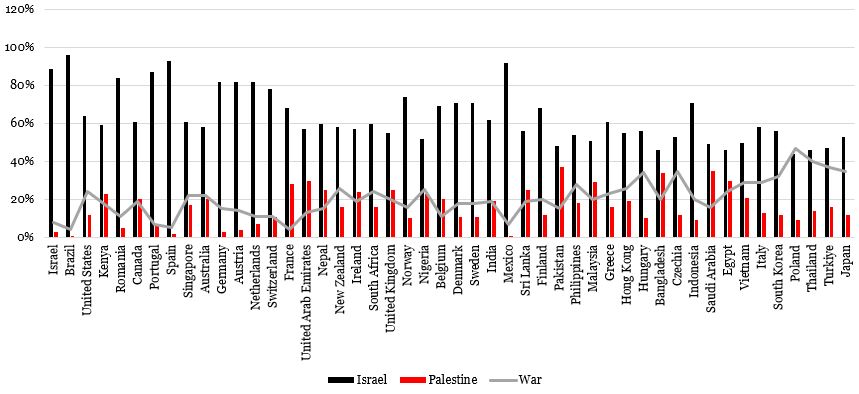
The search interest data between October 4 and October 11, 2023 (ended at 11:04 p.m.) highlights the disparities in global interest in the Israel-Palestine conflict. Unsurprisingly, Israel commands the highest level of interest within its borders, with a staggering 89% of search interest reflecting the conflict’s direct impact on the lives of Israeli citizens. Additionally, Brazil, a country geographically distant from the conflict, displays remarkable engagement at 96%, reflecting cultural connections and a significant Jewish community.

Exhibit 1: The linkage

Source: Google Trends, 2023; Infoprations Analysis, 2023

The Global Focus on “War” and Regional Interest

While the focus on the Israel-Palestine conflict varies, the concept of “war” garners significant attention globally, particularly in the United States, where it commands 24% of search interest. This underscores the historical role of the U.S. as a major player in international conflicts. Notably, the Middle East region demonstrates higher levels of interest in both Israel and Palestine, consistent with its geographical proximity and regional concerns. The United Arab Emirates, for instance, exhibits a substantial 30% interest in Palestine, emphasizing regional ties and commitment to the Palestinian cause. Our earlier analysis revealed a strong correlation: the more people in the countries (as seen in Exhibit 2) searched for information about Israel, the more they also showed interest in Palestine. Specifically, a 1% increase in interest in Israel corresponded to a 94% increase in interest in Palestine. When our analyst examined the inclusion of the topic of war alongside these two countries, it became evident that people in these countries demonstrated significant interest in both Israel and the concept of war. Notably, a 1% increase in their interest in Israel was associated with a 95% increase in their interest in war. Similarly, a 1% increase in interest in Palestine correlated with an 88% increase in interest in war.

Exhibit 2: Global search interest between October 4 and October 11, 2023

Source: Google Trends, 2023; Infoprations Analysis, 2023

Discrepancy in Interest: Israel vs. Palestine

The data reveals a significant discrepancy in global interest between Israel and Palestine, reflecting broader media coverage and international relations priorities. This imbalance can be viewed through the lens of global media coverage, raising questions about potential bias in global discussions surrounding the conflict.

Global Players in the Conflict

Understanding the dynamics of global interest in the Israel-Palestine conflict also requires examining the countries that actively support the involved parties. Currently, 84 countries express their support for Israel, including major players like the U.S., the UK, Australia, and a consortium of European nations. On the other hand, several countries, with Iran at the forefront, have rallied behind Hamas, the fundamentalist Islamic group that controls the Gaza Strip. This support takes the form of substantial financial and military assistance. Additionally, countries such as Qatar, Turkey, Lebanon, Syria, Yemen, Jordan, and the Arab League have showcased varying degrees of support for Hamas, which further complicates the resolution of the conflict.

Global Reactions to the Conflict

The ongoing Hamas-Israel conflict has prompted global reactions, with protests and demonstrations erupting in various countries, including Bahrain, Morocco, Turkey, Yemen, Tunisia, and Kuwait. These widespread protests championing Palestinian solidarity underscore the deep-seated concerns about the volatile situation in the region. Overall, the Israel-Palestine conflict continues to captivate the global stage, shaped by a myriad of factors, including regional dynamics, historical ties, and media coverage. Understanding the complexities of this enduring conflict is vital for fostering informed, balanced, and constructive dialogue, ultimately contributing to the pursuit of peace and stability in the region.

US State Regulators Intervenes in Coinbase’s Unregistered Securities Suit

0

The cryptocurrency exchange Coinbase is facing a legal challenge from U.S. state regulators who claim that it is offering unregistered securities to its customers. The regulators allege that Coinbase’s Lend program, which allows users to earn interest on certain digital assets, violates securities laws and poses risks to investors.

Coinbase announced the launch of Lend in June, promising to pay 4% annual percentage yield (APY) on deposits of the stablecoin USD Coin (USDC). The company said that Lend would not involve lending or borrowing, but rather a contractual agreement between Coinbase and its customers. Coinbase argued that Lend is not a security and does not require registration with the Securities and Exchange Commission (SEC) or any state regulator.

Coinbase Lend is a proposed service that would allow Coinbase customers to earn interest on their crypto assets by lending them to other users. According to Coinbase, the service would offer a 4% annual percentage yield (APY) on USD Coin (USDC), a stablecoin pegged to the U.S. dollar. Coinbase claims that the service would be secure, transparent, and easy to use, and that it would not involve any lockups or hidden fees.

However, the SEC disagreed and threatened to sue Coinbase if it proceeded with Lend. The SEC said that Lend involves an investment contract, which is a type of security, and that Coinbase failed to provide adequate disclosures and protections to investors. Coinbase responded by accusing the SEC of intimidation and lack of clarity and said that it would delay the launch of Lend until October.

On October 1, the Texas State Securities Board also issued a cease-and-desist order to Coinbase, alleging that Lend is a fraudulent scheme that violates Texas securities laws. The order said that Coinbase is misleading investors by claiming that Lend is not a security and by promising unrealistic returns. The order also said that Coinbase is exposing investors to potential losses due to hacking, theft, market volatility, and regulatory actions.

Coinbase has not yet responded to the state regulators’ orders, but it has previously stated that it will cooperate with any inquiries and defend its position in court if necessary. Coinbase has also said that it believes that Lend is in the best interest of its customers and that it will continue to innovate in the crypto space.

The SEC has not publicly explained its reasoning, but it has reportedly sent Coinbase a Wells notice, which is a formal notification that the agency intends to sue the company unless it changes its plans or convinces the SEC otherwise. The SEC likely views Coinbase Lend as a security because it involves an investment of money in a common enterprise with an expectation of profit from the efforts of others. This is the definition of an investment contract, which is one of the types of securities regulated by the SEC under the Securities Act of 1933.

The Securities and Exchange Commission’s action against one of the country’s biggest crypto exchanges has been seen as existential for the future of crypto in the United States, with the sector accusing the agency of regulating by enforcement in the absence of new laws from the U.S. Congress. Now, three new amicus briefs, which allow parties who are interested but not directly affected by the case to aid the court’s reasoning, argue crypto is neither significant nor special, and that the SEC can take on digital assets under existing law.

Meanwhile, several state regulators have also taken action against Coinbase’s Lend program. On September 28, the New Jersey Bureau of Securities issued a cease-and-desist order to Coinbase, ordering it to stop offering Lend to New Jersey residents. The order said that Lend is an unregistered security and that Coinbase has not provided sufficient information about the risks and benefits of the program.

For Coinbase, it could face fines, injunctions, and reputational damage, as well as potential delays or cancellations of its future products and services. For the crypto industry, it could signal a more aggressive regulatory stance from the SEC, which could affect other crypto lending platforms, decentralized finance (DeFi) protocols, and stablecoins.

It could also create more uncertainty and confusion for crypto investors and developers, who may face more legal risks and compliance costs. Coinbase has publicly denied any wrongdoing and accused the SEC of being unfair and hostile to innovation. The company has also published a blog post and a tweet thread detailing its interactions with the SEC and explaining why it believes Coinbase Lend is not a security.

Bitcoin Cash, OpenAI, Ethereum Foundation, Arkham and other Crypto News

0

Bitcoin Cash, the cryptocurrency that emerged as a result of a hard fork from Bitcoin in 2017, experienced a significant increase in liquidity in the third quarter of 2023. According to a report by CryptoCompare, the average daily trading volume of Bitcoin Cash rose by 53% from Q2 to Q3, reaching $1.6 billion. This was the highest growth rate among the top 10 cryptocurrencies by market capitalization.

The report attributed this surge to several factors, such as the adoption of Bitcoin Cash by payment platforms like BitPay and GoCrypto, the launch of a Bitcoin Cash-based decentralized exchange called Detoken, and the increased interest from institutional investors and hedge funds.

OpenAI and ChatGPT CEO Sam Altman expressed his support for Bitcoin, the leading cryptocurrency by market capitalization. He said that Bitcoin is a “superlogical and important step on the technology tree” that enables decentralized and trustless transactions. He also praised the innovation and resilience of the Bitcoin network, which has been running for over a decade without any major disruptions. Altman said that he believes that Bitcoin has a bright future and that it will play a key role in the evolution of the digital economy.

Arkham and Chainlink brings Arkham Data On-Chain; Chainlink Functions will provide developers with seamless on-chain access to Arkham’s labeling endpoint, which is the part of our API that takes a blockchain address as input, references our database, and then outputs any applicable intelligence from the Arkham database, namely, the real-world owner of the address.

Making our labeling endpoint data available onchain through Chainlink Functions makes it simple for Web3 application developers to easily incorporate Arkham data into their dApps – unlocking a new frontier of use cases, Miguel CEO and founder of Arkham wrote in a newsletter to investors and community members.

According to Fidelity, a leading asset manager with $4.5 trillion under management, Bitcoin is the most secure, decentralized and sound form of digital money in the market. Unlike other digital assets that rely on centralized authorities, intermediaries or validators, Bitcoin is powered by a distributed network of nodes and miners that ensure its immutability, scarcity and censorship-resistance. Fidelity argues that these properties make Bitcoin a superior store of value and a hedge against inflation and currency debasement.

In a surprising move, Bitcoin presidential candidate RFK Jr. announced that he is leaving the Democratic Party and launching an independent bid for the White House. The son of the late Robert F. Kennedy said he was disillusioned with the party’s stance on cryptocurrency regulation and civil liberties, and that he wanted to offer a third option to the American voters.

He also criticized the two-party system as corrupt and rigged and vowed to run a grassroots campaign funded by Bitcoin donations. RFK Jr. is a well-known activist and lawyer who has championed causes such as environmental protection, vaccine safety and human rights. He is also a vocal critic of the mainstream media and the pharmaceutical industry. He said he hopes to attract support from across the political spectrum, especially from young and tech-savvy voters who are dissatisfied with the status quo.

The US Securities and Exchange Commission (SEC) has launched an investigation into a security breach that affected Twitter in the weeks before the social media giant was acquired by Elon Musk. The breach, which occurred in late September, exposed the personal data of millions of Twitter users and allowed hackers to post unauthorized tweets from several high-profile accounts, including Musk’s. The SEC is looking into whether the breach had any impact on the valuation of Twitter or the terms of the deal, which was announced on October 2 and valued at $40 billion.

The SEC is also probing whether Twitter disclosed the breach in a timely and adequate manner, as required by federal securities laws. Twitter has said that it is cooperating with the SEC and other authorities, and that it has taken steps to improve its security and prevent future attacks. Musk, who is the CEO of Tesla and SpaceX, has said that he bought Twitter to make it a platform for “positive and constructive dialogue” and to support his vision of a multi-planetary civilization.

In a recent transaction, the Ethereum Foundation transferred 1,700 ETH from its treasury to a stablecoin exchange. The foundation received $2.74 million USDC in return, which is equivalent to the current market value of ETH at the time of the trade. The move is part of the foundation’s ongoing efforts to diversify its assets and ensure its long-term sustainability. The foundation has not disclosed its plans for the USDC funds, but it is likely that they will be used for supporting the development and innovation of the Ethereum ecosystem.

US Debt Rose by $1.2 Billion Per Hour in Past Days

0

The US debt crisis has reached a new level of severity, as the latest data shows that the federal government has been borrowing an average of $1.2 billion per hour for the past 19 days. This means that the national debt has increased by more than $22.8 billion per day, or $456 billion in total, since September 22, when the debt limit was reached.

The debt limit, also known as the debt ceiling, is the legal limit on how much the US Treasury can borrow to fund the government’s spending and obligations. Congress has to periodically raise the debt limit to avoid a default, which could have catastrophic consequences for the global economy and financial markets.

However, Congress has been unable to agree on a bipartisan solution to raise the debt limit, as Republicans have refused to cooperate with Democrats, who control both chambers of Congress and the White House. Republicans have argued that Democrats should use a special budget process called reconciliation to raise the debt limit on their own, without Republican votes. Democrats have rejected this option, saying that raising the debt limit is a shared responsibility that should not be politicized.

As a result of this impasse, the US Treasury has been using extraordinary measures to keep paying the government’s bills and avoid a default. These measures include suspending investments in federal retirement funds, postponing payments to state and local governments, and drawing down cash reserves. However, these measures are not enough to cover the government’s spending gap, which is why the Treasury has been borrowing at an unprecedented rate.

According to the Treasury Department, these extraordinary measures will run out by October 31, which means that the US will face a default if Congress does not raise the debt limit by then. A default would mean that the US would not be able to pay its creditors, its employees, its social security beneficiaries, its military personnel, and its contractors. It would also mean that the US would lose its AAA credit rating, which could trigger higher interest rates, lower economic growth, and higher inflation.

The US debt crisis is not only a domestic problem, but also a global one. The US dollar is the world’s reserve currency, and US Treasury bonds are considered the safest and most liquid assets in the world. A default by the US would undermine confidence in the dollar and in the global financial system, potentially causing a panic and a contagion effect across countries and markets.

Therefore, it is imperative that Congress acts swiftly and responsibly to raise the debt limit and avoid a default. The US cannot afford to jeopardize its economic recovery and its global leadership by playing political games with its creditworthiness. The US debt crisis is not a game, but a serious threat that must be resolved as soon as possible.

Binance’s $1B Crypto Recovery Fund deployed less than $30M.

Binance, the world’s largest cryptocurrency exchange by trading volume, has been on a mission to recover stolen or lost crypto assets from various hacking incidents. The company launched a $1 billion fund in July 2021 to support this effort, as well as to foster innovation and collaboration in the crypto industry. However, according to a recent report by Bloomberg, the fund has only deployed less than $30 million so far, raising questions about its effectiveness and transparency.

The report cites anonymous sources familiar with the matter, who claim that Binance has only used the fund to reimburse victims of two major hacks: the Poly Network hack in August 2021, which resulted in $610 million worth of crypto being stolen, and the BitMart hack in December 2021, which saw $196 million worth of crypto being taken.

Binance reportedly contributed $10 million and $15 million respectively to these cases, as well as some smaller amounts to other incidents. The sources also allege that Binance has not disclosed how the fund is managed, who is in charge of it, or how it decides which cases to support.

Binance has not commented on the report or confirmed the figures. However, the company has previously stated that the fund is not a charity, but a strategic investment vehicle that aims to enhance the security and sustainability of the crypto ecosystem. Binance has also said that the fund is open to partnering with other industry players, such as law enforcement agencies, security firms, and other exchanges, to track down and recover stolen funds.

The fund is part of Binance’s broader efforts to improve its reputation and compliance amid increasing regulatory scrutiny and pressure from authorities around the world. The exchange has faced bans, warnings, investigations, and lawsuits in several jurisdictions over its operations, services, and products. Binance has also hired several former regulators and experts to bolster its legal and compliance teams and has pledged to cooperate with regulators and follow local laws.

However, some critics argue that Binance’s actions are too little, too late, and that the exchange is still operating in a gray area without proper oversight or accountability. They also point out that Binance’s recovery fund may not be enough to cover the potential losses from future hacks or scams, given the growing size and complexity of the crypto market. Moreover, they question whether Binance’s fund is truly altruistic or motivated by self-interest, as it may benefit from boosting its own image and customer loyalty.