DD
MM
YYYY

PAGES

DD
MM
YYYY

spot_img

PAGES

Home Blog Page 3757

Why Does Bitcoin Use Energy?

0

Bitcoin is a decentralized digital currency that operates on a network of computers around the world. Unlike traditional currencies, bitcoin does not rely on a central authority or intermediary to validate transactions and issue new coins. Instead, bitcoin uses a system called proof-of-work, where participants (called miners) compete to solve complex mathematical puzzles and earn rewards in the form of new bitcoins and transaction fees.

Bitcoin, the most popular cryptocurrency, has been hailed as a revolutionary innovation that could transform the global economy. But there is a dark side to this digital gold: its enormous energy consumption. According to the Cambridge Bitcoin Electricity Consumption Index, Bitcoin consumes more electricity than many countries, such as Argentina, Sweden, or the Netherlands. In fact, if Bitcoin were a country, it would rank 25th in the world in terms of electricity usage.

Mining is also how new bitcoins are created and distributed. The first node that solves a puzzle gets rewarded with a certain number of bitcoins. This creates an incentive for more people to join the network and compete for the rewards. However, as more nodes join, the puzzles become harder and harder to solve, requiring more and more energy.

Proof-of-work is a way of ensuring that the transactions recorded on the bitcoin ledger (called the blockchain) are valid and irreversible. It also makes it difficult for anyone to manipulate or attack the network, as they would need to control more than half of the computing power (called the hash rate) to do so. This is known as the 51% attack problem.

However, proof-of-work also has a downside: it consumes a lot of energy. According to some estimates, the annual energy consumption of the bitcoin network is comparable to that of some countries, such as Argentina or Norway. This raises concerns about the environmental impact of bitcoin, especially as its price and popularity increase.

Why does proof-of-work use so much energy? The answer lies in the difficulty adjustment mechanism, which ensures that the average time between blocks (the units of data that make up the blockchain) is about 10 minutes. As more miners join the network and increase the hash rate, the puzzles become harder to solve, and vice versa. This means that the network always adjusts to maintain a constant level of difficulty and energy consumption, regardless of how many miners are active.

The difficulty adjustment mechanism is essential for the security and stability of the bitcoin network, but it also means that there is no limit to how much energy it can use. As long as there is an incentive for miners to participate (i.e., they can make a profit from mining), they will continue to invest in more powerful and efficient hardware and consume more electricity. This creates a positive feedback loop that drives up the energy demand of bitcoin.

There are some ways to reduce the energy consumption of bitcoin, such as using renewable sources of electricity, improving the efficiency of mining hardware, or switching to a different consensus mechanism, such as proof-of-stake, where participants stake their coins instead of using their computing power. However, these solutions are not without challenges and trade-offs, and they would require significant changes to the protocol and the network.

Bitcoin uses energy because it relies on proof-of-work to secure and maintain its decentralized network. This is a fundamental feature of its design, but also a major source of criticism and controversy. Whether the benefits of bitcoin outweigh its costs is a matter of debate and perspective.

Bitcoin is undoubtedly a remarkable innovation that has many benefits and potentials. But it also poses a serious threat to the environment and the climate. As Bitcoin enthusiasts and investors, we have a responsibility to be aware of this issue and to seek ways to mitigate it. Otherwise, we may end up paying a high price for our digital wealth.
Digital jobs from Apple, Google and Intel are Beckoning, says President Ruto

0

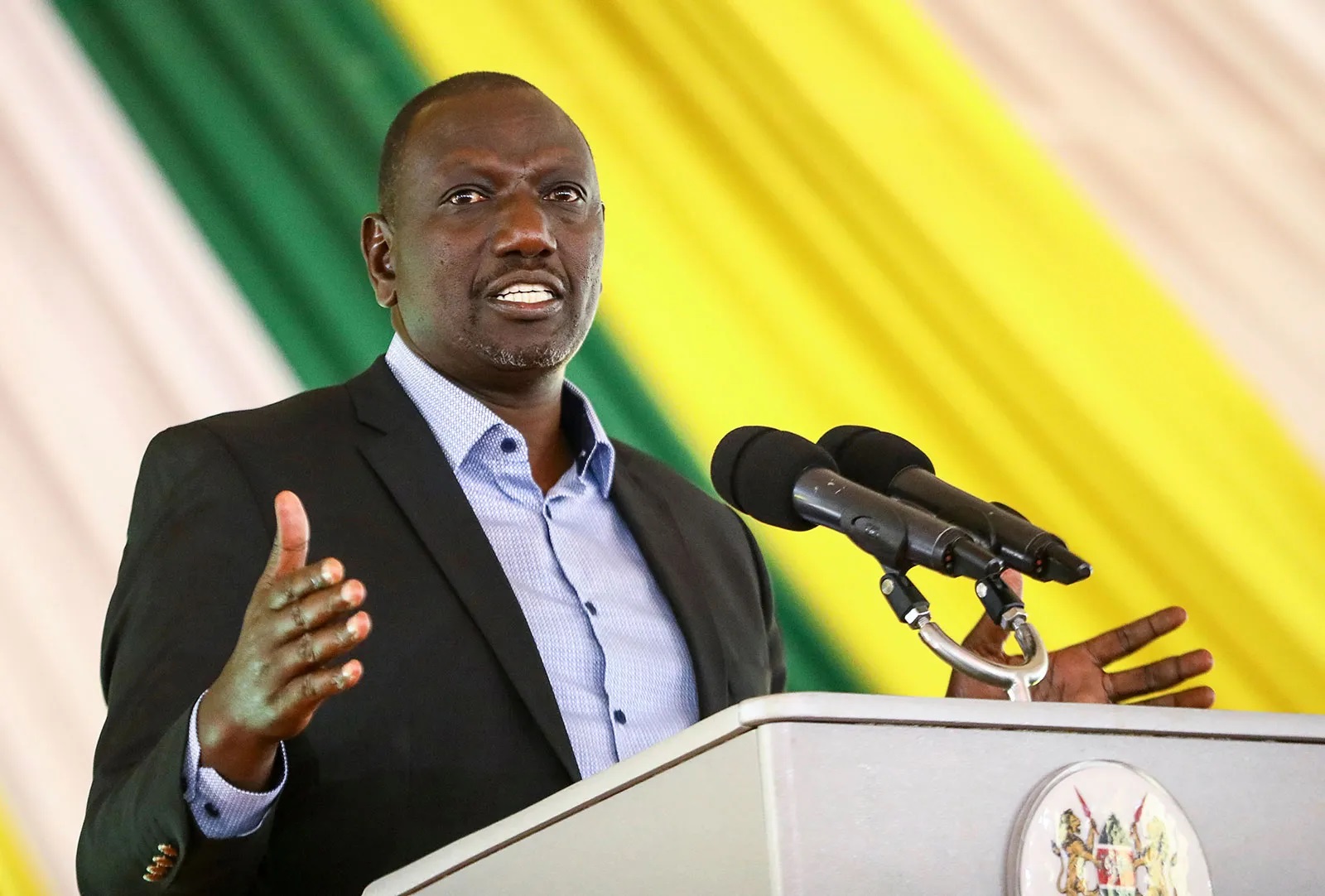
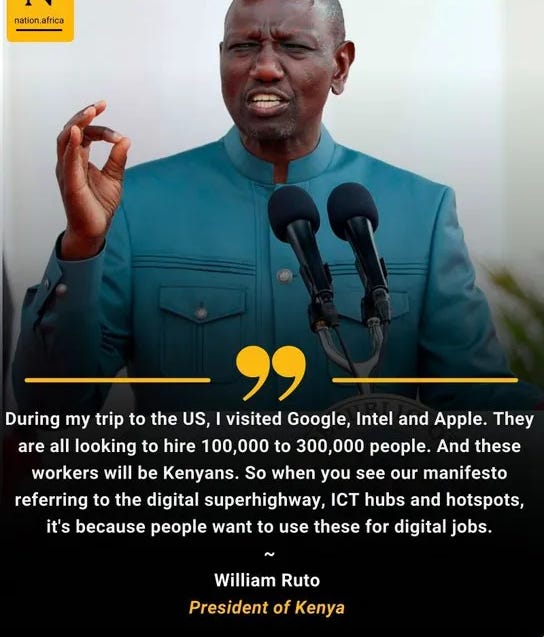
In a recent interview with the BBC, President William Ruto of Kenya revealed his ambitious plan to create millions of digital jobs for the youth in his country. He said that he has been in talks with some of the world’s leading tech companies, such as Apple, Google and Intel, to invest in Kenya and provide training and employment opportunities for the young generation.

Digital transformation is the process of using technology to improve the efficiency, effectiveness and accessibility of various services and sectors. It is a key component of Ruto’s vision for Kenya, as he aims to create a more prosperous, inclusive and innovative nation. In this blog post, we will explore some of the benefits of Ruto’s digital transformation agenda to Kenyans.

President Ruto said that he believes that Kenya has the potential to become a hub for innovation and technology in Africa, and that he wants to harness the talent and creativity of the Kenyan people. He said that he has been inspired by the success stories of other African countries, such as Rwanda and Ghana, that have embraced digital transformation and attracted foreign investment.

One of the main benefits of digital transformation is that it can enhance the delivery of public services, such as health, education, agriculture and security. By leveraging technologies such as cloud computing, artificial intelligence, blockchain and internet of things, Ruto plans to improve the quality, affordability and availability of these services to all Kenyans. For example, he intends to implement a universal health coverage scheme that will use digital platforms to register, verify and monitor beneficiaries, as well as to facilitate payments and claims.

He also wants to digitize the education system by providing online learning materials, digital libraries and smart classrooms. Additionally, he aims to modernize the agriculture sector by using drones, sensors and big data to optimize crop production and market access. Furthermore, he hopes to enhance the security and safety of Kenyans by deploying smart surveillance systems, biometric identification and e-government services.

Another benefit of digital transformation is that it can boost the economic growth and development of Kenya. By embracing technology, Ruto wants to create a more competitive, productive and diversified economy that can generate more jobs, income and opportunities for Kenyans. He envisions a digital economy that will support various sectors such as manufacturing, tourism, trade and finance. For instance, he plans to establish a digital industrial park that will host local and international technology companies and startups.

He also intends to promote digital tourism by creating online platforms that will showcase Kenya’s attractions and culture. Moreover, he aims to facilitate digital trade by simplifying customs procedures and reducing transaction costs. Additionally, he hopes to foster digital finance by enabling mobile money interoperability and expanding financial inclusion.

A third benefit of digital transformation is that it can foster social cohesion and empowerment among Kenyans. By adopting technology, Ruto wants to create a more connected, informed and engaged society that can participate in decision-making and governance processes. He believes that digital transformation can enhance democracy, transparency and accountability in Kenya. For example, he proposes to use social media and other online platforms to communicate with Kenyans and solicit their feedback on various issues. He also plans to implement an e-voting system that will allow Kenyans to cast their ballots electronically. Furthermore, he aims to empower marginalized groups such as women, youth and persons with disabilities by providing them with digital skills, tools and opportunities.

Apple is looking for senior software engineers to work on its iCloud platform. You will be responsible for designing, developing and maintaining scalable and reliable cloud services that power millions of devices and applications. You should have at least five years of experience in developing distributed systems using Java, C++, Python or similar languages, as well as a strong knowledge of cloud computing technologies, such as AWS, Azure or GCP.

Google is seeking data scientists to join its Google Cloud team. You will be working on cutting-edge projects that leverage Google’s massive data and computing resources to solve real-world problems for customers and partners. You should have a PhD or equivalent degree in computer science, statistics, mathematics or a related field, as well as a proven track record of conducting original research and publishing papers in top-tier journals or conferences.

Intel is hiring product managers to lead its artificial intelligence (AI) products portfolio. You will be defining the vision, strategy and roadmap for Intel’s AI products, such as processors, accelerators, software frameworks and tools. You should have at least three years of experience in product management or related roles, as well as a deep understanding of AI technologies, markets and trends.

Ruto said that he is aware of the challenges and risks that come with digitalization, such as cybercrime, data privacy and digital divide. He said that he is committed to ensuring that the digital economy is inclusive, secure and sustainable, and that he will work with the relevant stakeholders to develop policies and regulations that protect the rights and interests of the citizens.

President Ruto said that he hopes that his vision for a digital Kenya will inspire other African leaders to follow suit and join the global digital revolution. He said that he is confident that by working together, Africa can achieve its full potential and become a force for good in the world.

Floating the Naira is a Prudent Economic Strategy for Nigeria

0

Floating the Naira means allowing the exchange rate to be determined by market forces, rather than by a fixed peg to the US dollar or a basket of currencies. While this may seem appealing to some, as it would reflect the true value of the Naira and potentially attract more foreign investment, it also comes with significant risks and challenges.

First, floating the Naira would expose the economy to more volatility and uncertainty, as the exchange rate would fluctuate depending on supply and demand, as well as external shocks and speculations. This could lead to inflation, capital flight, currency crises, and reduced competitiveness of domestic industries.

Moreover, floating the Naira would require a strong and independent central bank that can effectively manage the monetary policy and intervene in the market when necessary. However, Nigeria’s central bank has been subject to political interference and pressure from various interest groups, which could undermine its credibility and autonomy.

Second, increasing production before considering floating the Naira would help diversify the economy and reduce its dependence on oil exports, which account for about 90% of foreign exchange earnings and 60% of government revenue. By boosting the non-oil sectors, such as agriculture, manufacturing, services, and tourism, Nigeria could create more jobs, increase income, improve trade balance, and enhance resilience to external shocks. Increasing production would also increase the demand for foreign exchange, which would appreciate the Naira and make it more stable and attractive.

Why is floating the naira important? Because it will reflect the true state of the economy and send the right signals to the policymakers and the private sector. A fixed exchange rate regime, as Nigeria currently has, creates distortions and inefficiencies in the allocation of resources. It also encourages rent-seeking and corruption, as some privileged individuals and groups can access foreign exchange at subsidized rates, while others have to pay a premium in the parallel market.

A floating exchange rate regime, on the other hand, will eliminate these distortions and create a level playing field for all economic actors. It will also force the government to adopt more prudent fiscal and monetary policies, as it will no longer be able to rely on depleting the foreign exchange reserves to defend the naira.

However, floating the naira alone is not enough. It has to be accompanied by other structural reforms that will enhance the competitiveness and resilience of the Nigerian economy. These include improving the business environment, investing in infrastructure, diversifying the export base, promoting innovation and entrepreneurship, strengthening the financial sector, and enhancing human capital development. These reforms will help Nigeria to reduce its dependence on oil revenues, increase its non-oil exports, attract more foreign direct investment, and create more value-added activities in the economy.

Therefore, I argue that increasing production before considering floating the Naira is a sensible and sustainable approach to achieve economic growth and development in Nigeria. Floating the Naira should not be seen as an end in itself, but as a means to an end. It should only be considered when the economy is ready and prepared for it, with adequate institutional capacity, fiscal discipline, monetary credibility, and structural reforms.

Nature of Reality vs Future of Humanity

0

Reality is not a fixed or objective thing, but a dynamic and subjective process. Reality is not something that exists independently of us, but something that we co-create with our senses, cognition, emotions, culture, and technology. Reality is not something that we passively observe, but something that we actively participate in.

This means that reality is not a given, but a choice. We can choose to accept the reality that is presented to us by our biological and social conditioning, or we can choose to create our own reality by using our imagination, creativity, and technology. We can choose to conform to the reality that is imposed on us by external forces, or we can choose to challenge and transform the reality that is limiting us.

One of the most influential views on the nature of reality is the materialist or physicalist view, which holds that reality is composed of matter and energy, and that everything can be explained by the laws of physics. According to this view, there is no room for anything supernatural, spiritual, or metaphysical in reality. Everything that exists, including our minds and consciousness, is ultimately reducible to physical processes and interactions.

The materialist view has been challenged by various alternative views, such as idealism, dualism, panpsychism, and quantum mechanics. These views propose that reality is not just physical, but also mental, spiritual, or probabilistic. They suggest that there are aspects of reality that transcend or escape the physical realm, such as the nature of consciousness, free will, or quantum entanglement.

The nature of reality has profound implications for the future of humanity. Depending on how we understand reality, we may have different visions and goals for our collective evolution. For example, if we adopt a materialist view, we may seek to enhance our physical capabilities and intelligence through technology, such as artificial intelligence, biotechnology, or nanotechnology. We may also try to colonize other planets or explore the multiverse.

On the other hand, if we adopt an alternative view, we may seek to develop our spiritual or mental potential through meditation, psychedelics, or mysticism. We may also try to connect with other forms of consciousness or dimensions of reality. We may value the quality of our experience more than the quantity of our knowledge or power.

The future of humanity depends on how we choose to shape our reality. If we choose to remain passive and complacent, we risk losing our agency and autonomy in a world that is increasingly dominated by powerful algorithms, corporations, and governments. If we choose to be active and curious, we have the potential to unleash our full potential and explore new horizons of possibility.

The future of humanity also depends on how we choose to relate to other realities. If we choose to be isolated and fearful, we risk becoming alienated and hostile in a world that is increasingly diverse and interconnected. If we choose to be open and compassionate, we have the opportunity to learn from and collaborate with other beings, both human and non-human.

The nature of reality vs the future of humanity is not a binary opposition, but a dialectical relationship. The way we perceive, and construct reality influences the way we envision and create the future. The way we imagine and pursue the future affects the way we experience and modify reality.

Therefore, we need to be mindful and responsible for both. We need to be aware of how our reality is shaped by our biases, assumptions, and expectations. We need to be critical of how our reality is manipulated by external forces that may not have our best interests at heart. We need to be creative in how we design our reality to reflect our values, goals, and dreams.

We also need to be curious and visionary about the future. We need to be informed by the latest scientific discoveries and technological innovations. We need to be inspired by artistic expressions and cultural diversity. We need to be engaged in the social movements and ethical debates. The nature of reality vs the future of humanity is not a problem to be solved, but a challenge to be embraced. It is an invitation to explore ourselves and our world in new ways. It is an opportunity to create ourselves and our world anew.

The nature of reality vs the future of humanity is not a simple dichotomy, but a complex and dynamic interplay. There may be elements of truth in both perspectives, and we may need to integrate them in a holistic and balanced way. Ultimately, the nature of reality and the future of humanity are not separate questions, but one question: what is the meaning and purpose of our existence?

LinkedIn Unveils New AI Features to Enhance Recruiting, Marketing, And Learning on The Platform

0

Social networking platform for job seekers, professionals, and businesses, LinkedIn has rolled out a slate of new AI features to enhance the platform’s usability.

Recently, the social network introduced a trio of Artificial Intelligence (AI) tools designed to optimize companies’ marketing, recruiting, sales, and employee coaching efforts.

The first AI tool recently debuted is called ‘Accelerate’. This tool according to LinkedIn is rolled out for Campaign Managers, which is an existing service that marketers can use to launch ad campaigns on the social network.

Accelerate uses AI to automatically generate ad campaigns complete with marketing copy and visuals.

The tool also suggests audiences that a brand’s advertisements should target. To activate the tool, marketers only have to enter a link to a web page that describes the products they wish to promote.

Accelerate was rolled out alongside a second new AI tool called ‘Recruiter 2024’. Just as the name suggests, this tool is designed to assist human resources professionals in easily finding the right candidates for a job opening

To search for potential applicants, all that is required for recruiters is to enter the natural language instructions into a chatbot-like interface. For instance, a recruiter seeking to hire software developers can type “find software developers”, and they will be presented with a list of potential candidates.

LinkedIn noted that the tool’s natural language interface not only makes writing search queries easier but also allows users to find more relevant candidates than before. 

Knowing fully well that Recruiters have a tough job in hiring the right candidates, the rollout of this tool will eliminate some of the challenges recruiters face, by simplifying the sourcing experience and improving the precision of search to help find relevant candidates.

The third AI tool that LinkedIn recently unveiled is the Learning service, which provides access to employee training courses and other educational materials. The new tool aims to provide what the Microsoft unit describes as an “AI-powered coaching experience.”

It allows users to ask a question about a certain business topic, such as launching marketing projects, and receive guidance in a natural language format. The tool is launching with an initial focus on two areas: leadership and management.

Furthermore, it’s capable of highlighting educational resources on LinkedIn Learning that answer the user’s question in more detail.

It is worth noting that LinkedIn is currently piloting its new AI features with a limited number of customers. The company plans to make the features more broadly available later this year.

The professional networking site will gradually roll out its first features, intended to streamline and simplify how recruiters find candidates on the site, between October 2023 and April 2024, and expects to announce more rollouts again in April.