DD
MM
YYYY

PAGES

DD
MM
YYYY

spot_img

PAGES

Home Blog Page 3772

Will Scorpion Casino’s (SCORP) Presale Match Polkadot (DOT) and Avalanche’s (AVAX) Successes?

0

As the crypto world twists and turns, the competition intensifies. In the spotlight today are Scorpion Casino’s (SCORP) presale, Polkadot (DOT), and Avalanche (AVAX). The burning question on every investor’s mind: Can Scorpion Casino’s presale compete the successes of Polkadot and Avalanche? Let’s delve into the dynamics of these cryptocurrencies, catering to readers seeking the next big crypto investment.

Polkadot (DOT): Bridging the Gaps in Blockchain Networks

Polkadot, recognized for its interoperability prowess, has become a leading player in the crypto arena. Its vision of connecting different blockchains seamlessly positions DOT as a leader for investors eyeing long-term growth. As the crypto market inches closer to the $2 trillion mark, Polkadot’s success becomes a benchmark for others to measure up to.

Avalanche (AVAX): Scaling New Heights with Consensus

Avalanche, with its unique consensus mechanism, stands out in the crypto landscape. Its ability to scale dynamically and provide an open platform for decentralized applications (DApps) has attracted considerable attention. As the global crypto market cap expands, AVAX’s performance indicates a growing appetite for unique solutions and scalability.

Scorpion Casino (SCORP): Merging Finance with Entertainment

In the midst of blockchain progress, Scorpion Casino emerges as a distinctive player, fusing finance and entertainment seamlessly. The SCORP presale, already amassing an impressive $4.3 million. Beyond the financial potential, Scorpion Casino offers an immersive online gaming platform, diversifying its appeal for investors seeking more than just monetary gains.

SCORP’s Gateway to Success

Scorpion Casino is gearing up for the final stages of its presale. This strategic move positions SCORP as a potential game-changer, offering investors a gateway to high returns.

The collaboration with influencers, daily staking rewards, and the imminent exchange listing reveal on February 15th add layers of anticipation, making SCORP an attractive prospect for those aiming to ride the crypto wave.

Explore SCORP’s Potential in the Final Presale Phase

As the crypto world is in the green, readers are encouraged to explore the Scorpion Casino presale and seize the opportunity to be part of a unique convergence of blockchain and gambling. The impending exchange listing reveal adds an element of anticipation, making it an opportune moment for investors to act.

As the global crypto market cap approaches unprecedented levels, Scorpion Casino emerges as a rising star. The potential for high returns coupled with a fusion of finance and entertainment positions SCORP favorably against the backdrop of Polkadot and Avalanche. The final presale phase marks a crucial juncture, inviting investors to witness the ascendancy of Scorpion Casino in the vast crypto constellation.


To learn more and invest in the Scorpion Casino presale, visit:

Presale: https://presale.scorpion.casino/

Twitter: https://twitter.com/ScorpionCasino

Telegram: https://t.me/scorpioncasino_official
Microsoft and OpenAI warn of Hackers’ Exploitation of AI Tools, Raising Concerns for Future AI Development

0

Microsoft and OpenAI have revealed a troubling trend: hackers are leveraging advanced AI models such as ChatGPT to refine and intensify their cyber assaults.

This revelation, made today, illuminates how malicious actors from Russia, North Korea, Iran, and China are leveraging cutting-edge technology to bolster their nefarious activities.

Recent research indicates that these adversaries are utilizing AI tools like ChatGPT for a myriad of purposes, spanning from reconnaissance of targets and optimization of scripts to the development of sophisticated social engineering tactics.

Microsoft sounded the alarm in a blog post, cautioning, “Cybercrime groups, nation-state threat actors, and other adversaries are exploring and testing different AI technologies as they emerge, in an attempt to understand potential value to their operations and the security controls they may need to circumvent.”

Among the identified groups, the infamous Strontium, affiliated with Russian military intelligence and notorious for its involvement in high-profile cyber intrusions, has been observed employing AI models to decode satellite communication protocols and refine technical operations. This group, also known as APT28 or Fancy Bear, gained notoriety for its interference in political affairs, including the targeting of Hillary Clinton’s presidential campaign in 2016.

Similarly, North Korean hackers operating under the alias Thallium have been leveraging AI models to exploit publicly reported vulnerabilities, streamline scripting tasks, and craft deceptive content for phishing campaigns. Meanwhile, the Iranian group Curium has been deploying AI to generate convincing phishing emails and evade detection by antivirus software.

Chinese state-affiliated hackers have also joined the fray, employing AI for diverse purposes such as research, scripting, translations, and tool enhancement.

The emergence of AI-powered cyberattacks has reverberated concerns throughout the cybersecurity community. The utilization of AI tools like WormGPT and FraudGPT has facilitated the creation of malicious emails and cracking tools, posing a significant threat to cybersecurity defenses.

Acknowledging the gravity of the situation, Microsoft and OpenAI have intensified efforts to counteract these malicious activities. While significant attacks leveraging AI models have not yet been detected, the companies remain vigilant, promptly shutting down associated accounts and assets.

In response to the escalating threat, Microsoft is spearheading innovative solutions that leverage AI to fortify cybersecurity defenses. Homa Hayatyfar, principal detection analytics manager at Microsoft, noted, “AI can help attackers bring more sophistication to their attacks, and they have resources to throw at it… we use AI to protect, detect, and respond.”

However, the increasing exploitation of AI tools by hackers raises concerns about the potential ramifications for the future development of artificial intelligence. The misuse of AI for malicious purposes could undermine public trust and support for AI technologies, leading to increased scrutiny and regulatory measures that could stifle innovation in the field.

Microsoft is at the forefront of developing a Security Copilot, an AI assistant tailored for cybersecurity professionals to swiftly identify breaches and navigate the deluge of data generated by cybersecurity tools.

Furthermore, in light of recent Azure cloud attacks and espionage incidents involving Russian hackers, Microsoft is undertaking a comprehensive overhaul of its software security infrastructure, underscoring the imperative of bolstering defenses against evolving cyber threats.

The company has warned of future use cases like voice impersonation, underlining the potential escalation of AI-powered cyberattacks to other areas of the technology.

“AI-powered fraud is another critical concern. Voice synthesis is an example of this, where a three-second voice sample can train a model to sound like anyone,” says Microsoft. “Even something as innocuous as your voicemail greeting can be used to get a sufficient sampling.”

OpenAI is testing a feature that will allow ChatGPT to remember certain information from one conversation to the next, the company said Tuesday. The chatbot will also be able to decide which parts of the conversations it should remember. The memory option will be available to hundreds of thousands of users at first; OpenAI will gather feedback before rolling it out more widely, the company told Bloomberg. Personalizing the user experience in this way can be an effective method for retaining customers, suggested the news site.

Users will be notified if they have access to the memory trial, and will be able to delete some or all of the saved information, or turn off the option entirely, OpenAI said. (LinkedIn News)

How Lean Principles Improve Supply Chain

0

He is a zen-master with deep capabilities on supply chain and logistics. An alum of DHL, UPS (Global Manager – Industrial Engineering EUD – Global Logistics), etc, he knows all the critical elements for a world-class supply chain framework.

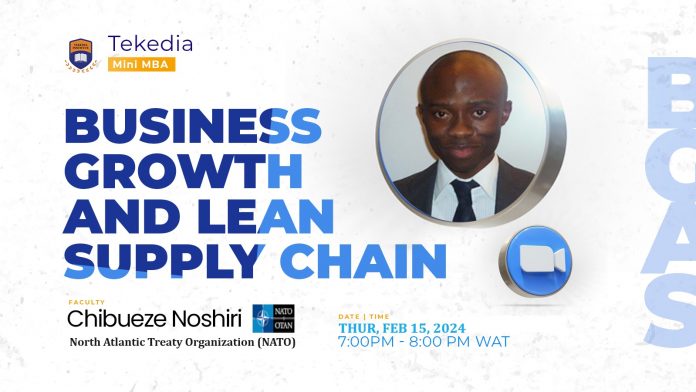
Good People, join us tomorrow at Tekedia Mini-MBA as we discuss supply chain. Our faculty, Chibueze Noshiri, from NATO Luxembourg, will explain how lean principles can improve supply chain systems, and advance business operations. Zoom link in the Board  .

Tekedia Institute Mini-MBA >> our mission is your Business Growth, your Career Growth.

Beyond A National Commodity Board To Regulate Food Prices, Nigeria Could Have a Lost Decade

1

I was still in secondary school when he was president, and as a village kid in Ovim, my problem was never food. You were guaranteed one loaf of Ezioma bread (15 kobo) in the morning. On the days after the main Oriendu Market, you could upgrade to Our Society bread. Our Society bread was “imported” from Enugu, from the bakery of Chief Umunna who never forgot his village even though he was serving Enugu people.

Fact be fact, even though I did not technically understand his many playbooks, but by reading books, I can extrapolate that IBB (Babangida) was a good operator even though he scaled many bad things in Nigeria. Besides playing roles in the construction of many core infrastructures in the nation, IBB did something history will remember him. He messed up with SAP but in the 1990s, in the bid to recover, he liberated the banking sector.

Today, from GTBank to Zenith Bank, Access to modern UBA, and beyond, some of the leading banks in Nigeria were created within 1989 to 1993, and a policy framework made that possible. Check data, banking powered the 1990s and early 2000s in Nigeria’s economy before telecoms took over in the mid 2000s.

So, we have a deal as Nigeria works to overcome a potential lost decade, what can the nation do? It may be time to revisit whatever IBB did in the 1990s. Can someone replicate the bounded financialization of Nigeria he engineered in agriculture? Can someone pick healthcare? What of education? I mean with the right policies, these sectors can grow, boom and advance Nigeria.

That would be a better plan than creating a bureaucracy just to regulate food prices: “In a bid to combat the persistent rise in food prices and ensure food security, Nigeria’s Federal Government has unveiled plans to establish a National Commodity Board…The National Commodity Board will be tasked with assessing and regulating food prices while maintaining strategic reserves of essential grains and other food items to stabilize prices.” This first part could have a negative impact on the market; the second part is good policy.

Good People, we know the reasons why food prices are up and they’re mainly because of insecurity and weakened exchange rate. Due to insecurity, farmers need battalions of soldiers to protect them in their farms and because those are not available in the “food basket of the nation”, supply is reduced. When that happens, prices are expected to go up. 

Also, as some food items are imported, if Naira loses value, prices are expected to go up. Focusing on insecurity to help farmers return to farms, and dealing with Naira weakening will deliver better results than blind regulation of food prices with a new bureaucracy. I am hoping that this bureaucracy will return a statement: for farmers to breathe and for food prices to drop, please fix insecurity in farms, even as you do all for the Naira to improve its standing.

Nigeria Proposes National Commodity Board to regulate food Prices

0

In a bid to combat the persistent rise in food prices and ensure food security, Nigeria’s Federal Government has unveiled plans to establish a National Commodity Board.

Vice President Kashim Shettima announced this initiative during the opening of a two-day high-level strategic meeting on climate change, food systems, and resource mobilization in Abuja.

The National Commodity Board will be tasked with assessing and regulating food prices while maintaining strategic reserves of essential grains and other food items to stabilize prices. Shettima emphasized the urgency of addressing food insecurity, citing it as one of the priorities of President Bola Tinubu’s administration.

“Our solution to the potential food crisis has become immediate, medium, and long-term strategies,” Vice President Shettima stated. He outlined short-term measures such as distributing fertilizers and grains to farmers, enhancing irrigation for year-round food production, and establishing the National Commodity Board to address price volatility.

“Our solution to the potential food crisis has become immediate, medium, and long-term strategies. The short-term strategy entails revitalizing food supply through specific interventions like the distribution of fertilizers and grains to farmers and households to counteract the effects of subsidy removal; fostering collaboration between the Ministry of Agriculture and the Ministry of Water Resources for efficient farmland irrigation, ensuring year-round food production, and addressing price volatility by establishing a National Commodity Board.

“This board will continually assess and regulate food prices, maintaining a strategic food reserve for stabilizing prices of crucial grains and other food items,” he said.

The Vice President assured that while the Tinubu administration is fully invested in the restoration of degraded land, there are ongoing plans “to restore four million hectares, or nearly 10 million acres, of degraded lands within” the nation’s borders as its contribution to the AFR100 Initiative.

The initiative aims not only to stabilize prices but also to address security challenges that have hindered farming activities. Shettima assured that efforts would be made to protect farmers and activate land banks to increase arable land for farming, ultimately boosting food output.

Furthermore, the administration is collaborating with mechanization companies to clear forests for farming and ensuring financial support through the Central Bank of Nigeria to fund the agricultural value chain. Shettima highlighted the administration’s commitment to improving Nigeria’s Human Capital Index by ensuring food availability and affordability.

Acknowledging the role of agriculture in job creation, Vice President Shettima reiterated the government’s focus on making agriculture attractive to the youth. The aim is to create millions of jobs within the agriculture value chain, aligning with global development agendas such as the UN-Agenda 2030 on Sustainable Development Goals and the African Union Agenda 2063.

The announcement of the National Commodity Board received commendations from stakeholders present at the event. Mrs. Gloria Akobundu, the National Coordinator of NEPAD, praised President Tinubu’s efforts towards national development and emphasized the importance of supporting smallholder farmers to address food shortages.

Dr. Ibrahim Maiyaki, the AU Chairman of Food System, emphasized the need for Africa to leverage its demographic dividend by enhancing productivity and economic growth through effective governance and regional integration in food transformation.

Weighing the implications

The establishment of a National Commodity Board marks a significant step by the Nigerian government to address food inflation and ensure food security. By regulating food prices and maintaining strategic reserves, the board aims to stabilize prices and mitigate the impact of market fluctuations on consumers and farmers.

However, the success of this initiative hinges on effective implementation and coordination among various stakeholders. The government must ensure transparency, accountability, and efficiency in the operations of the National Commodity Board to instill confidence in the market and avoid potential pitfalls such as corruption and mismanagement.

Moreover, while price regulation may provide short-term relief for consumers, it could have unintended consequences on market dynamics and investment incentives in the long run. Excessive regulation may discourage private sector participation and innovation in the agricultural sector, limiting productivity gains and hindering overall economic growth.

Additionally, the government’s efforts to address security challenges affecting farming activities are crucial for unlocking the full potential of the agricultural sector. Ensuring a safe and conducive environment for farmers is essential for increasing food production and promoting rural livelihoods.

Furthermore, the focus on youth engagement and job creation in agriculture aligns with broader development objectives but requires sustained investment in education, skills training, and infrastructure to harness the demographic dividend effectively.

Overall, while the establishment of a National Commodity Board represents a proactive measure to address food inflation, its success will depend on a holistic approach that integrates regulatory measures with broader policies aimed at enhancing productivity, resilience, and inclusivity in the agricultural sector.