DD
MM
YYYY

PAGES

DD
MM
YYYY

spot_img

PAGES

Home Blog Page 3773

Your Account Setup Instructions for Tekedia Mini-MBA Edition 13 (Feb 5 – May 4, 2024)

0

Hello,

Greetings. Thanks for joining us at Tekedia Institute. We have created or upgraded your account at https://school.tekedia.com/ with your email address (the very one you are receiving this invitation for account setup). This is a different location from where you read the ebooks.

There are three steps; Step 3 is compulsory. If you do not do Step 3, you will not see your course in your profile. Here is the instruction for account setup – https://school.tekedia.com/support/support/. (Please note the support video on the page as it may be helpful)

Once you complete the setup, you will see a post under LESSONS titled “Board13: Program News, Zoom Schedules and WhatsApp Link”. Please read it and join the WhatsApp Group, and note the Live Zoom schedules. The Week 1, Week 2, etc will drop as we progress in the program.

Class begins on Feb 5, 2024. If you have any questions, please contact us.

Regards,
Tekedia Mini-MBA Team

As Naira Hits N1,410/$, Help Me Tell the Nigerian Government To Retire The Floating of Naira Policy

5
Nigeria Naira US Dollar

One of the worst economic policies in Nigeria since 1999 is the current floating of the Naira. That decision has a score of “F” from me, because despite what any person could tell you, from the IMF to the Central Bank of Nigeria, economics is “science” played by the people. And science operates on principles. 

In the natural philosophy domains like engineering, those principles are self-evident: you cannot throw a beam during construction without supporting systems. In social science like economics, you cannot float a currency without FIRST ensuring that you can create parity on demand and supply. 

Yes, if demand continues to rise for US dollars in Nigeria and you have no means to improve the Supply of US dollars, you have disarmed the Naira, because market forces will weaken its positioning. This is economics 101; every WAEC Economics textbook always begins with Prof Lord Robbins definition of economics where he posited on the relationship between the “end and scarce means”.

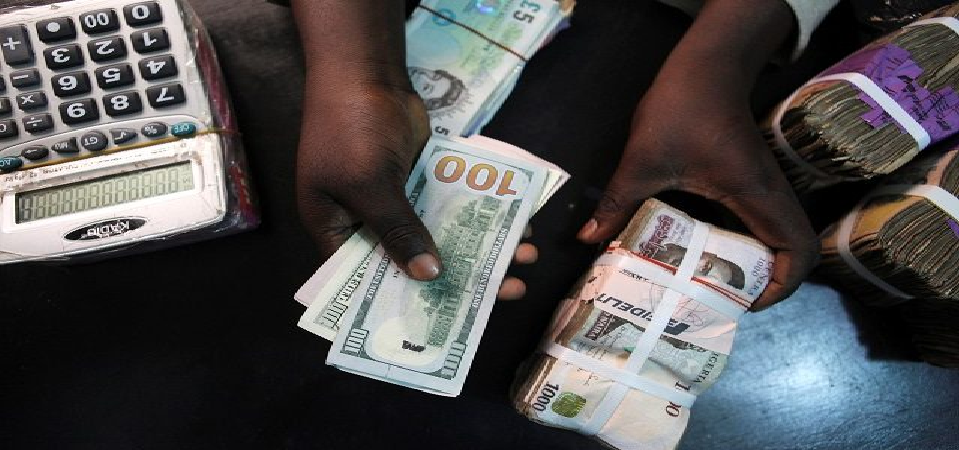
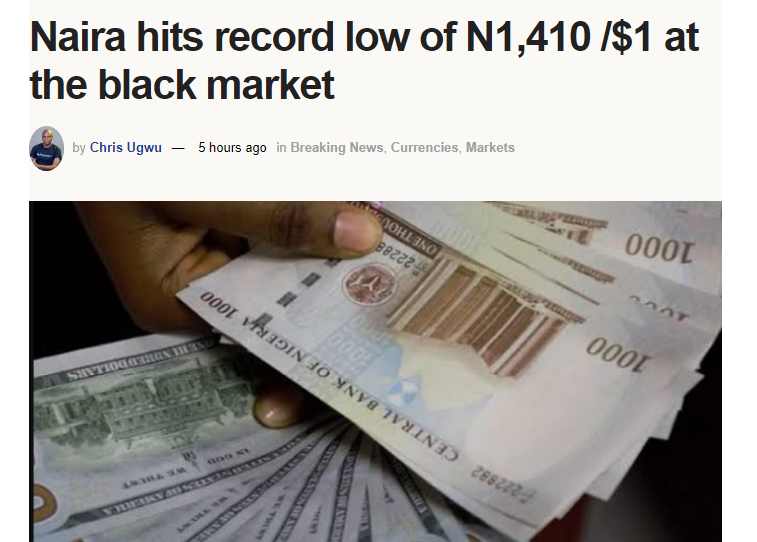
Today, Naira is hitting above N1,400/$: “Naira on Thursday fell to a record low of N1,410 per dollar following strong demand on the parallel market, also known as the black market. This represents 3.29% or N45.00 weaker than N1,365 recorded at the close of trading on Wednesday.” Where is the N600/$ stable state?

Nigeria needs to remove the float. What we were doing was just fine if we can attack the corruption in the policy over discarding the whole system.  If Mr. Wazobia wants to import Equipment A from Germany,  let him source his USD funds. And if you want to assist, offer a rebate on the official and black market rates. By offering a rebate, over the old system, you would be sure the equipment would be imported. 

I call on the Nigerian government to focus on policies which will create more US dollars by deepening our industrialization policy. But to think that we can float Naira and it can stabilize over time by pure financial engineering is an illusion. AO Lawal would have graded any suggestion “P8”. Factories, warehouses, etc for physical, digital and services will strengthen Naira, and nothing more, and Nigeria needs to get into that.

Good People, Nigeria must FLOAT industries (yes, companies) to get Naira to fight globally! And here floating companies mean starting enterprises across industrial sectors and growing them to the point they become public companies because they have become super successful.

In the past, we credited people cheap US Dollars, and they could divert the funds to other things. If we change to a rebate system, we would remove that loophole as before payment, we would reconcile data from customs, banks and the company, making sure cheap US dollars were going to PRODUCTIVE things over expanding mindless consumerism.

People, get me right; I am not a political person. I have been consistent with this position for months. I hope I am wrong. But from basic economics, removing frictions to attain market transaction equilibrium faster does not mean price can radically improve if Demand and Supply positions remain misaligned. That is fundamental and cannot be disintermediated as if 90 people each wants to buy $100 with Naira, and you have only two people selling each $100 for Naira, whether you use mobile app, bank hall, bureau de change, etc,  the price of Naira will go up, because there is no parity between demand and supply here.

This is the summary:  if 90 people each wants to buy $100 with Naira, and you have only two people selling each $100 for Naira, whether you use mobile app, bank hall, bureau de change, etc, the price of Naira will go up, because there is no parity between demand and supply here. The impact is clear: lack of stability in the exchange rate makes making long-term investments impossible, pushing the nation into a trading and rent-seeking ground.

The government can ideally do this floating later once it gets a good picture on how to have access to USD dollars via any means possible that excludes borrowing! The unstable state of the Naira is more dangerous to the economy than mismatch on pricing between official and black market currency rates which ironically the Naira floating did not close, making the core reason for the floating largely unrealized.

Fraud Prevention: Opay to Enforce KYC Requirements For Customers in March 2024

0

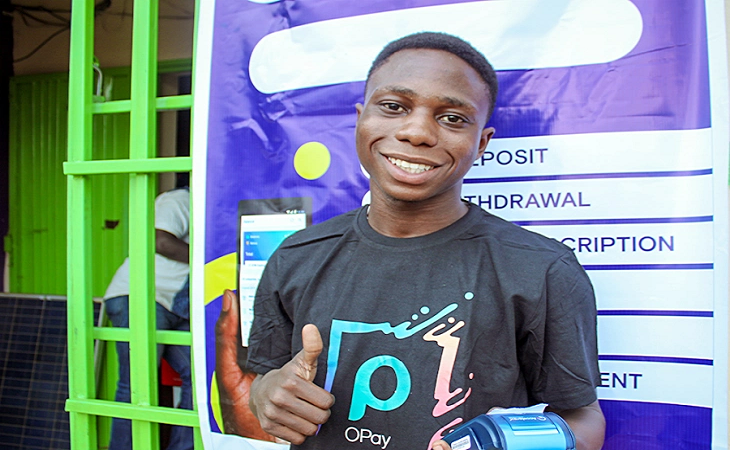
Nigerian Fintech company Opay has announced plans to enforce a stricter Know Your Customer (KYC) requirement starting from March 2024, to mitigate fraud on the platform.

This move is coming after the startup was scrutinized for revealing significant weaknesses in its platform. Multiple tests were reported to have exposed vulnerabilities, particularly in the facial identity system, raising concerns about the platform’s susceptibility to exploitation by malicious actors.

There was a viral video shared by a user displaying how users can open an account using other people’s bank account numbers.

At that time, checks showed that OPay continued to allow new users to sign up to its platform without proper verification.

According to reports, during the onboarding process on the platform, people were allegedly allowed to impersonate others by opening accounts in their names.

Multiple tests show that OPay’s basic account verification process for tier 1 is weak, and the facial identity system is porous, which could allow bad actors to register for the service and begin carrying out transactions within 60 seconds.

In a bid to strengthen security on the platform, OPay has now initiated the enforcement of the Bank Verification Number (BVN) and National Identity Number (NIN) requirements for wallet opening. Customers whose accounts are not KYC compliant will be blocked.

In line with this, OPay announced its partnership with Nigerian financial services company Interswitch, to curb these issues. With the Interswitch Payment Gateway (IPG), the partnership seeks to reduce transaction friction by offering consumers a safe and easy way to make payments.

Opay beef of security on the platform is coming on the heels of the Central Bank of Nigeria’s (CBN) directives on Know-Your-Customer (KYC), mandating all accounts and wallets for individuals to have BVN and/or NIN before March 1, 2024.

CBN also mandated that no new accounts or wallets should be opened without BVN or NIN. The director, of Card Business, OPay, Priscilla Olayemi, averred that the company in adhering to these new directives, has commenced the first two stages of the KYC.

Explaining further, she stated that, users under tier one accounts, cannot log in to carry out financial transactions without providing their BVN or NIN.

Also, the director of partnerships OPay, I.K Odiase, posited that any fraudulent account will be removed from the OPay platform, beginning March 1, 2024, while pleading with customers to confirm that the information provided while opening their accounts matches the information in their NIN and BVN.

Amid growing concerns stemming from high-profile fraud incidents and critiques of lenient KYC standards, Nigeria is promoting financial system stability by reinforcing KYC procedures.

The new rules come as an amendment to Section 1.5.3 of the Regulatory Framework for Bank Verification Number (BVN) Operations and Watchlist for the Nigerian Banking Industry.

OPay’s proactive approach towards enhanced KYC and secure transactions demonstrates the startup’s commitment to protecting users and fostering a trustworthy financial ecosystem in Nigeria.

Skai introduces world’s first hydrogen powered vertical takeoff and landing aircraft

0

Hydrogen is the most abundant element in the universe, and it has the potential to revolutionize the aviation industry. That’s why BMW-backed company Alaka’i Technologies has developed the world’s first hydrogen-powered vertical takeoff and landing (VTOL) aircraft, called Skai.

Skai is designed to offer a clean, efficient, and versatile way of traveling in urban and rural areas. Unlike conventional helicopters or planes, Skai does not rely on fossil fuels or batteries, but uses hydrogen fuel cells to generate electricity for its six rotors. This means that Skai has zero emissions, low noise, and a longer range than other VTOL vehicles.

Skai can carry up to five passengers or 450 kg of cargo and can fly for up to four hours or 650 km on a single tank of hydrogen. Skai can also be operated remotely or autonomously, making it suitable for various applications such as air taxi, emergency response, cargo delivery, or personal transportation.

Skai is not just a concept, but a reality. Alaka’i Technologies has already built and tested a full-scale prototype of Skai and has received approval from the Federal Aviation Administration (FAA) to conduct further flight tests. The company aims to launch Skai commercially in the next few years and has partnered with BMW Designworks to create a sleek and comfortable interior for Skai.

If you are looking for a vehicle that combines innovation, performance, and sustainability, look no further than the Skai. The Skai is a hydrogen-powered electric vertical take-off and landing (eVTOL) aircraft that is designed by BMW and Alaka’i Technologies. The Skai is the ultimate expression of BMW’s motto: “The Ultimate Driving Machine”.

The Skai can carry up to five passengers and has a range of 400 miles. It can fly at speeds of up to 118 mph and has a cruising altitude of 10,000 feet. The Skai is powered by six hydrogen fuel cells that produce zero emissions and can be refueled in minutes. The Skai also has a backup battery system and a ballistic parachute for safety.

The Skai is not just a vehicle, it is a vision for the future of mobility. The Skai aims to revolutionize urban transportation by offering a fast, convenient, and eco-friendly way to travel. The Skai can take off and land from any flat surface, eliminating the need for roads, bridges, or parking lots. The Skai can also fly over traffic jams, reducing congestion and pollution.

The Skai is more than just a flying car, it is a flying masterpiece. The Skai combines BMW’s expertise in design, engineering, and quality with Alaka’i’s experience in aerospace and hydrogen technology. The Skai has a sleek and elegant appearance that reflects its efficiency and functionality. The Skai has a spacious and comfortable cabin that offers panoramic views of the sky and the ground. The Skai has a simple and intuitive interface that allows the pilot to control the aircraft with ease.

The Skai is the ultimate expression of BMW’s motto: “The Ultimate Driving Machine”. It is a vehicle that delivers unparalleled performance, innovation, and sustainability. It is a vehicle that will change the way we move, live, and work. It is a vehicle that will make you feel like you are flying.

Skai is more than just an aircraft; it is a vision for the future of mobility. By harnessing the power of hydrogen, Skai offers a sustainable and flexible solution for moving people and goods across the sky. Skai is the ultimate expression of BMW’s motto: “The Ultimate Driving Machine”.

M-Pesa Outages: The Implication on The Kenyan Economy And The Need For More Mobile Money Platforms to Emerge

0

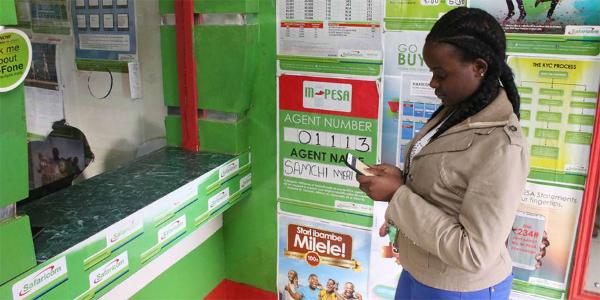
Kenyan mobile network Safaricom has come under heavy scrutiny, over the recent power outage that occurred on the mobile money platform M-Pesa.

Recall that M-Pesa was hit with downtime on Monday, inconveniencing millions of customers who rely on it for payment transactions.

The outage saw millions of Kenyans who rely on M-Pesa for their financial transactions such as paying for utilities like electricity, fuel, and parking fees, or purchasing items such as food and medicine in supermarkets and chemists stranded with unpaid bills.

This prompted the Communications Authority of Kenya (CA) to summon the company to shed light on the recent outage, which has rocked businesses and inconvenienced customers.

Safaricom, which has 27.7 million subscribers, explained in a statement that they suffered a technical issue and their services were being restored. The company said in a public notice that the outage had been fully resolved as of Tuesday, apologizing to its users.

The company wrote,

We experienced service intermittency with PayBill payments that resulted in some transactions not being completed on M-Pesa. The technical issue has since been resolved, and we continue to monitor the services closely. We apologize for any inconvenience that this disruption may have caused.”

Meanwhile, this is not M-PESA’s first outage. The mobile money went down for over two hours in early January 2024 and had a service outage in July 2023. These recurring outages affect the platform functionalities such as sending and receiving money, linked bank services, and other payment services.

Thousands of Kenyans have begun to feel discouraged from using the mobile service to make transactions because of the outages. However, other competing products can not match M-PESA’s market dominance, which would have given Kenyans more options.

The Implication of M-Pesa Outages on The Kenyan Economy 

M-Pesa is seen as a de facto national payment system in Kenya, which makes it a critical part of the economy. The mobile money platform accounts for about 99.9 percent of the value of mobile money transactions, underlining the entrenchment of the platform in the economy of the East African country.

M-PESA has been the market leader in Kenya, accounting for 96.5% of the market in 2023, followed by competitors Airtel Money and T-Kash. By March 2023, M-PESA had processed 26 billion transactions.

The mobile money parent company Safaricom owns the majority of the mobile infrastructure in Kenya, so it enjoys an almost total monopoly over the mobile payments space.

Considering that 43% of Kenya’s GDP flows through M-Pesa, a prolonged interruption would substantially disrupt economic activity.

This means that incessant outages on the service would bring transactions to a grinding halt, freezing commerce in its tracks. Also, businesses, large and small, would face crippling losses, and the flow of money would stagnate. The ripple effect would reverberate through supply chains, potentially dampening the entire economic engine.

A 2016 Treasury report and subsequent Treasury reports have often warned that a collapse of the M-Pesa service could, for instance, cause widespread disruption in the economy. This saw M-Pesa classified as a systemic risk to the country’s economy, underlining its crucial role.

While M-Pesa’s ubiquity may seem like a monopoly, it’s crucial to remember that competition does exist in the mobile money space. However, M-Pesa’s first-mover advantage and deep integration into the Kenyan economy have given it a substantial lead.

This however raises concerns about potential anti-competitive practices and the need for a leveled playing field for other players.

The Central Bank of Kenya, among other government agencies, has been attempting to make other mobile money products attractive to Kenyans. However, the development has yet to pick up as locals still prefer using the M-Pesa platform.

It is worth noting that the M-Pesa downtime serves as a stark reminder of the vulnerability inherent in such a centralized system.

This calls for the need for Diversification of Service Providers, to foster a competitive mobile money landscape that can reduce reliance on a single platform and provide users with alternative options in case of outages.