The African Union (AU) is preparing to inaugurate a new credit rating agency for the continent in the upcoming year, to tackle concerns regarding the fairness of current credit ratings assigned to African nations, according to an official who spoke to Reuters.
The proposal follows complaints by African leaders that rating agencies have been unfair to African nations.
In July of this year, during the 5th Ordinary Session of the Specialized Technical Committee, which centered on “Improving Africa’s Access to Capital: Debt Management and the Rising Influence of Credit Rating Agencies,” AU finance ministers gave their approval to a resolution endorsing the establishment of a new agency.
This initiative was spearheaded by the African Peer Review Mechanism (APRM), a branch of the AU established last year to promote governance improvements across the continent. It is expected that the full AU executive council will also ratify this resolution in February.
Credit ratings function as a tool to evaluate the probability of a borrower defaulting and play a crucial role in determining the terms under which financial institutions and other entities extend loans.
The proposed agency, which will operate within Africa, aims to offer a new perspective on assessing the risk associated with lending to African countries.
“Our goal has not been to replace the big three…we need them to support access to international capital. Our view has been to widen the diversity of opinions,” Misheck Mutize, who serves as the lead expert for country support on rating agencies within the African Union, told Reuters.
Mutize explained that this agency would furnish investors with contextual information when they are making decisions regarding the acquisition of African bonds or extending private loans to African nations.
“Our goal has not been to replace the big three…we need them to support access to international capital. Our view has been to widen diversity of opinions.
“We know the big three follow the opinion of other smaller ratings agencies. They’ve acknowledged that other smaller ratings agencies have got an edge in understanding domestic dynamics,” Mutize said.
More than a dozen African countries presently have outstanding international bonds.
The African Union, in collaboration with member nations such as Ghana, Senegal, and Zambia, asserts that the three major credit rating agencies—Moody’s, Fitch, and S&P Global Ratings—have exhibited bias in their assessments of lending risks in African countries. They argue that these agencies tend to downgrade African nations more swiftly, especially during crises like the COVID-19 pandemic.
However, all three of the major rating agencies vigorously deny any bias and maintain that their rating methodologies remain consistent across continents.
The rating agencies are yet to comment on the development. But earlier, Ravi Bhatia, the lead analyst for sovereign ratings at S&P, affirmed that the agency applies the same criteria uniformly across all regions.
Privacy and security are two of the most important features of any cryptocurrency. However, achieving both of them simultaneously is not an easy task. Most existing solutions either sacrifice privacy for security, or vice versa. For example, Bitcoin transactions are transparent and verifiable, but also expose the identities and balances of the users. On the other hand, some privacy coins use encryption or obfuscation techniques to hide the transaction details, but also introduce new risks and vulnerabilities.
That’s why a group of key crypto industry figures have recently proposed a new solution called Privacy Pools. Privacy Pools are a novel way to combine the best of both worlds: privacy and security. Privacy Pools are based on the concept of zero-knowledge proofs, which allow users to prove that they own certain assets or have performed certain actions, without revealing any other information. Privacy Pools use zero-knowledge proofs to create pools of funds that can be accessed by multiple users, without disclosing their individual identities or balances.
The main benefits of Privacy Pools are:
They enhance privacy by hiding the link between the sender and the receiver of a transaction, as well as the amount and the asset type.
They enhance security by preventing double-spending, fraud, and theft, as the funds in the pool are locked by a smart contract that can only be unlocked by valid proofs.
They enhance scalability by reducing the size and complexity of the transactions, as only the proofs need to be verified by the network.
They enhance interoperability by enabling cross-chain and cross-asset transactions, as any asset that supports zero-knowledge proofs can be pooled together.
Privacy Pools are still in the early stages of development, but they have already attracted the attention and support of some of the leading figures in the crypto industry. For example, Vitalik Buterin, the co-founder of Ethereum, has praised Privacy Pools as “a very clever idea” that could “potentially be a big win for privacy”. Similarly, Zooko Wilcox, the founder of Zcash, has expressed his interest and enthusiasm for Privacy Pools, saying that they could “enable new kinds of applications that we haven’t seen before”.
However, Vitalik Buterin, the co-founder of Ethereum, has co-authored a paper on a new protocol for improving privacy on the blockchain. The protocol, called ZKSwap, is based on zero-knowledge proofs and allows users to swap tokens without revealing their identities or balances. ZKSwap is a proposed alternative to Tornado Cash, a popular tool for anonymizing Ethereum transactions.
Tornado Cash uses a technique called zk-SNARKs, which require users to deposit and withdraw fixed amounts of tokens from a pool of funds. This limits the flexibility and efficiency of the system, as users have to wait for enough deposits and withdrawals to match their desired amounts. ZKSwap, on the other hand, uses a technique called zk-STARKs, which allow users to swap any number of tokens with any other user in a single transaction.
This reduces the gas fees and latency of the system, as well as the risk of front-running attacks. Moreover, zk-STARKs do not require a trusted setup, unlike zk-SNARKs, which means that no one can manipulate the system by generating fake proofs. ZKSwap is one of the latest efforts to enhance privacy on the blockchain, which is often seen as a trade-off with scalability and usability. By leveraging the power of zero-knowledge proofs, ZKSwap aims to provide a practical and secure solution for anonymous token swaps on Ethereum.
The paper, titled “ZKSwap: A Practical Protocol for Privacy-Preserving Token Swaps on Ethereum”, was co-authored by Vitalik Buterin, Alex Gluchowski, Barry Whitehat, Harry Roberts, and Roman Storm. The authors claim that ZKSwap is compatible with existing Ethereum standards and can be easily integrated with existing wallets and exchanges. They also provide a prototype implementation of the protocol and a security analysis of its properties.
Privacy Pools are not only a promising innovation for the crypto industry, but also a potential game-changer for the wider society. By providing a way to transact privately and securely, Privacy Pools could empower individuals and organizations to protect their financial freedom and sovereignty, while also fostering social good and economic growth. Privacy Pools could also pave the way for new use cases and business models that rely on trustless and confidential interactions, such as decentralized exchanges, lending platforms, prediction markets, voting systems, and more.
Privacy Pools are still in the research and development phase, but they have already shown their potential and value. As more crypto projects and platforms adopt and implement Privacy Pools, we can expect to see a new era of privacy and security in the crypto space.
The African Continental Free Trade Area (AfCFTA) is a landmark agreement that aims to create a single market for goods and services in Africa, with a population of 1.3 billion people and a combined GDP of $3.4 trillion. The AfCFTA entered into force in May 2019 and trading under its rules started in January 2021. It is expected to boost intra-African trade, industrialization, and economic development across the continent.
One of the key pillars of the AfCFTA is the Single African Digital Market (SADM), which is an initiative to harmonize digital policies and regulations, promote digital infrastructure and connectivity, and foster digital skills and innovation. The SADM will enable the free movement of data, goods, and services across Africa, as well as create new opportunities for digital entrepreneurs and businesses.
A crucial component of the SADM is the Pan-African Payment and Settlement System (PAPSS), which is a centralized payment platform that allows cross-border transactions in local currencies. The PAPSS was launched in July 2019 by the African Export-Import Bank (Afreximbank) and the African Union Commission (AUC). It aims to reduce the reliance on foreign currencies, lower transaction costs, and increase financial inclusion.
The PAPSS is expected to facilitate trade under the AfCFTA by providing a secure, efficient, and affordable payment system for intra-African trade. It will also support the development of regional value chains and the integration of informal traders into the formal economy.
However, the AfCFTA faces several challenges that need to be addressed in order to realize its full potential. One of these challenges is the lack of digital integration and interoperability among African countries, which hampers the flow of information, transactions and payments across borders. This is where the Single African Digital Market (SADM) and the Pan-African Payment and Settlement System (PAPSS) come in.
Some of the main challenges are:
Harmonizing trade policies and regulations among 54 diverse countries, with different levels of economic development, infrastructure, governance and institutional capacity.
Addressing non-tariff barriers, such as customs delays, transport costs, sanitary and phytosanitary measures, technical standards and quality requirements, that can raise the cost of doing business and reduce the competitiveness of African products.
Enhancing productive capacities and diversifying exports, especially in the industrial and service sectors, to take advantage of the larger market opportunities and avoid trade imbalances.
Ensuring that the benefits of trade liberalization are equitably distributed among and within countries, and that vulnerable groups, such as women, youth and small-scale farmers, are not left behind or marginalized.
Building political will and trust among member states, as well as engaging with stakeholders from the private sector, civil society and regional organizations, to foster ownership and commitment to the AfCFTA vision and objectives.
These challenges are not insurmountable, but they require concerted efforts and cooperation from all parties involved. The AfCFTA is not a panacea for Africa’s development challenges, but it is a crucial step towards achieving greater integration, cooperation and prosperity on the continent.
The SADM seeks to promote the development of digital infrastructure, platforms and services, as well as the adoption of common standards, protocols and guidelines for data protection, cybersecurity, consumer protection and taxation. The SADM also aims to foster digital skills, innovation and entrepreneurship among African youth and women. The PAPSS is designed to reduce the reliance on foreign currencies, lower transaction costs, increase financial inclusion and support monetary policy coordination. The PAPSS is expected to be operational by the end of 2021, with 18 countries already committed to join.
The SADM and the PAPSS are complementary and mutually reinforcing initiatives that will support the implementation of the AfCFTA and enhance its benefits for African businesses and consumers. By creating a digital single market and a payment system for Africa, they will enable faster, cheaper and more secure trade and e-commerce across the continent.
The AfCFTA, the SADM, and the PAPSS are ambitious and transformative initiatives that have the potential to reshape the economic landscape of Africa. They will create new markets, new opportunities, and new challenges for African businesses and consumers. They will also require strong political commitment, effective coordination, and adequate resources to ensure their successful implementation.
It was simple: how do you finance real estate and broad construction projects? Do you give out the loan and hope for the best? For centuries and decades in Africa, many mortgage firms, financiers, and builders have struggled to come to equilibrium. And that has affected our capacity to provide shelters, build bridges, roads, etc.
But now, something amazing is here: with CinderBuild Inc. mortgage credit card, you can take the loan for that project, and it will help supply every material you need for that construction. Simply, it unifies the core elements of building and construction in Africa: the fund and the materials!
Also, it can help you get a project done as a working professional: “As a trendsetting organization, with a steadfast focus on reshaping the building materials procurement industry landscapes, our journey with our corporate clients in the real estate and construction space has ignited an unprecedented wave of innovation leading to the birth of Nigeria’s first credit Mortgage Card.
“We are issuing salary-backed mortgage loans to Nigeria’s working class allowing them to make down payments and installmental payments on exclusive real estate properties listed by our esteemed corporates. By doing this, salary earners are now well equipped to confidently explore the real estate market and secure their dream homes with ease.”
Cinderbuild, a Tekedia Capital portfolio, is Africa’s largest real estate and construction materials marketplace. We continue to pioneer the future. Interested? The contacts are here cinderbuild.com .
Cinder Build was launched with a vision to bring about a seamless buying experience in the real estate and construction space.
Our business model on the supply side is hinged on solid partnerships with major manufacturers which gives us an enviable catalog of building materials at very competitive prices (We actually prefer the word unbeatable). We deliver this value on the demand side through our digital platform to two user segments; Resellers (C-stores) and Corporate buyers
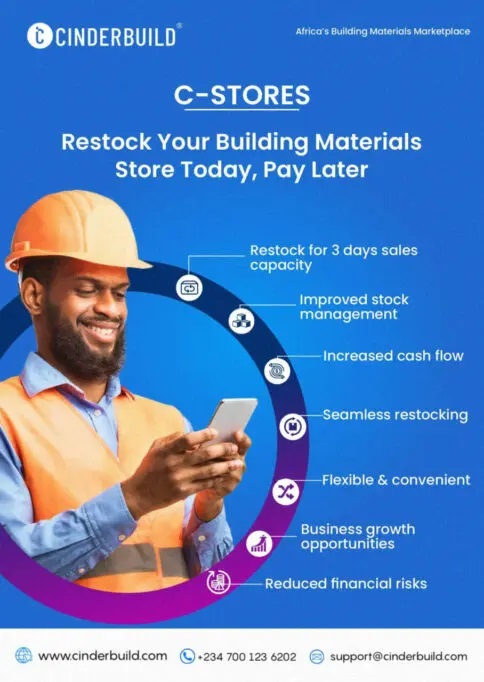
Initially, we focused on catering to the needs of the reseller segment. However, as time went on, we recognized the opportunity to establish dedicated offline distribution channels known as C-stores, stemming from our existing reseller user base. These C-stores, consisting of resellers who make substantial weekly bulk purchases, have become an integral part of our business. To alleviate the capital procurement challenges associated with restocking, we have implemented an automated system that ensures these C-stores receive restocks at least twice a week. As a result, they have become invaluable distribution partners for us. Presently, our network boasts over 1500 C-stores and continues to grow.
We have evolved as a business in line with data based feedback and insights gained from our interaction with key real estate and construction players, working with their procurement teams on their project. We developed Builder 360™, an all-in-one product suite to cater for this segment.
The Builder 360™ suite is an interconnected web of value-added solutions and services, made available to customers based on platform loyalty. For every amount spent on the platform, eligibility increases and at certain spend thresholds, users unlock a new solution typically addressing critical pain areas.
With Builder 360™, you get access to cutting-edge solutions that allow you outsmart inflation, store project materials virtually for future use. It doesn’t end there, you have access to inventory management tools, project financing, access to vetted artisans, visibility across board and much more.
Users can unlock the various solutions based on their rank within the community and they move up the rank as they hit transaction volume milestones.
Furthermore, the emergence of online marketplaces and procurement platforms like CinderBuild has made it easier for builders to source and purchase construction materials, equipment, and services. With CinderBuild’s Cloud Warehouse solution, for instance, builders can store materials virtually and receive on-demand piecewise site deliveries, reducing the need for physical storage space and eliminating the risk of theft or damage.
We are proud to currently serve a robust client base of corporates across the Real estate and construction space.
As a trendsetting organization, with a steadfast focus on reshaping the building materials procurement industry landscapes, our journey with our corporate clients in the real estate and construction space has ignited an unprecedented wave of innovation leading to the birth of Nigeria’s first credit Mortgage Card. We are issuing salary-backed mortgage loans to Nigeria’s working class allowing them to make down payments and installmental payments on exclusive real estate properties listed by our esteemed corporates. By doing this, salary earners are now well equipped to confidently explore the real estate market and secure their dream homes with ease.
Upon the successful acquisition of a property by a salary earner, the funds are transferred to our secure escrow system. Simultaneously, corporates have access to these funds, enabling them to procure high quality building materials for their construction projects from CinderBuild. This seamless integration streamlines the entire process, eliminating delays, and enhancing the efficiency of property development.
By empowering corporates with the financial resources to procure superior building materials, we are catalyzing a transformative change in the construction industry. The properties developed through our platform boast enhanced durability and quality materials, elevating the overall living experience for homeowners. This virtuous cycle fosters a reputation of excellence for corporates, attracting more potential buyers and creating a positive impact in the real estate market.
Owning a mortgage account with cinderbuild is simple and hassle-free. Homeowners can easily link their mortgage accounts to the card, allowing for direct payments and better visibility of mortgage-related transactions. Every financial transaction is meticulously tracked and recorded, ensuring complete visibility for both salary earners and corporates.
For us at CinderBuild, beyond the bottom line and the excitement of deploying a rapidly adopted technology solution, we are peeling back layer by layer the depth of value in tech enabled procurement and delivering this value to a fast growing user base in one of the largest construction markets in the world.
As we begin our next phase, we are tapping into the depth of learnings from launching in a robust market like Nigeria, and leveraging that to build locally-adapted digital products as we launch swiftly into more African countries. We see ourselves as an innovation leader in this space, as our teams are drawn from some of the most reputable institutions in the world, and backed by top-tier VCs from across Europe and the U.S.
Whether you’re building roads, bridges, housing estates, commercial buildings in the private and public sector, Builder 360™ has everything you need to take your construction projects and business to the next level.
Yellow Card, one of the largest cryptocurrency exchanges on the African continent, has partnered with MoonPay, a global leader in the cryptocurrency ecosystem, to drive crypto accessibility in Nigeria.
This strategic partnership is geared towards enabling Nigerians to engage in peer-to-peer crypto transactions with unprecedented ease, as well as eliminating the barriers that prevent them from participating in the crypto economy.
Yellow Card, one the largest cryptocurrency exchanges on the African continent with operations across 16 countries, offers a crypto exchange, easy cross-border payments powered by crypto, and an API suite for companies to on-and-off-ramp anyone on the continent and abroad.
Yellow Card strives to bring financial inclusion to everyone in Africa. The crypto exchange’s strategic partnership with MoonPay signifies a turning point in the accessibility and usability of cryptocurrencies within the region.
Speaking on the company’s recent partnership with MoonPay, West Africa Regional Manager at Yellow Card, Uzoma James said,
“At the core of our company’s mission is the belief that everyone should have access to the power and potential of cryptocurrencies. By joining forces with MoonPay, we aim to eliminate the barriers that prevent Nigerians from participating in the crypto economy. Together, we can help make crypto trading easy, intuitive, and available to all”.
On the other hand, MoonPay, a crypto exchange that offers a fast and simple way to buy and sell cryptocurrencies, has established itself as a frontrunner in the cryptocurrency industry, offering a comprehensive suite of solutions that simplify the onboarding process for newcomers to the crypto world.
With the recent partnership with Yellow Card, the crypto exchange is poised to extend its reach into the Nigerian market, catering to the specific needs and challenges faced by the local population.
Co-founder and CEO at MoonPay, Ivan Soto-Wright said,
“Supporting local bank transfers unlocks immense opportunities for crypto users, and we’re eager to introduce this experience to Yellow Card’s fast-growing ecosystem. Offering a simple, inclusive transaction method for users across Africa is an exciting step forward in our vision to onboard the world to Web3”.
Yellow Card and Moon Pay strategic collaboration seeks to enhance the use of Bitcoin and cryptocurrencies among Nigerians, to overcome transaction delays and drive business growth.
Leveraging local bank transfers, users can eliminate many of the obstacles that have traditionally hindered the crypto purchasing process.
Despite the restriction of crypto trading in Nigeria, the country has emerged as a powerhouse in the African cryptocurrency landscape, with increasing numbers of individuals turning to digital assets to hedge against inflation and economic uncertainty.
As the cryptocurrency landscape continues to evolve, the power of digital currencies empowers individuals and offers financial opportunities even in the most challenging circumstances.