
DD
MM
YYYY

PAGES

DD
MM
YYYY

spot_img

PAGES

Home Blog Page 3803

On chain sleuth ties Ethereum Foundation to 2016 GateCoin Hack as US SEC delays BlackRock’s Spot Ethereum ETF

4

A new investigation by an on-chain sleuth has revealed that the Ethereum Foundation may have been involved in the 2016 Gate Coin Hack, which resulted in the theft of more than 185,000 ETH and 250 BTC from the Hong Kong-based exchange.

The on-chain sleuth, who goes by the pseudonym of Boringsleuth, published a detailed report on X, where he traced the origin and destination of the stolen funds using blockchain analysis tools. He claims that he found evidence that some of the hacked ETH was sent to an address controlled by the Ethereum Foundation, and that the Foundation later sold some of the tainted coins on Kraken.

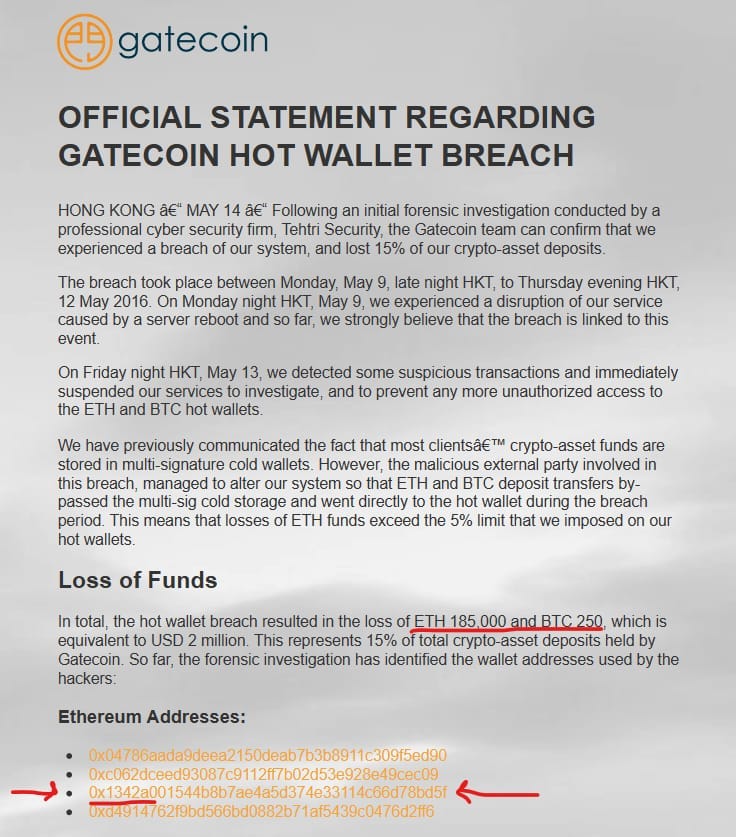
The Gatecoin Hack occurred between May 9th and May 12th, 2016, prior to at the onset of The DAO’s token sale & 1 Month Prior to The Dao Hack. Per Gatecoin’s official statement on May 14th, the hack resulted in losses of 185K Ethereum, valued at more than $460M today. At the time, Gatecoin “claimed” that the hacker was able to alter their own system to bypass their multi-sig cold storage, so that all inbound Deposits into Gatecoin went straight to their exploitable Hot Wallet.

They list the 4 Hacker Eth address’ below involved in the Exploit, Among the 4 ETH address’, one address, 0x1342a0, was originally funded PRIOR to the exploit. Our focus in this thread is looking into who it was that funded this Hacker’s wallet, in hopes of gaining an idea of who it was that was behind the Hack.
Boringsleuth’s report is based on the assumption that the hacker used a smart contract to split the stolen funds into smaller amounts and send them to different addresses. He says that he identified the hacker’s contract by looking for transactions that had a high gas price and a low value, which indicated that they were used to deploy a contract.

He then analyzed the contract’s code and found that it had a function called split Funds, which took an array of addresses and amounts as inputs and sent ETH to each address accordingly.

Boringsleuth says that he tracked down all the addresses that received ETH from the hacker’s contract and found that one of them belonged to the Ethereum Foundation. He says that he verified this by comparing the address with the list of addresses that received ETH from the genesis block, which are known to be controlled by the Foundation.

He also says that he checked the balance history of the address and found that it received 2,000 ETH from the hacker’s contract on March 15, 2016, which was one day after the Gate Coin Hack.

Boringsleuth claims that he further followed the trail of the stolen ETH and found that some of it was sold on Kraken between April and June 2016. He says that he identified the Kraken deposit address of the Foundation by looking for transactions that had a high value and a low gas price, which indicated that they were used to transfer ETH to an exchange.

He then cross-referenced the address with Kraken’s API and found that it matched with one of the Foundation’s accounts. He also says that he checked the trading history of the account and found that it sold 1,337 ETH for BTC between April 4 and June 13, 2016.

Boringsleuth concludes his report by saying that he has contacted both Gate Coin and the Ethereum Foundation to inform them of his findings but has not received any response from either party. He says that he hopes that his investigation will shed some light on one of the biggest unsolved hacks in crypto history, and that he will continue to monitor the movement of the remaining stolen funds.

US SEC delays BlackRock’s Spot Ethereum ETF

Meanwhile, the US Securities and Exchange Commission (SEC) has postponed its decision on the approval of BlackRock’s Spot Ethereum ETF, a fund that would track the price of the second-largest cryptocurrency by market capitalization. The SEC said it needed more time to evaluate the proposal, which was filed by BlackRock in October 2023. The new deadline for the SEC’s decision is March 29, 2024.

BlackRock is one of the world’s largest asset managers, with over $9 trillion in assets under management. The company has been exploring the crypto space for a while, and already offers exposure to Bitcoin futures through some of its funds. However, the Spot Ethereum ETF would be the first of its kind to directly invest in the underlying asset, rather than derivatives.

The SEC has been cautious about approving crypto ETFs, citing concerns about market manipulation, volatility, custody, and investor protection. So far, the regulator has only approved Bitcoin futures ETFs, which trade on regulated exchanges and are subject to margin requirements and clearinghouse oversight. Spot ETFs, on the other hand, would hold the actual cryptocurrencies in custody, and would require the SEC to grant exemptions from some of its rules.

The crypto community has been eagerly awaiting the approval of spot ETFs, as they would provide a more convenient and accessible way for investors to gain exposure to the nascent asset class. Spot ETFs would also potentially boost the liquidity and price discovery of the underlying cryptocurrencies, as well as attract more institutional investors to the space.

However, the SEC’s delay is not surprising, given its history of postponing or rejecting crypto ETF proposals. The regulator has repeatedly asked for more information and feedback from the public and the industry on various aspects of crypto ETFs, such as valuation, liquidity, arbitrage, market surveillance, and investor education. The SEC has also indicated that it prefers a comprehensive regulatory framework for crypto assets before approving spot ETFs.

BlackRock is not the only company that is seeking to launch a spot Ethereum ETF in the US. Other firms, such as VanEck, WisdomTree, and Bitwise, have also filed similar proposals with the SEC, but have not received any response yet. Meanwhile, Canada has already approved several spot crypto ETFs, including Bitcoin and Ethereum ones, which have attracted significant inflows and trading volumes.

It remains to be seen whether the SEC will finally greenlight a spot Ethereum ETF in 2024, or whether it will continue to delay or deny such products. The crypto industry is hopeful that the regulator will eventually recognize the benefits and potential of spot ETFs and will align its stance with other jurisdictions that have already embraced them.


A bold move from Governor Sanwo-Olu on Lagos Airline, and New Airport

0

A bold move from Mr. Governor: ‘Over the last five months, the Deputy Governor and I have been working to put a concise plan together for the establishment of an airline, but we did not make the plan open because of the need to get adequate knowledge about the operational procedures of airlines,” Governor Sanwo-Olu remarked. “The business plan is viable, and there is no issue about financing. The conversation has gone to an advanced stage, but we need to get the proper information on operations before we go ahead to implement the plan.”’

Yes, Lagos Air or Eko Air or whatever they decide to call it is coming. And I score it A because it is viable. Yes, Lagos Air is more viable than Nigeria Air for many reasons which include that a convergence at Lagos does not need any push, since it is already there.

As the nation’s commercial capital where more than 80% of local flights revolve around, a successful Lagos Air will give the current local operators a really tough competitive moment. You will like that as competition will serve the customers better.

That said, I am not of the opinion that states should operate airlines in Nigeria (excuse Lagos, a top-10 largest economy in Africa if you consider it a country). I will prefer for states to build airports and allow private sector participants to use those airports for their airlines. Be the hub and not the spoke especially in a place where the customer base is still evolving.

Comment on Feed

Not really. I think an airport in the Lekki area is a good playbook for Lagos. Over time, all the traffic will move there. The economy of Eti Osa LGA is bigger than the GDP of Gambia and Lagos’ GDP is possibly closer to Ghana’s. An airport there is not bad. But an airline, NOT a good move since Lagos cannot even run a train well.

Lagos State Unveils Ambitious Plan to Launch Commercial Airline and Construct New Airport

Lagos State Unveils Ambitious Plan to Launch Commercial Airline and Construct New Airport

0

Governor Babajide Sanwo-Olu of Lagos State has announced plans for the establishment of a state-owned commercial airline and the construction of a new airport in Lekki.

The governor made this revelation during the presentation of the administration’s achievements at the Lagos West Senatorial District People’s Town Hall Meeting on Thursday.

According to him, the idea of a state-owned airport has been under consideration for several months, and the state government is now in the final stages of determining the financing model for this ambitious project. Sanwo-Olu acknowledged that the next crucial steps involve securing Federal Government approval and establishing operational contingencies for the proposed commercial airline.

“Over the last five months, the Deputy Governor and I have been working to put a concise plan together for the establishment of an airline, but we did not make the plan open because of the need to get adequate knowledge about the operational procedures of airlines,” Governor Sanwo-Olu remarked. “The business plan is viable, and there is no issue about financing. The conversation has gone to an advanced stage, but we need to get the proper information on operations before we go ahead to implement the plan.”

The governor promised that the senatorial district would benefit significantly from the intracity railway development projects, with major passenger hubs of Blue Line and Red Line trains located in Lagos West.

Stakeholders applaud the move

Stakeholders within the aviation industry, who spoke to The Punch, have expressed optimism about the Lagos State government’s plans. Kingsley Nwokoma, Chairman of the Association of Foreign Airlines and Representatives in Nigeria, sees this development as positive for the industry.

“The aviation sector benefits from increased players, addressing recurring issues like low service quality, delayed flights, and cancellations,” he said.

Nwokoma further noted that having more airlines would be advantageous, addressing concerns such as flight delays and cancellations, which have been key issues for the Minister of Aviation.

“In the past, we had only a few airlines, but the current expansion is a welcomed and beneficial development for the sector. Nigeria requires more standardized airlines, potentially reaching the IATA clearing house,” he added.

The General Secretary of the Aviation Safety Round Table Initiative, Olumide Ohunayo, supported the need for more airlines to address the current demand-supply imbalance in the industry. He pointed to recent incidents of exorbitant Christmas ticket prices reaching N250,000 due to high demand, underscoring the necessity for growth.

However, Ohunayo advised the Lagos State Government to draw inspiration from the success of Ibom Air in Akwa Ibom, suggesting a state-dependent, professionally managed structure similar to Ibom.

The aviation expert noted the need for more players in the industry, citing Ibom Air as an example that a state could run an airline successfully.

“The industry is not unsaturated. We need more. We saw what happened during the last Christmas when tickets hit the roof of about 250,000 naira. So we had less supply. We would not have gotten to that fair price if the demand had outpaced supply,” he said. “I would advise that they shouldn’t make it a civil service airline but they should look at the Ibom structure whereby it is managed by professionals. That is the route to take.”

Lagos State’s Aviation Aspirations: A Historical Perspective

Nigeria’s aviation history is marked by several failed attempts by both the government and private entities to establish sustainable airlines. In 2017, Imo State became the first Nigerian state to have its own airline, aiming to operate regular scheduled flights to major cities across the country. Unfortunately, this venture, like many before it, turned into another unfortunate investment story.

Thus, Lagos State’s attempt to establish its airline is, however, met with skepticism in many quarters, given the historical challenges faced by previous national carriers in Nigeria. From the defunct Nigerian Airways of 1958 to ventures like Virgin Atlantic and the ill-fated Nigeria Air in 2023, these endeavors have sent a message of the state’s inability to successfully operate a national carrier.

Amidst the excitement and optimism, voices of concern and skepticism regarding Lagos State’s foray into the aviation industry persist. Some critics view this move as a potential waste of taxpayers’ money, questioning the state government’s ability to run a successful airline. Despite the success of Ibom Air, founded by Akwa Ibom state in 2019, as a potential benchmark, doubts remain about the viability of Lagos State’s venture.

Critics argue that Lagos should prioritize providing diverse means of transportation, expanding initiatives like the rail line launched last year to ease traffic congestion—a significant impediment to the state’s economic development.

While the aviation industry may benefit from increased players, some believe that the state’s resources could be better allocated to address pressing issues such as infrastructure road, and rail transportation that have remained a clog in the economic development of the state.

International Court of Justice Issues First Ruling on South Africa’s Genocide Case Against Israel Over Gaza War

0

The International Court of Justice (ICJ) has issued its ruling on the emergency measures requested by South Africa in its genocide case against Israel, focusing on Israel’s military campaign in the Gaza Strip.

Among other things, the court held that Israel must immediately take steps to prevent acts of genocide in Gaza, stopping short of ordering a ceasefire at this stage. The judges clarified that they have not yet ruled on the merits of the genocide allegations, a complex and intricate process that may take years to unfold.

Judge Donoghue said that the court [ICJ] has jurisdiction to adjudicate emergency measures in this contentious case.

Since the commencement of Israel’s military campaign on October 7, the toll on Gaza has been devastating. According to officials in Gaza, at least 26,083 people have lost their lives, and an additional 64,487 individuals have sustained injuries. Furthermore, thousands remain missing under the rubble, with most presumed dead. The human cost of the conflict is staggering, underlining the need for the international community’s response.

The ICJ has mandated that Israel must report to the court within one month, outlining the measures it is taking to adhere to the directive to prevent acts of genocide in Gaza. This ruling places significant international legal obligations on Israel, as it underlines the gravity of the situation and the imperative for immediate action to safeguard the civilian population.

In addition to preventing acts of genocide, the ICJ’s directive requires Israel to ensure that its forces do not engage in such acts and mandates the preservation of evidence related to alleged genocide. This is believed to denote the court’s commitment not only to physical protection but also to addressing the psychological impact of language that dehumanizes a group of people.

The ICJ president brought attention to the “dehumanizing language” used by senior Israeli officials against Palestinians. The court took note of statements, including those made by Israeli Defense Minister Yoav Gallant, who ordered a “complete siege” of Gaza and referred to the population as “human animals.” This aspect of the ruling acknowledges the broader impact of language on the affected population and reinforces the court’s commitment to justice.

As the reading continued, the ICJ president acknowledged the recognition of Palestinians’ right to be protected from acts of genocide. Judge Donoghue acknowledged that Israel’s military operation had resulted in a large number of deaths and injuries, extensive destruction of homes, the forced displacement of the majority of the population, and significant damage to civilian infrastructure.

Citing a statement by senior UN official Martin Griffiths, Judge Donoghue noted that Gaza has become a place of “death and despair.” Some of the allegations against Israel, she stated, fall within the provisions of the Genocide Convention. This acknowledgment is believed to have lent credence to the severity of the accusations, setting the stage for a thorough examination of the evidence and legal arguments in the ongoing case.

While the ICJ has not made a final determination on the genocide allegations, the emphasis on immediate preventive measures underscores the court’s acknowledgment of the urgency and severity of the situation in the Gaza Strip.

The court’s ruling sets the stage for a protracted legal process that will scrutinize the complex geopolitical and humanitarian aspects of the conflict.

The conflict, which has lasted for over three months, has drawn global interest, with Israel being accused of committing genocide against Palestinians with the help of the United States. However, The United States, a staunch ally of Israel, dismissed the case as “meritless.” Secretary of State Antony Blinken, during a visit to Tel Aviv, criticized the lawsuit, deeming it “galling” and noting ongoing threats from groups like Hamas, Hezbollah, and Iran.

“It is particularly galling, given that those who are attacking Israel — Hamas, Hezbollah, the Houthis, as well as their supporter Iran — continue to call for the annihilation of Israel and the mass murder of Jews,” he said.

South African lawyers are arguing that the recent Gaza war is not merely an isolated event but rather part of a protracted history of oppression against the Palestinian people by Israel.

South Africa seeks interim orders for an immediate halt to Israel’s military actions. The final rulings of the ICJ could set a groundbreaking legal precedent with far-reaching implications for international relations. However, given the intricate geopolitical dynamics, the outcome remains uncertain.

The international community, which has invested a lot of interest in the matter, is expected to closely monitor Israel’s response to the court’s directives, hoping for a lawful answer that will contribute to lasting peace and justice in the region.

Attend Growth Hour – “knowledge for your career, your company…is our mission”

0

You’re invited to a free and open event as Tekedia Institute marches to the start of Tekedia Mini-MBA edition 13 on Feb 5, 2024. The event, Tekedia Growth Hour, focuses on how to deepen “Knowledge To Grow Careers & Companies”; everyone is invited even if you are not joining us in Tekedia Mini-MBA.

We will also use the event to discuss the curriculum for edition 13 as we collect insights from our community on topics and areas to qualify for Tekedia Mini-MBA LIVE sessions. We expect at least 35 live sessions during the 3-month program on top of prerecorded courseware structured around 13 modules, covering all critical domains of business management and leadership. We have a digital seat for you on Zoom as follows:

  • Topic: Preparing for Careers and Businesses of the Future
  • Date: Saturday, Jan 27, 2024
  • Time: 4-5pm WAT
  • Speaker: Ndubuisi Ekekwe, MBA, PhD (Banking/Finance), PhD (Engineering); Lead Faculty, Tekedia Mini-MBA
  • Venue: Zoom link here 

Tekedia Institute: knowledge for your career, your company…is our mission.