
DD
MM
YYYY

PAGES

DD
MM
YYYY

spot_img

PAGES

Home Blog Page 3811

Visa will Leverage on Solana for Cross Border Payment Processing

0

Visa, the global leader in digital payments, has announced that it will leverage the Solana blockchain to enable fast and secure cross-border transactions. Solana is a high-performance, scalable, and decentralized platform that supports smart contracts and decentralized applications. Visa will use Solana’s native token, SOL, as a bridge currency to facilitate the conversion of fiat currencies into digital assets and vice versa.

Visa’s move is a significant milestone for the adoption of blockchain technology and cryptocurrencies in the mainstream financial sector. Visa has been actively exploring the potential of blockchain and crypto since 2015, when it launched its first blockchain-based pilot project with Chain, a San Francisco-based startup. Since then, Visa has partnered with various crypto platforms and companies, such as Coinbase, Crypto.com, Fold, and Anchorage Digital, to offer crypto-related services to its customers and merchants.

Visa’s decision to use Solana as its cross-border payment network is based on several factors, such as:

Speed: Solana can process over 50,000 transactions per second (TPS), making it one of the fastest blockchains in the world. Visa currently handles about 1,700 TPS on average but expects to see a surge in demand for cross-border payments as more people and businesses adopt digital assets.

Scalability: Solana can scale linearly with the number of nodes in the network, without compromising security or decentralization. This means that Solana can handle increasing volumes of transactions without increasing fees or congestion.

Interoperability: Solana supports interoperability with other blockchains and protocols, such as Ethereum, Binance Smart Chain, Terra, and Serum. This enables Visa to connect with a diverse range of crypto ecosystems and offer its customers more choices and flexibility.

Innovation: Solana is home to some of the most innovative projects and applications in the crypto space, such as Audius, a decentralized music streaming service; Star Atlas, a metaverse game; and Pyth Network, a decentralized oracle service. Visa can leverage these innovations to create new value propositions and use cases for its customers and merchants.

Visa’s cross-border payment solution using Solana will be available in select markets in the first half of 2024. Visa plans to expand the service to more regions and currencies in the future. Visa’s CEO, Alfred Kelly, said:

We are excited to partner with Solana to bring the benefits of blockchain and crypto to our global network of customers and merchants. Solana is a cutting-edge platform that offers speed, scalability, interoperability, and innovation. We believe that Solana can help us deliver faster, cheaper, and more secure cross-border payments that will drive financial inclusion and economic growth around the world.

Visa has been experimenting with blockchain technology since 2015, when it invested in Chain, a blockchain startup that later became Interstellar. Chain developed an enterprise blockchain platform called Chain Core, which Visa used to create its own solution for business-to-business (B2B) payments, called Visa B2B Connect.

Visa B2B Connect is a network that enables financial institutions and their corporate clients to make fast, secure, and transparent cross-border payments. It leverages blockchain technology to reduce intermediaries, costs, and risks, and to provide end-to-end visibility and traceability of transactions. Visa B2B Connect was launched in 2019 and is now available in over 90 markets.

Visa has also partnered with IBM to integrate its blockchain platform, IBM Blockchain, with Visa’s global payment network, VisaNet. This collaboration allows Visa to offer new services and capabilities to its clients and partners, such as identity verification, data sharing, and smart contracts.

Visa has also recognized the potential of cryptocurrencies and digital currencies to transform the payments industry. The company has adopted a pragmatic approach to crypto, distinguishing between two types of digital assets: traditional cryptocurrencies, such as Bitcoin, and fiat-backed digital currencies, such as stablecoins.

Visa views traditional cryptocurrencies as digital gold, or assets that are mainly used for investment and speculation. The company does not see much role for these cryptocurrencies in its network, except for enabling users to buy and sell them using Visa cards or wallets.

On the other hand, Visa sees fiat-backed digital currencies as a new form of money that can be used for everyday payments by consumers and merchants. The company believes that these digital currencies can benefit from Visa’s scale, security, and reach, and that Visa can help bridge the gap between crypto and fiat.

To achieve this vision, Visa has been working on several initiatives to connect crypto and blockchain networks to its network of networks. These include:

Enabling crypto wallets and platforms to issue Visa credentials and offer Visa-powered services to their users. For example, Visa has partnered with Crypto.com, BlockFi, Fold, and Bitpanda to enable their users to spend their crypto balances using Visa cards at millions of merchants worldwide.

Enabling financial institutions and fintechs to offer crypto-related products and services to their customers using Visa’s infrastructure. For example, Visa has partnered with Anchorage Digital, a digital asset bank, to enable institutional clients to buy and sell digital assets using Visa’s settlement platform.

Supporting the development and adoption of stablecoins and central bank digital currencies (CBDCs) as a new form of payment. For example, Visa has integrated USDC, a leading stablecoin backed by the US dollar, into its network, allowing users to send and receive USDC payments without converting to fiat. Visa is also collaborating with central banks and regulators to explore the potential of CBDCs and how they can interoperate with existing payment systems.

Visa is committed to advancing the crypto and blockchain ecosystem by providing access, value, and innovation. The company is constantly exploring new ways to leverage these technologies to enhance its products and services, and to create new opportunities for its clients and partners.

Visa believes that crypto and blockchain are not only here to stay, but also have the potential to shape the future of money and commerce. By connecting these networks to its trusted network of networks, Visa aims to enable more people and businesses to participate in the digital economy.
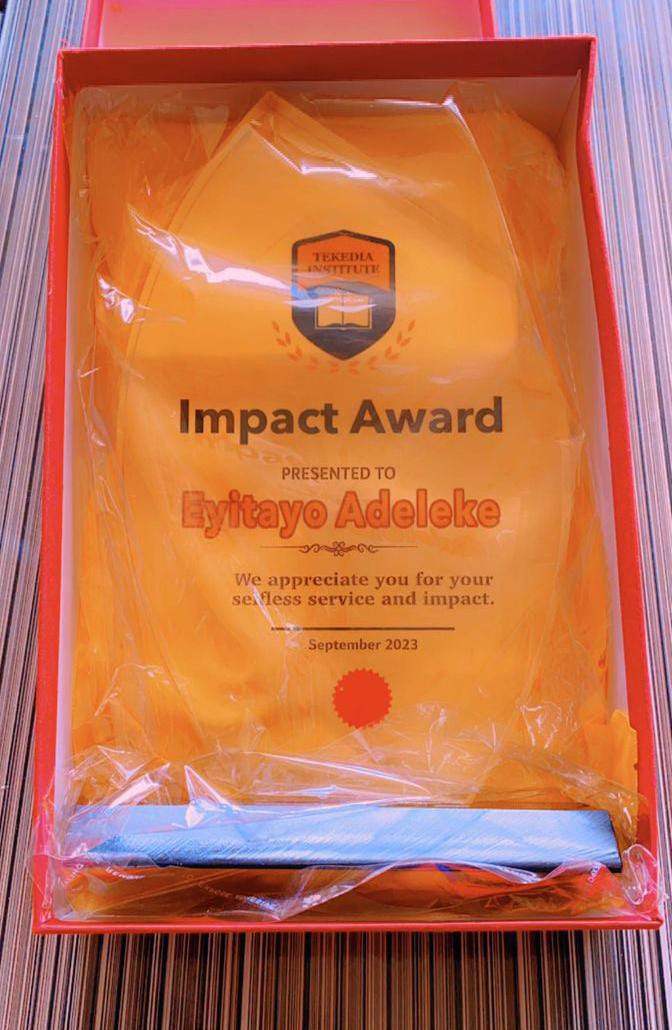

Congrats Eyitayo Adeleke for Your Tekedia Impact Award

0

Let me join our Learners and some Faculty members present to congratulate Eyitayo Adeleke, mMBA, Tekedia CollegeBoost program manager, for receiving the Tekedia Impact Award. We discovered Eyitayo when he was a student in FUT Minna. And quickly, he brought new perspectives to our Institute. He created/facilitated new ideas like the graduation event, the t-shirt, the academic gown, linkages to thousands who come for Tekedia CollegeBoost, etc.

Give him instruction to do something, cross it out because he will execute it. And we’re happy that he has graduated and is still helping us. We admire his tenacity, vision, self-driven mindset, and uncommon positivity.

Congrats Eyitayo and more wins.

MetaMask Announces Crypto-to-Fiat Cash Out for Users

0

MetaMask, the popular Ethereum wallet and browser extension, has announced a new feature that allows users to convert their crypto assets to fiat currency directly within the app. This feature, called MetaMask Swaps, aims to simplify the process of cashing out crypto profits and provide more flexibility and convenience for users.

MetaMask Swaps leverages the decentralized exchange aggregator service 0x, which sources liquidity from various protocols and platforms, such as Uniswap, Kyber, Curve, Balancer, and more. Users can compare the best prices and fees across different sources and choose the most optimal option for their swap. The swap is executed in a single transaction, saving users time and gas costs.

To use MetaMask Swaps, users need to have a MetaMask account with some ETH or ERC-20 tokens in it. They also need to connect their bank account or debit card to MetaMask via the Wyre or Ramp payment services, which are integrated into the app. Users can then select the crypto asset they want to swap, the fiat currency they want to receive, and the amount they want to swap. MetaMask will display the available swap options and let users choose the best one. Once confirmed, the swap will be processed, and the fiat currency will be deposited into the user’s bank account or debit card.

MetaMask Swaps is currently available in beta for users in the US, UK, and EU. The feature is expected to roll out globally in the coming weeks. MetaMask says that this feature is part of its vision to make crypto more accessible and user-friendly for everyone. However, despite its decentralized nature, MetaMask also operates like a centralized entity in some respects, which may raise some concerns for its users and the wider Ethereum community.

One of the main issues is that MetaMask controls the access to the dApps through its own interface and servers. This means that MetaMask can decide which dApps are displayed on its homepage, which ones are featured or promoted, and which ones are hidden or blocked. Moreover, MetaMask can also monitor the user activity and collect data on the dApps they visit, the transactions they make, and the tokens they hold. This data can be used for various purposes, such as analytics, marketing, or even censorship.

Another issue is that MetaMask requires users to agree to its terms of service and privacy policy, which may not be aligned with the ethos of decentralization and user sovereignty. For instance, MetaMask’s terms of service state that it can terminate or suspend the user’s access to the service at any time, for any reason, without notice or liability. It also states that it can modify or discontinue the service at any time, without prior notice. Furthermore, MetaMask’s privacy policy states that it can share the user’s personal information with third parties, such as affiliates, partners, or service providers.

These issues highlight the potential risks and trade-offs that users face when using MetaMask as their gateway to the decentralized web. While MetaMask provides a convenient and user-friendly way to access dApps, it also imposes some limitations and constraints on the user’s freedom and privacy. Therefore, users should be aware of these issues and exercise caution when using MetaMask. They should also explore alternative ways to access dApps, such as using other wallets, browsers, or protocols that are more decentralized and transparent.

MetaMask is one of the most popular Ethereum wallets, with over 10 million monthly active users. It allows users to interact with various Ethereum-based applications, such as decentralized exchanges, games, NFTs, lending platforms, and more. MetaMask also supports other blockchain networks, such as Polygon, Binance Smart Chain, Arbitrum, Optimism, and more.

Coinbase creates Crypto Lending Service, AS Base Experiences Network Bug

0

Coinbase, one of the largest cryptocurrency exchanges in the world, has announced a new service that will allow institutional clients to borrow crypto assets from its platform. The service, called Coinbase Lending, is designed to provide liquidity and flexibility for investors who want to leverage their crypto holdings for various purposes.

According to a blog post by Coinbase, the lending service will initially support USD Coin (USDC), a stablecoin pegged to the US dollar, and Bitcoin (BTC), the most popular and valuable cryptocurrency. Coinbase Lending will offer competitive interest rates and flexible terms, as well as the security and reliability of Coinbase’s custody and trading infrastructure.

Coinbase Lending is part of the company’s broader vision to create an open financial system that empowers people and businesses around the world. By enabling institutional clients to access crypto lending, Coinbase hopes to foster innovation and growth in the crypto ecosystem, as well as provide more opportunities for its customers to benefit from the potential of digital assets.

In a different twist, Coinbase-incubated Base has experienced a stall in block production on its mainnet network. The incident occurred on September 5, 2023, at around 23:00 UTC, and lasted for about two hours. According to the Base team, the root cause of the stall was a bug in the consensus algorithm that prevented validators from reaching agreement on the next block.

The Base team said that they have identified and fixed the bug, and that they are working on restoring the network to normal operation. They also assured users that no funds were lost or compromised during the stall, and that all transactions will be processed once the network resumes. The team apologized for the inconvenience and thanked the community for their patience and support.

Base is a project incubated by Coinbase, one of the largest cryptocurrency exchanges in the world. Base aims to provide a scalable, secure, and interoperable platform for developing decentralized applications (DApps) that can run on any blockchain. Base uses a novel consensus mechanism called Proof-of-Space-Time (PoST), which leverages storage resources to secure the network and reward participants. Base also supports cross-chain communication and interoperability through its Base Bridge protocol, which allows users to transfer assets and data across different blockchains.

Proof-of-Space-Time is still an emerging technology that faces some challenges, such as plot generation time, storage cost, and network synchronization. However, it is also a promising solution that could enable more efficient, secure, and inclusive blockchain networks in the future.

Base launched its mainnet network in July 2023, after conducting several testnet phases and audits. The project has attracted a lot of attention and investment from both the crypto and the mainstream sectors, as it promises to enable a new wave of innovation and adoption in the decentralized space. However, the recent stall in block production has raised some concerns about the reliability and security of the platform, especially as it competes with other established and emerging smart contract platforms such as Ethereum, Solana, Cardano, and Polkadot.

Coinbase Lending is currently in beta and available to a select group of institutional clients. The company plans to expand the service to more customers and more crypto assets in the future. Interested clients can sign up for early access on Coinbase’s website.

Catalyst Fund Announces The Raise of $8.6 Million Fund to Invest in Climate-Focused African Startups

0

Catalyst Fund, a pioneering pre-seed venture capital fund and accelerator focused on driving climate resilience innovation in Africa, had announced the raise of $8.6 million fund to invest in climate-focused African startups.

Catalyst Fund secured the funds from investors which include FSDAi, USAID Prosper Africa, Cisco Foundation, FSD Africa, and investment from seasoned tech investor and CEO of Acrolinx, all of whom are committed to enhancing the impact of African pre-seed climate-focused startups.

The total funds raised by Catalyst Fund reached the first close of its $40 million fund, intended for investment in climate startups in Africa.

The VC accelerator plans to invest in agri-tech, insurtechs, climate fintechs and startups in fishery management, food systems, cold chain, waste management and water management.

It is expediting sustainable green growth, and will focus on solutions that can enable communities to better prepare for and manage shocks, adapt livelihoods to climate impacts and build long-term resilience.

The pan-African fund is targeting pre-seed startups and has already invested in 10 startups from six countries including Egypt, Senegal and Morocco. It plans to invest in 20 startups this year, and a total of 40 startups in the long-run.

Pre-seed startups will get an initial $200,000, follow on investments of up to $500,000 at the seed stage and $1.5 million in Series A rounds.

Speaking on the funds raised for Climate-focused African startups, Maelis Carraro, managing partner of the catalyst fund said,

“By blending equity investments with hands-on venture building, we believe we can unlock tremendous potential for innovative companies on the continent. Supporting ventures at the pre-seed stage requires more than capital. Our venture builders are the engineers, data scientists and growth marketing experts who can supercharge founders’ journeys toward building scalable and highly impactful ventures”.

The Catalyst Fund was launched in 2015, as a pre-seed accelerator addressing challenges such as funding, talent and market access for startups. However, last year, it switched from an accelerator to a VC fund.

Initially backed by the Bill & Melinda Gates Foundation and JPMorgan Chase & Co., and fiscal sponsorship from Rockefeller Philanthropy Advisors, over the years the accelerator scaled with support from the UK Foreign Commonwealth and Development Office (FCDO), PayPal, and Mastercard Foundation.

The Catalyst Fund startup accelerator worked to fill important gaps in the innovation ecosystems across Africa, Latin America and Asia, including: lack of patient capital to test and iterate products in-market, lack of skill sets to rapidly build viable solutions for underserved customers and lack of connections for many local founders with global and local investors and corporate partners.

The accelerator tackled these challenges by offering a combination of catalytic grant capital, bespoke venture-building support from market and sector experts and access to a global network of investors and corporate innovators, while sharing insights, learnings and toolkits with the broader inclusive tech ecosystem.

In line with its mission to support entrepreneurs who use technology, finance, and data innovation to tackle the biggest challenges and opportunities, in 2022 the VC accelerator expanded its mandate to invest in enterprises that address the most pressing global challenge, climate change.

The Catalyst Fund is among the growing number of new capital pools focused on climate change in Africa. The VC accelerator is so focused on climate adaptation solutions across sectors, with a goal to make communities more resilient to the impacts of climate change.

Since 2015, it has accelerated 71 companies across 15 markets. The VC firm has made a commitment to continue to accelerate inclusive tech companies across key markets in the coming years, from early-stage Fintech startups to digital commerce companies, to those focusing on climate change adaptation and more.