DD
MM
YYYY

PAGES

DD
MM
YYYY

spot_img

PAGES

Home Blog Page 3822

Court Orders Nigeria to Pay Godwin Emefiele N100m Over Rights Violations

0

A ruling by the High Court of the Federal Capital Territory, Maitama, has ordered the Federal Government to compensate the embattled former Governor of the Central Bank of Nigeria, Mr. Godwin Emefiele, with a hefty sum of N100 million.

The ruling, delivered by Justice Olukayode Adeniyi, condemned the prolonged detention of Emefiele by security agencies without trial, deeming it both illegal and unconstitutional.

This judgment found the actions of the Federal Government and its agencies to egregiously infringe upon Emefiele’s fundamental rights enshrined in the 1999 Constitution. Moreover, the court issued a restraining order against the Federal Government and its agents, prohibiting any re-arrest or detention of Emefiele without a valid court order.

The genesis of this legal battle emerged from a fundamental rights enforcement suit initiated by the former CBN boss, challenging the legality of his extended detention in the custody of the Department of State Services (DSS). Emefiele, in his lawsuit, sought damages totaling N1 billion as redress for the rights violation.

Story Background

Emefiele’s legal ordeal commenced with his suspension by President Bola Tinubu on June 9, which subsequently escalated when the Department of State Services (DSS) rearrested him in July 2023. The dramatic arrest followed a confrontation with Correctional Services officers subsequent to a bail grant by a Federal High Court in Lagos.

Late last year, Emefiele was granted bail at the sum of N20 million by the Lagos court. Justice Nicholas Oweibo, presiding over the case, affirmed that the charges against Emefiele were bailable offenses but ordered his remand at the correctional center until the bail conditions were met.

Facing charges related to illegal possession of a firearm and ammunition at the Federal High Court in Lagos and corruption charges in Abuja, the DSS later withdrew the charges. The Director of Public Prosecutions cited emerging facts necessitating further investigation as grounds for the withdrawal.

Despite the withdrawal of charges, Emefiele remained in custody and was subsequently transferred to the Economic and Financial Crimes Commission (EFCC). There, he faced a six-count charge for alleged involvement in procurement fraud. Although granted bail worth N300 million, stringent conditions, including producing two Abuja-resident sureties with property within the Maitama District, delayed his release until December 23, culminating in about 34 days spent at Kuje prison.

Presently, Emefiele confronts allegations of economic crimes, fraud, and breach of public trust. A report by Special Investigator Jim Obazee, appointed by President Tinubu, has leveled accusations of financial misconduct against Emefiele during his tenure as CBN governor.

These successive detentions and legal battles have marked a tumultuous period for the former apex bank chief.


Africa’s Leading Startup Ecosystems, The ‘Big Four’, Attracted 87% of Funding in The Region in 2023

0
Fund, money cash dollar

Recent report have revealed that Africa’s leading startup ecosystem the ‘big four’ which comprise South Africa, Kenya, Nigeria, and Egypt, attracted 87% of funding in the region, their largest share since 2019.

These regions were home to 71% (357 out of 500) of the start-ups who raised $100k or more on the continent last year.

Despite the 36% decline in fundraising in 2023, down from the $5 billion recorded in 2022, marking the lowest figure since 2020 ($2.1 billion), the big four nations continued to shine.

In terms of funds raised by region, the report showed that North Africa captured the largest share with 33.67% of the total funds raised, followed by East Africa (26.22%), Southern Africa (19.94%), West Africa (17.89%), and Central Africa (1.92%)

By sector, fintech start-ups remain the best-funded nuggets in Africa, accounting for 45% of total financing raised last year.

Here is How Each Country in the ‘Big Four’ Performed

Kenya

With just under $800m raised in 2023, Kenya shot up to the first position, after it attracted the most funding, 28% of the continent’s total. While it suffered a decline (-25% YoY), its share of Eastern Africa’s funding grew from 86% in 2022 to 91% in 2023. 93 start-ups raised $100k or more during the period (19% of Africa’s total).

Egypt

In Egypt, there were 48 such ventures raising $100k+ in 2023, the lowest number out of the Big Four. But thanks to a YoY decline (-20%) it was enough for the country to claim the second spot.

Egypt’s share of North African funding grew substantially from 72% in 2022 to 95% in 2023 (+23pp, by far the strongest progression), due both to the magnitude of MNT-Halan’s fundraising, and Algeria and Tunisia’s inability to repeat their strong 2022 performance.

South Africa

South Africa’s share of regional funding remains the highest at 97%. The 70 start-ups who raised $100k or more in the country cumulated $600m in funding i.e. 21% of the continent’s total. South Africa was the only one of the Big Four not to see its total funding shrink between 2022 and 2023 (+8% YoY).

Nigeria

Nigeria is reported to be the country where the most dramatic change happened in 2023. While the country still claimed the highest number of start-ups to raise $100k or more on the continent), the amount they raised was divided by 3 YoY (-67%) to reach $410m, compared to $1.2b in 2022, and $1.7b in 2021.

As a result, its share of Western African funding continued to drop to reach 68%, down from 85% in 2021, and 77% in 2022. This marked the lowest regional share of any Big Four market since 2019.

According to investors, the ‘Big Four’ have continued to remain the regions with the highest funding because their markets include talent, existing innovation, infrastructures that need disruption, and the deepness of technology infrastructure which covers telecommunications, mobile money penetration, government alliances, and clear regulations.

Kenya Leads African Startup Funding, Overtook Nigeria in 2023 with $800m

0

In a shift from the regular investment development within Africa’s burgeoning startup sphere, Kenya surpassed Nigeria as the primary recipient of startup funding in 2023, securing an impressive $800 million, as revealed by a comprehensive analysis conducted by research firm ‘Africa: The Big Deal.’

The report’s insights shed light on a shift in funding dynamics across the continent, highlighting shifts in investment dynamics and geographical trends.

“Nigeria, previously at the helm in 2021 and 2022, witnessed a remarkable downturn, sliding to the fourth position with a modest $410 million raised in 2023,” stated ‘Africa: The Big Deal,’ noting the nation’s stark decline from a staggering $1.7 billion in 2021.

Highlighting Nigeria’s dramatic transformation, the report noted, “While Nigeria retained the highest number of startups raising $100k or more (146, accounting for 29% of the continent), the total amount raised plummeted to $410 million from $1.2 billion in 2022 and $1.7 billion in 2021.”

It added, “As a result, its share of Western African funding continued to drop to reach 68%, down from 85% in 2021, and 77% in 2022. This is the lowest regional share of any Big Four market since we started collecting the data in 2019.”

The dominance of what the report categorizes as ‘The Big Four’ – Nigeria, Kenya, Egypt, and South Africa – persisted, capturing a significant 87% share of all startup funding across Africa in 2023, the highest concentration since 2019.

Despite a 25% decline in funding, Kenya emerged as the frontrunner, securing the largest investment share (28%) of the continent’s total, with 93 startups raising $100k or more, constituting 19% of Africa’s aggregate funding.

Egypt, with 48 startups securing $100k or more, claimed the second spot among the Big Four, experiencing a moderate decline (-20%) compared to Kenya and Nigeria. Notably, Egypt’s share of North African funding surged to an impressive 95% in 2023, marking substantial growth from 72% in 2022.

“But thanks to a YoY decline (-20%) more moderate than Kenya and most importantly Nigeria, it was enough for the country to claim the second spot. Egypt’s share of North African funding grew substantially from 72% in 2022 to 95% in 2023 (+23pp, by far the strongest progression), due both to the magnitude of MNT-Halan’s fundraising, and Algeria and Tunisia’s inability to repeat their strong 2022 performance,” the report stated.

Maintaining its position as the highest recipient of regional funding at 97%, South Africa stood out, with 70 startups raising $100k or more, accumulating $600 million, comprising 21% of the continent’s total. Impressively, South Africa defied the trend with an 8% year-over-year increase in total funding, distinguishing itself from the declining trends in the other Big Four nations.

The report underlined how these transformative shifts redefined Africa’s investment ecosystem, signaling a notable alteration in the geographical distribution of startup funding, with Kenya’s ascension as a significant focal point.

Overall, the findings noted the evolving nature of Africa’s startup ecosystem, reflecting the fluidity of investment patterns and the emergence of new frontiers for entrepreneurial growth.

Analyst at ‘Africa: The Big Deal’ said this shift not only marks a turning point in funding dynamics but also signifies the evolution and maturation of Africa’s startup ecosystem, opening doors to new opportunities and challenges.

Apple’s iPhone Sales Plummet 30% in China Amid Pressure from Huawei

0

In a significant shift within the Chinese smartphone market, Apple witnessed a staggering 30% drop in iPhone sales during the first week of 2024, according to analysts from Jefferies.

This precipitous decline not only rattled Apple’s position but also served as the primary force behind a broader double-digit plummet in smartphone shipments across the country. It also underscores a fightback by Chinese companies against the dominance of American companies in the local market.

Jefferies, in a recently published note, revealed that despite robust discounting efforts on various iPhone models through major Chinese online platforms, including a 16% price slash on the iPhone 15 Pro and Pro Max on Pinduoduo, Apple struggled to retain its market share against the onslaught of domestic rivals.

Analysts from Jefferies said this decline in Apple’s sales showcases intensified competition in China’s smartphone arena, particularly with the resurgence of Huawei.

Throughout 2023, Apple experienced a marginal 3% year-over-year dip in sales in China, marking a modest decline. However, this recent 30% plunge in the first week of 2024 signified a swift acceleration in the company’s struggle within its third-largest market.

The Jefferies analysts pinpointed the rise of Chinese competitors, notably Huawei, as a key factor behind Apple’s struggles. They highlighted the impact of Huawei’s triumphant return to the high-end smartphone market with its Mate 60 series, which emerged in August last year, marking a significant comeback post-U.S. sanctions that previously impeded the company’s progress.

Huawei’s resurgence in the market was unmistakable, securing a commendable 6% surge in market share in the Chinese smartphone realm for the final quarter of 2023. This growth trend, according to analysts, is poised to continue exerting pressure on Apple throughout 2024.

Our projections indicate a challenging year ahead for Apple, with an anticipated continuous decline in shipment volumes, while Huawei is expected to further solidify its market presence, the Jefferies note forecasted.

The analysts estimated Huawei’s shipment figures to soar to approximately 64 million smartphones globally in 2024, a substantial leap from the estimated less than 35 million units shipped in 2023.

This market upheaval in China has broader implications for the smartphone industry. Analysts, including those from IDC, anticipate a potential rebound for the Chinese smartphone market after a prolonged downturn. IDC forecasts unspecified year-on-year sales growth in the fourth quarter of 2023, signaling a potential turnaround after ten consecutive quarters of dwindling shipments.

Apple and Huawei did not respond immediately to requests for comment on this stark shift in market dynamics.

Apple’s grapple with sales decline and Huawei’s accelerating resurgence in China’s market marks the Chinese telecom giant’s growing defiance of the US sanctions. The analysts estimate that Huawei will ship approximately 64 million smartphones worldwide in 2024 – up substantially from the estimated less than 35 million shipped in 2023.

This new market dynamics set the stage for a fierce battle in the Chinese smartphone market, with ramifications expected to reverberate throughout the global tech industry.

ATM Usage in Nigeria Dropped 40% in 2023, as Naira Scarcity Persist – KPMG Report

0

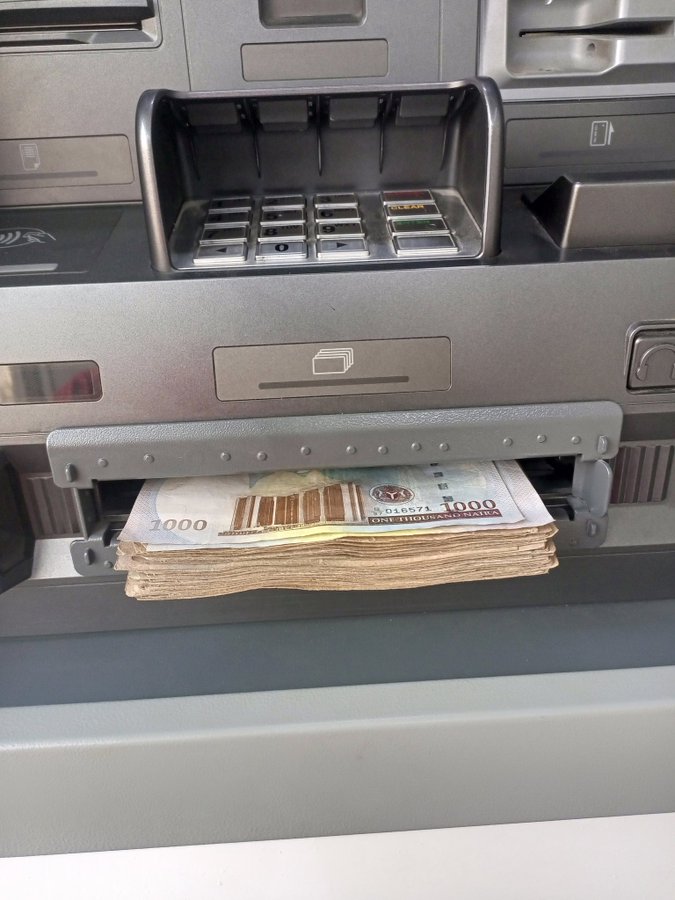
A recent report from multinational professional services network, KPMG, reveals that the usage of Automated Teller Machines (ATM) in Nigeria, dropped by 40 percent in the last quarter of 2023, amid the scarcity of Naira.

In the report titled “In pursuit of value”, KPMG revealed that the figures were obtained from surveyed customers of Nigerian and Ghanaian banks who narrated their experiences during the year 2023.

Part of the report reads,

Currently, four in 10 customers report weekly ATM usage, a notable decline from the previous seven in 10 over the last few years. This decline in ATM usage coincides with a significant rise in agency banking usage, with six in 10 customers frequenting bank agents every week.

“Consequently, digital payments surged, marking a 52 percent increase in total NIBSS Instant Payment transactions by October 2023 compared to January of the same year. This was triggered by the Central Bank of Nigeria’s (CBN) initiative to overhaul the Naira, aiming to regulate cash circulation and reduce reliance on physical currency”.

The report further explained that the rise in digital payment overwhelmed Tier-1 banks with multiple cases of transaction failure but fintechs such as Opay, PalmPay, and Moniepoint rose to the challenge leading to a significant change in customers’ preferences.

According to the survey, 58% of respondents switched banks or had reasons to change to fintechs during the period. This presents a radical shift from the 15% who switched banks in 2022.

Also, around 13 percent of retail banking respondents now rely on fintech for their primary banking needs from the four percent who made the switch in 2022.

Despite assurances from the Central Bank of Nigeria that there is enough cash in the economy, Nigerians have continued to decry the cash scarcity, as many Automated Teller Machines spread across the country, lack funds.

Fresh developments in the financial sector have shown that despite the CBN’s move to ameliorate the cash crunch situation by suspending charges for cash withdrawals above regulatory limits, scarcity of currency notes in the banks nationwide has continued to hit harder.

Findings revealed that banks across the country have continued to ration cash withdrawals in the banking halls and through their Automated Teller Machines (ATMs) while Point of Sale Operators, PoS, operators, have taken advantage by hiking transaction fees by not less than 100%.

Amidst the turmoil, the CBN Governor Yemi Cardoso, have repeatedly assured Nigerians that it had supplied the banks with enough cash. But this has not in any way reflected in the country, as the CBN blames the scarcity on hoarding.