DD
MM
YYYY

PAGES

DD
MM
YYYY

spot_img

PAGES

Home Blog Page 3841

India to launch Polar Satellite Launch Vehicle PSLV-C58, M7.5 Earthquake hits Noto Peninsula in Japan

0

The Indian Space Research Organization (ISRO) is gearing up for another milestone in its space exploration program. On January 15, 2024, ISRO will launch the Polar Satellite Launch Vehicle (PSLV-C58) from the Satish Dhawan Space Centre in Srihari Kota, Andhra Pradesh.

The PSLV-C58 will carry three satellites into orbit: the Cartosat-3B, an advanced Earth observation satellite; the IMS-2, a microsatellite for maritime surveillance; and the Anusat-2, a nanosatellite for amateur radio communication.

The PSLV-C58 is the 58th flight of the PSLV, which is India’s most reliable and versatile launch vehicle. The PSLV has a four-stage configuration, with alternating solid and liquid propellant stages. The PSLV-C58 will use the ‘XL’ variant of the PSLV, which has six strap-on boosters to provide extra thrust during the initial phase of the launch. The PSLV-C58 will have a total mass of 320 tonnes and a height of 44 meters.

The primary payload of the PSLV-C58 is the Cartosat-3B satellite, which is the second satellite in the Cartosat-3 series. The Cartosat-3B has a panchromatic camera that can capture images with a resolution of 0.25 meters and a multispectral camera that can capture images with a resolution of 1 meter. The Cartosat-3B will be used for various applications such as urban planning, infrastructure development, coastal zone management, disaster management, and military intelligence.

The secondary payloads of the PSLV-C58 are the IMS-2 and the Anusat-2 satellites. The IMS-2 is a microsatellite weighing 15 kilograms, developed by ISRO in collaboration with the Indian National Centre for Ocean Information Services (INCOIS). The IMS-2 will carry a transponder that can receive and relay signals from ships and vessels in the Indian Ocean region. The IMS-2 will help in enhancing maritime security and safety, as well as providing data for oceanographic research.

The Anusat-2 is a nanosatellite weighing 3 kilograms, developed by Anna University in Chennai. The Anusat-2 will carry a transceiver that can enable amateur radio communication among enthusiasts across the world. The Anusat-2 will also demonstrate some novel technologies such as a deployable antenna, a sun sensor, and a magnetic torque rod.

The PSLV-C58 will launch from the first launch pad of the Satish Dhawan Space Centre at 9:30 am IST on January 15, 2024. The launch window will last for 20 minutes. The PSLV-C58 will inject the Cartosat-3B into a sun-synchronous orbit at an altitude of 505 kilometers and an inclination of 97.5 degrees. The IMS-2 and the Anusat-2 will be released into lower orbits of 485 kilometers and 465 kilometers respectively.

The PSLV-C58 launch will be another feather in the cap of ISRO, which has been achieving remarkable feats in space exploration. ISRO has successfully launched more than 300 satellites from various countries using the PSLV. ISRO has also made history by sending missions to the Moon and Mars and is currently preparing for its first human spaceflight mission, Gagan Yaan, scheduled for 2025.

ISRO’s motto is ‘Space for national development’. By launching the PSLV-C58 with three important satellites, ISRO will once again demonstrate its commitment to using space technology for the benefit of India and humanity.

M7.5 Earthquake hits Noto Peninsula prompting in Japan

A powerful earthquake with a magnitude of 7.5 struck the Noto Peninsula in Japan on Monday, triggering a tsunami warning for the coastal areas. The quake occurred at 12:34 p.m. local time, at a depth of 10 kilometers, according to the Japan Meteorological Agency (JMA).

The JMA issued a tsunami warning for the Ishikawa, Toyama and Niigata prefectures, urging residents to evacuate to higher ground and avoid the shorelines. The agency said that waves of up to three meters could hit the coast within an hour of the quake.

The quake was felt strongly across the central and northern regions of Japan, shaking buildings and disrupting transportation. The JMA said that there were no reports of major damage or injuries so far but warned that aftershocks could occur in the next few days.

The Noto Peninsula is located on the Sea of Japan side of Honshu, the main island of Japan. It is known for its scenic coastline and traditional culture. The area was hit by a magnitude 6.9 earthquake in 2007, which killed one person and injured more than 200.

The latest quake comes as Japan marks the 10th anniversary of the devastating earthquake and tsunami that struck the northeastern part of the country on March 11, 2011, killing nearly 20,000 people and triggering a nuclear meltdown at the Fukushima Daiichi power plant.

The earthquake was caused by the movement of the Eurasian and North American tectonic plates along a subduction zone, where one plate slides under another. The JMA said that the quake had a maximum intensity of 6+ on the Japanese scale of 0 to 7, meaning that it was very strong and could cause severe damage.

The tsunami warning was lifted at 2:12 p.m. local time, after no significant waves were observed along the coast. However, the JMA advised people to stay alert for possible changes in sea level and to follow the instructions of local authorities.

The government set up an emergency task force to deal with the situation and Prime Minister Yoshihide Suga said that he would do everything possible to ensure the safety and security of the people. He also expressed his sympathy and support to those affected by the quake.

The earthquake was felt as far away as Tokyo, where some buildings swayed for several minutes. Many people took to social media to share their experiences and to check on their friends and family. Some also posted videos and photos of the quake and its aftermath.

Binance founder CZ’s request to leave US before sentencing denied by Judge as SEC plans to notify BTC ETF issuers

0

In a major setback for the crypto industry, a US federal judge has rejected the motion of Changpeng Zhao, the founder and CEO of Binance, to travel outside the US before his sentencing hearing. Zhao, who is widely known as CZ, is facing criminal charges of money laundering, tax evasion and violating sanctions laws.

CZ was arrested in September 2023, when he landed in New York to attend a crypto conference. He was accused of operating an unlicensed money transmitting business, facilitating transactions with sanctioned entities and individuals, and failing to report his income and assets to the IRS. He pleaded not guilty and was released on a $10 million bail, with the condition that he surrender his passport and remain in the US until his trial.

However, CZ filed a motion in November 2023, requesting permission to travel to Singapore, where Binance is headquartered, for business and personal reasons. He claimed that he needed to oversee the operations of his company, which is the largest crypto exchange in the world by trading volume, and that he had family and health issues that required his presence in Singapore. He also argued that he was not a flight risk, as he had cooperated with the authorities and had substantial ties to the US.

The prosecution opposed CZ’s motion, stating that he posed a significant flight risk, given his access to vast financial resources, his influence in the crypto community, and his connections to multiple jurisdictions that do not have extradition treaties with the US. They also alleged that CZ had continued to engage in illegal activities while on bail, such as transferring funds to offshore accounts, communicating with sanctioned entities and individuals, and promoting unregulated crypto products.

On December 15, 2023, Judge James Otero denied CZ’s motion, ruling that he had not shown sufficient reasons to justify his travel request. The judge said that CZ had failed to provide any evidence of his family or health issues, and that his business interests did not outweigh the risk of flight. The judge also noted that CZ had violated some of the terms of his bail agreement, such as using encrypted messaging apps and accessing crypto wallets.

CZ’s legal team appealed the judge’s decision, claiming that it was arbitrary and unreasonable. They also filed a new motion on December 29, 2023, asking for a reconsideration of the travel request, citing new developments in CZ’s personal and professional life. They said that CZ had received an urgent medical diagnosis that required him to undergo surgery in Singapore, and that Binance was facing a potential takeover by a rival company that threatened its existence.

However, on January 1, 2024, Judge Otero denied CZ’s new motion as well, saying that it was essentially a rehash of the previous motion, with no new or compelling evidence. The judge said that CZ had not provided any medical records or documents to support his diagnosis claim, and that Binance’s takeover threat was speculative and unsubstantiated. The judge also expressed skepticism about CZ’s sincerity and credibility, saying that he had shown a pattern of deception and evasion throughout the case.

CZ’s sentencing hearing is scheduled for February 15, 2024. He faces up to 20 years in prison if convicted on all charges. His lawyers have said that they will continue to fight for his rights and freedom, and that they will appeal the judge’s rulings to a higher court. Meanwhile, Binance has issued a statement saying that it is operating normally and that it is confident in its future prospects.

SEC may notify Bitcoin ETF issuers as soon as Tuesday or Wednesday – Reuters

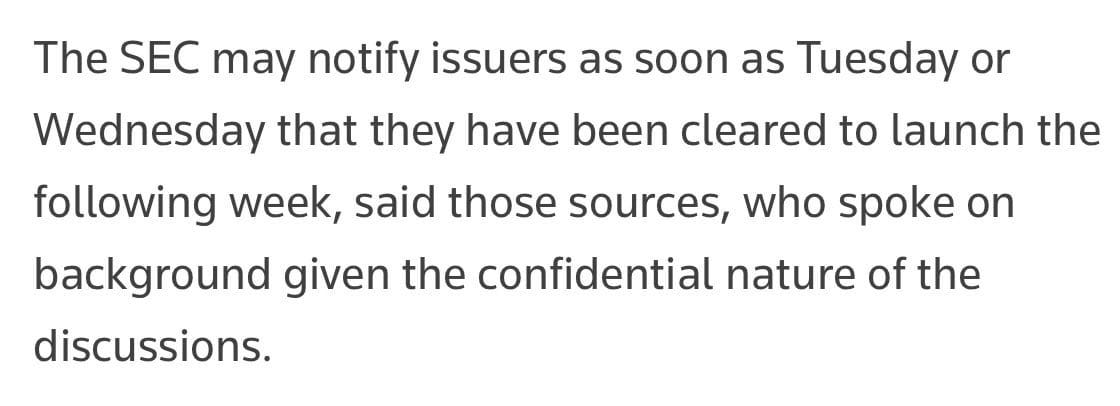
Meanwhile, the long-awaited Bitcoin ETFs may finally get the green light from the U.S. Securities and Exchange Commission (SEC) as early as this week, according to a Reuters report. The report cites unnamed sources familiar with the matter, who said that the SEC could notify the issuers of the first Bitcoin futures ETFs as soon as Tuesday or Wednesday that they have met all the regulatory requirements and can start trading on Monday, January 15th.

This would be a major milestone for the cryptocurrency industry, which has been lobbying for years for a Bitcoin ETF that would allow retail and institutional investors to gain exposure to the digital asset without having to buy and store it directly. A Bitcoin futures ETF would track the price of Bitcoin through contracts traded on regulated exchanges, such as the Chicago Mercantile Exchange (CME).

The SEC has been reluctant to approve a Bitcoin ETF that would hold the underlying asset, citing concerns over market manipulation, custody, and investor protection. However, the agency has signaled a more favorable stance towards a Bitcoin futures ETF, which would fall under the existing regulatory framework for commodity-based funds.

The Reuters report did not name the issuers that could receive the SEC’s approval, but several firms have filed for a Bitcoin futures ETF in recent months, including, BlackRock, ProShares, Invesco, Valkyrie, VanEck, and Galaxy Digital. The SEC has set deadlines to either approve or reject these applications in October and November but shifted to January 2024 to accommodate more clarity and provisions.

However, the SEC has set a deadline of January 14, 2024, to make a decision on VanEck’s spot Bitcoin ETF proposal, which is the first one in line for review. If approved, it would be the first spot Bitcoin ETF in the US, and likely pave the way for others to follow. If rejected, it would be another setback for the crypto industry, which has been waiting for years for a spot Bitcoin ETF in the US.

BlackRock’s filing suggests that it is confident that the SEC will eventually approve a spot Bitcoin ETF in the US, and that it wants to be ready to launch its own product when that happens. BlackRock has already shown its interest in Bitcoin and other cryptocurrencies, as it has invested in several crypto-related companies and funds and has allowed some of its funds to hold Bitcoin futures contracts.

By launching a spot Bitcoin ETF in the US, BlackRock would further cement its position as a leader in the crypto space and offer its clients a new way to gain exposure to the digital asset class.

If approved, a Bitcoin futures ETF could boost the demand and liquidity for Bitcoin, as well as its price. It could also pave the way for more crypto-related products and services in the U.S. market, such as a spot Bitcoin ETF or an Ethereum ETF. However, some analysts have also warned that a Bitcoin futures ETF could introduce more volatility and risk for investors, as well as higher fees and tracking errors.

BTC, ETH, Crypto stocks and ETFs: Which performed best in 2023?

0

The year 2023 was a remarkable one for the cryptocurrency market, as it witnessed new highs, lows, and innovations. Among the various assets that investors could choose from, BTC, ETH, crypto stocks and ETFs were some of the most popular and profitable options. We will compare the performance of these four categories and analyze the factors that influenced their returns.

BTC: The king of crypto

BTC, or Bitcoin, is the oldest and most dominant cryptocurrency in the world. It was created in 2009 by an anonymous person or group using the pseudonym Satoshi Nakamoto. BTC is a decentralized digital currency that operates on a peer-to-peer network without any intermediaries. It uses cryptography to secure transactions and control the creation of new units.

BTC started the year 2023 at around $43,000, after reaching an all-time high of $69,000 in November 2022. It faced some volatility in the first quarter, as regulatory uncertainty, environmental concerns, and competition from other cryptocurrencies weighed on its price.

However, it rebounded strongly in the second quarter, as institutional adoption, innovation, and network upgrades boosted its demand and value. It reached a new record in June 2023 from 2021 lows, making it the first cryptocurrency to achieve this rebound milestone.

BTC continued its upward trend in the third quarter, as more countries legalized its use as a legal tender, such as El Salvador, Panama, and Ukraine. It also benefited from the launch of several Bitcoin ETFs in the US and Canada, which made it easier for investors to access the asset without having to deal with custody and security issues. It surpassed $35,000 in September 2023, gaining more than 200% year-to-date.

BTC faced some challenges in the fourth quarter, as China intensified its crackdown on crypto mining and trading activities, causing a temporary drop in its hash rate and price. It also faced some competition from ETH and other altcoins, which offered higher returns and innovation potential.

ETH: The leader of smart contracts

ETH, or Ethereum, is the second-largest cryptocurrency by market capitalization and the most widely used platform for smart contracts and decentralized applications (DApps). It was launched in 2015 by Vitalik Buterin and other co-founders. ETH is a programmable currency that allows developers to create and run various applications that can facilitate transactions, agreements, and interactions without intermediaries or censorship.

ETH started the year 2023 at around $1200, after reaching an all-time high of $4,000 in December 2022. It faced some pressure in the first quarter, as high gas fees, scalability issues, and security breaches hampered its usability and adoption. However, it regained momentum in the second quarter, as it completed its long-awaited transition to a proof-of-stake (PoS) consensus mechanism, which reduced its energy consumption and increased its speed and security.

It also introduced several improvements to its network, such as EIP-1559 and EIP-3675, which enhanced its monetary policy and governance. ETH soared to new heights in the third quarter, as it benefited from the growth of various sectors that relied on its platform, such as decentralized finance (DeFi), non-fungible tokens (NFTs), gaming, and metaverse. It reached a new peak of $10,000 in August 2023, making it the second cryptocurrency to achieve this feat.

ETH maintained its strong performance in the fourth quarter, as it continued to innovate and attract more users and developers. It also faced some competition from other smart contract platforms, such as Solana, Cardano, and Avalanche, which offered lower fees, higher throughput, and interoperability. However, it managed to retain its leadership position and end the year at around $2400, up 200% from the start of the year.

Crypto stocks: The bridge between traditional and digital markets

Crypto stocks are shares of companies that are involved in or related to the cryptocurrency industry. They include miners, exchanges, brokers, custodians, payment providers, and software developers. Crypto stocks offer investors a way to gain exposure to the crypto market without having to buy or hold the actual coins or tokens. Crypto stocks started the year 2023 with high expectations, as they benefited from the increased popularity and adoption of cryptocurrencies in 2022.

They also enjoyed the support of the regulatory environment, which became more favorable and clearer for crypto-related businesses in many jurisdictions. Crypto stocks performed well in the first half of the year, as they reported strong earnings growth and expanded their products and services.

Some of the notable performers were Coinbase, the largest US-based crypto exchange, which went public in April 2023 and reached a market capitalization of $100 billion in June 2023; MicroStrategy, the business intelligence firm that became the largest corporate holder of BTC, which saw its share price increase by 300% in the same period; and Square, the payments company that integrated BTC and ETH into its Cash App and launched its own decentralized exchange (DEX) in May 2023.

Crypto stocks faced some headwinds in the second half of the year, as they encountered some challenges and risks. Some of the main factors were the increased competition from the traditional financial institutions, which entered the crypto space with their own offerings; the heightened regulatory scrutiny and enforcement actions from the authorities, which targeted some of the crypto companies for alleged violations or fraud; and the cyberattacks and hacks that compromised some of the crypto platforms and services.

Crypto stocks ended the year with mixed results, as they reflected the diversity and dynamism of the crypto industry. Some of the best performers were Galaxy Digital, the diversified crypto asset manager, which increased its assets under management by 400% to $40 billion in December 2023.

Bitfarms, the Canadian crypto mining company, which expanded its operations and increased its hash rate by 500% to 10 Exa hash per second in the same month; and PayPal, the online payments giant, which added more crypto features and options to its platform and reached 500 million active users in November 2023.

Crypto ETFs: The easy and convenient way to invest in crypto.

Crypto ETFs are exchange-traded funds that track the performance of a basket of cryptocurrencies or crypto-related assets. They offer investors a simple and convenient way to invest in the crypto market without having to deal with the technicalities and complexities of buying, storing, or securing the actual coins or tokens.

Crypto ETFs started the year 2023 with high demand, as they provided a solution for the investors who wanted to access the crypto market but were deterred by the barriers or risks of owning or trading cryptocurrencies directly.

They also appealed to the institutional investors who sought to diversify their portfolios with a new and emerging asset class. Crypto ETFs performed well in the first three quarters of the year, as they mirrored the performance of their underlying assets.

Some of the most popular and successful crypto ETFs were the Grayscale Bitcoin Trust (GBTC), which became the largest crypto ETF in the world with over $50 billion in assets under management in July 2023; the Purpose Bitcoin ETF (BTCC), which became the first Bitcoin ETF to be approved and listed in the US in February 2023; and the VanEck Digital Assets ETF (DAPP), which became the first ETF to offer exposure to a broad range of crypto-related companies in April 2023.

Crypto ETFs faced some challenges in the fourth quarter of the year, as they experienced some volatility and outflows. Some of the main reasons were the profit-taking and rebalancing activities by some investors who wanted to lock in their gains or reduce their exposure to the crypto market; the increased competition from other investment vehicles that offered more flexibility and variety to the investors; and the regulatory uncertainty and delays that affected some of the pending or proposed crypto ETFs.

Crypto ETFs ended the year with positive returns, as they demonstrated the potential and growth of the crypto market. Some of the best performers were the Bitwise 10 Crypto Index Fund (BITW), which tracked the performance of the top 10 cryptocurrencies by market capitalization and returned over 300% in 2023.

The Amplify Transformational Data Sharing ETF (BLOK), which invested in companies that used blockchain technology to transform their businesses and industries and returned over 200% in the same period; and the ARK Next Generation Internet ETF (ARKW), which allocated a portion of its portfolio to GBTC and other innovative companies that leveraged or enabled the internet and returned over 150% in 2023.

Builders, the Crypto bear market is almost over

If you are a builder in the crypto space, you might be feeling discouraged by the prolonged downtrend in the market. You might be wondering if your project will ever see the light of day, or if you should just give up and move on to something else. But don’t lose hope. The bear market is almost over, and the next bull run is just around the corner. Here are some reasons why you should keep building and stay optimistic about the future of crypto.

You know how hard it has been to survive the prolonged bear market that started in 2022. The crypto industry has faced many challenges, such as regulatory uncertainty, environmental concerns, security breaches, and low adoption rates. Many projects have failed, and many investors have lost faith in the future of decentralized technologies.

But there is hope on the horizon. According to some experts, the bear market is almost over, and we can expect a new cycle of growth and innovation in 2024. Here are some reasons why:

The adoption of crypto is increasing, especially in emerging markets where people need alternative financial solutions. More and more people are using crypto for remittances, payments, savings, and lending. According to a recent report by Chainalysis, the global crypto adoption index grew by 880% in 2023, with Vietnam, India, Pakistan, and Ukraine leading the way.

The innovation of crypto is accelerating, especially in the areas of decentralized finance (DeFi), non-fungible tokens (NFTs), and Web3. More and more developers are building applications that leverage the power of smart contracts, digital assets, and peer-to-peer networks. According to a recent report by DappRadar, the total value locked in DeFi protocols reached $500 billion in 2023, while the total sales volume of NFTs surpassed $100 billion.

The regulation of crypto is improving, especially in the major markets where governments are recognizing the potential of blockchain technology. More and more countries are adopting clear and supportive legal frameworks for crypto businesses and users. According to a recent report by CryptoCompare, the crypto regulatory index improved by 50% in 2023, with Singapore, Switzerland, Japan, and the UK leading the way.

These are just some of the signs that indicate that the crypto industry is maturing and ready for a new phase of growth. As builders, we have a unique opportunity to shape the future of this industry and create value for ourselves and our communities. We should not give up on our vision and mission, but rather double down on our efforts and prepare for the next bull market.

The fundamentals are strong. Despite the price fluctuations, the underlying technology and innovation in the crypto space are still advancing at a rapid pace. New protocols, platforms, applications, and use cases are being developed every day, offering solutions to real-world problems and creating value for users. The adoption and awareness of crypto are also growing, as more people, institutions, and governments recognize its potential and benefits.

The market cycles are natural. Crypto is a highly volatile and speculative asset class, which means it is subject to extreme highs and lows. This is not a sign of weakness, but rather a reflection of the market psychology and sentiment. Historically, crypto has gone through several boom-and-bust cycles, each followed by a period of consolidation and accumulation. These cycles are necessary to shake out the weak hands, test the resilience of the network, and create the conditions for the next wave of growth.

The future is bright. Crypto is not just a fad or a bubble. It is a paradigm shift that will transform the world as we know it. Crypto is not only a new form of money, but also a new way of organizing society, empowering individuals, and creating wealth.

Crypto is not only a challenge to the status quo, but also an opportunity to create a more open, fair, and inclusive world. Crypto is not only a technology, but also a movement, a community, and a culture. So don’t give up on your dreams. Keep building, keep learning, keep innovating. The bear market is almost over, and the best is yet to come.

Nigerian Senate Passes N27.5tn 2024 Budget with N1.2tn Increase

0

On Saturday, the Nigerian Senate bulldozed its way through a storm of controversies to pass the 2024 budget, boasting an eye-watering increase of about N1.2 trillion. The approval, a hefty bump from the N27.5 trillion initially proposed by President Bola Tinubu in November, now stands at an imposing N28.7 trillion.

Raising eyebrows and fueling the already fervent discourse on fiscal responsibility, the upper legislative chamber took a bold step by pegging the benchmark of oil prices at $77.96 per barrel of crude oil. This move is seen as an effort to align with the current volatile market values of the coveted commodity on the international stage.

However, what has gripped the nation’s attention is the slew of allocations and adjustments that accompanied the budget passage. The federal lawmakers nodded approvingly to an oil production rate of 1.78 million barrels per day and held steadfast to an exchange rate of N800 to a US dollar. GDP growth rate found its place in the budget at a promising 3.88%, while the budget deficit was greenlit at a staggering N9.18 trillion.

In a theatrical denouement, Senate President Godswill Akpabio, amidst an air of tension and dissent, declared the budget’s passage after a majority of lawmakers supported it through a voice vote. This contentious approval followed a thorough consideration of a report presented by the Chairman of the Senate Committee on Appropriations, Adeola Olamilekan.

Olamilekan, presenting the report, recommended a financial rollercoaster ride. A whopping N1.7 trillion was greenlighted for Statutory Transfers, while Debt Service came with a jaw-dropping price tag of N8.2 trillion. The drama didn’t end there – recurrent (non-debt) expenditure weighed in at N8.7 trillion, and capital expenditure made its grand entrance at a princely sum of N9.9 trillion.

The reason behind this budgetary crescendo

According to Olamilekan, the joint National Assembly Committee on Appropriation identified a critical need for additional funding in areas not listed in the initial Appropriation Bill presented by President Tinubu. The inadequacy in budgetary allocations for certain Ministeries, Departments, and Agencies (MDAs) was exposed, leading to this staggering increase.

But the Senate’s financial theatrics didn’t stop at the national budget. In an audacious move, the National Assembly decided to swell its 2024 budget from N197 billion to an astounding N344 billion. This eye-watering 75% increase from the initial proposal and a 51% surge from the 2023 budget allocation have left tongues wagging and pens scribbling.

What ignited the most fervent debates was the detailed breakdown of the National Assembly’s bounty. A staggering N78.624 billion was earmarked for the House of Representatives, while the Senate bagged a cool N49.145 billion. However, the extravagant allocations didn’t stop at lawmakers’ pockets.

In a brazen display of indulgence, the National Assembly set aside N4 billion for the construction of a new National Assembly Recreational Centre and a further N6 billion to build car parks. These revelations have reignited discussions about the bloated cost of governance in Nigeria.

The allocations rolled out like a red carpet for opulence – N4.5 billion was approved for the completion of the National Institute for Legislative and Democratic Studies (NILDS) building. Furthermore, N2.7 billion was greenlit for the furnishing of committee meeting rooms and other offices within the Senate building.

The National Assembly spared no expense, allocating N3 billion each for infrastructure upgrades and the establishment of a modern printing press. Another N3 billion was earmarked for purchasing books in the National Assembly library. Specific allocations included N2.5 billion to the Pension Board, N1.230 billion for retired clerks and permanent secretaries and a cool N1 billion for constitution review.

To add a layer of irony to the entire spectacle, the Senate Appropriations Committee secured a cozy N200 million, while the Public Accounts Committee claimed its share with N130 million. The House was not left behind, garnering N150 million for their Public Accounts Committee.

The Socio-economic Rights & Accountability Projects (SERAP) has decided that enough is enough, boldly declaring their intent to sue the National Assembly for what they term an “outrageous and unlawful increase” in allocations for lawmakers. SERAP has framed the move as an assertion of the people’s voice against the backdrop of millions of Nigerians grappling with extreme poverty.

“We’re suing the National Assembly over the outrageous and unlawful increase in the allocations for lawmakers from N197 billion to N344 billion, to satisfy their lavish lifestyles while millions of Nigerians live in extreme poverty,” the organization announced.

The Senate’s budgetary maneuvers have become a catalyst for a broader discussion about the role of the National Assembly and the urgent need for financial prudence in the country.

Traders are Abandoning US Dollar for Oil Transactions

0

Oil is one of the most important commodities in the world economy, and its price and trade have a significant impact on global markets. Traditionally, oil has been priced and traded in US dollars, the dominant reserve currency and the medium of exchange for most international transactions.

However, in recent years, some oil producers and consumers have started to shift away from the US dollar and use other currencies or assets for their oil deals. What are the reasons behind this trend, and what are the implications for the US and the global economy?

One of the main reasons why some oil traders are abandoning the US dollar is the desire to reduce their exposure to US sanctions and geopolitical risks. The US has imposed sanctions on several major oil producers, such as Iran, Venezuela, and Russia, as well as some of their trading partners, such as China and Turkey.

These sanctions limit the access of these countries to the US financial system and restrict their ability to sell their oil in US dollars. By using alternative currencies or assets, such as the euro, the yuan, or gold, these countries can bypass the US sanctions and maintain their oil trade with their allies and customers.

Another reason why some oil traders are abandoning the US dollar is the diversification of their portfolios and risk management. The US dollar has been losing its value and purchasing power over time due to inflation, debt, and monetary expansion.

Moreover, the US dollar faces increasing competition from other reserve currencies, such as the euro and the yuan, as well as emerging digital currencies, such as Bitcoin and stablecoins. By using different currencies or assets for their oil transactions, oil traders can hedge against the fluctuations of the US dollar and benefit from the appreciation of other currencies or assets.

A third reason why some oil traders are abandoning the US dollar is the alignment of their interests and preferences with their trading partners. Some oil producers and consumers have strong economic and political ties with each other, and they prefer to use their own or regional currencies or assets for their oil trade.

For example, China is the largest importer of oil in the world, and it has been promoting the use of its currency, the yuan, for its oil imports from countries like Russia, Iran, and Saudi Arabia. Similarly, some European countries have been using the euro for their oil imports from countries like Iran and Iraq. By using their own or regional currencies or assets, these countries can strengthen their economic integration and cooperation, as well as reduce their dependence on the US dollar.

The trend of abandoning the US dollar for oil transactions has significant implications for the US and the global economy. On one hand, it could reduce the demand for the US dollar and weaken its status as the dominant reserve currency and medium of exchange. This could increase the cost of borrowing and financing for the US government and businesses, as well as reduce their influence and leverage over other countries.

On the other hand, it could also create more opportunities for innovation and competition in the global financial system and foster more diversity and stability in the international monetary order. This could benefit both oil producers and consumers by lowering transaction costs, increasing efficiency, and enhancing resilience.

Automated trading and Algo gets FBS MT4

If you are looking for a reliable and flexible platform to automate your trading strategies, you might want to check out the FBS MT4 trading platform. FBS is a global broker that offers various trading instruments, including forex, metals, stocks, indices, and cryptocurrencies. FBS also supports automated trading and algorithmic trading, which can help you save time and optimize your performance.

Automated trading is a method of executing orders using pre-programmed trading instructions based on various criteria, such as time, price, volume, indicators, etc. Automated trading can eliminate human emotions and errors, as well as take advantage of market opportunities 24/7. Algorithmic trading is a subset of automated trading that involves using complex mathematical models and algorithms to generate and execute orders.

FBS MT4 is one of the most popular and widely used platforms for automated and algorithmic trading. It has a user-friendly interface, advanced charting tools, technical analysis indicators, and a built-in programming language called MQL4. MQL4 allows you to create your own custom indicators, scripts, and expert advisors (EAs), which are automated trading systems that can run on the FBS MT4 platform.

FBS MT4 also offers access to a large online community of traders and developers who share their ideas, experiences, and codes. You can find thousands of free and paid EAs, indicators, and scripts on the MQL4 website or the MetaTrader Market. You can also test and optimize your EAs using the Strategy Tester tool, which simulates historical market data and provides detailed statistics and reports.

If you want to start automated or algorithmic trading with FBS MT4, you need to follow these steps:

  1. Open an account with FBS and download the FBS MT4 platform from their website.
  2. Choose an EA or create your own using MQL4 or other tools.
  3. Install the EA on the FBS MT4 platform and adjust the settings according to your preferences and risk tolerance.
  4. Enable automated trading on the FBS MT4 platform and monitor your EA’s performance.

Automated and algorithmic trading can be a powerful way to enhance your trading experience and results. However, you should also be aware of the risks and challenges involved, such as technical issues, market volatility, broker slippage, etc. Therefore, you should always test your EAs before using them on a live account and use proper risk management techniques.

FBS MT4 is a great platform for automated and algorithmic trading that offers many features and benefits for traders of all levels. If you want to learn more about FBS MT4 or open an account with FBS, you can visit their website or contact their customer support team.

FBS MT4 is compatible with Windows, Mac, iOS, and Android devices, so you can access your account anytime and anywhere. You can also benefit from the FBS customer support team, which is available 24/7 to assist you with any issues or questions.

To start trading with FBS MT4, you just need to open an account with FBS and download the platform for free. You can also try out the platform with a demo account before you invest real money. FBS MT4 is a trading platform that combines simplicity and functionality to suit traders of all levels.