DD
MM
YYYY

PAGES

DD
MM
YYYY

spot_img

PAGES

Home Blog Page 385

What is NFT Strategy as BoDoggos and Claynosaurz Launch on Bands.fun?

0

The launch of treasury strategy tokens tied to popular collections like BoDoggos and Claynosaurz on what appears to be the bands.fun platform is a play on or variant of “pump.fun,” the Solana-based memecoin and NFT launchpad known for rapid token deployments.

This fits into the booming “NFT Strategy Token” ecosystem, where tokens are designed to automate treasury management, yield generation, and flywheel mechanics for NFT holders.

What Are NFT Strategy Tokens?

These are innovative ERC-20 or Solana SPL tokens linked to specific NFT collections. They function like a “perpetual machine”.

The token treasury buys NFTs from the collection at market price, relists them at a premium (e.g., 1.2x), and uses sale proceeds to buy and burn more strategy tokens—creating self-sustaining growth and yield for holders.

Trading fees often 8-10% on DEX swaps like Uniswap or Raydium feed the treasury; royalties from NFT sales add more fuel. With NFT trading volumes rebounding up 150% YoY per recent OpenSea data, these tokens bridge DeFi and NFTs, turning passive holdings into active income generators.

Early adopters like PunkStrategy ($PNKSTR) have hit $87M market caps since September 2025 launches. This model exploded in late September 2025 when TokenWorks integrated them with OpenSea, enabling seamless trading and a 20 ETH rewards pool for top performers.

The BoDoggos and Claynosaurz Launches on Bands.fun

BoDoggos Treasury Strategy Token BoDoggos is an established Solana PFP collection 8,888 dog-themed NFTs launched in June 2023, with a focus on crypto entertainment and collectibles via their site.

The new strategy token automates treasury buys of BoDoggos NFTs, channeling fees into a K9-themed yield strategy recently revealed, per crypto news outlets. This includes staking rewards and podcast tie-ins from their “Morning Show.”

Rolled out in early October 2025 on bands.fun, coinciding with Solana’s memecoin surge. Early volume spiked 300% post-launch, with treasury holdings already at 50+ NFTs.

Aimed at “choosing rich” via meme-dog vibes—think BONK meets DeFi. Floor price for base BoDoggos NFTs is ~0.5 SOL, up 20% since the token drop.

Claynosaurz is a vibrant Solana NFT collection 10,000+ animated 3D dinosaur PFPs, launched in 2023, known for utilities like staking and metaverse access.

This strategy token focuses on “dino treasury raids,” using swap fees to acquire rare traits (e.g., golden scales) and burn supply for scarcity. Delphi Digital highlights it as a top Solana play in their 2025 NFT report.

Simultaneous with BoDoggos on bands.fun, October 4-5, 2025. Initial treasury seeded with 100 ETH equivalent in SOL. Floor price charts show a 15% uplift to ~2.2 SOL per NFT. It’s positioned for gaming integrations, with rumors of a Claynosaurz GameFi expansion.

These launches on bands.fun a fun, community-driven launchpad emphasizing “band” narratives like music/meme collabs mark a shift from pure memecoins to utility-driven NFT treasuries. No major glitches reported yet, unlike some pump.fun rollouts.

5 New NFT Strategy Tokens Launching This Week

Building on the momentum, bands.fun and TokenWorks are deploying 5 fresh strategy tokens tied to high-profile collections. These are set for sequential launches October 7-11, 2025, with airdrops for early BoDoggos/Claynosaurz holders.

Pudgy Penguins buys rare penguins; 1% royalty boost; ETH treasury focus. Bored Ape Yacht Club (Ethereum) Ape-specific staking; integrates BAYC metaverse yields; 10% swap burn.

Moonbirds (Ethereum) Toad trait farming; nests 5+ birds per cycle; DeFi nesting yields. Moonbirds variant Bird-exclusive; burns 1.5% supply on sales; community-voted buys.

Azuki an Anime ecosystem tie-in; auto-buys Elementals; $8M seed treasury. All feature the flywheel buy-relist-burn loop, 8-10% DEX fees to treasury, and OpenSea listings for liquidity. Total rewards pool: 50 ETH across the batch.

High volatility (e.g., $PNKSTR dipped 2% daily but +392% monthly). DYOR—focus on collections with >$10M floor volume. Trade on Uniswap/Raydium; stake for 4-6% APY yields.

This wave could push NFT strategy tokens to a $1B+ sector by EOY 2025, per DappRadar forecasts, rivaling soulbound tokens (SBTs) in utility. BoDoggos and Claynosaurz add meme + gaming flavor, differentiating from ETH-heavy plays like PUNKSTR.
CME Group Officially Announces Plan To Expand Futures Trading Options on A 24/hrs Basis

0

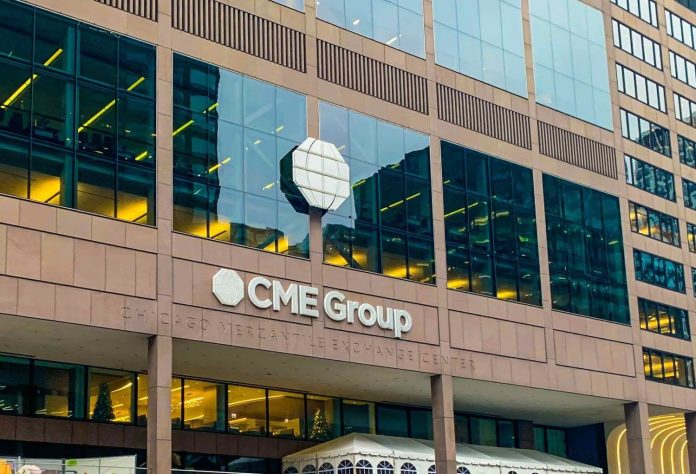
CME Group— the world’s leading derivatives marketplace—officially announced plans to expand its cryptocurrency futures and options trading to a 24/7 model, starting in early 2026, subject to regulatory approval from bodies like the U.S. Commodity Futures Trading Commission (CFTC).

This move aligns regulated crypto derivatives more closely with the nonstop nature of spot cryptocurrency markets, addressing growing institutional demand for round-the-clock risk management.

The products will trade continuously on the CME Globex electronic platform, with only a brief two-hour weekly maintenance window over the weekend exact timing TBD. This eliminates the current pauses outside traditional business hours and on weekends.

Affected Products: This applies to CME’s suite of crypto derivatives, including:Bitcoin (BTC) and Micro Bitcoin futures and options.
Ether (ETH) and Micro Ether futures and options.

Recently launched Solana (SOL) futures and upcoming XRP futures set for October 2025.
Trades executed from Friday evening through Sunday evening will carry the next business day’s trade date.

Clearing, settlement, and reporting will occur on the following business day, maintaining standard operational integrity. As stated by Tim McCourt, CME Group’s Global Head of Equities, FX, and Alternative Products:

While not all markets lend themselves to operating 24/7, client demand for around-the-clock cryptocurrency trading has grown as market participants need to manage their risk every day of the week. This reflects the maturation of digital assets and bridges traditional finance with crypto’s global, always-on ecosystem.

CME has been a pioneer in regulated crypto trading since launching Bitcoin futures in 2017. In 2025 alone, its crypto products have hit record highs:Open Interest: $39 billion in notional value across contracts.

335,200 contracts (Q3 2025), equating to ~$14.1 billion in notional value. Over 1,010 large open interest holders by late September 2025, signaling strong engagement from hedge funds, asset managers, and other pros.

This expansion could further boost liquidity and price discovery, especially as Bitcoin and Ether prices surge BTC recently hit a two-month high around $125,000. However, it remains pending approval, so watch for updates from regulators in the coming months.

Constant access to hedging tools could dampen volatility during off-hours (e.g., weekends), as institutional traders can actively manage positions in response to global events, reducing the risk of large price gaps.

24/7 trading caters to international investors across time zones, potentially increasing trading volumes and reinforcing CME’s role as a global pricing benchmark for crypto.

Institutional investors hedge funds, asset managers, often avoid crypto due to its volatility and lack of regulated hedging tools outside traditional hours. 24/7 access allows them to hedge spot crypto holdings or speculative positions at any time, likely attracting more institutional capital.

The move could draw in new players, such as pension funds or banks, who require robust, regulated markets. CME’s existing 1,010+ large open interest holders as of September 2025 suggest strong institutional interest, which could grow further.

With continuous trading, crypto derivatives become more viable for inclusion in traditional portfolios, blending digital assets with equities, bonds, and commodities.

Historically, CME’s crypto product expansions via Bitcoin futures in 2017, Ether futures in 2024 have coincided with price rallies, as they signal mainstream acceptance. Bitcoin’s recent climb to ~$124,000 could see further upside if 24/7 trading fuels demand.

24/7 futures trading may reduce price discrepancies between spot and futures markets, as traders can exploit arbitrage opportunities in real-time, potentially stabilizing prices across exchanges.

The plan requires CFTC approval, which could set a precedent for other exchanges to offer 24/7 crypto derivatives. A smooth approval process might encourage regulators to greenlight additional crypto products, like spot ETFs or new futures.

CME’s move could pressure competitors like CBOE or emerging crypto-native platforms to extend trading hours, intensifying competition in the regulated crypto derivatives space.

While CME’s products primarily serve institutions, increased liquidity and price stability could benefit retail traders on spot exchanges, as CME’s futures often influence spot market pricing.

Retail traders may not directly access CME’s futures due to high contract sizes like 5 BTC per standard contract, but micro futures 0.1 BTC or 0.01 ETH make participation more feasible. 24/7 trading could encourage retail brokers to offer similar products.

24/7 crypto trading on a regulated platform like CME further integrates digital assets into mainstream finance, blurring the line between crypto and traditional markets.

Success here could spur other exchanges to experiment with 24/7 trading for other asset classes, potentially reshaping how global markets operate.

As crypto becomes a larger part of institutional portfolios, its correlation with traditional markets may increase, impacting broader market dynamics during economic events.

Continuous trading demands robust systems to handle high volumes and prevent outages. Any technical failures could erode trust, especially during volatile periods.

24/7 trading could amplify risks of manipulation in less liquid hours, though CME’s surveillance and regulatory oversight mitigate this compared to unregulated spot markets.

Newer products like Solana futures and upcoming XRP futures could gain traction faster with 24/7 access, potentially elevating their market profiles.

Germany’s Housing Crisis A Deepening Threat to Economic Recovery As Russia Rejects Alleged Drones Sighted on German Sites

0

Germany’s chronic housing shortage has escalated into a full-blown crisis, with recent reports estimating a deficit exceeding 1.2 million units in the western regions alone.

This shortfall is not only pricing out families and young professionals but also stifling broader economic momentum at a time when the country is grappling with stagnation and recession risks.

As of October 2025, the issue dominates headlines, with experts warning of a “domino effect” on growth, labor mobility, and social stability.

The Scale of the Shortage

Germany needs to build approximately 320,000 new apartments annually through 2030 to catch up with demand, driven by population growth, urbanization, and an influx of skilled workers.

However, completions are projected to hover around just 225,000–230,000 units in 2025, a decline from 245,000 in 2023 and a sharp drop from the government’s unfulfilled target of 400,000 per year.

Building permits tell an even grimmer story: approvals for multi-family homes fell nearly 20% in the first half of 2024, while single-family permits plunged 26.6%, signaling a pipeline that’s drying up fast.

Urban centers like Berlin, Munich, and Hamburg are hit hardest, where queues of hundreds form for single viewings, and rents have surged—up 27% for relets since 2013 in some areas.

A growing number of households over 40% in major cities now spend more than 40% of income on housing, crossing the OECD’s “overburdened” threshold. This affects not just low-income groups but the middle class.

The housing crunch is a direct drag on Germany’s already faltering economy, which contracted in 2023 and is forecasted to shrink another 0.2% in 2025—marking three straight years of recession, the longest since the 1940s.

With 28% of companies reporting skill gaps amid an aging population, Germany desperately needs foreign talent. Yet, unaffordable housing deters immigrants and even domestic workers from relocating to high-demand areas like manufacturing hubs.

Economists estimate this mismatch could shave 0.5–1% off annual GDP growth, as untapped productivity goes unrealized. The sector, which employs over 2.5 million people, is in freefall due to high interest rates though easing, bureaucratic red tape, and insolvencies.

Depleted order books and financing woes mean residential activity won’t rebound significantly until 2026 at earliest, per ING analysts. This cascades into related industries like materials and logistics, amplifying the downturn.

Skyrocketing rents erode disposable income, curbing spending on everything from cars to vacations—key drivers of Germany’s export-led economy. Combined with stagnant wages and 8–10% unemployment in some sectors, it’s fueling inequality and pushing voters toward political extremes, as seen in the February 2025 snap elections.

Despite modest house price gains projected at 3.5% for 2025 up from 3% prior forecasts, downside risks from trade tensions and economic weakness loom large. Investors eye residential rentals as a “defensive” play amid the shortage, but overall real estate transaction volumes have halved since 2023.

Broader headwinds—like energy costs from the Ukraine fallout, a manufacturing PMI stuck below 50 for 26 months, and a €123 billion annual pension funding gap—compound the pain.

Bond yields are climbing 10-year real yields at 0.93%, signaling investor jitters over debt. Strict building codes, lengthy approvals often years and noise/heating mandates make projects “practically impossible,” per construction CEOs.

The BauGB reform aims to ease this, but progress is slow. Inflows of refugees and workers add demand without matching supply, sparking debates about prioritization like new asylum complexes in Berlin amid local shortages.

The rent cap Mietpreisbremse expires end-2025 without extension likely, and subsidies remain limited despite calls for more. Political gridlock post-coalition collapse hasn’t helped.

Low homeownership under 50% and urban migration exacerbate urban-rural divides. Optimists point to ECB rate cuts trickling into mortgages outstanding loans hit €1.61 trillion by March 2025 and investor interest in “distressed assets” as sparks for recovery.

The residential sector could see 3–4% price/rent growth in 2025, creating opportunities for yields. But without bold moves—like slashing red tape or €60 billion in targeted subsidies—the crisis risks entrenching recession.

As Ifo Institute forecast warns: “Nothing will happen in 2025; investments will shrink further.” This isn’t just a housing story—it’s a litmus test for Germany’s economic resilience. With elections fresh in memory and global uncertainties mounting, addressing it could be the key to unlocking growth.

Russia Firmly Rejects Alleged Drones Sighted on Key German Sites Attributed to Kremlin

In early October 2025, unidentified drones were sighted over key German sites, including Munich International Airport, Frankfurt Airport, an ammunition depot, and military bases in states like Schleswig-Holstein and Thuringia.

These incursions led to temporary airport closures on October 2 and 3, disrupting thousands of flights and stranding passengers during the busy Oktoberfest period.

German authorities described the drones as “military-grade reconnaissance” models, unarmed but capable of espionage, with some reports suggesting they originated from ships in the Baltic Sea or were Iranian-manufactured.

This fits into a broader wave of drone activity across Europe, affecting NATO allies like Poland, Denmark, Norway, Estonia, and Romania since late August.

Russia’s Rejection of Allegations

On October 6, 2025, the Kremlin firmly rejected claims of Russian involvement, calling them “baseless” and lacking evidence. Kremlin spokesperson Dmitry Peskov stated that “the whole story about these drones is strange, to say the least, but Russia should not be blamed without evidence,” and emphasized that Moscow “does not launch drones over Europe.”

He referenced the arrest of a German “aviation enthusiast” as a possible alternative explanation and mocked the situation, suggesting German investigations might take “the next century.”

Earlier, on October 3 at the Valdai Discussion Club, President Vladimir Putin dismissed the accusations with sarcasm, joking, “I won’t do it again—not to France, not to Denmark, not to Copenhagen,” while accusing European leaders of “whipping up hysteria” to justify military spending increases.

Russia has consistently denied similar claims, including a September incursion over Poland which it attributed to “drift” from Ukraine operations and August surveillance flights over U.S. weapons routes in eastern Germany.

German Chancellor Friedrich Merz directly implicated Russia on October 6, stating, “We assume that Russia is behind most of these drone flights,” and warned that violations are occurring “more frequently than during the Cold War.”

He described the drones as tools for “espionage attempts and efforts to cause public anxiety,” with no armed threats yet detected. Interior Minister Alexander Dobrindt called the Munich closures a “wake-up call” on drone vulnerabilities, urging more funding for detection and interception tech.

Defense Minister Boris Pistorius echoed this, noting the flights target ports and rail hubs used for Ukraine aid.This escalation has prompted EU-wide measures. European defense ministers agreed to a “drone wall” along eastern borders for better detection and jamming.

Germany plans to amend laws allowing the military to shoot down drones. Jets were scrambled in Poland to down Russian drones in September—the first such NATO-Russia aerial engagement. Secretary General Mark Rutte condemned the “reckless behavior.”

Experts view these as “hybrid warfare” tactics—blending espionage, sabotage risks, and psychological pressure—amid Russia’s war in Ukraine. Ukrainian President Volodymyr Zelenskyy warned of escalation, suggesting Russia uses “shadow fleet” tankers for launches.

While no attacks have materialized, the incidents have heightened transatlantic tensions, with U.S. President Donald Trump questioning Russia’s actions on Truth Social.

European leaders like Denmark’s Mette Frederiksen stress Russia as the primary threat, pushing for unified defenses. Investigations continue, but the pattern underscores vulnerabilities in NATO airspace as the Ukraine conflict enters its fourth year.

Top 3 Cryptos to Watch in 2025: Ozak AI, Solana, and Ethereum

0

Crypto markets in 2025 are shaping up to be more dynamic than ever, with investors turning toward projects that offer both innovation and long-term potential. Amid the noise of meme coins and speculative tokens, three standout names—Ozak AI, Solana, and Ethereum—have captured market attention for their strong fundamentals, cutting-edge use cases, and impressive growth outlooks.

Ozak AI (OZ)

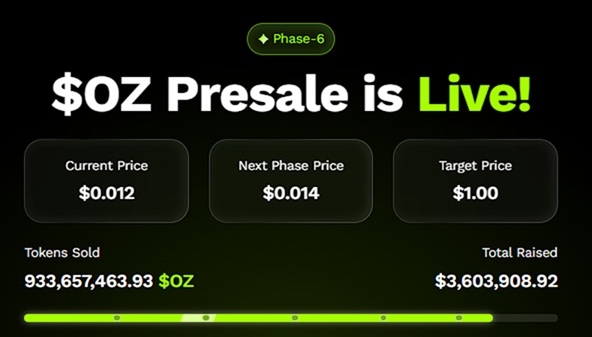
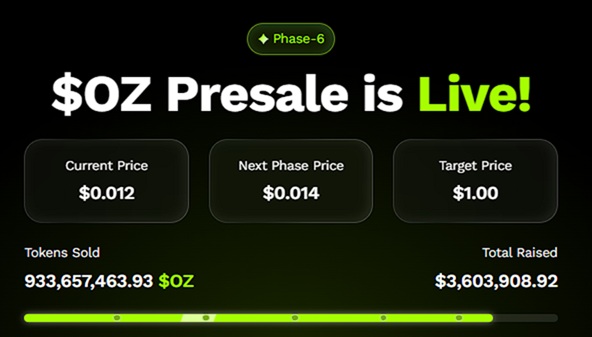
Ozak AI is quickly emerging as one of the most promising tokens in the AI-driven blockchain segment. Currently priced at $0.012 in its 6th presale stage, Ozak AI has already raised over $3.5 million, with more than 930 million tokens sold—a clear indicator of strong investor confidence. What sets Ozak AI apart is its seamless integration of artificial intelligence with blockchain infrastructure.

The project’s partnerships with major tech networks like Perceptron Network and SINT highlight its deep-rooted vision for AI autonomy and real-world utility. Through Perceptron’s 700,000+ active nodes, Ozak AI aims to power decentralized prediction agents capable of delivering real-time market insights and trust-based AI decisions. Its partnership with SINT, which provides AI agents, SDK tools, and voice interfaces, further expands Ozak AI’s ecosystem into voice-activated data interactions and multi-chain communication.

Ozak AI’s roadmap is equally ambitious. By 2029, the project targets 100 million users, supported by its growing community and integrations with HIVE’s blockchain data API for 30ms market signal updates. With listings already on CoinGecko and CoinMarketCap, and a CertiK audit completed, Ozak AI is showing both transparency and credibility—rare traits in the early stages of crypto ventures.

Price-wise, analysts project that once Ozak AI transitions from OZ presale to public trading, the token could witness a substantial surge, potentially reaching $0.50 to $1 within its first major bullish cycle. If AI adoption in crypto continues to accelerate, Ozak AI could become one of 2025’s biggest breakout stories.

Solana (SOL)

After the network challenges in preceding years, Solana (SOL) has re-emerged as a top performer in 2025’s altcoin cycle. Its community improvements have extensively improved scalability and uptime, making Solana one of the fastest blockchains with minimal transaction costs. SOL’s environment continues to develop unexpectedly, hosting thousands of dApps, NFTs, and DeFi protocols that pressure strong community activity.

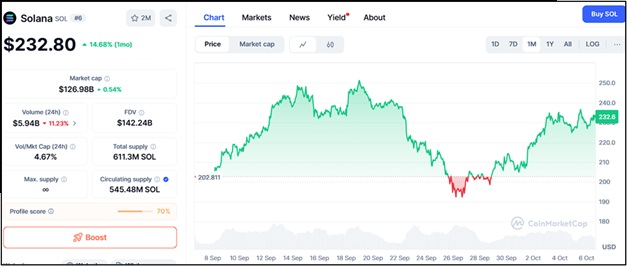
At present trading stages near $180, Solana faces resistance at $240, $260, and $280, at the same time as support holds around $160, $145, and $120. Analysts accept as true with that a breakout above the $240 area could set the level for a rally toward $300, aligning with bullish momentum visible throughout the market.

Solana’s long-term increase is likewise being supported via institutional interest and cross-chain adoption. Its energy-efficient Proof-of-History mechanism and seamless developer equipment have made it the desired platform for next-gen blockchain applications—from GameFi initiatives to on-chain AI models. As 2025 progresses, Solana’s mixture of speed, scalability, and active development could make it one of the year’s top-performing Layer 1 property.

Ethereum (ETH)

No listing of main cryptocurrencies would be complete without Ethereum (ETH), the backbone of the decentralized net. Ethereum continues to evolve post-merge, transferring in the direction of an extremely efficient proof-of-stake model at the same time as it specializes in scalability through Layer 2 networks consisting of Arbitrum, Optimism, and Base.

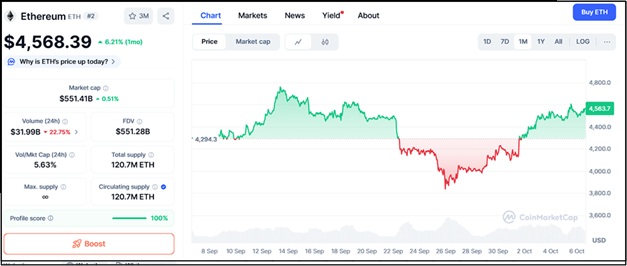
ETH currently trades near $3,200, going through resistance at $3,500, $3,850, and $4,200, with support levels at $2,950, $2,700, and $2,400. Market analysts are expecting that Ethereum could reach as high as $6,000 to $8,000 inside the next bull run if institutional adoption continues and DeFi 2.0 protocols increase their on-chain liquidity.

Moreover, Ethereum’s ecosystem remains unrivaled in terms of innovation. From tokenized real-global assets to business enterprise-grade smart contracts, ETH continues to anchor the Web3 revolution. Its deep liquidity, developer community, and dominance in decentralized finance make it no longer just a safe wager but an essential pillar of crypto’s long-term destiny.

While Solana and Ethereum retain their proof of dominance with speed and scalability, Ozak AI often is the revolutionary wildcard that might reshape how AI and crypto engage. Each of those 3 initiatives brings something particular to the table: Ethereum gives stability and a sizable environment, Solana gives efficiency and performance, and Ozak AI introduces intelligence and autonomy to blockchain structures. As 2025 unfolds, these three cryptos constitute not simply funding possibilities but glimpses into the evolving structure of the following digital generation.


About Ozak AI

Ozak AI is a blockchain-based crypto project that provides a technology platform that specializes in predictive AI and advanced data analytics for financial markets. Through machine learning algorithms and decentralized network technologies, Ozak AI enables real-time, accurate, and actionable insights to help crypto enthusiasts and businesses make the correct decisions.


For more, visit:

Website: https://ozak.ai/

Telegram: https://t.me/OzakAGI

Twitter: https://x.com/ozakagi

XRP Surges Toward $5, Yet Ozak AI’s $0.012 Entry Draws Smarter Money In

0

Crypto investors are watching XRP’s bullish climb closely as the token continues its steady ascent toward the long-awaited $5 mark. Renewed institutional demand, Ripple’s global payment integrations, and rising investor confidence have made XRP one of the top-performing altcoins of 2025.

But while major holders anticipate XRP’s breakout, a growing number of savvy investors are turning to a different opportunity — Ozak AI (OZ). Priced at just $0.012 in its Stage 6 presale, Ozak AI has already raised over $3.5 million and sold more than 930 million tokens, with analysts calling it the next high-growth AI crypto capable of delivering 100x returns once listed.

XRP Surges Toward $5 on Institutional Optimism

XRP’s resurgence has been one of the most exciting stories of the year. Once burdened by regulatory uncertainty, Ripple’s legal victory and expanding network of banking partnerships have reignited enthusiasm around the token. As global remittance systems increasingly adopt blockchain solutions, XRP’s role as a bridge currency for cross-border payments continues to gain traction.

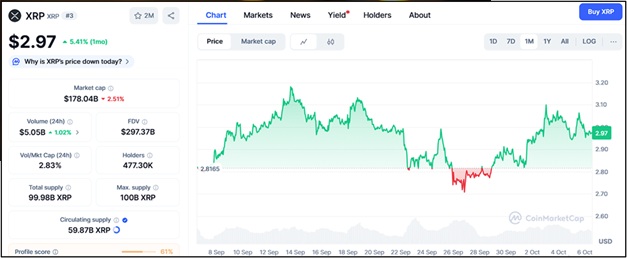
Currently trading around $3.10, XRP faces resistance at $3.50, $4.20, and $5.00, while finding support near $2.80, $2.40, and $2.00. Breaking above $4 would likely open the door to a strong rally, especially if Ripple secures more institutional liquidity partnerships.

However, even with growing real-world utility, XRP’s large market capitalization naturally limits its potential upside. Analysts expect it to 2x–3x in 2025 — impressive, but nowhere near the 100x projections that early-stage tokens like Ozak AI could deliver.

Ozak AI’s $0.012 Entry Draws Smarter Money

While XRP attracts institutional traders seeking stability, Ozak AI has become the go-to project for investors looking for high-risk, high-reward opportunities backed by real technology. Ozak AI merges artificial intelligence and blockchain analytics to offer predictive insights, real-time data processing, and autonomous trading through its innovative Prediction Agents.

The platform’s architecture integrates Arbitrum Orbit for scalability, EigenLayer AVS for decentralized validation, and the Ozak Stream Network (OSN) — a system designed to process vast streams of crypto data with millisecond precision. These features enable traders, institutions, and developers to analyze market conditions and forecast movements before they occur.

At its core, Ozak AI aims to democratize access to hedge fund-level intelligence, making advanced predictive analytics accessible to everyday crypto traders. This real-world utility sets Ozak AI apart from typical presales that rely solely on hype rather than tangible innovation.

$3.5M Raised and Growing Investor Confidence

Ozak AI’s presale momentum has been nothing short of remarkable. The project has already raised more than $3.5 million and sold 930 million tokens, signaling overwhelming investor confidence. Its Stage 6 OZ presale at $0.012 continues to attract both retail and institutional participants seeking early exposure before exchange listings.

Unlike many speculative tokens, Ozak AI has also undergone thorough CertiK and internal audits, ensuring transparency and smart contract security. It is officially listed on CoinMarketCap and CoinGecko, providing verified price tracking and visibility. These milestones demonstrate that Ozak AI is not just another hyped-up presale — it’s a well-structured, auditable, and fast-growing ecosystem backed by real fundamentals.

OZ’s Strategic Partnerships Accelerate Growth

Ozak AI’s rise is further supported by a growing list of partnerships. Collaborations with Dex3, Hive Intel, and SINT enhance its AI and automation capabilities, enabling seamless data flow between networks. Meanwhile, alliances with Manta Network, Coin Kami, Forum Crypto Indonesia, Block Bali Com, and Bitcoin Addict Thailand have helped expand its reach within Asia’s rapidly growing blockchain market.

The project has also gained visibility through key appearances at Coinfest Asia 2025, hosting exclusive events like Sundown Signals and The Ozak AI Roadshow, where investors, developers, and crypto enthusiasts got firsthand insight into its potential. This proactive approach has positioned Ozak AI as one of the most networked and promising AI projects in the space.

Why Ozak AI Appeals to Smarter Investors

Investors chasing the next big opportunity are beginning to view Ozak AI as a strategic long-term play rather than a short-term speculation. While XRP offers established infrastructure and adoption, Ozak AI provides exponential upside — the same kind of early-stage asymmetry that defined Solana, Polygon, and Chainlink in their infancy.

Its combination of AI-driven intelligence, blockchain validation, and verified transparency offers a balance of credibility and innovation rarely seen in presales. Moreover, as the AI narrative gains strength across the crypto landscape, Ozak AI’s positioning at the heart of predictive analytics gives it a clear advantage over competing altcoins.

As XRP surges toward $5, it continues to prove its strength as a pillar of institutional crypto adoption. Yet, for investors seeking more than incremental growth, Ozak AI’s $0.012 entry presents one of the most compelling opportunities of 2025.

With $3.5 million raised, 930 million tokens sold, strategic partnerships, and audited transparency, Ozak AI represents a rare fusion of innovation and investment potential. While XRP captures headlines, Ozak AI is quietly capturing the attention of smarter money — the kind that recognizes that the biggest winners in crypto are born before the hype, not after it.


About Ozak AI

Ozak AI is a blockchain-based crypto project that provides a technology platform that specializes in predictive AI and advanced data analytics for financial markets. Through machine learning algorithms and decentralized network technologies, Ozak AI enables real-time, accurate, and actionable insights to help crypto enthusiasts and businesses make the correct decisions.


For more, visit:

Website: https://ozak.ai/

Telegram: https://t.me/OzakAGI

Twitter: https://x.com/ozakagi