DD
MM
YYYY

PAGES

DD
MM
YYYY

spot_img

PAGES

Home Blog Page 3866

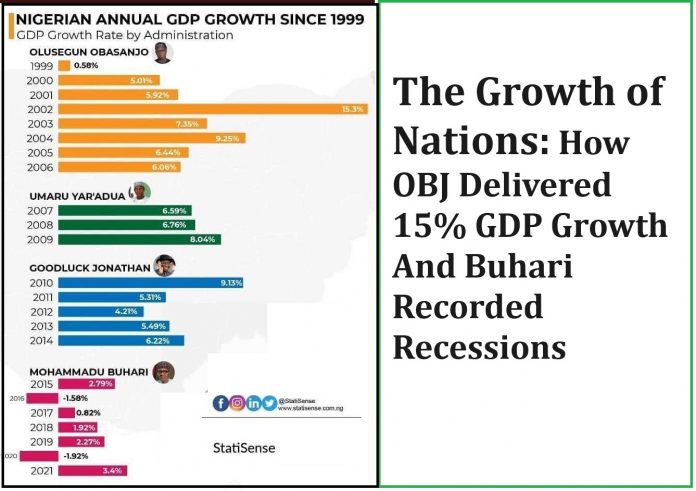
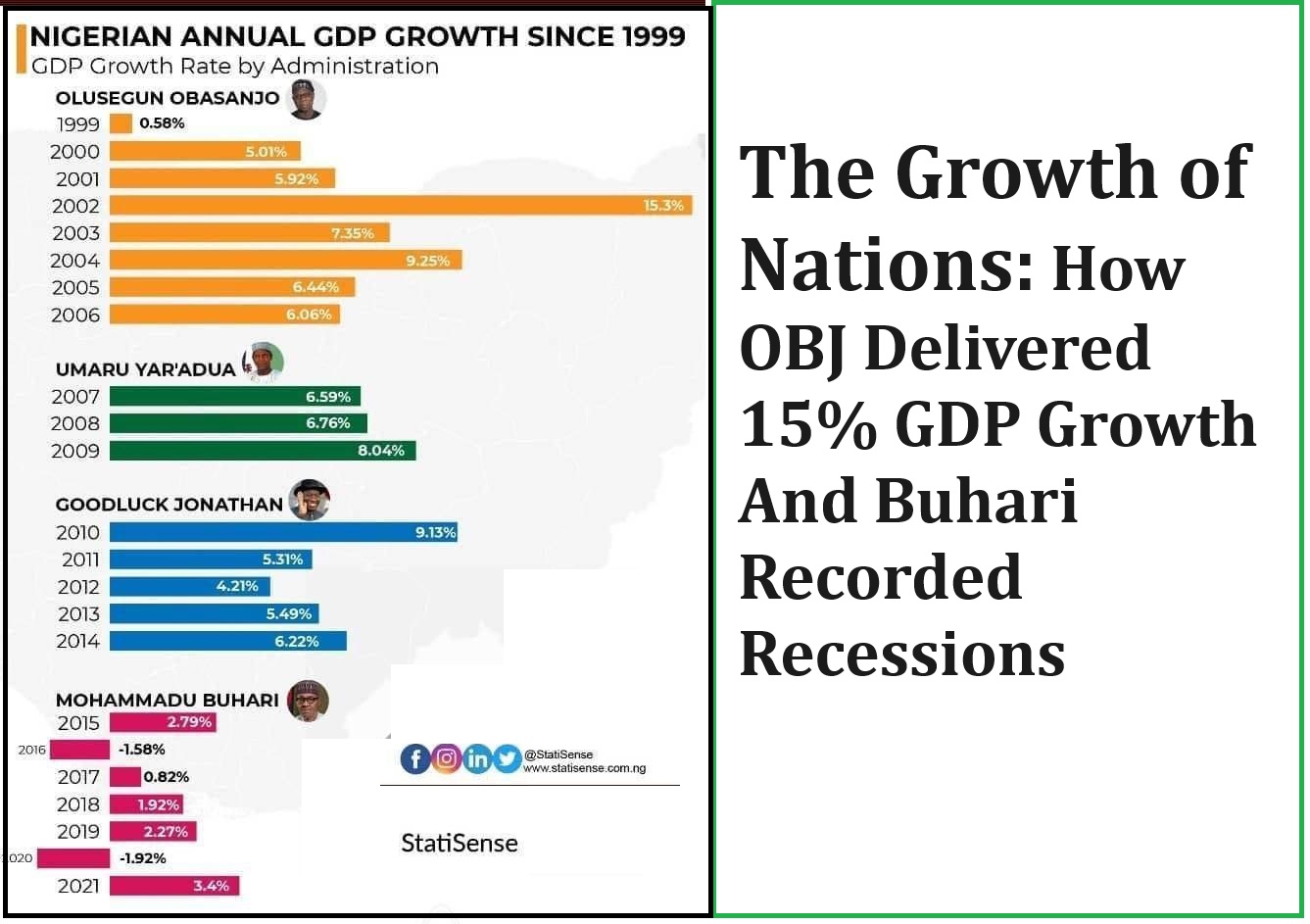
The Growth of Nations: How OBJ Delivered 15% GDP Growth And Buhari Recorded Recessions

4

What did Obasanjo do in 2002 for that 15.3% GDP growth rate spike? The telcos began operating at scale. Yes, a new industry was added in the Nigerian economy – and we grew. (That was the voice telephony era).

About ten years later, Jonathan got an extended version of it, when our phones became internet nodes as the mobile internet era began.  Another was expected to follow a decade later. Unfortunately, as I write, Nigeria is still struggling to unlock that era. I have called it the application utility era where our devices now become bank branches, logistics hubs, etc at scale. 

Lagos, which has the potential to become more important than Nigeria from 2030 is there, but other areas are yet to join. The Lagos budget of N2.3 trillion, about N2 trillion larger than the budget of Kano, is expected to widen, to the extent that by 2030, the per capita on Lagos’ budget will be multiples of Nigeria’s budget. Simply, everyone will move to Lagos because it will be like Vatican City in Italy without a special visa. I posit that Nigeria will be structurally dismantled, economically, because Lagos will exert more influence than Abuja.

As we search for growth vistas, understand that OBJ miracle has nothing to do with oil price. Across all indicators, Obasanjo was a great operator while Buhari was the worst, since 1999. And Jonathan was better than Buhari; he stabilized the exchange rate, inflation rate, etc, NOT because oil prices were high, but because he was better than the man who took over from him. Under him, Nigeria recorded its highest per capita on record. 

Buhari engineered at least one preventable recession: the frozen government after delays on appointing ministers when he took over. The second one which happened during the pandemic was already brooding as a result of the land border closure.

Good People, if you look at the numbers, and focus on the national budgets, under Buhari, in absolute Naira and USD dollars, Buhari’s government spent more money than Jonathan’s, on yearly average, and what oil money did not provide to the administration, they borrowed. Because Naira is Naira, whether from oil sale or debt, the issue here is efficiency on its management and deployment. Follow me:

  • Nigeria 2013 budget: N4.99 trillion 
  • Nigeria 2014 budget: N4.69 trillion
  • Nigeria 2015 budget: N4.5 trillion

  • Nigeria 2016 budget: N6.06 trillion
  • Budget 2019: N8.92 trillion
  • Budget 2022:  N16.39 trillion

(convert with the exchange rate then, Buhari had more US dollars to spend)

As this new government begins 2024 to execute its budget, it must find an anchor to drive growth. OBJ used core telecoms but the impact is largely marginal now. The new government has real estate, agriculture, light manufacturing and amazingly education as areas to unlock growth. Nigeria must evolve out of the current finance-first mindset to industry*-first mindset which OBJ used to pioneer most of the economic anchors we enjoy today.

*includes services, manufacturing, etc
Re-examine Failure

0
Source: Titanium Success

As an entrepreneur, I have failed at several things. I have also read and listened to many other people talk about failure, and here are some things I think are worth sharing to prepare for 2024. Humans will fail at something at some point in their lifetime. It cannot be avoided.

Failure might appear like an end for many people, but if you change the lens through which you view failure, it could become a game-changer in your life, career, and business.

  1. Normalise Failure

First, you must realize and acknowledge that everyone fails, and you will fail, too. It is a normal part of life and learning. Don’t look at it as a shameful event or refrain from talking about it. Instead, view it as a learning opportunity and a stepping stone to something bigger. If you get this perspective ingrained, you will be less hit when you fail at something. At least, if you fail, it is proof that you are trying to do something new, and trying new things should be a regular part of life.

2. Share your failures and learn from them

Sometimes, when you fail at something, it takes another pair of eyes to look at it and tell you what you could have done better. As you try to analyze, analyze your failures, identify areas for improvement, and avoid repeating them, also share them with others. They could learn from your failures and sometimes even share perspectives you had not identified earlier. Sharing your failures authentically can connect you with others and foster empathy. When learning from a ‘failure event,’ don’t focus on what went wrong. Try to spot your strengths and what you did right in the situation.

3. Celebrate wins and keep moving forward

Celebrate small wins and acknowledge your progress, not just the final destination. Even if you did not get to where you want or achieve what you desired, you learned something.Keep moving forward. If you repeat the same task, you now have the advantage of experience. You know what will not work.

4. Laugh at the Humor and be kind to Yourself

Learn to laugh at yourself and find the humor in unexpected situations. This can lighten the mood and reduce stress. There is almost always something to laugh about, even when you fail at something. Also, be kind to yourself during difficult times. Don’t be too hard on yourself. Treat yourself with the same understanding and support you would offer a friend.

5. Hone your grit and resilience

The ability to bounce back after failing at something depends on these two. And you might also want to consider defining your success metrics. Society tags certain events that you do not necessarily have to adopt. Define what success would mean to you. Focus on what truly matters to you and brings you fulfillment.

To sum it up in a few words, life is full of surprises. If you let yourself stay down every time you experience something bad, you will miss out on the good and greater ones ahead. You can be almost sure that you will fail at something in 2024. But you will also succeed at several things. Don’t let the failures keep you down. Keep an open mind. Keep a positive attitude.

New Year Resolutions And Why New Years Do Not Change Who You Are Intrinsically

0

The phrase “New Year, New Me” was quite popular some years back, although I suppose the new generation has found new ways to express it. Generally, it would hinge on the idea or list of ideals that one wishes to adopt in the new year or goals to be achieved in the 365 days. But for all the excitement it begins with, it takes a couple of weeks, maybe months for some, before people begin to realize that the New Year does not change who you are intrinsically.

In “The Secrets of Mind Power” by William Walker Atkinson, one can find a lot of helpful principles and techniques on how to apply the mind power to achieve anything. I highly recommend the book, and for the New Year resolutions, I’ll dwell on two of the lessons he shared.

Develop Willpower and Concentration

You will never achieve anything worthwhile until you develop a single-minded ability to focus on one thing and block out distractions. You must consciously train your mind to focus on your goals and overcome distractions. Strengthen your willpower to stay on track in the face of challenges and setbacks.

Sometimes, you will be battling with some unconscious but deeply ingrained habits. For instance, some persons hardly achieve 50% of their daily to-do lists because of tiny (or major) distractions now and then. A statistic says the average person checks his phone once every 10 to 12 minutes. This could translate to almost 100 times a person randomly picks up his phone in a day. If every time such a person picks up his phone, he uses it for about 2 minutes; then we might be looking at about 3+ hours of unaccounted time in the day. Let’s not talk about the times you think about the phone, even when you are not with it.

The mind is not a switch. You can hardly go from thinking about one thing to another just like that. It takes conscientious training and willpower to get the mind to concentrate on a thing and block out other things. And if you can get this right, you can get many other things to fall in line.

Achieve Success through Harmony

True success goes beyond material gains. It covers every aspect of your life and gives that balanced life that incorporates physical, mental, emotional, and spiritual well-being. You cannot single out one area of your life to succeed and decide to ignore the others. Let me give an instance.

If you have decided that 2024 is the year you want to get a higher-paying job role, is it okay to fix your target of sending out as many applications as possible? Maybe not. You can succeed in this direction by seeing how every other aspect can work towards this single goal. A self-development goal, for instance – Do you need to take a new course or skill to improve your chances? Do you need to do a leadership course? Social network goals like – do you need to attend more professional events and meet more people in your industry of choice? Do you need to begin to dress the part?

When you look at it holistically like this, you see that no part of your life is isolated from the others. You need success in some areas to achieve success in other areas, and the sooner you begin to connect the dots, the better for you.

Conclusion

I deliberately choose to leave out things like affirmation, positive thinking, visualization, and self-suggestion because I think a lot is being said about those already. Try these out and see how much difference it makes. Your mindpower can do more for you than you know once you learn to harness and focus it.

In addition, I think your resolutions need not dwell so much on what you want to achieve or gain but on who you want to become. That is how to harmonize all aspects of your life towards the goal.

Happy New Year to you all.

Should Recruiters Provide Feedback To Job Applicants Irrespective of Outcome

0

The job application process can be a nerve-wracking experience, filled with anticipation and uncertainty for applicants. One aspect that often leaves candidates in the dark is the lack of feedback from recruiters regarding their application outcomes. Some recruiters do not even get back to the applicant to tell them they were not selected for the role.

The question arises: should recruiters provide detailed feedback to applicants, explaining the reasons behind their decisions?One applicant posted on Twitter (now X) that it was as bad as proposing to a girl and being told that “if you received no response within two weeks, you should assume that the outcome was negative.” While both situations are far apart, I see the reason behind the analogy and why it could feel that bad for the applicant.

The Case for Feedback:

  1. Professional Growth: Offering constructive feedback can contribute to an applicant’s professional development. Understanding the strengths and weaknesses highlighted during the recruitment process allows candidates to refine their skills and improve future applications.
  2. Transparency: Providing feedback fosters transparency in the hiring process. Applicants invest time and effort in crafting resumes and preparing for interviews. Clear and honest feedback helps them comprehend the factors influencing the decision-making process, building trust in the recruitment system.
  3. Positive Employer Branding: Companies prioritizing providing feedback create a positive reputation in the job market. Word-of-mouth travels fast, and a reputation for constructive communication can attract high-quality candidates who appreciate the transparency and fairness in the hiring process.

The Case Against Feedback:

  1. Legal Concerns: In some cases, providing detailed feedback may raise legal concerns for recruiters. If the feedback includes subjective opinions or potentially discriminatory information, it could lead to legal complications. Many companies choose to err on caution to avoid legal repercussions.
  2. Time Constraints: Recruiters often juggle numerous responsibilities, and providing personalized feedback to every candidate can be time-consuming. Some argue that the time invested in giving detailed feedback to unsuccessful candidates could be better spent on other essential tasks in the recruitment process.
  3. Subjectivity of Decisions: Hiring decisions can be subjective and influenced by various factors. Communicating the intricacies of these decisions might not always be straightforward, and recruiters may worry about misinterpretation or dissatisfaction on the part of the candidates.

Conclusion

Whether recruiters should provide feedback to applicants is complex and multifaceted. While there are clear advantages regarding professional growth, transparency, and positive employer branding, legal issues, time constraints, and the subjectivity of decisions also merit consideration.

I think the feedback could be both ways so that the recruiter gets some feedback about the recruitment process, and the applicant gets some feedback on their performance, too. This is the only way both can grow in their roles. Although I understand that when tens of candidates have been interviewed, it could be herculean, it is worth a shot.

Something as simple as “we decided to go with someone else at this time because we need someone with more… for the role” can suffice.

What do you think?

What are your thoughts on this matter? Do you believe recruiters should provide detailed feedback to unsuccessful candidates, or do you think the current level of communication is sufficient? Share your opinions and experiences on this topic as the conversation around feedback in the recruitment process continues to shape the dynamics of the professional world.

Exploring Marketcap of Tron Blockchain

0

Tron is a blockchain-based platform that aims to create a decentralized internet and a global digital content ecosystem. Tron was founded by Justin Sun, a former chief representative of Ripple in China, and launched its mainnet in June 2018. Tron claims to have over 40 million active users and over 1,800 decentralized applications (DApps) running on its network.

One of the key metrics that investors and traders use to evaluate the value and potential of a cryptocurrency is its market capitalization, or marketcap for short. Marketcap is calculated by multiplying the current price of a coin or token by its total circulating supply. For example, if a coin has a price of $0.1 and a circulating supply of 10 billion, its marketcap is $1 billion.

According to CoinMarketCap, as of December 27, 2023, Tron has a price of $0.045 and a circulating supply of 71.66 billion, which gives it a marketcap of $3.22 billion. This makes Tron the 15th largest cryptocurrency by marketcap, behind Bitcoin, Ethereum, Binance Coin, Cardano, Solana, XRP, Polkadot, Terra, Avalanche, Dogecoin, Shiba Inu, Polygon, Chainlink and Stellar.

Tron’s marketcap has fluctuated significantly over the years, reaching an all-time high of $19.7 billion in January 2018, when Tron was trading at $0.3 per coin. Since then, Tron has experienced several cycles of boom and bust, along with the rest of the crypto market. Tron’s marketcap reached a low of $764 million in March 2020, when the Covid-19 pandemic caused a global market crash. However, Tron recovered strongly in the following months, reaching $4.6 billion in May 2021, before dropping again to $2.2 billion in July 2021.

Tron’s marketcap is influenced by various factors, such as the overall sentiment and performance of the crypto market, the development and innovation of the Tron platform and ecosystem, the adoption and usage of Tron’s DApps and services, the competition and collaboration with other blockchain projects, the regulatory and legal environment in different countries and regions, and the marketing and communication strategies of Tron’s team and community.

Tron’s marketcap is also affected by the supply and demand dynamics of its native token, TRX. TRX is used to pay for transactions and smart contracts on the Tron network, as well as to stake and vote for validators who secure the network. TRX can also be exchanged for other cryptocurrencies or fiat currencies on various platforms and exchanges. Additionally, TRX can be used to access various DApps and services built on Tron, such as BitTorrent, WinkLink, JustSwap, JustLend and JustNFT.

The total supply of TRX is capped at 100 billion, with 71.66 billion currently in circulation. The remaining 28.34 billion are held by the Tron Foundation for various purposes, such as development incentives, ecosystem rewards and strategic partnerships. The Tron Foundation has pledged to lock up these tokens until January 1st, 2025, to ensure transparency and accountability.

The demand for TRX depends on the utility and value proposition of the Tron platform and ecosystem, as well as the speculation and expectations of investors and traders. The more users and developers adopt and use Tron’s DApps and services, the more demand there will be for TRX to power them.

The more innovation and improvement that Tron’s team and community deliver, the more confidence and trust there will be in Tron’s future potential. The more exposure and awareness that Tron’s marketing and communication efforts generate, the more interest and attention there will be from new and existing participants in the crypto space.

Tron’s marketcap is a reflection of its current price multiplied by its circulating supply. However, behind this simple calculation lies a complex interplay of various factors that affect both the supply and demand of TRX. Tron’s marketcap is not only a measure of its value and potential as a cryptocurrency project but also an indicator of its progress and performance as a blockchain platform.