DD
MM
YYYY

PAGES

DD
MM
YYYY

spot_img

PAGES

Home Blog Page 387

OPEC+ Agrees to Modest Output Hike as Saudi-Russia Compromise Shapes Oil Market Outlook

0

The Organization of the Petroleum Exporting Countries and its allies (OPEC+) have announced a modest production increase of 137,000 barrels per day for November.

The agreement, which emerged from a brief but consequential meeting between Saudi Arabia and Russia — the two power brokers within the alliance — reflects an uneasy compromise. Riyadh, eager to defend its global market position, pushed for a more substantial hike, while Moscow preferred to hold back, wary of sending oil prices into a deeper slide.

Oil prices have been losing altitude in recent weeks, with Nigeria’s Bonny Light crude hovering around $69 per barrel and Brent trading near its lowest levels in four months. The market’s weakness is being driven by rising inventories, waning demand growth, and persistent macroeconomic uncertainty.

Even as OPEC+ sought to portray the move as a vote of confidence in global demand, analysts see it as a cautious step designed to prevent panic selling. Yet the underlying data tells a more complicated story.

The International Energy Agency (IEA) has warned that global inventories could swell through the end of the year and reach record levels by 2026, citing cooling demand in China, slower industrial activity in Europe, and surging production from the Americas.

Nigeria’s Tightrope

For Nigeria, the decision presents a familiar dilemma — the promise of increased output weighed against the threat of lower prices. As one of OPEC’s long-standing members and Africa’s largest oil producer, Nigeria stands to benefit from the slightly higher quota. However, its fiscal health remains vulnerable to fluctuations in prices.

The Nigerian National Petroleum Company Limited (NNPC) is banking on crude earnings to strengthen foreign exchange reserves and stabilize government revenue. But with oil prices slipping, those hopes could be challenged.

In anticipation of tighter margins, NNPC recently extended its crude supply deal with the 650,000-barrel-per-day Dangote Refinery for another two years. The agreement is meant to guarantee feedstock for the refinery and reduce Nigeria’s dependency on imported fuel — a critical step toward insulating the economy from global volatility.

However, that does not overshadow the unpredictability of the global oil environment. Reports of unsold cargoes from the Middle East are increasing, and futures markets are showing signs of weakness.

Shifting Strategies Inside OPEC+

The Saudi-Russian compromise is more than just a numbers game — it reflects deeper tensions within OPEC+, according to some analysts. Saudi Arabia, which carried much of the burden of past production cuts, is now signaling impatience. Crown Prince Mohammed bin Salman’s government appears eager to reclaim market share, especially as it prepares for next month’s Washington visit to meet President Donald Trump, who has been openly vocal about wanting lower oil prices to ease inflationary pressures.

At the same time, Russia’s alignment with a limited production boost shows its preference for price support as it continues to navigate sanctions and energy export restrictions.

The alliance’s production performance also exposes internal constraints. Of the 2.2 million barrels per day meant to be restored between May and September, barely 60% has materialized. Technical bottlenecks, overproduction penalties, and aging infrastructure have all limited the pace of recovery in several member nations.

Nigeria’s Output Gains

However, Nigeria’s oil production has shown steady improvement. Data from the Nigerian Upstream Petroleum Regulatory Commission (NUPRC) shows that output in July 2025 averaged 1.71 million barrels per day — up 9.9% from a year earlier. The figure includes 1.507 million barrels of crude oil and 204,864 barrels of condensate.

Compared with June’s 1.69 million barrels per day, the increase is modest but significant, given years of operational challenges and pipeline sabotage. Forcados terminal led the recovery with 9.04 million barrels in July, up 2.1% from June, while Bonny terminal saw a sharper jump of 12.7%, producing 8.07 million barrels compared to 7.16 million in the previous month.

Even with production ticking upward, Nigeria — and OPEC+ more broadly — faces an increasingly fragile oil market. A continued glut is expected to push prices further down, eroding fiscal revenues and shaking confidence in the alliance’s management of supply.

Although the OPEC+ meeting lasted just nine minutes, the brevity of the session was itself telling. Delegates avoided public discussion of surplus risks, maintaining the group’s traditional optimism even as the IEA forecasts a possible record oversupply by 2026.

The next meeting, set for November 2, will determine whether the alliance sticks to its current cautious expansion or reverts to defending prices.

Bitcoin Hits ATH at $125,000, Pulling In $4.5bn in ETF with Ethereum

0

Investor appetite for crypto assets has surged again, as U.S.-listed spot Bitcoin and Ethereum exchange-traded funds (ETFs) drew more than $4.5 billion in net inflows last week, ending a brief lull and setting a bullish tone for October — a month traders often dub “Uptober” for its history of strong digital asset performance.

According to data from SoSo Value, Bitcoin ETFs accounted for roughly $3.2 billion of the total inflows, marking their second-largest weekly total on record, behind only the $3.37 billion peak of November 2024. The period also saw trading volumes surge to about $26 billion, a sharp uptick that analysts interpret as a sign of renewed institutional participation and growing conviction that an accumulation phase is underway.

BlackRock’s iShares Bitcoin Trust (IBIT) led with $1.78 billion in inflows, followed by Fidelity’s FBTC at $692 million. Ark 21Shares drew $254 million, while Bitwise captured $212 million, signaling that both heavyweight asset managers and emerging ETF providers are benefiting from the wave of capital rotation into regulated crypto vehicles.

Meanwhile, Ethereum ETFs mirrored the momentum, bringing in $1.29 billion in inflows and generating nearly $10 billion in weekly trading volume. BlackRock’s ETHA dominated with $687 million, followed by Fidelity’s $305 million, Grayscale’s $175 million, and Bitwise’s $83 million.

Broader Market Recovery and Institutional Rotation

The synchronized surge across both Bitcoin and Ethereum ETFs made last week one of the busiest in the history of crypto-linked ETFs. Analysts say the trend reflects a broader market recovery narrative — one that goes beyond short-term trading activity.

The shift is being interpreted as institutional portfolios rotating back into digital assets, aiming to position early in what could become a multi-quarter rally. This move coincides with signs of macroeconomic stabilization, as inflation in the U.S. shows a steady decline and global liquidity improves.

As a result, Bitcoin soared past $125,000, a new all-time high, underscoring how ETF-driven demand is doing more than fueling speculative trades — it’s laying the foundation for a new structural bull cycle.

Crypto research firm 10x Research described the magnitude of these inflows as “unprecedented,” adding that institutional behavior now looks materially different from past cycles.

“Behind the scenes, billions of dollars in ETF inflows and a quiet shift in institutional behavior suggest that this breakout may have deeper roots,” the firm said in a note. “Even regulators are adding fuel to the fire, with new tax guidance that caught corporate treasuries off guard.”

The report’s mention of tax policy changes refers to recent U.S. Treasury guidance clarifying how corporations should report digital asset holdings — a move that, while intended to tighten compliance, also legitimized crypto exposure on balance sheets for a growing number of companies.

 Bitcoin ETFs Versus Traditional Funds

In comparative terms, the $4.5 billion pulled into Bitcoin and Ethereum ETFs last week stands out even within the broader U.S. ETF market. Traditional equity ETFs — including S&P 500 and Nasdaq trackers — have seen similar or smaller inflows during weeks of peak activity this year.

By percentage of assets under management (AUM), the inflows into crypto ETFs represent one of the fastest growth rates among all asset classes in 2025, according to Morningstar data. Analysts suggest this pace of capital movement underscores a structural shift in institutional portfolio diversification, where digital assets are no longer seen as fringe alternatives but as core holdings alongside equities and commodities.

Ethereum’s Catch-Up and Institutional Diversification

Ethereum’s inflows also mark a significant inflection point. For much of 2024, institutional ETF interest was almost exclusively concentrated in Bitcoin. But the $1.29 billion influx into Ethereum funds suggests that investors are beginning to broaden their exposure across the crypto spectrum, betting on the next leg of innovation — particularly in decentralized finance (DeFi), tokenized assets, and smart contract applications.

Ethereum’s performance is increasingly being viewed as complementary, not secondary, to Bitcoin. Institutions now see both as long-term hedges against monetary debasement and as parallel technologies underpinning future financial infrastructure.

Outlook: From “Uptober” to Year-End

With inflows accelerating and prices hitting record highs, the question now is whether this “Uptober” momentum can sustain through year-end. Analysts caution that profit-taking and macro shocks could still trigger volatility, but the consensus view is that institutional demand has shifted the market’s center of gravity.

In previous cycles, crypto rallies were often retail-driven and short-lived. This time, the participation of BlackRock, Fidelity, and other Wall Street giants is seen as anchoring long-term stability — and potentially redefining how the next bull market unfolds.

World Liberty Financial is Preparing To Launch a Debit Card, But All Eyes Are on the New Omni-Bank, Digitap

0

World Liberty Financial’s, co-founder Zak Folkman, has said that the project will be introducing its own debit card and a retail application very soon. The company that is supported by the Trump family is on a quest to combine traditional banking with digital assets.

Similarly, Digitap ($TAP) has caught the attention of top investors from across the world for launching the first omni-banking platform. Digitap is offering users seamless control over both fiat and crypto on one platform.

With real-time crypto-to-fiat conversions on 100+ cryptocurrencies and 10+ fiat currencies, experts have ranked Digitap as a top 5 cryptocurrency in the cross-border payments market, predicted to reach $320 trillion by 2032.

World Liberty Financial Debit Card is Coming Soon

At Korea Blockchain Week 2025’s Impact conference in Seoul on Tuesday, September 23, the co-founder of World Liberty Financial, Zak Folkman, announced that the company has plans to launch its own debit card “very soon.” Folkman explained that launching a debit card will allow the project to integrate their USD1 and their World Liberty Financial app right into their Apple Pay.

While Folkman didn’t drop a roadmap for the launch of the WLF debit card, he said that “it’s coming very soon.” Crypto experts believe that the debit card will complement the upcoming retail application from World Liberty Financial. The retail app is in the works and is expected to launch in the near future.

Folkman described the upcoming WLF retail app as “Venmo meets Robinhood.” The app combines traditional Web2-style peer-to-peer payment features with trading elements similar to those on Robinhood. Despite the optimism about extending digital assets to retail users, Folkman announced that World Liberty Financial will “never” launch its own chain.

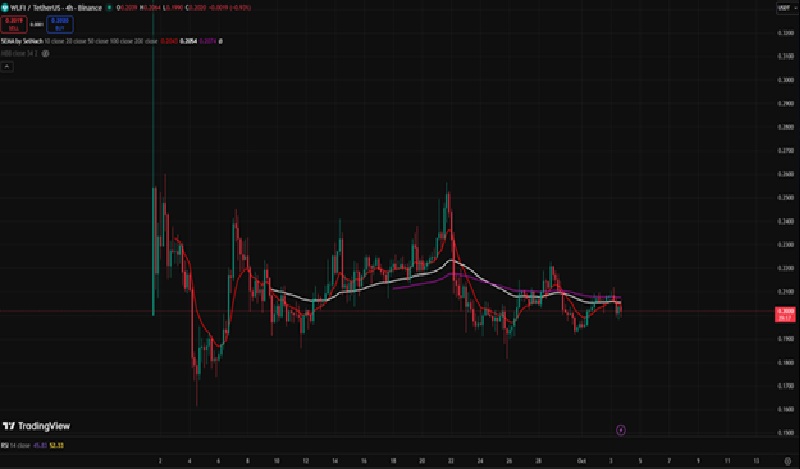
The debit card and app will push WLF a step further in becoming a bridge between traditional finance and on-chain markets. Despite the major news, the WLF token price has been underperforming. The WLF token price has plunged by nearly 10% over the last thirty days.

Digitap Set To Transform Global Money With the World’s First Omni-Bank

Digitap ($TAP) has caught the attention of investors because of its novel approach to cross-border payments. Digitap is built around a multi-layered financial platform that integrates both traditional banking and crypto functions into a single platform that works seamlessly.

With Digitap, individuals and businesses can transact in more than 100 cryptocurrencies and multiple currencies using the speed, security, and low cost of cryptocurrencies. There is real-time conversion on the DigiTap platform from crypto to any fiat, giving users more value in each transaction.

This seamless interoperability removes the need for third-party exchanges, designed to make crypto for beginners easier than it has ever been. In addition, DigiTap offers both virtual and physical debit cards on its platform for cross-border payments, along with a secure wallet system that bridges crypto and fiat in real time.

Excitement Builds As Digitap Presale Goes Live

The financial world has erupted with excitement at the launch of Digitap because of its potential to transform how money is moved in the future. With Digitap poised to play a critical role in the evolution of the cross-border payments market, predicted to reach $320 trillion by 2032, analysts place it among the best cryptos to invest in now.

This has shown in the early presale performance of Digitap, where it has raised over $500,000 in its first few days through the sale of over 14.9 million $TAP tokens. At a current price of $0.0125, $TAP is one of the hidden crypto gems worth buying right now.

The massive passive income opportunity of Digitap through staking is also another reason why investors are excited about this project. Holders of $TAP who stake their tokens can earn an APY of up to 124%, putting Digitap in a category of its own in the passive income generation category.

WLF vs $TAP: Which is the Best Cheap Crypto To Buy Now?

While the WLF token is backed by a global name, its recent price performance has been dismal. While on the other hand, Digitap is rising with incredible momentum and huge latent potential.

With Digitap looking to secure its place as the heartbeat of the cross-border payment market, $TAP has a greater upside potential. This is why analysts are predicting that $TAP holders who stay could see returns of more than 50x by 2026.

Discover the future of crypto cards with Digitap by checking out their live Visa card project here:

Presale https://presale.digitap.app

Website: https://digitap.app

Social: https://linktr.ee/digitap.app

Why Private Companies Will Rise Before Stronger and Efficient Public Institutions Will Emerge in Africa

0

In the narrative of Africa’s development, there is a structural inversion we must accept: private companies will lead the charge before public institutions become truly capable. To hope that public institutions must be perfect before private enterprises can flourish is to misunderstand how nations have historically evolved.

Rockefeller invented the US oil sector before the government came to regulate. Vanderbilt was writing the script on the railways as the government followed, and Carnegie seeded steel making well beyond the understanding of the bureaucrats. You can see same in finance in the age of JP Morgan. In Nigeria, movie entrepreneurs created Living in Bondage before the government put out any regulation for Nollywood.

Simply, when you look back at some economies — whether in Europe, North America, or East Asia — you’ll discover that robust private firms often preceded the full maturation of efficient public institutions. Why? Because governments rely on tax revenue, investments, and economic vibrancy to build functional institutions. Without thriving companies generating value, there is no fuel for institutional evolution.

This was my concern in a piece in Harvard where I noted that Africa was urbanizing before industrialization, flipping centuries-old script that you industrialize, and then urbanize. As Lagos, Port Harbourt and Onitsha urbanize, the industries are even fading, triggering massive loss of social welfare.

So, we cannot demand flawless roads, world-class schools, or nimble regulatory bodies first, then build businesses — that path is a recipe for perpetual delay. Africa’s case is the same. We can—and should—lay down the entrepreneurial seeds even when many of the enabling conditions are suboptimal. The logic is simple: the success of private firms creates the resources and moral force with which states can upgrade institutions.

Good People, too often in African discourse we hear: “We must fix infrastructure, governance, education — then we can attract serious businesses.” But this is backward. Waiting for a perfect environment is a form of analysis paralysis. Governments are resource constrained; they cannot fix everything at once. In truth, public institutions often languish because there isn’t a thriving private sector to pay the piper.

In Nigeria, for instance, many critics say we must solve power, roads, or corruption before investing. But who pays for those fixes? Who generates the tax base? Who attracts the talent? Without strong and scalable private firms, these ambitions remain illusions.

Of course, many think Nigeria has a big purse. Our national budget is about the size of the healthcare budget of South Africa which spends close to $100 billion more in national budget even though it has about 30% of our population. Yes, I get it – how efficient are we the little we have?

Catalysts of Institutional Change

When private firms begin to scale, they do more than pay taxes: they pressure the state to respond. As corporations grow, they demand better regulation, consistency, predictable enforcement, and smart policies. When that pressure becomes real, governments are forced — or persuaded — to evolve.

Consider sectors that did not exist until entrepreneurial pioneers emerged. Those pioneers create markets, demonstrate value, and force governments to invent agencies, rules, and oversight bodies. Without those catalysts, institutions wait in the wings, hoping for charity or foreign aid.

The Chicken-and-Egg That Isn’t

Yes, institutions matter. Yes, without them, firms face headwinds. But there is no global case where first they built perfect public institutions, and then prosperous firms sprouted. Rather, industrious private actors often spring—even amid institutional weakness—and provide the very impetus for institutional reform.

Largely, my point is not that public institutions are unimportant; rather, their maturation is downstream of private sector dynamism. Simply, you must build and thrive to fund the stronger and efficient governments you expect!

A Strategic Prescription

  1. Invest where you can now. Don’t wait for perfect infrastructure; find niches or sectors where friction is lower, and begin building.

  2. Scale matters. Focus on firms that can grow across borders, exploit digital platforms, or leverage regional linkages.

  3. Engage the state. Use the legitimacy and resources of growing firms to persuade governments to improve regulatory, legal, and administrative frameworks.

  4. Build symbiosis. The ideal African development model is not top-down, nor purely laissez-faire, but a mutually reinforcing ecosystem of private excellence and responsive public institutions.

Conclusion

In African states, the path to better governance does not begin with perfect public institutions — it begins with bold, capable, scalable private enterprises. These firms create both the resources and impetus for states to step up. The road to stronger institutions in Africa passes through the thriving of private companies first. And so, for those who want to see African institutions become efficient and strong, the real work is in enabling — and investing — in private companies today.

Top 10 Crypto to Watch in 2025 – Blazpay ($BLAZ) at $0.006 Tops the Presale List

0
Blazpay - best crypto presale for this bull run

The 2025 bull run has kicked off a frenzy in the presale market, where early investors are chasing opportunities that could deliver massive returns before tokens ever hit exchanges. While Bitcoin and BNB remain the giants of the industry, smaller projects like Kadena, Sei, and Casper Network are also attracting strong interest.

At the center of this momentum is Blazpay ($BLAZ), which is gaining attention as the best crypto presale for this bull run. With more than 1.2 million users already engaged, over 10 million transactions processed, and 100+ partners across 20 blockchains, Blazpay is emerging as a true top 100x crypto presale candidate.

Let’s break down Blazpay alongside other major tokens to see why it’s being called a crypto presale with 1000% return potential.

1. Blazpay ($BLAZ) – Phase 1 Presale Momentum

  • Current Price: $0.006
  • Next Phase Increase: +25%
  • Users: 1.2M+
  • Transactions: 10M+
  • Partners: 100+
  • Chains Integrated: 20+

Blazpay is entering the spotlight with its AI-driven DeFi superapp that combines Swap AI, Bridge AI, portfolio tracking, NFT marketplace integration, and fiat on/off ramps in a single platform. Unlike most presales, Blazpay is not starting from zero it already has real users, real integrations, and a growing community.

The presale is currently in Phase 1, offering tokens at just $0.006. Once this round is filled, the price jumps by 25%, creating urgency for investors looking to enter before later phases push valuations higher. Early backers stand to benefit from built-in scarcity and the long-term loyalty program that rewards holders.

Blazpay is the only presale token combining AI-powered DeFi tools with a fully operational ecosystem of 1.2M+ users. That foundation makes it one of the strongest cases for a crypto presale with 1000% return potential.

Blazpay - best crypto presale for this bull run

How to Buy Blazpay in Phase 1

  1. Visit the official website: Blazpay.com.
  2. Connect your wallet (MetaMask, WalletConnect, etc.).
  3. Choose your $BLAZ allocation.
  4. Confirm the transaction and secure tokens before the next price jump.

With scarcity baked into the model, this is the best crypto presale for this bull run and a strong contender for a top 100x crypto presale.

2. Kadena (KDA) – Scaling with Braided Chains

  • Price: $0.34
  • Market Cap: Moderate, in the hundreds of millions

Kadena is a unique layer-1 blockchain with its braided chain architecture, offering high throughput while maintaining security. With enterprise-level smart contract capabilities, Kadena is positioned to compete in large-scale adoption. While not a new project, it continues to attract investors who believe in its scalability promise.

For those seeking diversification alongside Blazpay, Kadena represents a strong infrastructure bet with real-world use cases.

3. Sei (SEI) – DeFi Trading Chain

  • Price: $0.2765
  • Market Cap: $1.69B
  • Volume (24h): $128M

Sei is optimized for decentralized trading with features like low latency and order sequencing. It’s carving out a niche in the DeFi sector, where speed and fairness are critical. With its growing developer base, Sei could become a backbone for trading protocols in the bull run.

It’s not a crypto presale with 1000% return, but it is shaping up as a long-term growth play.

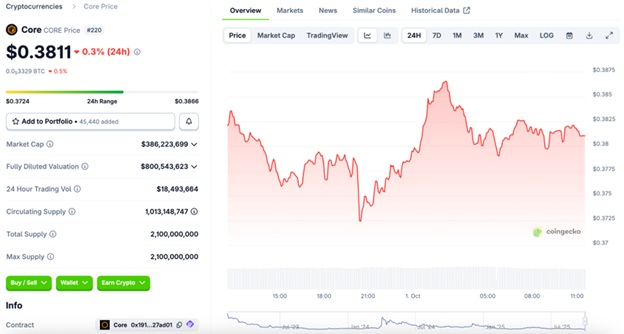
4. Core Blockchain (CORE) – DAO-Driven Ecosystem

  • Price: $0.38
  • Market Cap: Just under $500M

Core focuses on decentralized governance and sustainable ecosystems. By empowering its community through DAO mechanisms, it appeals to investors looking for transparent blockchain projects. While it doesn’t have the explosive presale appeal of Blazpay, it’s quietly building momentum as a top 100x crypto presale alternative.

5. Harmony (ONE) – Sharding and Efficiency

  • Price: $0.0091
  • Market Cap: Low hundreds of millions

Harmony uses sharding to provide scalable and cost-efficient transactions. It has been part of multiple presale and DeFi conversations due to its interoperability features. Despite a low current price, its infrastructure makes it one of the cheaper entry points for investors seeking outsized returns in the bull run.

6. BNB – Exchange Utility Giant

  • Price: $1,011
  • Market Cap: $140.7B
  • 24h Change: +1.3%

Blazpay - top 100x crypto presale

BNB remains one of the largest and most influential coins in the market. As the native token of Binance, it powers discounts, staking, and an entire smart chain ecosystem. Though it isn’t a presale token, its dominance provides a benchmark for emerging projects like Blazpay.

BNB’s continued growth signals strong demand for tokens with utility.

7. Cronos (CRO) – Crypto.com’s Flagship

  • Price: $0.1937
  • Market Cap: $6.7B

Cronos powers the Crypto.com ecosystem, offering staking, governance, and interoperability with Ethereum. As one of the larger exchange-backed coins, it benefits from strong institutional support. While CRO is not a crypto presale with 1000% return, it has reliable growth potential.

8. Bitcoin (BTC) – The Benchmark

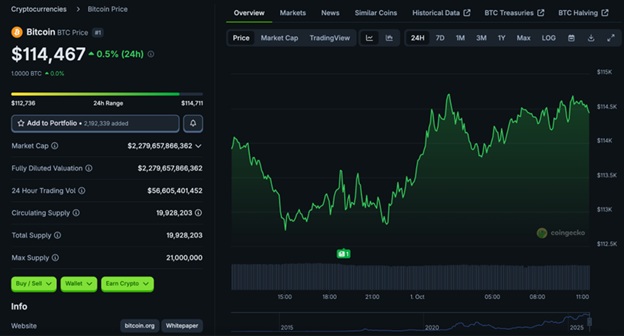
  • Price: $114,532
  • Market Cap: $56B+

Bitcoin is still the leader of the pack, often referred to as digital gold. While not a presale, it remains the asset against which all new tokens are compared. For investors exploring Blazpay or other presales, Bitcoin serves as a hedge and benchmark for performance.

9. Casper Network (CSPR) – Enterprise Adoption

  • Price: $0.0097
  • Market Cap: $130M

Casper is focused on enterprise-grade adoption, offering scalability and upgradability through its proof-of-stake model. It’s less volatile than other tokens, but its business-focused blockchain could attract institutional investors as blockchain adoption accelerates in 2025.

10. Ergo (ERG) – Privacy-First DeFi

  • Price: ~$1.30 (approx, varies)
  • Market Cap: ~$90M (approx)

Ergo is a smart contract platform emphasizing privacy and cryptographic security. By blending proof-of-work consensus with innovative financial contract design, Ergo stands out in the DeFi niche. While smaller in scale, it’s gaining traction as a high-potential underdog.

Bottom Line – Blazpay Leads Among 2025’s 10 Presale Picks

The 2025 bull run is putting presales back in the spotlight. While legacy giants like Bitcoin and BNB remain solid, the best crypto presale for this bull run is shaping up to be Blazpay ($BLAZ). With AI-driven features, a massive user base, and a presale price of just $0.006 in Phase 1, Blazpay has all the hallmarks of a top 100x crypto presale.

For investors looking to capture a crypto presale with a 1000% return, early entry into Blazpay’s Phase 1 offers one of the most compelling opportunities of 2025.

Secure your allocation in Blazpay Phase 1 now at Blazpay.com before the price increases by 25%. Early investors stand to capture the biggest gains of this bull run.

Blazpay - crypto presale with 1000% return

Join the Blazpay Community


Website – https://blazpay.com

Twitter – https://x.com/blazpaylabs

Telegram – https://t.me/blazpay