
DD
MM
YYYY

PAGES

DD
MM
YYYY

spot_img

PAGES

Home Blog Page 3889

Elections in Transition: Russia’s Democratic Process Unveiled

0

We, the multinational people of the Russian Federation, united by a common fate on our land, establishing human rights and freedoms, civil peace and accord, preserving the historically established State unity, proceeding from universally acknowledged principles of equality and self-determination of peoples, revering the memory of ancestors who have passed on to us their love for the Fatherland and faith in good and justice, reviving the sovereign statehood of Russia and asserting the firmness of its democratic basis, striving to ensure the well-being and prosperity of Russia, proceeding from the responsibility for our Fatherland before present and future generations, recognizing ourselves to be a part of the world community, do hereby adopt THE CONSTITUTION OF THE RUSSIAN FEDERATION.

This section of the 1993 Constitution (as amended in 2020) emphasizes the need of solidarity, patriotism, and group responsibility for the advancement of the Russian Federation. Russia is a democratic, federative, law-based state with a republican system of government, according to the Constitution. The three branches of government are the legislative, executive, and judicial. The president is elected to serve a six-year term and is eligible for reelection for a second term. The upper chamber Federation Council and the 450-seat State Duma make up the Federal Assembly.

Our analyst examines the constitution with the aim of revealing the country’s democratic process as people go to the polls in 2024 for the presidential election. In summary, the framework provides a basis for understanding the historical context of presidential elections in Russia and can be applied to anticipate key elements and dynamics in the upcoming 2024 presidential election. It underscores the democratic foundation, legal framework, and role of key institutions in shaping the electoral process.

Exhibit 1: Russia’s democratic framework according to Constitution
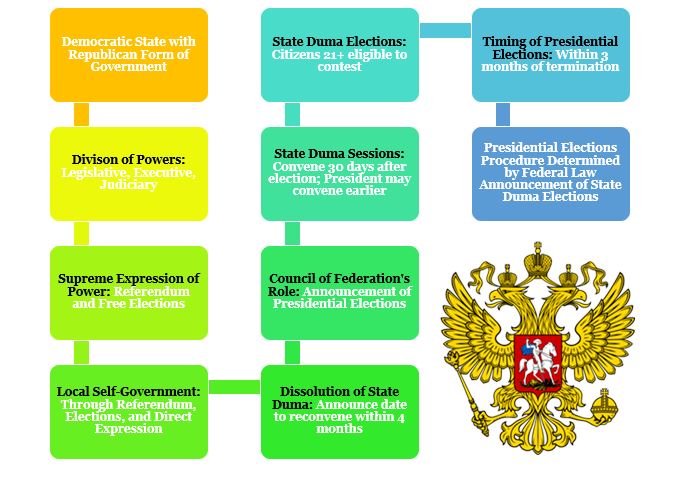
Russia 2024
Source: Russian Federation Constitution, 1993; Our Analyst’s Conceptualisation, 2023

Democratic Foundation. Russia is declared a democratic state with a republican form of government. The Constitution emphasizes the importance of human rights, civil peace, and accord.

Division of Powers. State power is divided among the legislative, executive, and judicial branches.

Supreme Expression of Power. The supreme direct expression of the power of the people is through referendums and free elections, as stated in Article 3(3) of the Constitution.

Presidential Elections. The procedure for presidential elections is determined by federal law, as per Article 81(4). The President announces elections to the State Duma in accordance with the Constitution and federal law (Article 84).

Timing of Presidential Elections. Presidential elections are to be held within three months of the early termination of the presidential office (Article 92(2)).

State Duma Elections. Any Russian citizen aged 21 or older with the right to participate in elections may be elected as a deputy of the State Duma (Article 97).

State Duma Sessions. The State Duma convenes its first session 30 days after the election, but the President may convene it earlier (Article 99(2)).

Council of Federation’s Role. The Council of Federation is responsible for the announcement of presidential elections (Article 102(e)).

Dissolution of State Duma. In case of dissolution, the President announces the date of elections so that a newly-elected State Duma may be convened not later than four months after the dissolution (Article 109(2)).

Local Self-Government. Local self-government is exercised through referendums, elections, and other forms of direct expression of citizens’ will (Article 130(2)).

Previous Presidential Elections

Democratic Tradition. Russia, as per its constitution, follows a democratic process in electing its president. Previous elections have been held in accordance with these democratic principles.

Federal Law Influence. The procedure for presidential elections being determined by federal law implies that changes in election processes may occur over time based on legal amendments.

Role of Council of Federation. The Council of Federation has been historically involved in the announcement of presidential elections, emphasizing a centralized authority in the electoral process.

2024 Presidential Election

Legal Framework. The 2024 presidential election will likely adhere to the existing constitutional framework and any relevant changes in federal laws governing the electoral process.

Council of Federation’s Role. The Council of Federation’s involvement in announcing the election suggests a continued role in shaping the electoral landscape for the upcoming 2024 election.

Potential for Amendments. Given the flexibility implied by “determined by federal law,” there could be potential amendments or changes to the election procedure leading up to the 2024 election.

Democratic Principles. The emphasis on democratic values in the constitution is likely to be a key factor in shaping the discourse around the 2024 election, underscoring the importance of free and fair elections.

Public Participation. The mention of referendums and direct expression of citizens’ will in local self-government indicates a broader commitment to public participation, which may be reflected in the 2024 election process.


Notable Provisions of Lagos State Physical Planning Regulations On Planning and Renovation Permits

0

Land Law :- Notable Provisions Of The Lagos State Physical Planning Permit Regulations On Planning & Renovation Permits.

In light of the recent spate of demolitions carried out by the Lagos State government, away from the politics of it all, it is important that to be sure that before acquiring a piece of land and developing, a clear understanding of the provisions of the physical planning laws of the state should be had by a buyer.

This article will be looking at important provisions of the Lagos State Planning Permit Regulations & will be focused on the topics of :-

– Planning Permits.

– Renovation Permits.

What do the regulations say on applications for planning permits?

– Any person, be it an individual or corporation, or government agency intending to carry out any development on any land within the state shall make an application to the Lagos State Physical Planning Permit Authority (LASPPPA) for a grant of a planning permit for such development.

– All physical developments in the state shall have an approved planning permit.

– All planning permits to be granted shall be within the context of an approved operative development plan (master/local plan) where available. Where there is no operative development plan, an application shall be considered on the result of the planning information application process.

What is the procedure for applying for a planning permit?

– Applications for development shall be made as appropriate by the developer in a regulatory form prescribed by LASPPPA .

– Applications are to be accompanied by :-

1). 1 set of architectural drawings.

2). Duly signed survey plans.

3). Land Title Documents.

– A duly completed application form shall be submitted by the applicant or through appointed registered professionals in the building industry to the authority, with the following documents :

1). 1 survey plan copy with relevant survey reference number.

2). 5 sets of screened architectural drawings of the proposed development prepared, signed, sealed and stamped by an architect registered to practice in Nigeria which shall include the site plan indicating details including the following :-

a). Area covered by the subject site.

b). The beacon numbers or pillars indicating the property boundary and linear dimensions.

c). Land Use Planning & Analysis Reports (LUPAR).

d). Front, rear, left & right side elevations of the building, the height, floor levels & others that may be required.

What are the provisions of the regulations on renovation permits?

Alteration, Addition & Repair

– No building shall be renovated in the state without renovation permits granted by the LASPPPA.

– Applicants shall be issued letters of renovation permits subject to satisfying certain conditions as specified in the regulations.

– Any person intending to renovate a building shall before carrying out such renovation, submit to the authority an application, stating the details of renovation and evidence or previous planning permits if any. The process shall attract 25% of the prevailing processing fees.

Alterations & Addition

– No building shall be altered or added or redeveloped in the state without planning permits from the authority through an application containing details which include :

a). As-built drawings

b). The proposed alterations, repair, development, drawing & super-imposed on the as-built drawing.

c). A certificate of structural fitness within indemnities issued by a registered civil/structural engineer.

d). A civil or structural engineer’s undertaking to supervise the alteration, addition or repairs. 

Land Law :- Requirements For Fencing & Demolition Permits In Lagos State

This article will be focused on fencing and demolition permits in Lagos state & their requirements as prescribed by the Lagos State Physical Planning Permit Regulations/”The Regulations” (LASPPPA). 

What are the provisions of the regulations on fencing permits?

– No fencing work shall be allowed on any land in the state without a permit from LASPPPA.

– Any person who intends to carry out fencing work shall submit the following documents :-

a). An application & drawings (architecture and/or structural designs).

b). 1 sun-print survey plan of the subject site.

c). Evidence of title documents.

d). Receipts of prescribed fee payments.

– A fence line shall be recessed by a minimum of 900mm from the front property boundary for purposes of landscaping/beautification.

– The front fence line shall be made of a maximum of 3.0 mtrs consisting of 1.5 meters solid wall from ground level and remaining height shall be a minimum of 1 meter see-through made of any material.

– The party walls between adjacent properties shall maintain a maximum height of 3 meters from existing road level.

What are the provisions of the regulations on demolition permits?

– Any developer who intends to demolish any existing structure shall apply in writing to the authority for the issuance of a demolition permit as provided in these regulations.

– No site with existing structure shall be demolished in the state without a demolition permit granted by the authority to remove the structure.

– Any intending applicant for a demolition permit shall submit an application to LASPPPA accompanied with the following documents :- 

a). evidence of title documents;

b). photographs of existing structures.

What is the applicable fee for demolition permits?

– Regulatory demolition permit fees in Lagos State are charged at 250 Thousand Naira.

What are the provisions of the regulations on Land Use Zones & Complementary uses?

– The following shall be permissible developments under the regulations in all the approved Land Use Zones as specified therein.

The “Libelous” Publications Of Mr Francis Van Lare: Taking Legal Steps!

1

A seventy-year-old Nigerian man has been on the lips of bloggers and netizens for the past one week now. The man by the name “Francis Van Lare” in celebration of his seventieth birthday published on his Facebook wall the names of all the women he alleged to have had sex with since he started engaging in sexual activities from the 1960s. 

Some of the names he published looked familiar because he didn’t just publish first names, he published both the first and last names of the persons. 

Some persons who claimed they are the bearers of the names he published are threatening to sue him for libelous defamation but this is why the suit for libel from some of the women against Mr Francis Van Lare may likely not succeed in the court of law. 

What then is libel? Libel is a “published” “false statement” that is “damaging” to a person’s reputation. Once it is a written or published defamation it becomes a libel but it is merely spoken or verbal, it is slander. 

For a suit of libel to succeed in court it must be; 

  1. Published 
  2. It must be a false statement 
  3. It must be damaging to one’s reputation or defamatory 
  4. It must not just be a mere opinion expressed as an opinion. 
  5. It must be specifically addressed to a particular person or group of persons

This is to say that for a claimant suit to succeed, the statement must be written or published, the statement must be seen to be damaging to the claimant’s reputation, the statement must be false and it must not be an opinion and it must be addressed to or about a specific person and not a generalized statement. 

For instance, if I post or publish that Mr John Doe is a thief, for Mr John Doe to successfully bring a suit for libel against me, there must not be any evidence or proof showing that Mr John Doe have stolen before or that he is truly a thief; if my statement of him being a thief is true then he cannot succeed in an action for Libel against me because my statement is not false. Again, if I post on my wall a generalized statement that I have slept with Mrs Jane Doe, anybody or everybody bearing the name “Jane Doe”, cannot bring up an action against me because I did not specify the Jane Doe I’m talking about even though my statement could be false and defamatory to every Jane Doe out there. 

Back to the Facebook publication of Mr Francis Van Lare; As already highlighted that one of the core ingredients of libel or slander is that the defamatory statement must be addressed to a particular individual. If Mr Francis Van Lare published on his wall that he has slept with Mrs Jane Doe, and one Mrs. Jane Doe decides to sue Mr Francis Van Lare for libel, Mr Francis Van Lare’s defense could be that he never referred to that particular Mrs Jane Doe as there are a lot of persons bearing Mrs Jane Doe. So a claimant must show that the libel was addressed to him or her specifically. 

So most of the ladies threatening to sue may not succeed in the libel claim because it will be difficult for them to show in court that the is truly theirs and not any other person out there because those names, although common and popular names are not exclusive to anybody but the case will be different if after publishing the names of the ladies and he went further to add other personal details to specify the ladies he is referring to.

Libel is both a civil wrong and a crime in Nigeria. If convicted, it is punishable with a 1-2 years jail term as provided in section 375 of the criminal code act

Robinhood Expanding its Crypto Trading services to Customers in Europe

0

Robinhood, has announced that it is expanding its cryptocurrency trading services to customers in the European Union. This means that EU residents can now buy and sell Bitcoin, Ethereum, Dogecoin and other digital assets on Robinhood’s app, without paying any commission fees.

Robinhood is a leading online brokerage platform that offers commission-free trading of stocks, options, cryptocurrencies, and more. The company has attracted millions of users, especially young and novice investors, who value its ease of use, gamified features, and social media presence.

According to a press release, Robinhood will launch its crypto trading services in the UK, Germany, France, Spain, Italy, and the Netherlands in early 2024. Customers in these countries will be able to buy and sell cryptocurrencies such as Bitcoin, Ethereum, Dogecoin, and more, with zero commission fees and instant settlement. They will also be able to access real-time market data and news on crypto assets through the Robinhood app.

Robinhood’s crypto trading services are already available in the US, where the company has over 10 million customers and more than $20 billion in assets under custody. The company claims that it is one of the largest and fastest-growing crypto platforms in the US, with over 6 million crypto traders in 2021.

Robinhood’s expansion to Europe is part of its global vision to empower millions of people to participate in the financial system. The company believes that crypto is a key driver of financial inclusion and innovation, and that it can help create a more equitable and sustainable world.

“We’re thrilled to bring our crypto trading services to Europe, where there is a huge demand and enthusiasm for crypto,” said Vlad Tenev, co-founder and CEO of Robinhood. “We believe that everyone should have access to the tools and information they need to invest in the future of money. We’re excited to join forces with our European customers and partners to make this vision a reality.”

However, Robinhood has also faced significant criticism and scrutiny from regulators, lawmakers, and customers over its business practices, policies, and role in the recent market volatility.

The company said that it wants to make crypto investing more accessible and affordable for everyone, regardless of their location or financial background. Robinhood also claimed that it offers some of the best prices in the market, as it sources liquidity from multiple venues and passes the savings to its customers.

Robinhood’s move into the EU market comes amid growing demand for crypto assets in the region, as well as increased regulatory scrutiny and competition. The company said that it has obtained the necessary licenses and approvals from the relevant authorities, and that it complies with the highest standards of security and compliance.

Robinhood’s crypto trading service is currently available in 10 EU countries: Austria, Belgium, Denmark, Finland, France, Germany, Ireland, Italy, Spain and Sweden. The company said that it plans to add more countries and currencies in the future, as well as more features and functionality to its app.

Robinhood’s crypto trading service is separate from its stock trading service, which is only available in the US. The company said that it is working on bringing its stock trading service to the EU as well but did not provide a specific timeline or details.

Robinhood is one of the most popular and controversial online brokers in the US, where it has attracted millions of young and novice investors with its commission-free and gamified platform. However, it has also faced criticism and lawsuits for its role in the GameStop saga earlier this year, as well as for its frequent outages, customer service issues and alleged market manipulation.

Why US SEC has been reluctant to approve spot Bitcoin ETF Applications

0

A spot Bitcoin?ETF would track the price of the underlying cryptocurrency directly, rather than relying on futures contracts or other derivatives. This would provide investors with a more transparent and cost-effective way to gain exposure to the digital asset class.

BlackRock, the world’s largest asset manager, has not given up on its ambition to launch a spot Bitcoin?ETF in the US. The company has been in talks with the Securities and Exchange Commission (SEC) to address the regulator’s concerns and demonstrate the feasibility of such a product.

However, the SEC has been reluctant to approve any spot Bitcoin?ETF proposals, citing issues such as market manipulation, custody, liquidity, and investor protection. The regulator has repeatedly delayed or rejected applications from various firms, including VanEck, Valkyrie, and WisdomTree.

BlackRock, which already offers two funds that invest in Bitcoin futures, believes that it can overcome these challenges and convince the SEC to greenlight its spot Bitcoin?ETF. The company has been working closely with the regulator to address its questions and provide evidence of the maturity and robustness of the Bitcoin market.

According to sources familiar with the matter, BlackRock has presented data and analysis on various aspects of the Bitcoin ecosystem, such as price discovery, volatility, arbitrage, trading volume, and custody solutions. The company has also highlighted the benefits of a spot Bitcoin?ETF for investors, such as diversification, hedging, and innovation.

BlackRock is confident that its spot Bitcoin?ETF would meet the SEC’s standards and expectations and hopes to receive a positive response from the regulator soon. The company believes that a spot Bitcoin?ETF would be a game-changer for the crypto industry and would attract significant inflows from institutional and retail investors alike.

Franklin Templeton, one of the world’s largest asset managers, has filed an amendment to its Bitcoin spot ETF application with the US Securities and Exchange Commission (SEC). The firm is seeking to launch the Franklin Templeton Bitcoin ETF, which would track the performance of Bitcoin based on the prices from selected spot exchanges. The ETF would not use derivatives or futures contracts, but rather hold Bitcoin directly in a custodial arrangement with NYDIG Trust Company.

The amendment, submitted on November 29, 2023, provides additional details on the proposed ETF’s investment objective, strategy, risks, fees, and valuation methods. The document also outlines how the ETF would comply with the SEC’s requirements for investor protection, liquidity, transparency, and market integrity.

According to the filing, the ETF would have a total annual operating expense ratio of 0.75%, which includes a management fee of 0.50% and other expenses of 0.25%. The ETF would trade on the NYSE Arca exchange under the ticker symbol FTBT.

The Franklin Templeton Bitcoin ETF is one of several spot Bitcoin ETF applications that are currently under review by the SEC. The regulator has not yet approved any such products in the US, despite growing demand from investors and increasing competition from other jurisdictions that have already authorized Bitcoin ETFs. The SEC has expressed concerns about the potential for fraud, manipulation, and volatility in the Bitcoin market, as well as the lack of reliable and consistent pricing data.

Franklin Templeton believes that its Bitcoin spot ETF would address these issues by using a robust methodology to select the spot exchanges that would provide the reference price for the ETF. The firm also claims that its custodial arrangement with NYDIG would ensure the security and safety of the Bitcoin holdings, as well as facilitate the creation and redemption of ETF shares.

Moreover, the firm argues that its Bitcoin spot ETF would offer investors a convenient and cost-effective way to gain exposure to Bitcoin without having to deal with the technical challenges of buying, storing, and transferring the digital asset.

The SEC has not yet announced a decision date for the Franklin Templeton Bitcoin ETF application, but it is expected to do so within 45 days of receiving the amendment. If approved, the Franklin Templeton Bitcoin ETF would be the first spot Bitcoin ETF in the US, and a major milestone for the crypto industry.

Paxos secures in principle approvals for Stablecoin Issuance and Crypto services in Dubai

Meanwhile, Paxos, a leading blockchain infrastructure platform, announced today that it has received in principle approvals from the Financial Services Regulatory Authority (FSRA) of Abu Dhabi Global Market (ADGM) to operate a regulated crypto-asset business and provide stablecoin services.

This is a significant milestone for Paxos, as it will be one of the first companies to offer regulated crypto services in the Middle East and North Africa (MENA) region. Paxos will be able to provide custody, trading, settlement, and issuance of digital assets to institutional and professional clients in ADGM.

Paxos will also be able to issue its own stablecoins, such as Paxos Standard (PAX) and Binance USD (BUSD), which are backed 1:1 by US dollars and audited monthly by a third-party firm. Paxos stablecoins are widely used across the global crypto ecosystem, with over $16 billion in circulation as of November 2021.

Charles Cascarilla, CEO and Co-Founder of Paxos, said: “We are thrilled to receive these in principle approvals from the FSRA, which demonstrate our commitment to operating at the highest level of regulatory standards. We look forward to bringing our innovative solutions to the MENA market and expanding access to the digital economy.”

CEO of the FSRA of ADGM, said: “We are pleased to welcome Paxos to ADGM’s leading and dynamic digital asset ecosystem. As a pioneer of blockchain technology and a provider of regulated crypto services, Paxos will contribute to the development and growth of this sector in ADGM and the wider region.”

The main features and differences between these two digital assets that are both pegged to the US dollar.

PYUSD is the stablecoin launched by PayPal, the payment processing giant, in August 2023. It is fully backed by US dollar deposits, US treasuries, and similar cash equivalents. On PayPal, you can buy and sell 1 PYUSD for 1 USD. PYUSD is designed for digital payments and Web3 environments, meaning that it can be used for online shopping, peer-to-peer transfers, smart contracts, decentralized applications, and more.

PYUSD is issued by Paxos Trust Company, a regulated entity that also issues USDP and other stablecoins. PYUSD is an ERC-20 token that runs on the Ethereum blockchain, so it can be stored in any compatible wallet and transferred to any Ethereum address.

USDP is another stablecoin issued by Paxos Trust Company. It was formerly known as PAX or Paxos Standard, and it rebranded to USDP in June 2023. Like PYUSD, USDP is also backed 1:1 by the US dollar and it is also an ERC-20 token on Ethereum. However, USDP has some features that distinguish it from PYUSD. For example, USDP has a lower gas fee than PYUSD, meaning that it costs less to send and receive USDP transactions on the Ethereum network.

This is because USDP uses a smart contract optimization technique called CREATE2 that reduces the amount of data stored on the blockchain. Another difference is that USDP has more integrations with other platforms and services than PYUSD.

For instance, USDP can be used on Binance Smart Chain, Solana, Polygon, Avalanche, and other blockchains that support cross-chain bridges. USDP can also be used on various decentralized exchanges, lending platforms, yield farming protocols, and other DeFi applications that accept stablecoins.

PYUSD and USDP are both stablecoins that are pegged to the US dollar and issued by Paxos Trust Company. They are both ERC-20 tokens on Ethereum, but they have some differences in terms of gas fees, integrations, and use cases. Both PYUSD and USDP offer a way to access the benefits of cryptocurrencies without the volatility of other assets like Bitcoin or Ether.