DD
MM
YYYY

PAGES

DD
MM
YYYY

spot_img

PAGES

Home Blog Page 3898

DStv Rescinds AFCON Blackout Decision in Last-Minute Turnaround

0

In a surprising twist of events, South African broadcasting giant DStv has reversed its decision not to broadcast the highly anticipated African Cup of Nations (AFCON) tournament. 

The company, through its SuperSport channels, announced on Wednesday that it had secured the broadcasting rights and will air all 52 matches of the AFCON 2023, despite last week’s declaration that it had failed to obtain the necessary rights.

“No gree for anybody! Watch all 52 matches of the #afcon2023 on @supersports,” the company declared in a statement on X, formerly known as Twitter. 

This announcement came as a welcome relief to football fans, particularly those in Sub-Saharan Africa, who were left disheartened by the initial news of DStv’s inability to broadcast the 34th AFCON.

DStv’s abrupt change of stance occurred just days before the tournament’s kickoff, with less than 72 hours remaining before the opening match. The eleventh-hour deal reflects the company’s dedication to providing fans with access to the football spectacle that unites the continent.

However, the initial blackout scare was part of a broader shift in the African football broadcasting industry. Togolese broadcaster New World TV recently secured exclusive broadcasting rights for all Confederation of African Football (CAF) competitions in the Sub-Saharan Africa region. This included the 2023 and 2025 AFCON tournaments, leading to an unexpected blackout on DStv for Nigerian viewers.

This development marked a significant departure from the status quo, ousting previous rights holders like SuperSport International and Canal Plus from the scene. The three-year deal between New World TV and CAF covers an impressive 13 competitions, spanning 46 countries in the Sub-Saharan Africa region.

Moreover, the groundbreaking agreement mandates that free-to-air stations within these nations acquire broadcasting rights through sublicensing facilitated by New World TV. This transformative approach seeks to democratize access to football content, ensuring a broader audience can partake in the excitement of CAF competitions beyond the AFCON tournaments.

CAF announced last week, a substantial 40% increase in prize money for the tournament. This move is set to boost the financial rewards for participating teams and further intensify the competition among the continent’s football powerhouses.

Despite the initial disruption caused by the exclusivity shake-up, DStv’s late deal ensures it now stands alongside StarTimes, NTA, AfroSport, and other networks that will broadcast matches from the biggest football showpiece in Africa.

However, the abrupt change in DStv’s stance raises questions about the intricacies of negotiations between the broadcasting giant and CAF. The sudden reversal, while bringing relief to football fans, underlines the complexities involved in securing broadcasting rights for premier football competitions.

With the suspension of board and management of 3 banks, watch how Nigeria stock exchange reacts tomorrow

1

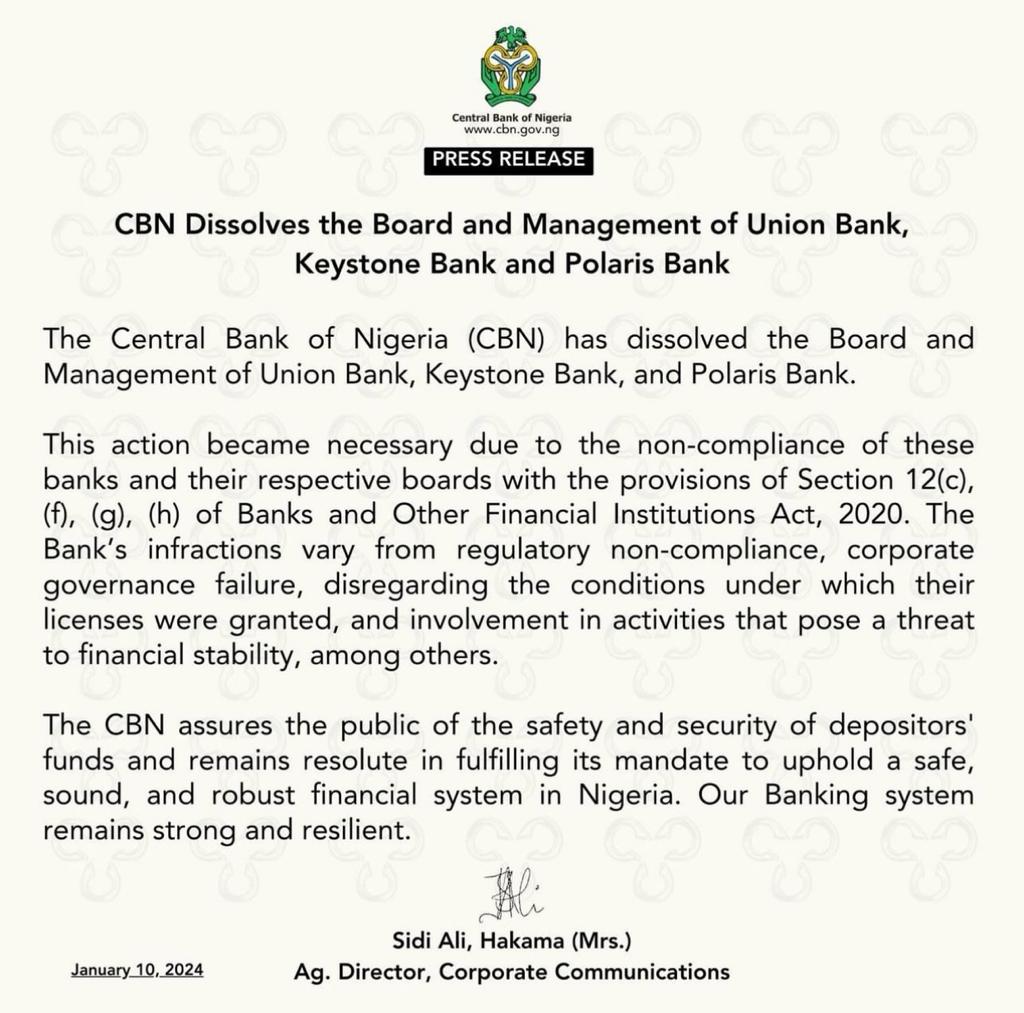
What would you be looking for in the Nigerian stock exchange tomorrow? I will be looking at how the market will react to the hammer on Union, Keystone, and Polaris banks, with the apex bank suspension of their board and management teams. 

Understand that this is not just about these three banks. The notice released when Dangote Group headquarters was searched indicated that more than 50 companies are under the microscope. 

This does imply that more actions are coming. So, are we at a time when investors will begin to pay attention in our information-immune stock exchange where no news makes any impact?

Ladies and Gentlemen, be vigilant because what happened to Savannah Bank and Bank PHB remains evergreen. Those two banks disappeared within minutes. In short, they dissolved as Nigeria happened on them, and with our poor property rights regime, investors lost everything. Platinum Capital was my broker; it did not even have time to email us before it went dead as everything happened within 6 hours! 

So, do not underestimate the current action in your risk model. Before I cause panic, depositors are not in my equation; my focus here is the investing public, not depositors of banks.

How Nigerian police circumvent the justice system with the holding charge tactic.

0
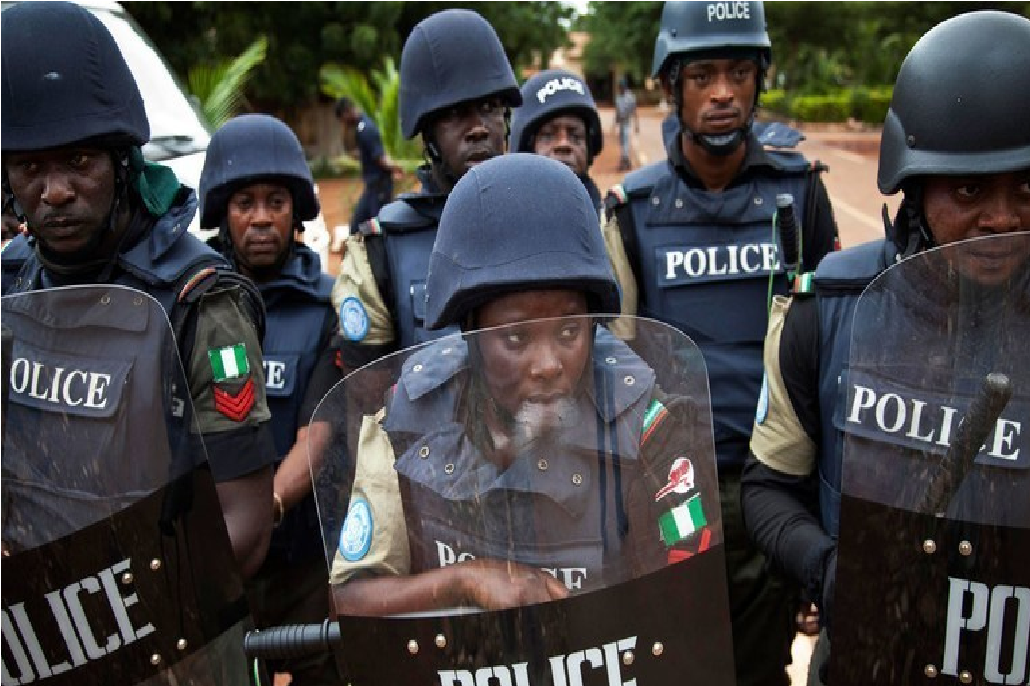
Nigeria police continues to struggle to maintain peace

The provisions of sections 293-299 of the Administration of Criminal Justice Act, 2015, (ACJA), created a serious problem which could be seen to have undermined the constitutional provisions of section 35; the problem it created is that it tends to give an open cheque to Magistrates courts to entertain holding charges, order the remand or issue the remand warrant to law enforcement agencies against suspects without trial. The law enforcement agencies have serially exploited this thereby making a joke on the constitutional provisions of personal liberty and suspects’ right to bail. 

It has been in the spirit of the Constitution that nobody should be denied his personal liberty under any circumstance, including an accused person but law enforcement agencies have adopted this mischievous tactic to circumvent the constitutional provision of the protection of the liberties of an accused person is through this practice of remand warrant or holding charge. 

Remanding a suspect in custody is just a careful way the law enforcement agencies use to deny a suspect his right to bail. The word remand simply means to recommit (an accused person) to custody after a preliminary examination or to return to custody pending trial or for further detention. Holding charges on the other hand is done when a charge is filed against a suspect for a minor offense to keep the suspect in custody while the prosecutors gather more evidence and prepare more serious charges. It is simply a temporary charge so as to keep the person in detention before the real charges are filed.

Mind you that the provisions of section 35 of the Constitution are unwavering as the umbrella that protects the liberties of individuals; be it an innocent person or an accused person. 

Subsection 1 of section 35 provided as follows; (1)  Every person shall be entitled to his personal liberty and no person shall be deprived of such liberty save in some cases and in accordance with a procedure permitted by law, as outlined in 1(a) to (f).

Subsequently, subsection 4 provided thus; Any person who is arrested or detained in accordance with subsection (1) (c) of this section shall be brought before a court of law within a reasonable time. By the wide interpretation of this section 35(4(1c), a reasonable time has been held to be no later than 48 hours. This is to say that the law enforcement agency must not detain a suspect not later than 48 hours without releasing him on bail or charging him to court but with the mischievous practise of “holding charge” or remand warrant, a law enforcement agent can decide to get a remand warrant from the magistrate court and detain a suspect longer than 48 hours. 

Despite the fact that the court has consistently frowned against this practice of holding charges in a plethora of cases, law enforcement agencies still engage in the practice. In the case of Olawoye V. C.O.P. (2006), 2 NWLR the Court of Appeal authoritatively stated that the arraignment before a Magistrate Court in a case where the magistrate court lacks jurisdiction is tantamount to a holding charge and it is unconstitutional and illegal. Also In the case of Enwere v. C.O.P., it was held that “holding charge” is unknown to Nigeria Law and an accused person detained thereunder is entitled to be released on bail within a reasonable time before trial. A similar position was held by the court in the case of SHAGARI V. CO.P. (2007) 5 NWLR where it held that “holding charge is unknown to Nigerian law and any person or an accused person detained thereunder, is entitled to be released on bail within a reasonable time before trial”.

I, therefore, expect law enforcement agencies, going forward to know that the Constitution of the Federal Republic of Nigeria in section 35 frowns at the practice of holding charge and therefore being a superior law invalidates and renders nullity the provisions of sections 293-299 the Administration of Criminal Justice Act, 2015, (ACJA) which has presumptuously given the room for this mischief. 

Nigeria Dissolves Board and Management of Polaris, Union and Keystone Banks

0

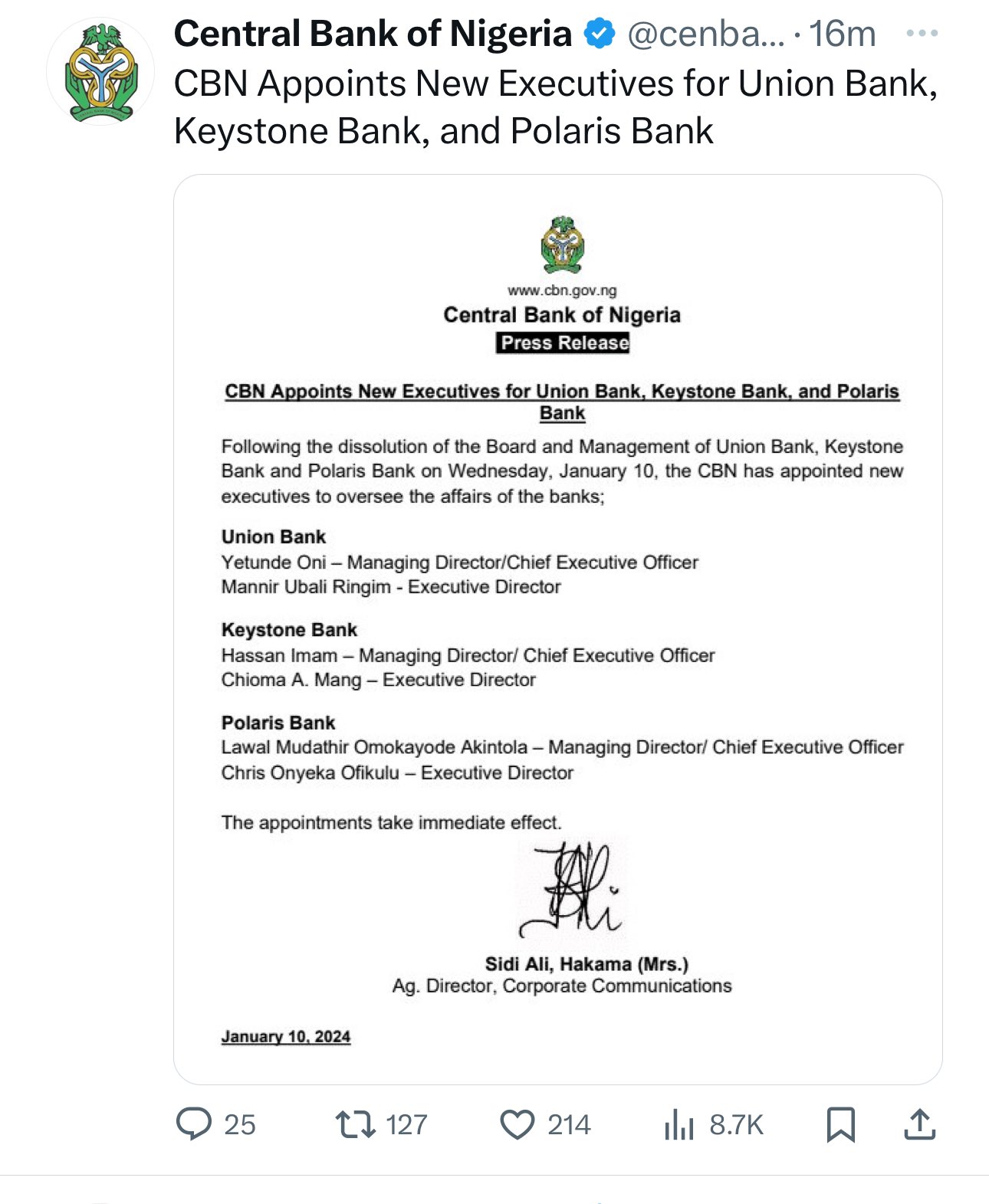
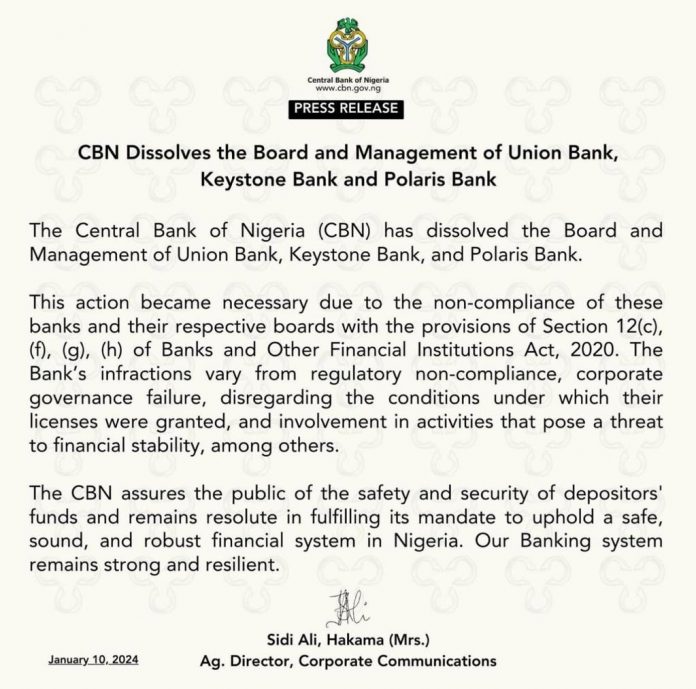
I read it and contested that it was a rumour. But with this evidence, it is indeed true. Yes, the Central Bank of Nigeria has dissolved the boards and management teams of Union, Keystone and Polaris banks (and in extension Titan bank since it swallowed Union Bank). This is simply unprecedented and another big asterisk on Buhari’s stewardship of Nigeria’s economy.  For three banks to get this hammer in one day is a big statement in the land.

Good People, if you are looking for the most fearful person in Nigeria right now, I have a cheat sheet for you: Special Investigator Jim Obazee who wrote the report. It does seem like his report will take many people to early retirement and some to [you fill the space].

I will always vote for Nigeria’s progress and I do hope this helps.

Alleged Financial Mismanagement Rocks Nigeria’s Central Bank as Investigator’s Report Exposes High-Level Fraud

Mercari to accept Bitcoin payments in Japan

0

Mercari, the popular online marketplace in Japan, has announced that it will start accepting Bitcoin payments for its services. This is a major milestone for the adoption of cryptocurrency in the country, as Mercari is one of the largest and most widely used platforms for buying and selling goods online.

Mercari’s decision to accept Bitcoin comes after the Japanese government recognized Bitcoin as a legal form of payment in 2017 and introduced regulations to protect consumers and prevent money laundering. Since then, more than 200,000 stores in Japan have started accepting Bitcoin, and the number is expected to grow as more people become aware of the benefits of using digital currency.

Mercari’s CEO, Shintaro Yamada, said that the company wants to offer more options and convenience to its users, and that Bitcoin is a natural fit for its business model. He said that Mercari’s mission is to create value in a global marketplace where anyone can buy and sell anything, and that Bitcoin can help achieve that goal by enabling fast, secure, and low-cost transactions across borders.

Mercari will use BitFlyer, one of the largest and most trusted cryptocurrency exchanges in Japan, to process its Bitcoin payments. Users will be able to choose Bitcoin as a payment option when they check out on Mercari’s website or app, and scan a QR code to complete the transaction. The amount of Bitcoin will be calculated based on the current exchange rate at the time of purchase. Mercari will then convert the Bitcoin to Japanese yen and transfer it to the seller’s account.

Mercari said that it will launch its Bitcoin payment service in the first half of 2024, and that it will initially be available for selected categories of goods, such as electronics, fashion, and books. The company said that it plans to expand the service to more categories and regions in the future, and that it hopes to attract more customers and sellers who are interested in using cryptocurrency.

Mercari’s announcement has been met with positive reactions from both the crypto community and the general public in Japan. Many users have expressed their excitement and support for Mercari’s move, saying that it will make online shopping more convenient and fun. Some users have also said that they will start using Mercari more often because of its Bitcoin payment option.

Mercari is not the only online platform that accepts Bitcoin in Japan. Other notable examples include Rakuten, Japan’s largest e-commerce company, which allows users to pay with Bitcoin on its online mall, travel site, and mobile app; DMM.com, a major online entertainment and media company, which accepts Bitcoin for its digital content and services; and GMO Internet, a leading internet service provider, which offers Bitcoin as a salary option for its employees.

Japan is widely regarded as one of the most progressive and friendly countries for cryptocurrency in the world. The country has a vibrant and active crypto scene, with many startups, investors, developers, and enthusiasts who are driving innovation and adoption. Japan also hosts some of the largest and most influential crypto events, such as the Tokyo Blockchain Week and the Japan Blockchain Conference.

Mercari’s decision to accept Bitcoin is a significant step forward for the crypto industry in Japan, and a sign of confidence in the future of digital currency. By embracing Bitcoin, Mercari is not only offering more value and choice to its users, but also contributing to the growth and development of the crypto ecosystem in Japan.