DD
MM
YYYY

PAGES

DD
MM
YYYY

spot_img

PAGES

Home Blog Page 3909

African Smartphone Market Surges 12% Year-on-Year in Q3 2023 Despite Currency Challenges And Import Restrictions

1

In a recent report by Canalys, the African smartphone market saw a 12% surge year-on-year in the third quarter of 2023.

Despite macroeconomic headwinds, volatile currencies in key markets, and import restrictions, the region experienced an impressive growth in smartphone shipment, totaling up to 17.9 units.

In the report, Transsion, a Chinese smartphone manufacturer provider of smart devices and mobile services for consumers in global emerging markets, whose brands include Tecno, Itel, and Infinix, maintained its leading position, and achieved 9% annual growth, securing a dominant 48% market share.

The company is strategically expanding its footprint, especially in emerging markets, focusing on price bands below US$100.

Coming in second position is Samsung which recorded total shipments of 4.6 million, with a market share of 26%. The company was hit by a 13% decline due to challenges in its mid-to-high-end devices.

Followed next is Xiaomi, which successfully positioned itself as an aspirational brand for many consumers, gaining popularity with products such as the Redmi series A2, Note 12 4G, 12, and 12C. This strategy is also successful for Xiaomi in North African countries such as Egypt and Morocco. Egypt experienced a double-digit 19% growth in smartphone shipments, signaling vendors have successfully addressed the challenges posed by strict import restrictions in the previous year.

Speaking on the report, Canalys Senior Consultant, Manish Pravinkumar said that the African market has demonstrated strong resilience in demand and supply amid macroeconomic challenges.

In his words,

Despite rapid currency devaluation, South Africa’s smartphone market exhibited a remarkable growth of 20%. This surge was fueled by the demand for entry-level devices, particularly catering to the extensive pre-paid segment. Additionally, mid-tier devices experienced heightened demand, and the prevalence of load-shedding contributed to this trend, as people increasingly prioritize smartphones with quality screens and robust battery life to keep them entertained during power outages.

Nigeria’s smartphone market expanded substantially, with TRANSSION playing a pivotal role by offering entry-level devices and Xiaomi successfully positioning itself as an aspirational brand for many consumers, gaining popularity with products such as the Redmi series A2, Note 12 4G, 12, and 12C. Vendors’ local teams are leveraging the strengths of their brand assets and global product portfolios to augment market positions in Africa.

TRANSSION, through initiatives such as the Takenow device financing schemes for TECNO and collaborations with Easybuy, has not only boosted sales but also advocated for an increase in Average Selling Price (ASP). HONOR and Xiaomi are, making significant impacts by introducing diverse products at accessible prices, and points. This strategic move aims to expedite the transition from basic feature phones to smartphones, injecting excitement into markets.

Meanwhile Samsung maintained its A-series to drive volume. And, confronted with the challenge of consumers preferring mid-range devices from Xiaomi, OPPO, and Realme, Samsung proactively promoted foldable devices to secure a prominent position in the premium segment. Huawei has been collaborating with local software suppliers in South Africa, continually enhancing the usability of HMS and tackling the lack of GMS.”

While recording significant growth in the third quarter of 2023, Canalys foresees limited expansion in the African region, expecting single-digit growth in 2024. The firm believes that the availability of device financing schemes from operators and channel partners could significantly enhance accessibility and boost adoption rates.


Dell Technologies Believes Generative AI Will be The Centre of Business Focus in 2024

0

American-based technology company Dell Technologies believes that Generative AI will be the center of business focus in 2024.

The MD of the tech company, Catherine Doyle predicts that generative AI will move from theory to practice, which will see powerful PCs unlock more AI advancements, and zero trust will become central to cybersecurity practices.

Doyle disclosed that in 2024, generative AI projects will start to be business-ready with visible productivity gains becoming evident while noting that an increasing number of Irish businesses will adopt AI and scale it across their organisations. She predicts that breakthrough technologies will help Irish businesses to navigate new challenges that may emerge in the coming months and to innovate at speed.

In her words,

According to our latest GenAI Pulse survey, nearly half of IT leaders expect to see meaningful results from generative AI initiatives within six months to a year. One of the first steps that leaders can take to ensure successful AI adoption in the year ahead is to organize and structure data within their business.

“With the global explosion of data and AI, there will be an increasing need for organizations in Ireland to put in place the computing power to manage it effectively. Quantum computing will begin to address this and bring about a massive leap in the computing power that is required to unlock AI innovation. If we were surprised by the generative AI advancements of the last year, leaders should expect to see a bigger jump forward when quantum computing becomes intertwined in the near future.

“Over the next 12 months, the PC experience will shift from searching to prompting, from reading to understanding, and from editing to directing. This will result in the emergence of a two-way human-machine partnership in workplaces across Ireland. Also, as AI becomes a key part of laptops and devices, it will unlock improved privacy and security while also advancing sustainable design.”

Doyle further predicts that the promise of powerful digital assistants will become a reality next year, as PCs and AI technology become more powerful.

As technology continues to advance at a rapid pace, presenting a mix of opportunities for businesses in every sector, organizations with a strong culture of innovation are best placed to drive growth.

While AI evolution is still in the early stages, it is a technology that offers boundless possibilities for innovation and driving growth. Generative AI can help every business transform data into intelligent applications that enable them to solve complex business challenges, improve the customer experience, or enable new ways of working.

Notably, the introduction of AI into the business sphere will allow companies who adopt the technology, to gain a competitive advantage over their counterparts in the market. Also, as the rate of technological innovation increases in line with the use of exponential technologies, market dynamics will change accordingly, and those businesses that adopt the most flexible and modern strategieswill significantly increase their chances of financial success. 

For the greatest benefits, businesses should look at putting the full range of smart generative AI technology, into their processes and products, as deploying the right AI technology into their business will enable them to gain the ability to:

  • Save time and money by automating and optimizing routine processes and tasks.
  • Increase productivity and operational efficiencies.
  • Make faster business decisions based on outputs from cognitive technologies.
  • Avoid mistakes and ‘human error’, provided that AI systems are set up properly.
  • Use insight to predict customer preferences and offer them a better, personalized experience.

It is worth noting that Businesses that are reluctant to adopt AI technologies into their operations, will lag behind those that do and will suffer more prominent financial expenses in the long run.

You Underestimate How Prepared You Are to Win In 2024

1

It is Christmas and this is a message for the #Future.

Nothing great has ever been achieved without a start. The promise of the future depends on #Action today. Is this the right time for that next move, from a General Manager to a Director? Why not move ahead with the product launch, after all, you have taken months and months over-analysing things? Can the customers be given the opportunities to test the hypothesis of this product?

You underestimate how prepared you are. You underestimate how ready you are. Yes, get over that indecision and take action. Launch that company. Apply for that graduate program. Apply for that next line job. Unveil that product. Move forward, and you will be surprised at the outcome. Remember: nothing great has ever been accomplished until someone takes action. Action begins history!

Greatness has been achieved, not because of special talent or absolute readiness, but rather via total dedication, perseverance and commitment when humans meet obstacles. The first victory over obstacles is overcoming what keeps you from taking ACTION.

In 2024, #TakeAction on something productive, and see how the impact will compound. Win that Future. Merry Christmas and happy new year ahead.

Stripe is Building APIs for Crypto Businesses, Amid Tim Draper Donating to Fund Bitcoin Development

0

Stripe, the leading online payment platform, has announced that it is developing a suite of APIs for crypto businesses. The APIs will enable crypto companies to integrate Stripe’s payment infrastructure and access its global network of customers and partners.

Stripe’s APIs will support various use cases for crypto businesses, such as:

Accepting payments in cryptocurrencies and stablecoins. Converting crypto to fiat and vice versa. Managing crypto wallets and balances. Issuing and redeeming crypto tokens. Creating and verifying crypto proofs. Complying with regulatory requirements and best practices.

Stripe’s APIs will leverage its existing technology stack and expertise in payment processing, fraud prevention, compliance, reporting, and customer support. Stripe’s APIs will also be compatible with its existing products and features, such as:

Stripe Connect, which enables platforms and marketplaces to accept payments from and pay out to third parties.

Stripe Billing, which simplifies recurring and subscription-based billing.

Stripe Radar, which detects and prevents fraud using machine learning.

Stripe Atlas, which helps entrepreneurs start and scale their online businesses.

Stripe Capital, which provides financing to growing businesses.

Stripe’s APIs will be available in beta later this year and will be open to crypto businesses of all sizes and types, from exchanges and wallets to protocols and platforms. Stripe’s APIs will initially support Bitcoin, Ethereum, and USDC, with plans to add more cryptocurrencies and stablecoins in the future.

Tim Draper donated $150,000 to fund Bitcoin developers

In a generous gesture of support for the Bitcoin community, billionaire venture capitalist Tim Draper has donated $150,000 to the Bitcoin Development Fund, a non-profit organization that provides grants to Bitcoin developers.

The donation was announced by the Bitcoin Development Fund on Twitter, thanking Draper for his contribution and stating that it will help fund “the future of Bitcoin development”.

Draper is a well-known figure in the crypto space, having invested in several successful projects such as Coinbase, Ledger, and Tezos. He is also a vocal advocate of Bitcoin, predicting that it will reach $250,000 by 2022.

Draper’s donation is part of a larger trend of increased funding for Bitcoin development, as more individuals and organizations recognize the importance of supporting the core protocol and its ecosystem. According to Bitcoin Optech, a newsletter that tracks Bitcoin development, there are currently over 50 developers who receive regular funding from various sources, such as companies, foundations, and sponsors.

The Bitcoin Development Fund is one of the entities that facilitate this funding, by collecting donations from the public and distributing them to developers who work on improving Bitcoin’s security, scalability, privacy, and usability. The fund was launched in 2019 by BitMEX, a leading crypto exchange, and has since received support from other prominent donors such as Square Crypto, Kraken, and Gemini.

The fund’s website states that its mission is to “ensure the long-term success of Bitcoin by funding open-source projects that contribute to its advancement”. The fund also aims to increase transparency and accountability in Bitcoin development, by publishing regular reports on its activities and finances.

The fund currently supports six developers: Calvin Kim, Dhruv Mehta, Fanquake, Gleb Naumenko, Jeremy Rubin, and Michael Ford. These developers work on various aspects of Bitcoin, such as improving its performance, testing its code, enhancing its network protocol, and researching new technologies.

The fund welcomes donations from anyone who wants to support Bitcoin development and accepts contributions in both fiat and crypto. The fund also encourages potential donors to contact them if they have specific preferences or suggestions regarding the projects or developers they want to fund.

By donating to the Bitcoin Development Fund, Draper has shown his commitment to the growth and innovation of Bitcoin. His generous gesture will undoubtedly inspire more people to follow his example and contribute to the development of the world’s leading cryptocurrency.

Stripe’s APIs for crypto businesses are part of its vision to increase the GDP of the internet by enabling more online commerce. Stripe believes that crypto is a powerful catalyst for innovation and inclusion, and that by providing easy-to-use APIs for crypto businesses, it can help accelerate the adoption and growth of the crypto ecosystem.

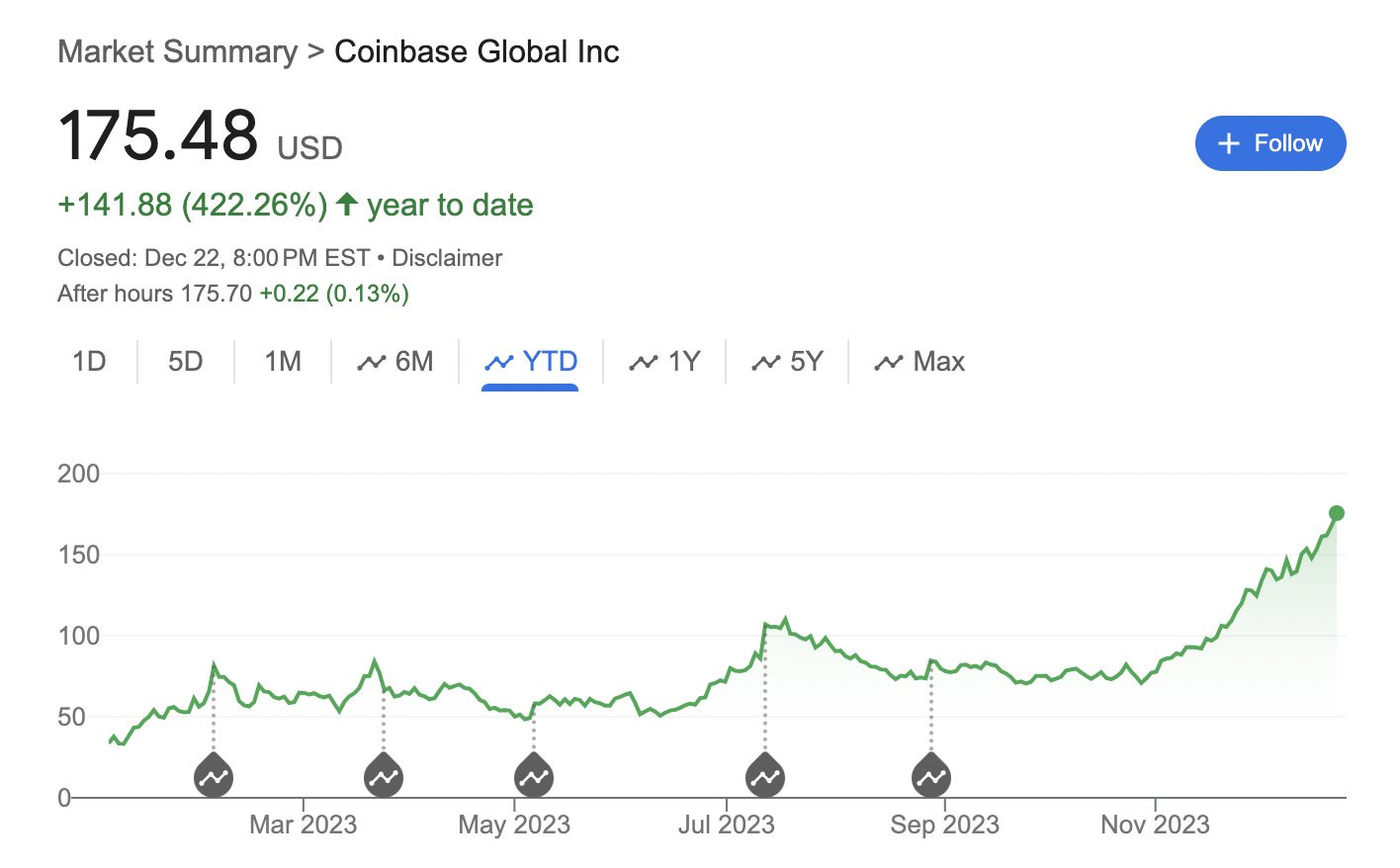
Coinbase is now up 422% year-to-date

0

Coinbase, the leading cryptocurrency exchange in the US, has seen its share price soar by 422% since the beginning of the year, as investors flock to gain exposure to the booming crypto market.

The company, which went public in April, reported record revenues and profits in the third quarter, driven by strong trading volumes and user growth. Coinbase now has more than 73 million verified users, up 96% year-over-year, and more than 9.4 million monthly transacting users, up 117% year-over-year.

The impressive performance of Coinbase reflects the growing demand for bitcoin and other digital assets, which have reached new highs in 2021. Bitcoin, the largest cryptocurrency by market capitalization, recently surpassed $60,000 for the first time since April, while Ethereum, the second largest, hit a new all-time high of over $4,800. The total market value of all cryptocurrencies now exceeds $2.8 trillion, according to CoinMarketCap.

Coinbase is not the only company that is benefiting from the crypto craze. Wall Street firms are also eager to tap into this emerging asset class, which offers high returns and diversification benefits.

Several banks, such as Goldman Sachs, Morgan Stanley, and JPMorgan Chase, have launched or are planning to launch crypto-related products and services for their clients, such as funds, futures, ETFs, and custody solutions. Some traditional asset managers, such as BlackRock, Fidelity, and Vanguard, have also expressed interest or invested in crypto.

The increasing adoption of crypto by institutional investors is a positive sign for the industry, as it indicates a shift in perception and acceptance of this new form of money. However, there are still many challenges and risks that need to be addressed, such as regulatory uncertainty, security breaches, volatility, and environmental concerns.

The cryptocurrency market has been growing at an unprecedented rate in the past years, reaching a total market capitalization of over $2.5 trillion in May 2021. Bitcoin, the largest and most popular cryptocurrency, has seen its price surge from around $10,000 in October 2020 to over $60,000 in April 2021, before experiencing a sharp correction in May and currently trading around $43,700 per BTC.

This phenomenal growth has attracted the attention of many institutional investors, who are looking for ways to gain exposure to this new and exciting asset class. Wall Street, in particular, has been showing a strong interest in bitcoin and other cryptocurrencies, as they offer a number of advantages over traditional assets, such as:

High returns: Cryptocurrencies have outperformed most other asset classes in terms of returns, especially in the long term. For example, bitcoin has delivered an annualized return of over 200% since its inception in 2009, compared to around 10% for the S&P 500 index.

Diversification: Cryptocurrencies have a low correlation with other asset classes, meaning that they can reduce the overall risk and volatility of a portfolio. For example, bitcoin has a correlation of around 0.2 with the S&P 500 index, meaning that they move independently from each other most of the time.

Innovation: Cryptocurrencies are at the forefront of technological innovation, as they are based on blockchain technology, which is a decentralized and distributed ledger that records transactions securely and transparently. Blockchain technology has the potential to disrupt many industries and sectors, such as finance, healthcare, supply chain, and more.

Coinbase and other crypto players will have to navigate these issues and prove their resilience and innovation in order to maintain their growth and competitive edge in the long run.