DD
MM
YYYY

PAGES

DD
MM
YYYY

spot_img

PAGES

Home Blog Page 3913

Percentage of Global Population Without a Bank Account Down to 24%

0

Financial inclusion is a key indicator of economic development and social welfare. It means that people have access to basic financial services, such as savings, payments, credit and insurance, that enable them to participate in the formal economy and improve their lives.
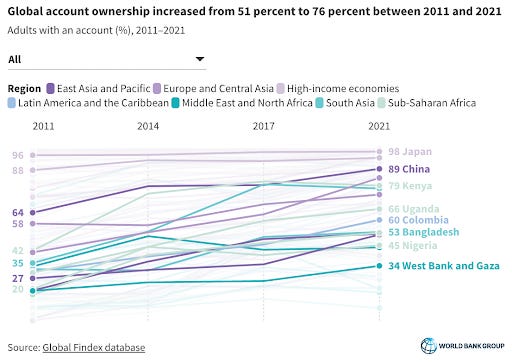
However, according to the latest data from the World Bank, there are still 1.7 billion adults in the world who do not have a bank account or a mobile money provider. This represents 24% of the global population, a significant decrease from 31% in 2014, but still far from the universal access envisioned by the Sustainable Development Goals.

Why does financial inclusion matter? Because it empowers people to make informed choices about their money, to save for emergencies and opportunities, to invest in their education and health, to start and grow businesses, to support their families and communities, and to contribute to the overall economic growth and stability of their countries.

Financial inclusion also reduces poverty and inequality, as it enables the most vulnerable and marginalized groups, such as women, rural dwellers, refugees and migrants, to access formal financial services that are affordable, convenient and secure.

The Sustainable Development Goals (SDGs) are a set of 17 global goals adopted by the United Nations in 2015, as part of the 2030 Agenda for Sustainable Development. They cover various aspects of human and planetary well-being, such as poverty, hunger, health, education, gender equality, clean energy, climate action and peace. One of the targets under the SDG 1 (No Poverty) is to ensure that all men and women have equal access to basic financial services by 2030.

Why does financial inclusion matter? Because it empowers people to make informed choices about their money, to save for emergencies and opportunities, to invest in their education and health, to start and grow businesses, to support their families and communities, and to contribute to the overall economic growth and stability of their countries.

Financial inclusion also reduces poverty and inequality, as it enables the most vulnerable and marginalized groups, such as women, rural dwellers, refugees and migrants, to access formal financial services that are affordable, convenient and secure.

How can we achieve financial inclusion for all? There is no single solution, but rather a combination of factors that need to work together. These include:

  • Developing an enabling regulatory environment that fosters innovation and competition, while protecting consumers and ensuring financial integrity.

  • Leveraging digital technologies, such as mobile phones, biometrics and blockchain, that can lower the cost and increase the reach of financial services, especially in remote and underserved areas.

  • Building inclusive financial infrastructure, such as payment systems, credit bureaus and identification systems, that can facilitate interoperability and data sharing among different providers and platforms.

  • Enhancing financial literacy and capability, through education and awareness campaigns, that can help people understand and use financial services effectively and responsibly.

  • Promoting financial inclusion as a cross-cutting issue, that requires coordination and collaboration among various stakeholders, such as governments, regulators, private sector, civil society, donors and international organizations.

Financial inclusion is not an end in itself, but a means to an end. It is a tool that can help people achieve their potential and aspirations. It is a right that should be accessible to everyone. It is a challenge that we can overcome together.

Why is financial inclusion important? Because it can help people improve their lives and achieve their goals. For example, financial inclusion can help people:

  • Manage their cash flow and cope with unexpected shocks, such as illness, natural disasters, or loss of income.

  • Build assets and invest in education, health, housing, or business opportunities.

  • Reduce their vulnerability and increase their resilience to poverty and inequality.

  • Participate in the formal economy and benefit from the opportunities it offers.

Financial inclusion is not only good for individuals, but also for societies and economies. Financial inclusion can:

  • Support economic growth and development by mobilizing savings, allocating resources efficiently, and facilitating innovation and entrepreneurship.

  • Promote social cohesion and stability by reducing inequality, empowering women and marginalized groups, and enhancing trust and cooperation among people.

  • Strengthen financial systems and institutions by increasing their outreach, diversification, competition, and sustainability.

However, financial inclusion is not a magic bullet that can solve all the problems of the world. Financial inclusion is not an end in itself, but a means to an end. It is a tool that can enable people to achieve their potential and aspirations. But it is not enough by itself. Financial inclusion needs to be complemented by other policies and interventions that address the root causes of poverty, exclusion, and vulnerability.

Therefore, financial inclusion should not be seen as a standalone goal, but as part of a broader agenda of inclusive development. Financial inclusion should be aligned with the Sustainable Development Goals (SDGs), which are a set of 17 global goals that aim to end poverty, protect the planet, and ensure peace and prosperity for all by 2030. Financial inclusion can contribute to many of the SDGs, such as:

  • SDG 1: No Poverty

  • SDG 2: Zero Hunger

  • SDG 3: Good Health and Well-being

  • SDG 4: Quality Education

  • SDG 5: Gender Equality

  • SDG 8: Decent Work and Economic Growth

  • SDG 10: Reduced Inequalities

  • SDG 13: Climate Action

To achieve financial inclusion for all, we need to work together as a global community. We need to involve all stakeholders, such as governments, regulators, financial service providers, civil society organizations, donors, academia, media, and most importantly, the people themselves. We need to foster a culture of innovation, collaboration, learning, and adaptation. We need to leverage the power of technology, data, and digital platforms.

2023 – A Year of Inflation, War and Ever-Divisive Politics

0

The past year has been marked by many challenges and uncertainties, such as rising prices, global conflicts, and polarized opinions. However, it has also been a year of remarkable innovation and progress in various fields of science and technology. We will review some of the most notable achievements and breakthroughs that have shaped 2023 and offer a glimpse into the future.

The year 2023 will be remembered for many reasons, some of them grim and some of them inspiring. On the one hand, the world faced unprecedented challenges such as soaring inflation, violent conflicts, and deepening polarization.

On the other hand, the human spirit of innovation and resilience shone through in remarkable ways, as new technologies emerged to address some of the most pressing problems of our time. In this blog post, we will review some of the highlights and lowlights of this eventful year and reflect on what they mean for the future of humanity.

One of the most notable developments of 2023 was the breakthrough in nuclear fusion by South Korea’s KSTAR facility, which achieved a stable plasma state for 30 seconds at a temperature of 100 million degrees Celsius, nearly seven times hotter than the core of the Sun. This milestone was hailed as a major step towards achieving clean and unlimited energy for the world and sparked a renewed interest in fusion research among other countries and organizations.

Another area where technology made a significant impact was in health care, especially in the fight against COVID-19 and its variants. Several new vaccines and treatments were developed and distributed around the world, thanks to the collaboration of scientists, governments, and private sector partners. Some of the most promising innovations included mRNA-based vaccines that could be tailored to specific strains of the virus, nanobots that could deliver drugs directly to infected cells, and artificial intelligence that could diagnose and monitor patients remotely.

However, not all technological advances were positive or beneficial for humanity. 2023 also witnessed some of the worst cyberattacks in history, targeting critical infrastructure, government agencies, and private companies.

Some of the most damaging incidents included a ransomware attack that paralyzed the US oil pipeline system, a hack that exposed the personal data of millions of Facebook users, and a coordinated assault that disrupted the global internet service for several hours. These attacks exposed the vulnerability of our digital systems and raised serious questions about cybersecurity and privacy.

Moreover, technology also played a role in exacerbating some of the social and political issues that plagued 2023. The spread of misinformation and propaganda through social media platforms contributed to increasing polarization and extremism among different groups and ideologies.

The use of drones and autonomous weapons in warfare raised ethical and legal dilemmas about accountability and human rights. The emergence of biotechnology and genetic engineering posed challenges to our understanding of identity and morality.

As we look back at 2023, we can see that it was a year of contrasts, where technology was both a source of hope and a cause of concern. We can also see that it was a year of learning, where we had to adapt to new realities and cope with new challenges. We can hope that 2024 will be a year of action, where we will use technology wisely and responsibly to create a better world for ourselves and others.

Grapecoin sees 40% Dump, Ethereum, Pumps to $2300, as Serum Becomes Crypto’s Next Big Thing

0

Grapecoin, a new cryptocurrency project that claims to be the “future of decentralized finance”, has experienced a massive sell-off after its initial coin offering (ICO) on December 20. The token price dropped by more than 40% in less than 24 hours, wiping out millions of dollars from investors who bought the hype.

According to the Grapecoin website, the project aims to create a “fair and transparent” ecosystem for lending, borrowing, and earning interest on crypto assets. The project also boasts of having a “unique” governance model that allows token holders to vote on important decisions and proposals.

However, some analysts and critics have pointed out several red flags and inconsistencies in the Grapecoin project. For instance, the project has not disclosed the identity of its team members, nor has it provided any proof of code audit or security audit. The project also has a high inflation rate of 10% per year, which could dilute the value of the token over time.

Moreover, some investors have reported difficulties in withdrawing their funds from the Grapecoin platform, as well as encountering errors and glitches on the website and the app. Some have also accused the project of being a “rug pull”, a term used to describe a scam where the developers abandon the project and run away with the money.

The Grapecoin team has not issued any official statement or explanation regarding the token price crash or the technical issues. The project’s social media accounts have also been silent since the ICO. Some users have speculated that the project may have been hacked or compromised, while others have lost hope of recovering their investments.

The Grapecoin debacle is another reminder of the risks and challenges involved in investing in new and unproven crypto projects. While some projects may offer high returns and innovative features, they may also carry high volatility and uncertainty. Investors should always do their own research and due diligence before putting their money into any crypto venture.

Ethereum shows sign of life pumps to $2300

Ethereum, the second-largest cryptocurrency by market capitalization, has been showing some signs of life in the past few days. After a prolonged period of sideways trading, ETH finally broke out of its resistance zone and surged to $2300, a level not seen since early September.

What is behind this bullish momentum? There are several factors that could be contributing to Ethereum’s rally, such as:

  • The anticipation of the upcoming upgrade, Ethereum 2.0, which will transition the network from a proof-of-work (PoW) consensus mechanism to a proof-of-stake (PoS) one. This will improve the scalability, security and efficiency of Ethereum, as well as reduce its environmental impact.

The growing adoption of decentralized applications (DApps) and decentralized finance (DeFi) protocols that run on Ethereum. According to DappRadar, there are over 3000 DApps on Ethereum, with more than $20 billion in total value locked (TVL). Some of the most popular DApps include Uniswap, Aave, Compound and MakerDAO.

The increasing demand for non-fungible tokens (NFTs), which are unique digital assets that can represent anything from art to music to gaming items. Ethereum is the dominant platform for NFT creation and trading, with over 90% of the market share. Some of the most notable NFT projects on Ethereum include CryptoPunks, Axie Infinity and Bored Ape Yacht Club.

The favorable technical indicators that suggest Ethereum is in a strong uptrend. ETH has crossed above its 50-day and 200-day moving averages, which are key support levels. It has also formed a bullish flag pattern on the daily chart, which indicates a continuation of the previous rally.

What does this mean for Ethereum investors? It is possible that Ethereum could continue its upward trajectory and reach new highs in the near future. However, there are also some risks and challenges that could hinder its growth, such as:

The competition from other smart contract platforms that offer faster transactions, lower fees and more innovation. Some of the main rivals of Ethereum include Cardano, Solana, Polkadot and Binance Smart Chain.

The regulatory uncertainty that surrounds the cryptocurrency industry. There have been some recent developments that could affect Ethereum’s legal status and taxation, such as the infrastructure bill in the US, the ban on crypto transactions in China and the proposed digital asset legislation in India.

The volatility and unpredictability of the crypto market. Ethereum is still subject to the influence of external factors, such as global events, market sentiment and whale movements. It is not uncommon for Ethereum to experience sudden drops or spikes in price, which could test the nerves of investors.

Therefore, it is advisable for Ethereum investors to do their own research, diversify their portfolio and manage their risk accordingly. Ethereum is a promising project with a lot of potential, but it is also a high-risk, high-reward investment that requires careful analysis and planning.

Serum becomes crypto’s next big thing

If you have been following the crypto space for a while, you might have heard of SBF, or Sam Bankman-Fried, the founder and CEO of FTX, one of the largest and most innovative crypto exchanges in the world. SBF is known for his philanthropy, his trading prowess, and his support for various crypto projects, especially those built on Solana, a high-performance blockchain platform that he helped fund and grow.

One of the projects that SBF has been backing since its inception is Serum, a decentralized exchange (DEX) that runs on Solana and leverages its speed, scalability, and low fees. Serum is not just a DEX, but a whole ecosystem of DeFi applications, such as lending, borrowing, derivatives, stablecoins, and more. Serum aims to bring the best of both worlds: the trustlessness and permissionlessness of DeFi, and the liquidity and efficiency of centralized exchanges.

Serum has been growing steadily since its launch in August 2020, attracting more users, developers, and partners to its platform. Recently, Serum announced a major milestone: it reached over $1 billion in total value locked (TVL), which is a measure of how much crypto assets are deposited in its smart contracts. This makes Serum one of the largest DEXes in the world, and the first one to cross the $1 billion mark on Solana.

But what makes Serum so special, and why is it poised to become crypto’s next big thing? Here are some of the reasons:

Serum is fast and cheap. Thanks to Solana’s architecture, which can process over 50,000 transactions per second with sub-second finality and sub-penny fees, Serum can offer a trading experience that rivals that of centralized exchanges. Users can trade any asset on Serum with minimal latency and slippage, without worrying about network congestion or high gas costs.

Serum is interoperable and composable. Serum is built with a cross-chain vision, meaning that it can connect with other blockchains and allow users to trade any asset across different platforms. For example, users can trade Bitcoin or Ethereum on Serum using wrapped versions of these assets that are compatible with Solana.

Moreover, Serum is designed to be composable, meaning that its components can be easily integrated with other DeFi applications to create new use cases and functionalities.

Serum is decentralized and community driven. Unlike centralized exchanges, which are controlled by a single entity and subject to regulation and censorship, Serum is fully decentralized and governed by its users. Anyone can create a market on Serum, list any asset, or provide liquidity.

Anyone can also participate in the governance of Serum by holding its native token, SRM, which gives them voting rights and other benefits. Serum’s community is vibrant and active, contributing to the development and innovation of the platform.

Serum is backed by SBF and other industry leaders. Serum has the support and endorsement of some of the most influential figures and organizations in the crypto space, such as SBF, who is also the co-founder of Serum; Alameda Research, one of the largest crypto trading firms; Jump Trading, a leading market maker; Multicoin Capital, a prominent crypto venture capital firm; and many others. These partners provide Serum with liquidity, capital, expertise, and exposure.

Serum is an old SBF favorite that has proven its value and potential over time. It is now becoming crypto’s next big thing as it continues to grow and innovate in the DeFi space. If you are looking for a fast, cheap, interoperable, decentralized, and community-driven DEX that is backed by some of the best in the industry, look no further than Serum.

The Central African Republic (CAR) Adopts Bitcoin As Legal Tender

0

The Central African Republic (CAR) has become the latest country to adopt bitcoin as legal tender, following the footsteps of El Salvador and Panama. The decision was announced by President Faustin-Archange Touadéra on December 22, 2023, as part of a series of economic reforms aimed at boosting the country’s growth and stability.

According to the president, bitcoin will help the CAR overcome its challenges of financial inclusion, remittance costs, inflation and currency devaluation. He said that bitcoin will enable the citizens of the CAR to access a global and decentralized network of value that is open, transparent and secure. He also expressed his hope that bitcoin will attract more foreign investment and innovation to the country, which has been plagued by civil war and poverty for decades.

The president’s announcement was met with mixed reactions from the international community and the local population. Some praised the move as a bold and visionary step towards embracing the future of money, while others criticized it as a risky and irresponsible gamble that could undermine the country’s sovereignty and stability.

Some experts warned that bitcoin could expose the CAR to volatility, cyberattacks, money laundering and sanctions evasion. Some residents expressed their skepticism and confusion about how bitcoin works and how it will benefit them.

The CAR government has said that it will launch a national education campaign to inform the public about bitcoin and its advantages. It will also partner with local and international organizations to provide technical assistance and infrastructure for the adoption of bitcoin.

The government has set a deadline of June 1, 2024, for all businesses and institutions to accept bitcoin as a form of payment, alongside the Central African CFA franc, which will remain as the country’s official currency.

The CAR is the third African country to adopt bitcoin as legal tender. The trend reflects the growing interest and adoption of cryptocurrencies in Africa, where many people face challenges of accessing traditional financial services and suffer from high inflation and currency instability. Bitcoin offers an alternative way of storing and transferring value that is independent of central authorities and intermediaries.

The adoption of bitcoin by the CAR could have significant implications for other countries in the region and beyond. It could inspire more countries to follow suit and embrace cryptocurrencies as a way of enhancing their economic sovereignty and resilience. It could also create more opportunities for cross-border trade and cooperation among countries that use bitcoin as a common currency.

However, it could also pose challenges for regional integration and coordination, especially among countries that use the CFA franc as a shared currency. It could also increase the pressure on central banks and governments to regulate and monitor cryptocurrencies more closely, in order to prevent potential risks and abuses.

Fed’s policy is Expected to boost Consumer Spending and Business Investment

0

The Federal Reserve’s recent decision to keep interest rates near zero and continue its bond-buying program has significant implications for the US economy and the world.We will examine how the Fed’s policy is expected to boost consumer spending, business investment, and housing activity, as well as support global growth and trade.

Consumer spending is the largest component of the US gross domestic product (GDP), accounting for about 70% of the total. The Fed’s policy lowers the cost of borrowing for consumers, making it easier for them to finance purchases of goods and services, such as cars, appliances, vacations, and education. Lower interest rates also increase the disposable income of consumers, as they pay less on their mortgages, credit cards, and other debts.

This boosts their confidence and willingness to spend. Moreover, the Fed’s policy stimulates the stock market and the housing market, which increases the wealth of consumers and encourages them to spend more.

Business investment is another key driver of the US economy, contributing about 15% of the GDP. The Fed’s policy lowers the cost of capital for businesses, making it more attractive for them to invest in new equipment, machinery, software, research and development, and expansion. Lower interest rates also improve the cash flow of businesses, as they pay less on their loans and bonds. This enhances their profitability and ability to invest.

Furthermore, the Fed’s policy supports the demand for US goods and services from domestic and foreign consumers, which increases the sales and revenues of businesses and motivates them to invest more.

Housing activity is a vital sector of the US economy, representing about 15% of the GDP. The Fed’s policy lowers the mortgage rates for homebuyers, making it more affordable for them to purchase new or existing homes. Lower mortgage rates also increase the refinancing activity of homeowners, allowing them to lower their monthly payments or take out cash from their home equity.

This frees up more money for them to spend or save. Additionally, the Fed’s policy boosts the home prices and construction activity, which creates jobs and income for workers and contractors in the housing industry.

The Fed’s policy also has positive spillover effects on the global economy and trade. By stimulating the US economy, the Fed’s policy increases the demand for imports from other countries, especially those that are major trading partners with the US.

This helps their economies grow and recover from the pandemic-induced recession. By keeping the US dollar low relative to other currencies, the Fed’s policy makes US exports more competitive in foreign markets, which boosts US manufacturers and farmers.

Moreover, by providing liquidity and stability to the global financial system, the Fed’s policy reduces the risks of financial crises and contagion in emerging markets and developing countries.

In conclusion, the Fed’s policy is expected to boost consumer spending, business investment, and housing activity in the US economy, as well as support global growth and trade. The Fed’s policy is intended to achieve its dual mandate of maximum employment and price stability in the long run. However, there are also potential challenges and risks associated with the Fed’s policy, such as inflationary pressures, asset bubbles, fiscal imbalances, and geopolitical tensions.