DD
MM
YYYY

PAGES

DD
MM
YYYY

spot_img

PAGES

Home Blog Page 3927

Jumia Shuts Down Jumia Food in Nigeria and African Markets, Prioritizes Core E-commerce Operations

0

Jumia Technologies AG (JMIA), Africa’s prominent e-commerce platform, has announced the cessation of its unprofitable food delivery service, Jumia Food, in Nigeria and multiple African countries. This strategic move is part of a broader initiative to concentrate on its core e-commerce and JumiaPay operations across markets.

The closure, slated for December 2023, follows a comprehensive strategic review revealing Jumia Food’s misalignment with the current operating landscape and macroeconomic conditions. Despite contributing around 11% to Jumia’s Gross Merchandise Value (GMV) for the nine months ending September 30, 2023, the food delivery segment has persistently struggled to achieve profitability since its inception.

Francis Dufay, CEO of Jumia, emphasized the immense potential within their physical goods business.

“The more we focus on our physical goods business, the more we realize that there is huge potential for Jumia to grow, with a path to profitability. We must take the right decision and fully focus our management, our teams and our capital resources to go after this opportunity. In the current context, it means leaving a business line, which we believe does not offer the same upside potential – food delivery,” he said.

Echoing this sentiment, Antoine Maillet-Mezeray, EVP Finance & Operations of Jumia, acknowledged the challenging economics of the food delivery industry globally and in Africa. “Food delivery remains a business with very challenging economics,” he stated, underlining the prioritization of efforts on the physical goods e-commerce business across their operational markets.

“We want to focus our efforts on our physical goods e-commerce business, in the eleven markets where we operate. This is a matter of prioritization of opportunities, and expected return on investment,” he added.

Jumia Food currently operates in Nigeria, among other African countries. The decision to shutter this segment will involve transitioning several employees to the ongoing physical goods business.

This strategic reorientation reflects Jumia’s commitment to driving profitable growth and focusing on its core e-commerce endeavors across 11 operational markets.

Despite its substantial presence in the African e-commerce sector, Jumia has encountered significant financial losses in Nigeria, where intense competition and operational challenges led to reported losses. For instance, in its 2022 financial report, Jumia revealed a net loss of approximately $46 million attributed to its Nigerian operations, underscoring the complex dynamics of the market.

Moreover, amid these changes, Jumia has observed noteworthy growth in its JumiaPay transactions, reaching 3.2 million in the third quarter of 2023, signifying an 8% year-over-year increase. Impressively, about 44.7% of orders on the Jumia platform during the same period utilized JumiaPay, marking a significant rise from 31.9% in the third quarter of 2022. This surge largely stems from increased JumiaPay usage across both physical goods and food delivery platforms.

TRON (TRX) and Binance Coin (BNB): The Old Guard Making Way For The Presale Investors Can’t Take Their Eyes Off

0

Tron (TRX) and Binance Coin (BNB) are two top altcoins, both launched in 2017 and have played important roles in the growth of the cryptocurrency market. However, a new presale project named Pullix has caught the attention of crypto investors due to its revenue sharing features. Below we will discuss why all 3 tokens are a great addition to your cryptocurrency portfolio.

TRON (TRX) and Binance Coin (BNB): The Old Guards

TRON and Binance Coin are two of the most popular cryptos, each contributing significantly to the ecosystem. TRON, founded by Justin Sun, aimed to create a decentralized internet by providing a platform for content creators and developers.

The TRON coin, TRX, has remained a leading network, processing more stablecoin transactions than other networks. The Tron coin is also the 11th largest crypto, with a market cap of $9.1 billion.

On the other hand, Binance Coin is more identifiable as the native token of the biggest centralized exchange. BNB was ranked as one of the best cryptos to invest in because it played a pivotal role in facilitating transactions within the platform.

The Shifting Dynamics: Why Investors Have Turned To Pullix

While Tron and Binance Coin remain top altcoins, there is a shifting dynamics in the crypto space. The allure of Pullix lies in the platform’s potential to replace the likes of Binance. Pullix has introduced a new trading platform that has merged the benefits of centralized and decentralized exchanges.

Another significant advantage for Pullix is the addition of new tradable assets. Users will be able to purchase, sell, and trade assets in the currency, commodities, and ETF markets on Pullix. This has given Pullix an advantage over competitors such as Binance and Tron. Thus, Pullix users will get access to a number of powerful institutional trading tools powered by openAI.

Pullix has also included an enticing new feature called “Trade-to-Earn.” Users are rewarded instantaneously when they buy, sell, or exchange assets on the platform. The platform’s ERC20 tokens, PLX, will be utilized to reward users. PLX token holders will also be able to stake them to receive even more incentives.

Now, in its early crypto presale, investors can secure tokens at a discounted rate before the public sale. The ERC20 tokens are currently available at $0.042. Given the prospects of the exchange platform, analysts have projected gains of up to 100x, making PLX one of the best cryptos to invest in.

Final Thoughts

While Tron coin and BNB still remain some of the best cryptos to buy, Pullix’s newer technology has caught the attention of investors. The inclusion of AI and advanced trading features has strategically positioned Pullix to take the baton from the old guards.

Visit Pullix

Join The Pullix Communities

Russia’s Strategy for International Cooperation

0

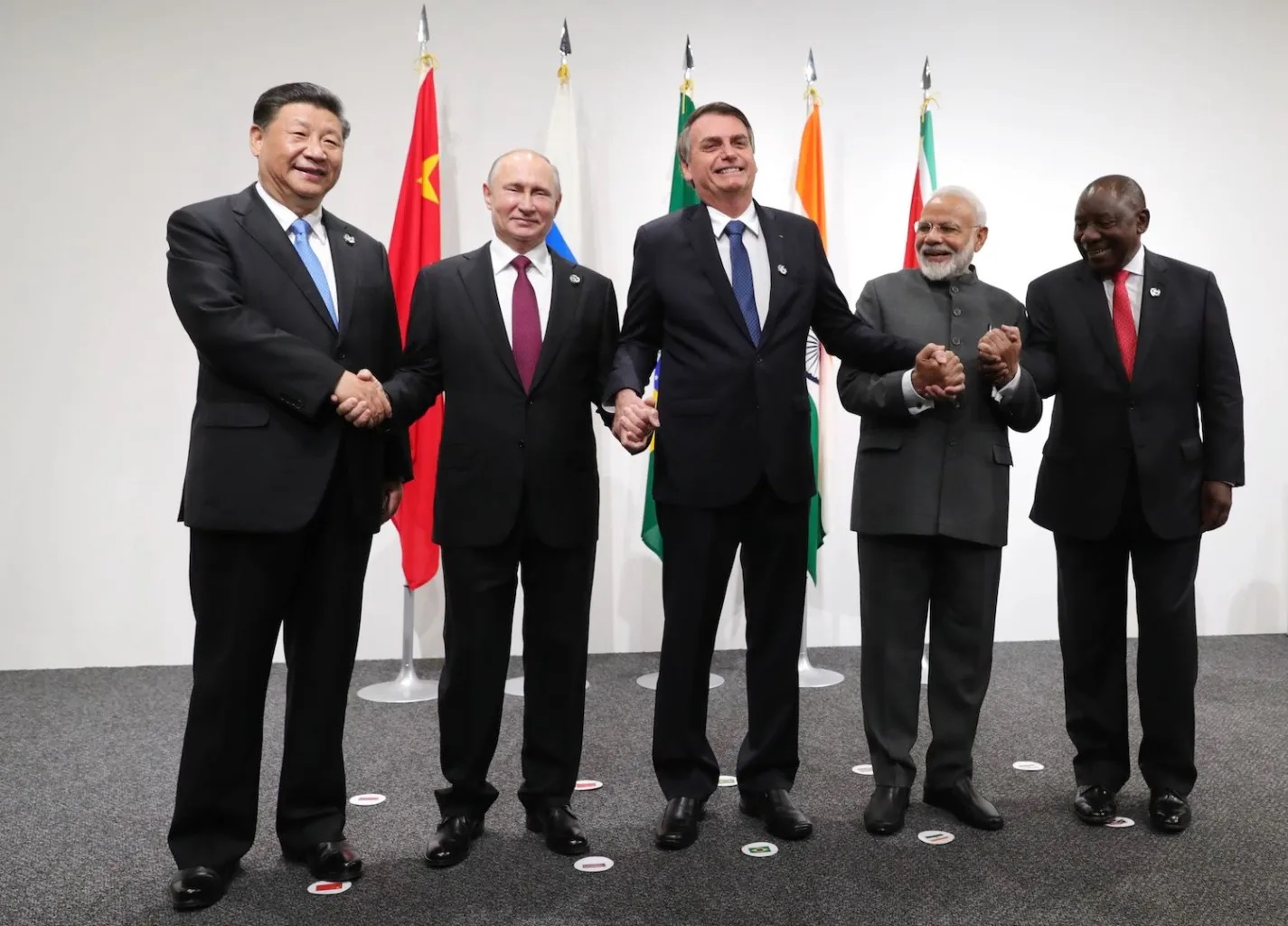
Bridges are important for more than just connecting communities. Bridges are required for the formation and maintenance of strategic relationships in order to capture common interests and benefits. This is one of the primary reasons why a group of people, organizations, and governments have distinct strategies for establishing and maintaining relationships. Countries from the Global North to the Global South are announcing the aims of partnerships and the measures to achieve them in their foreign policy declarations. When the occasion calls for it, presidents may also make spoken statements.

All of this is known to Moscow. That is why, for decades, it has articulated its foreign interactions and collaborations with relevant governments and enterprises in accordance with global best practices. As one of the sovereign centers of global development, it has played a unique historical role in shaping the modern system of international relations and eradicating the global system of colonialism. Its mission is to maintain the global balance of power and establish a multipolar international system. Therefore, Russia being guided by the principles of sovereign equality and respect for each other’s interests towards maintaining strategic stability, strengthen international peace and security.

The Russian Federation’s strategic foreign policy aims to create an equitable and sustainable world order, maintain international peace and security, and promote peaceful coexistence and progressive development. It assists in developing comprehensive responses to common challenges and threats, promotes mutually beneficial cooperation with foreign states and their associations, counters anti-Russian activities, establishes good neighborly relations with contiguous states, assists Russian allies and partners in promoting shared interests, and strengthens the capacity of multilateral regional associations and integration structures.

The Russian Federation also aims to consolidate its position in the world economy, ensure national development goals, and protect its interests in the world’s oceans, space, and airspace. It also aims to enhance Russia’s role in the global humanitarian space, preserve historical truth, and protect the rights, freedoms, and legitimate interests of Russian citizens and entities abroad. It also develops ties with its compatriots living abroad, ensuring their rights and cultural identity are protected. In an effort to fortify the underpinnings of the global financial system, Russia is also taking the lead in and starting regional financial projects.

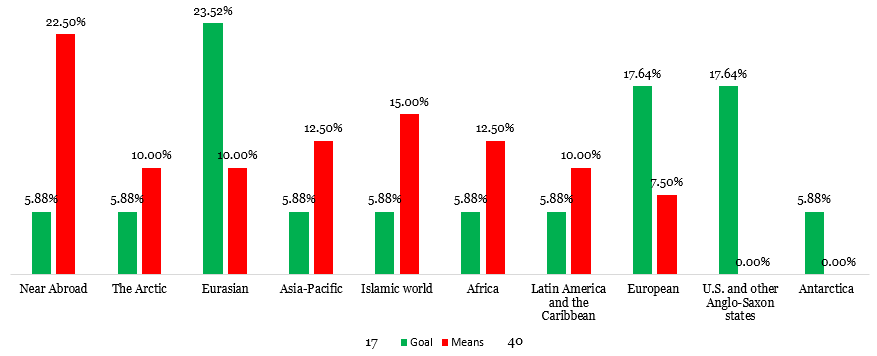
Our analyst further examined the recently released Concept of the Foreign Policy of the Russian Federation with a view to revealing the number of goals and means the country has for continents across the world as well as implications for building sustainable foreign relations. The policy document clearly states the establishment of an equitable and sustainable world order, the rule of law in international relations, and strengthening international peace and security as the key priorities of the Russian Federation.

Figure 1: Number of goals and means in regional tracks of the foreign policy of the Russian Federation
Source: The Concept of the Foreign Policy of the Russian Federation, 2023

Analysis indicates that, in terms of goals, the Russian Federation pursues more significant international relations with countries in Near Abroad, the Arctic, Asia-Pacific, Africa, Latin America and the Caribbean, and Antarctica than with those in Eurasia, Europe, the United States, and other Anglo-Saxon states. It should be noted that this does not mean that the Russian Federation does not make an effort to keep in touch with the governments of these continents. Our analyst notes that it only shows the degree of prioritization that is in place while creating goals.

Meanwhile, analysis suggests that the shortfall in goal setting seems to be complemented by the number of means allocated to some of the continents: Near Abroad, the Arctic, Asia-Pacific, Africa, Latin America and the Caribbean and Antarctica. For example, analysis reveals that Near Abroad, which comprises countries in the Commonwealth of Independent States, that is, Armenia, Azerbaijan, Belarus, Kazakhstan, Kyrgyzstan, Russia, Tajikistan, and Uzbekistan, has over 22% of the 40 means found in the policy document.

On the other hand, the Artic, Asia-Pacific, Islamic World, Africa, Latin America and the Caribbean, which have fewer goals, were allocated a significant percentage of means. Our analyst observes that this might be linked with the Russian Federation’s recent focus on the continents in the context of the new geopolitical order system, multipolarity.

The Discovery Museum and Nigerian Heritage Mediatization

0

The Discovery Museum, founded in July 2021 by its inventor, is a shining example of creativity and curation located in the center of Abuja’s Art Tech District. The museum’s story is shaped by a constellation of characters led by a team of digital artists, storytellers, conservators, exhibition designers, educators, and media producers.

Located in the heart of the Art Tech District, the Discovery Museum offers a singular setting for interpreting Nigeria’s rich cultural legacy. This innovative organization aims to go beyond being a storehouse of treasures and instead redefine the standard museum experience. Rather, it uses technology to make Nigeria’s histories, traditions, culture, and values both concrete and abstract.

Exposition’s Focal Points

Military prowess or roles, classic architectural homes, and virtual and tangible remembrance of the past are the main themes of this carefully chosen selection from the museum’s vast collection for analysis. The museum encourages visitors to interact closely with particular components of Nigeria’s cultural fabric by focusing the story.

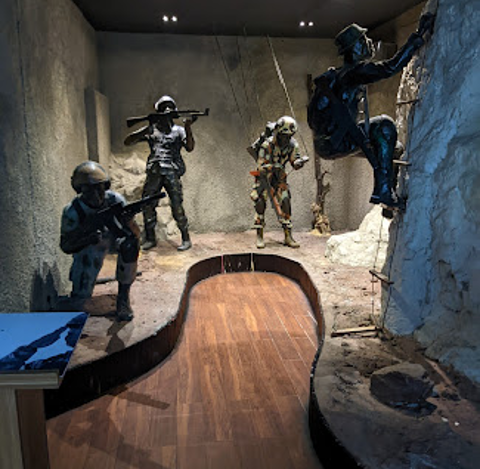
Military statue: During times of war or peacekeeping, various military displays are molded using muds and cements. The national army’s colors are painted on the sculptures. There are both dark and light sections in the space. The terrain was intentionally created to resemble a standard combat zone.

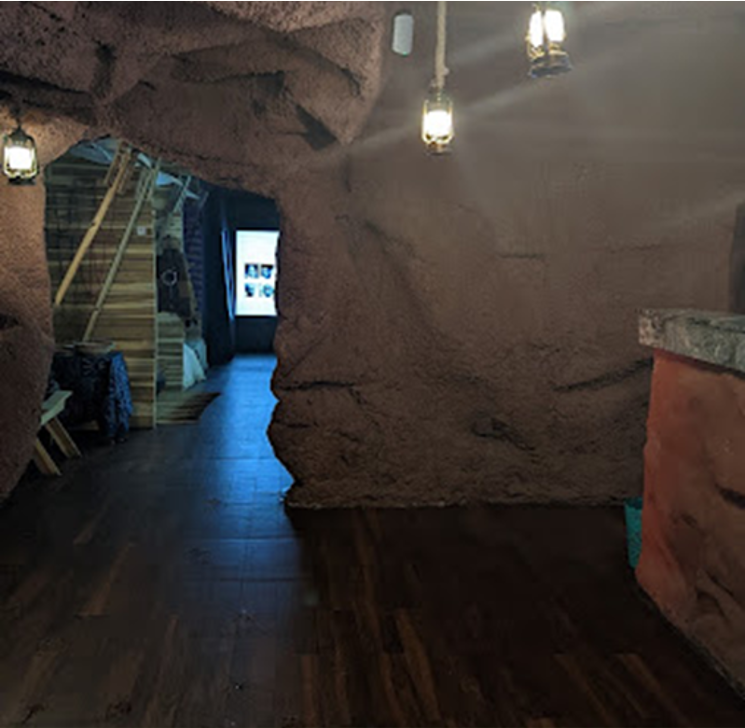
Red mud room and lamps: This exhibit, which can be seen in one of the 360-degree room’s sections, features traditional architecture from numerous towns, cities, and villages. Muds are used to mimic the style of traditional African interiors, where lamps are strung like contemporary lightbulbs. The curator utilized mechanical lighting from the modern era, which predates the development of the light bulb, in place of conventional mud lamps.

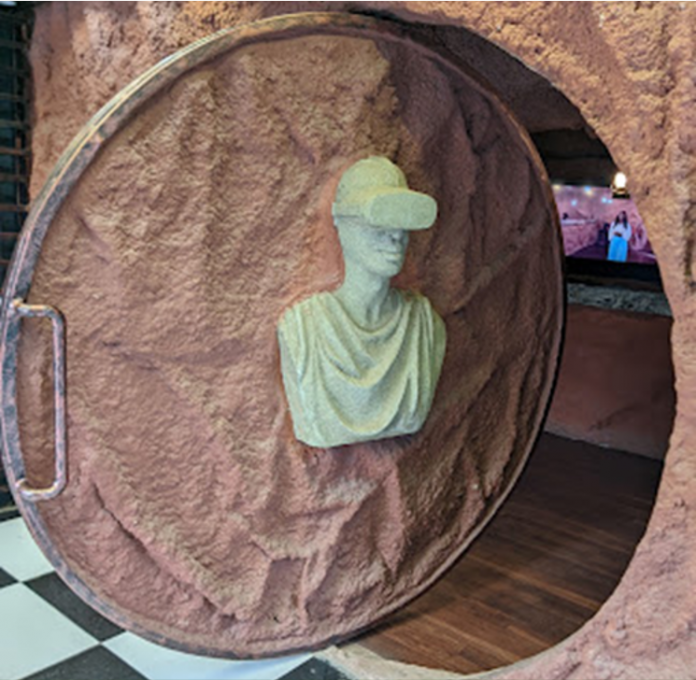
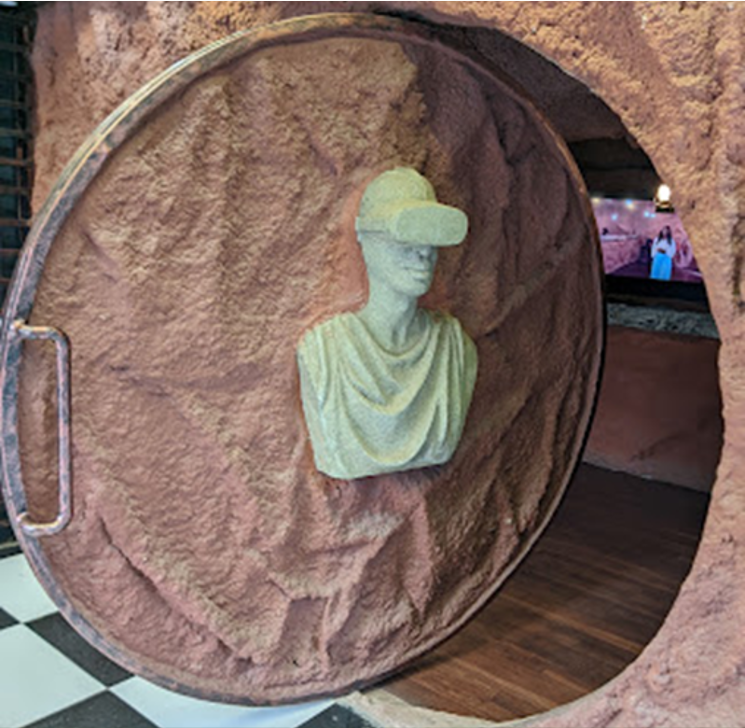
Cyclic entry to VR room: This exhibition uses a traditional well ring composed of metal and mud as a portal to the virtual reality room in order to satisfy the hybridization and synchronization of technology, arts, and culture for lasting experiences for museum visitors. The entrance also displays an augmented and virtual reality sign.

Critical Reflections

The analyzed expositions at the Discovery Museum offer profound insights into the intersections of material culture, identity representation, and postmodernism in the realm of individual and collective memories. The hybridization and synchronization approaches employed by the museum create alternative realities, challenging and renegotiating cultural narratives, histories, and traditions.

This approach resonates with Foucault’s heterotopia concept, where spaces exist outside conventional societal structures. The museum becomes a transformative space, a heterotopia challenging the norm, constructing new narratives, and redefining the boundaries of cultural experience.

Postmodern concepts of hybridity and intertextuality come to life within the Discovery Museum. Traditional and contemporary elements seamlessly merge, exemplified by the use of mechanical lamps replacing traditional mud lamps or incorporating modern lighting equipment into a traditional gaming setting. This dynamic interplay represents communicative figurations, constructing socio-cultural domains through specific frames of relevance and communicative practices.

In essence, the Discovery Museum emerges not just as a keeper of artifacts but as a dynamic space where the past and present converge. It is a testament to the power of mediatization in crafting memorable museum experiences, where technology becomes a bridge between historical roots and the ever-evolving landscape of cultural expression.

The Lessons from A Cat and Kittens on Leadership [video]

0

What happens when a more experienced worker is trying to solve a problem, and suddenly others come along to assist. Then, they cause problems which must then be fixed. Largely, that cat would have made the jump without the assistance of the kittens. But things happen. So, as the cat jumped and one of the kittens fell off, a problem was created for the cat to fix.

Watching this video, there are many lessons. But one is very noticeable: the cat had to ‘communicate’ up, get the kittens to get out of the way (as they obstructed previous attempts), before it came down to pick the fallen kitten back up.

Please when the supervisor tells you sometimes to get out of the way (we hope with decency and politeness), do not take it as being mean, because there are things which are better done by the experienced hands. If the cat did not get those kittens to get out of the way, it would have struggled to take that fallen one back up.

I see levels of work here: the cat at a time had to go strategic  even as the kittens stayed at the operational level, showing up needlessly to contribute. That strategic level elevation of planning what must happen at the top (and taking care of it, kittens make way) instead of just jumping incessantly to overcome the barrier was the key to victory. Yes, the cat ‘thought” over the assignment, developed a plan and executed it, for success. Indeed, if we have a habit of tasking our mental energy, we can achieve more even when reducing our physical energy.

If you take 2 minutes to play your day the night before or early in the day, you can save 60 mins through efficient time management and productivity! #WorkSmart.

Comment on Feed

Comment 1: Lessons I learnt from this video: Having best strategy is not enough, you need to communicate your plan with your team, ensure they understand (effective communication). As seen in the video the mother cat was trying to communicate with the kittens, but they can’t relate, because there is a communication bridge, so the cat has to go to meet them (engaged the right channel) for them to understand. Then be smart in your application. Thanks for sharing this informative clip Prof Ndubuisi Ekekwe

Comment 2: Thank God I watched the video before reading your comment. At that key lesson of getting the kittens to get off the way so it could execute the chance of solving the problem got me thinking, ‘this is where AI’ struggles except programmed to view other AIs as obstacles and objects too.

Comment 3: Prof, This is a great, I believe that empathy and firmness helps while we communicate both the strategy and the operational plans to team members – while hand holding them so that they learn on the job more sure footedly.