Good People, do not accuse me of insensitivity by telling the hard working members of Nigeria’s labour unions what to do right now, as Nigeria experiences immense economic pressure, due partly to evolving policies in the nation. But the fact is this: strikes will compound Nigeria’s problems when you see that we have lost capacity to control/influence inflation, our fuel price, currency exchange rate, etc. If we do not show up at work, a vicious circle could be activated and that could be dangerous.
Here is my suggestion: the government should move fast with solutions since it moved really fast with policy changes. And this is not really about sharing money, but making it clear that Nigeria needs foreign investments to stabilize the exchange rate (the export driven path will take years, not months).
A huge incentive could bring in $billions from the diaspora provided the funds are coming to stimulate production, and not accelerate consumerism. We can explore the Israeli model.
Can we pay 13th month to Labour so that the government can have a few more weeks to architect what it wants to do, now that some ministers are hopefully going to start?
(Remember, I am against the removal of fuel subsidies; I want Nigeria to fight what makes fuel subsidies look bad: corruption. I am also against floating or swimming Naira; I want Nigeria to use data to run its forex so that only productive ventures are pushed into “official” rates – and that means fight the corruption in forex. Yes, Nigeria’s imbalance in the balance of payment makes floating Naira hopeless.)
Comment: Well ND, I know you are trying so hard to be neutral and avoid talking about politics but the truth is that what Nigeria needs is good leader(s) not all these your economic theories. The current leaders we have now care nothing about these your theories.
My Response: You see why people like you are the reasons Nigeria is collapsing. You have your name as “Advocacy” and yet you do not want a debate because you have already made up your mind. You do not want a professor to share his ideas because you have made up your mind. But yet, you are advocating – advocating what?
Let me tell you – there used to be a time when to be hired as a CBN governor in Nigeria, you must have published many papers on economics. And when you arrive, you have tested many indicators. Today, we hire bankers with no fundamental element of economics. Yes, theories work because from theory you move to practice.
More so, what is good leadership? It comes from knowledge and awareness. Some people you call bad leaders are offering the best they have. The problem is YOU who cannot understand that their best will not be good.
So, do not diminish the world by using the Nigerian standards to define how things work. Oliver De Coque wrote “egwu oma si na chukwu” [good music comes from God]. Good leaders come from when people like you act well by voting competence over tribe, money, etc and advocating with open hearts and not closed mindsets.
Comment 2: Unfortunately, your solution focus is the removal or the taming of corruption in both fuel subsidies and forex. That makes it already impossible to implement in Nigeria at the moment as corruption in both the public and private sector remains the biggest single problem the country faces.
It will be wishful thinking for anyone to imagine that they can fix corruption in Nigeria to a point that allows policy, institutions and laws to work as intended for the good of all(within the short period of 4 years).
As painful as it may be, the option that may succeed is to take away the bait and hope that a more productive economy will evolve.
Comment 3: I completely agree Ndubuisi Ekekwe with your suggestion of attracting foreign direct investment (FDI) to stabilize Nigeria’s exchange rates and strengthen the economy. To achieve this, it is crucial for the government to focus on creating an investor-friendly environment through policy changes and frameworks. Streamlining bureaucratic processes and creating a transparent regulatory environment will undoubtedly make Nigeria more attractive to foreign investors. By reducing red tape and providing clear guidelines, the government can encourage both large companies and SMEs to invest in the country, leading to economic growth and job creation. Investing in infrastructure is vital to attract FDI. Developing reliable transportation networks, power supply, and efficient ports will not only benefit large industries but also provide a solid foundation for SMEs to operate more efficiently and access local and international markets. This, in turn, will bolster economic activities and create opportunities for SMEs to thrive.
Comment 4: What is happening to Nigeria and every other country is what we have said before. Virtually, all African countries are cut off guard by the challenges of the digital economy. We did not build the required infrastructure to thrive in it and the economists we have are not willing to gather new knowledge to play catch-up. Africa is growing so fast that its manual system cannot deal with new challenges of a new context. We hope all African countries will wake up to this reality and build the required digital infrastructure to manage and thrive in a new context. This could also happen at state level if we build this infrastructure in one state to show case what it is and how nations can leverage it.
Artificial Intelligence (AI) is a hot topic and has gained much attention lately. However, it’s essential to consider the potential risks associated with its development to ensure that humans don’t suffer negative consequences from its use. Some of the most prominent concerns include:
1. Bias in output: AI systems can exhibit biases similar to humans when trained with incomplete information. This could lead to unfair targeting of specific individuals or groups.
2. Privacy and security: The vast amount of personal data processed and stored by AI systems raises concerns about privacy and security. This data can be used for identity theft, fraud, and other cybercrimes if it falls into the wrong hands.
3. Job security: The automation of many jobs through AI could lead to economic and social challenges for those who are at risk of losing their jobs.
4. Harmful invention: The development of autonomous weapons raises ethical concerns about decision-making without human intervention.
5. Dark execution process: The lack of transparency in AI systems makes it difficult for people to understand how they arrive at their conclusions.
6. Regulation concerns: The lack of regulations surrounding the use of AI could lead to its misuse and abuse, causing unforeseen consequences.
Recommendations
To address these concerns, several strategies can be taken:
– To combat bias in output, AI development teams should focus on improving the quality and diversity of data used to train AI. Diverse data sets can help reveal and correct biases.
– Stronger data protection regulations can be implemented to ensure safe data collection, processing, and storage.
– Investment in AI training programs for reskilling and upskilling can help employees who risk losing their jobs due to automation.
– Autonomous weapons should be developed and used in a morally responsible way.
– Open-sourcing algorithms and emotional processes used by AI systems can help identify and correct potential weaknesses, increasing user trust in the system.
– Governments should establish ethical, data protection, and transparency requirements to govern the creation and use of AI.
It’s vital to approach AI development and deployment cautiously, considering ethical considerations, transparency, and accountability.
Collaboration between governments, businesses, and the public is necessary to maximize the benefits of AI while minimizing its adverse effects.
Conclusion
In summary, while AI presents many exciting opportunities, it’s essential to consider the potential risks and take measures to ensure its development and use are responsible and ethical.
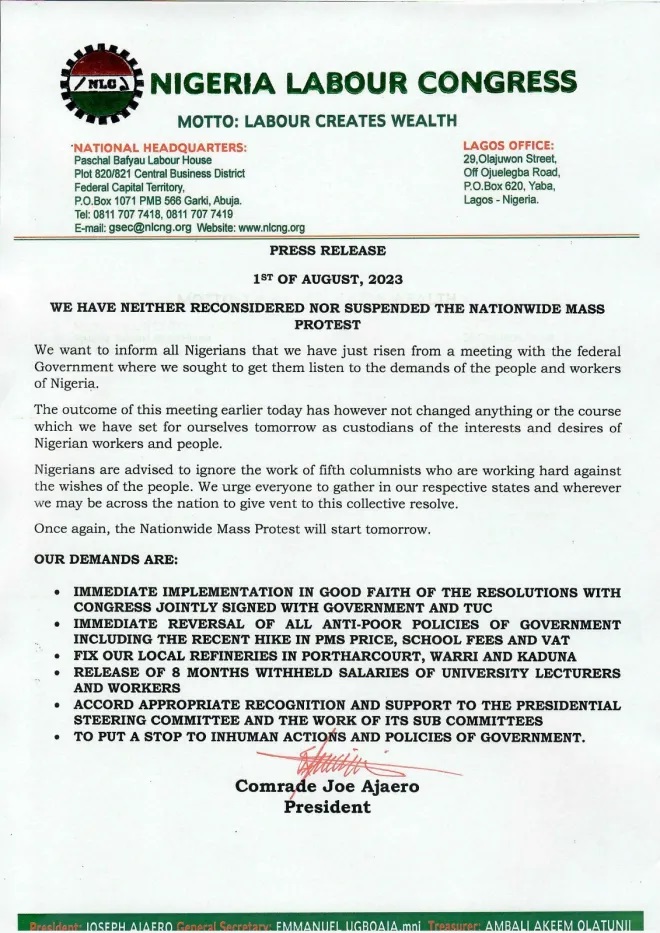
The Nigeria Labour Congress (NLC) has reiterated its commitment to embark on a nationwide strike starting Wednesday, following the expiration of its seven-day ultimatum to the federal government.
The labor union conveyed this message on Tuesday evening through a statement signed by its President, Joe Ajaero, reiterating that their demands remain unchanged.
The announcement comes a day after President Bola Tinubu announced a series of intervention measures to cushion the impact of the subsidy removal.
The Secretary of the NLC, Emma Ugbaja, had previously mentioned that although they appreciated President Tinubu’s intervention measures, they found them to be insufficiently comprehensive.
Ugbaja indicated that the NLC and the Trade Union Congress (TUC) would consult with their members to reach a consensus on the next course of action before the end of Tuesday, in preparation for Wednesday.
“We want to inform all Nigerians that we have just risen from a meeting with the Federal Government where we sought to get them to listen to the demands of the people and workers of Nigeria,” Ajaero said in the union’s statement.
“The outcome of this meeting earlier today has however not changed anything or the course which we have set for ourselves tomorrow as custodians of the interests and desires of Nigerian workers and people.
“Nigerians are advised to ignore the work of fifth columnists who are working hard against the wishes of the people. We urge everyone to gather in our respective states and wherever we may be across the nation to give vent to this collective resolve.
“Once again, the Nationwide Mass Protest will start tomorrow.”
The removal of the fuel subsidy, which was announced by Tinubu in May, triggered a significant rise in the cost of living, prompting the (TUC) and the NLC to issue their first ultimatum to the federal government.
Organized labor is demanding the prompt reversal of all government policies that negatively affect the poor, including the recent increases in petrol prices, school fees, and VAT.
Additionally, the labor unions are calling for the government to undertake the rehabilitation of local refineries in Port Harcourt, Warri, and Kaduna and release eight months’ worth of withheld salaries for university lecturers (members of the Academic Staff Union of Universities, ASUU) and workers.
Furthermore, organized labor insists on the government giving appropriate recognition and support to the Presidential Steering Committee and its subcommittees to address and halt human actions and policies detrimental to the people.
The union said in June that it is unfair for the government to remove fuel subsidies without making adequate provisions to mitigate the impact. That is because the local refineries, especially the publicly owned four, have remained comatose as a result of “the government’s inability to get them operationally turned around.”
The NLC said that between 1993 and 2023 about U$6b was used for Turn Around Maintenance of the Refineries without any results.
By now, you have probably seen a few tasters and hints about an up-and-coming product from 9ja Cosmos – Sinosignias.
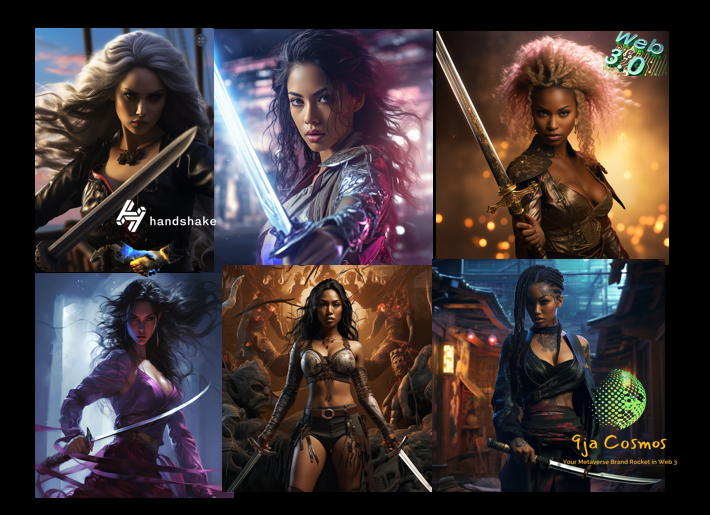
In summary – this is a product of two components – A Sino Amazon (Tokenized Artwork) (Think NFT), is a member of a Female Warrior Sisterhood that terrorised the East Asia Seas 1100-1700 AD.
A Sinosignia is a symbol that resembles (but isn’t) an eastern language character. It comes as a Web 3 TLD (Top Level Domain), minted to the Handshake Blockchain.
Each Sino Amazon has their own unique Sinosignia. It represents their commitment, oath, bond, and seal.
As a set, each component has a ‘multiplier’ effect on each other in terms of security and utility.
In short, as a pair, and in alignment with the product narrative, the two parts are impossible to steal, and have more uses than either would on their own. This is what gives them their value.
But I want to leave the product there, because this is about my journey with generative AI since I started trying to do the Sino Amazon artwork myself.
Beginnings.
I’m not much good at art. What happened was I got this idea while securing lots of country centric domains to extend the .9jacom program. I ended up inadvertently picking up a lot of domains cheap that started ‘vlad’ and ended in something that rhymed with ‘the impaler’, and they sounded really jokey – like ‘vladthepondsailor’.
I head the guy that did artwork on the ‘bored apes’ was going out on his own to do something on a theme called ‘Sneaky Vampire Syndicate’ and I wanted to get in touch to see if some partnership could be done to combine the tokenized collection and the crazy ‘vlad’ domains as a joint offering.
All digital art collectible ‘NFT type’ projects were ‘in the toilet’ and there had been some high profile wallet compromises involving the few that were maintaining some value, so in the segment downturn, a product that offered more, and would be much harder to steal, seemed a good idea.
I made a few enquiries and asked around, but its like nobody could find the guy.
By this time though, I became more intrigued by the concept and wanted to realize it some other how, rather than it having to be about SVS and my ‘vlad’ domains specifically.
SVS Illustrations
I’d seen some artwork on Pinterest which had women warriors in ancient east Asian attire though the women looked mixed race between east Asian and sub -Saharan. At the same time, while I was logged in on a node, a large number of domains of what seemed to be one eastern language character appeared in the domain auctions. It seemed the auction author had forgotten about them (yes, that actually happens!), though when I checked, the characters had no meaning.
The domains had only nominal bids on them, and I put very slightly larger bids on myself, which didn’t get challenged. That is when I got the idea of doing the artwork myself rather than relying on a partner. So I set about writing a narrative that could tie some variation of these images I’d seen on Pinterest and the newly acquired domains.
Then the task was going to be about creating a range of images, and wining sufficient domains that could pair with each other in compliance with the narrative. I reckoned I needed about 1000 sets, so, a lot of hard work. I started in October 2022.
Early efforts
In October, My first efforts to create something in line with the Sino Amazon scope, were on the first version of DALLE E. It didn’t come out terribly well. By November, it was possible to use DALLE E 2. I created some images on the free allocation, but the gap between what I was aiming for and what I got was bigger than the Pacific and the Atlantic added together.
First Saved effort of a Sinosignia on the original Dalle E
By mid November I began trying Stable Diffusion based providers. I also gave Midjourney a try. I used all the free credits for the MJ trial, but the cost of heavy use was high.
The base engine of SD is open source, so many providers use it, but their implementation seems to be different and it impacts on the quality of results. I tried DreamStudio, Fotor, NightCafe and a few others that online descriptions say ‘seem’ to use Stable Diffusion, though the sites actually don’t say. I found DreamStudio to be the best overall implementation of SD, but Midjourney still had a superior ‘finish’ quality compared to others. There were some ‘organic’ aspects to DreamStudio however, which had merit, which I will describe in a moment.
I built up a strong repository of DreamStudio content, for which I needed an artist to come in as a partner and do some clean-ups. They weren’t yet up to a marketable standard. I had some great discussions with some folk on LinkedIn who seemed very enthusiastic about getting involved in the project, impressed by the wider aims of 9ja Cosmos. Two people in particular were in detailed DMs with me almost every day.
Early effort with Stable Diffusion (This isn’t acceptable as a Sino Amazon)
However as time went on, they never became technically involved and also drifted away from regular LinkedIn presence. Perhaps they had wider issues than a change of heart about the project.
I eventually bit the bullet, dumped some subscriptions to things where I could, and took up the flagship product in the Midjourney options.
The Hollywood Effect
I wasn’t born into a household with a TV. In an age when people can stream video on a mobile phone, this probably seems incomprehensible to many. I can’t remember when a TV came exactly, but it was a black and white TV screen, and the national station had only one channel.
Public funds were very tight, and there was no domestic film industry, only the news and a few domestic current affairs shows. Anything feature length was from abroad, and a minimum of 10 years old before we got it.
A Midjourney victim of ‘The Hollywood Effect’ which didn’t make it. Being a Sino Amazon is harder work than a ‘catwalk pose’ in a period outfit. And where is the weapon ??
When we could see international content, a frequent staple I could remember were westerns of a type that were called ‘Cowboys and Indians’. Where I was at that time, Native Americans were known as ‘Red Indians’. As a small kid I never understood this. They were a shade of grey. It was a B/W TV. Nobody locally had a colour one. I was this sort of kid that always asked adults loads of questions and would then reason with them why I thought the answer I was given was flawed. I would keep going with the line of questioning until I thought the modified answer I got was reasonable. Sometimes I didn’t get to an end point and got a slap on the back of the head from a random adult. This however never dissuaded me from my questioning techniques.
I was told that in the studio, where they make the film, the Indians were probably red, but we had no way of telling, because the B/W TV can only show shades of grey. We had no Native Americans living locally, so I couldn’t test the thesis, and had to (grudgingly) accept this as something neither proven nor disproven. Armed with the ‘shades of grey’ ‘excuse’, adults now became emboldened to provide me with this answer to many queries I had about things I saw on TV.
Giannina Facio, a Costa Rican, top, cast as Saladin’s Sister (an Ethnic Kurd from Tikrit [modern day Iraq] in the late 1100s AD) in ‘Kingdom of Heaven’ 2005 and above, as the wife of Maximus Decimus Meridius, and a Roman (Italian) in Gladiator (2000). Welcome to ‘The Hollywood Effect’Then I had the ‘gotcha’ moment. Most of these ‘Red Indians’ were painted as the bad guy, and were ‘extras’ and usually died in the films. But then I noticed in another film that a certain ‘Red Indian’ was an ‘extra’ as a bad guy in a group of outlaws lead by Gene Hackman, who all got shot up by John Wayne. The same ‘extra’ cowboy, previously an ‘extra’ Indian, was a white guy.
So I now started asking why did they have to use someone who isn’t a ‘Red Indian’ to be one in a film, since the film was made where they come from?
This was my earliest exposure to – ‘The Hollywood Effect’.
I’m not six years old anymore, and both visual technologies and media through which to educate oneself on far distant lands has exploded. White guys with feathers on their heads and a bit of fake war paint won’t fly anymore but in some other ways ‘The Hollywood Effect’ still exists.
Casting can take someone with fairly soft and malleable features, say Halle Berry, off to Costume and Make-up and in one film, she is an open market stall owner in Luanda, in another, she is a crown princess in Riyadh, in another she is a local civil rights activist in Myanmar. Reality check is that indigenes of these countries look nothing alike, and authenticity should demand the same actor couldn’t possibly fill all these types of roles. To be believable, the best fiction needs to exist in an envelope of fact. This is how escapism becomes marketable.
Strong Points and Weak Points of different AI engines.
Midjourney has by far the best finish quality of any of the AI engines I have tried. But my experience was it is heavily limited by ‘The Hollywood Effect’ , particularly when it comes to imagining authentic and organic Amazons of ethnicities mixed between the countries of their operating region, and other places much further away.
Everything started to head towards a convergence of facial features which started to become common traits irrespective of additional features such as hair style and skin tone. The more variations I created, becoming further removed from the first generation root, the more pronounced these homogenizations became.
Irrespective of the overall drive to have this sense of mystery and pluralism about Sino Amazon origin, there is a sort of organic and authentic realism in what I’m looking for, and I can tell influence from ‘The Hollywood Effect’ when I am looking at it
A Sino Amazon may be an operator in many cultures but is a mistress to none.
A Sino Amazon is a mistress to none.
While some of the other AI engines give less of a slick finish, they seemed to be able to produce more faithful results from origin influences.
I included some blending, and the use of images from other AIs in prompts for MJ, as well as some manual techniques, which brought improved results. Some semblance of ‘The Hollywood Effect’ still survives in some final product.
Unfortunately, MJ also has one of the most aggressive community standards, and frequently creates false positives for things that wouldn’t bat an eyelid in a PG13 rated film. It seems particularly sensitive to breast cleavage lines that would be obviously apparent in any two piece bathing suit.
I have a lot of raw images good as anti Hollywood Effect’ modifiers for use in blending or prompts, but MJ refuses to accept them on standards compliance grounds. Sometimes MJ even refuses its own output!
‘The Hollywood Effect’ also seems to have an obsession with ‘classic’ perceptions around beauty and body shape. This is also one of the homogeneity drivers I suspect exist in MJ. After all, the more attractive the content people receive, the more likely they are to continue subscribing. Real Amazons aren’t going to look like models in period costume. They are going to come in all shapes and sizes. Efforts to include references to body shape as a legitimate effort to bypass that aspect of ‘The Hollywood Effect’ often fall foul of MJ’s community standards compliance.
While this is nowhere near the quality of a finished product, it has great potential as a modifier of ‘work-in-progress’ to be improved with MJ. Unfortunately MJ red flagged it as an input, because of the cleavage line. – Not sure what MJs expectations are. The result is supposed to be battle-worn Amazons in combat, sometimes in hot and humid environs – not nuns!
Being Prescriptive
The more outcomes you decide as being clearly either right or wrong, the harder it is to get a good result from AI. AI doesn’t like lots of absolutes (rights or wrongs), it likes a lot of equi-valid versions of ‘different’
The easiest things to do with MJ (and AI in general), are head shots, head and shoulder shots, strange demonic, alien or abstract stuff. This is because the AI has a high probability of success. The prompt provider has little by way an AC (Acceptance Criteria) or maybe none at all, beyond a vague idea that it ‘must look cool if I post it in online media’.
The more prescriptive the creator needs to be about the output, the harder it gets, as more results will fail.
The subject’s interaction with an object is a common point of failure, because it must be realistic. This is particularly true of weapons. Lots can go wrong with the placing of weapons or the grip on weapons. Trying to inject motion creates more complexity, and therefore more chance of failure. I try to ‘encourage’ the output to feature some form of a feather weight ultra-sharp blade, because a fluid grip, while in motion, is plausible, a bit like playing table-tennis.
On the other hand, a ‘Bastard Sword’ of the type typically needing a double-handed grip by 400lb medieval crusader in chainmail, just looks laughable when pictured, held with just thumb and forefinger by a sub 150lb woman as if she is carefully getting rid of a shard of glass.
Frequently, results have blades suspended in air, penetrating the subjects body, or simply not present at all. Contortions of the subjects body can also portray a result as implausible.
Wielding a blade closely resembling a ‘Bastard Sword’ – Firm grip, but only one hand. Is this a pass or fail?
Period authenticity is another prescription. There is some latitude with the Amazons themselves, as the narrative describes them in a cauldron of local folklore with myths around demonic skills, necromancy, cybernetic implants, alchemy, shape shifting, time travel (non exhaustive list). The environment however is coastal land and seas stretching between modern day Indonesia and Japan, from 1100-1700 AD.
Non period elements of the background, such as evidence of electric power, self-propelled vehicles, air transport, and post-period manufacturing, can happen really easily, and invalidate an otherwise great result.
Appraising other people’s work
I get asked a lot, actually not by Generative Art Creators, but by other people, mostly on LinkedIn, what do I think of…. and they will mention the art of some other creators.
Of course, I can’t really tell, because, particularly with Midjourney, the talent isn’t so much in the image quality but in the success at being prescriptive.
I’ve given some ideas about the sorts of things that are difficult or easy to achieve, but I really can’t tell unless I know the creators Acceptance Criteria, or Success Criteria.
A failure around proper formation of archery tools and the interaction of the subject.
This is on a spectrum from 0 to Infinity almost. It is fairly impossible to get Generative AI to create art around a sequence of numbers, letters, and/or symbols.
The most difficult action still with period weapons, for me would be a bow and arrow still, resembling shots from maybe ‘Robin Hood’ (2010). ‘The Hunger Games’ (2013) also features archery, but the tools are far more modern.
Archery is more complex than spear, blade or staff type weapons, as the subject has to interact with three separate parts, the grip on the bow, the bowstring, and of course, the arrow. Even getting the AI to faithfully create a believable image of a subject walking passively with a bow in one hand is quite difficult, far less for an action still.
Fear not a Sino Amazon for what you can see; Fear what you cannot see.
Non period archery tools would be less than ideal, but not a show stopper, as the Sinosignia narrative allows Sino Amazons amazing mysterious attributes that transcend time and space.
Happy to take questions or receive observations that don’t compromise 9ja Cosmos IP.
Thank you to those who have come out to support the new 9ja Cosmos page
We do however need the strong support of ‘Tekedians’ to move the needle forward, so more followers for the page are urgently needed.
9ja Cosmos is here…
Get your .9jacom and .9javerse Web 3 domains for $2 at:
In a recent blog post, David Marcus, the former president of PayPal and the current head of Facebook’s Novi digital wallet, announced that his team is working on integrating Bitcoin Lightning Network into their platform. He explained that this decision was motivated by the need for a universal open protocol for payments that can enable fast, cheap and secure transactions across the world.
Marcus wrote: “We are building on Bitcoin Lightning because it’s time for the world to have a universal open protocol for payments. A protocol that is not controlled by any one entity, that can be improved by anyone, and that can benefit everyone. A protocol that can bring down barriers and create more economic opportunities for billions of people.”
He added that Bitcoin Lightning Network is a layer-two solution that leverages the security and decentralization of Bitcoin, while improving its scalability and efficiency. He said that Lightning Network can enable instant and low-cost payments, even for microtransactions, and that it can support interoperability and innovation across different platforms and services.
Marcus also addressed some of the challenges and risks associated with Bitcoin Lightning Network, such as the need for better user experience, liquidity management, channel routing and security. He said that his team is working on solving these issues and creating a seamless and safe experience for users. He also emphasized that Novi will not charge any fees for using Bitcoin Lightning Network, and that users will always have full control and ownership of their funds.
Marcus concluded his blog post by saying: “We believe that Bitcoin Lightning Network is a game-changer for the future of payments. It has the potential to make payments more accessible, affordable and inclusive for everyone. We are excited to be part of this journey and to contribute to the development and adoption of this amazing technology.”
But what is Bitcoin Lightning Network? The Bitcoin Lightning Network is a second-layer solution that aims to improve the scalability, speed and cost of Bitcoin transactions. It is based on the idea of creating payment channels between users, which allow them to exchange bitcoins without broadcasting every transaction to the main blockchain. This reduces the network congestion and the fees, as well as enables instant and private payments.
To use the Lightning Network, users need to open a payment channel with another user or connect to an existing channel through a network of nodes. A payment channel is a smart contract that locks a certain number of bitcoins in a multisig address, which requires the signatures of both parties to spend. The channel can be open for as long as the users want, and they can update the balance of the channel by exchanging signed transactions that reflect how much each party owns. These transactions are not broadcasted to the main blockchain, but only stored by the users.
To close the channel, either party can broadcast the latest transaction to the main blockchain, which will release the bitcoins according to the final balance. Alternatively, if one party tries to cheat by broadcasting an old transaction, the other party can use a penalty transaction to claim all the bitcoins in the channel, as long as they do so within a certain time window.
The Lightning Network also allows users to route payments through multiple channels, using a technique called hashed timelock contracts (HTLCs). This means that a user can pay another user who is not directly connected to them, by using an intermediary node that forwards the payment. The HTLC ensures that the intermediary node cannot steal or withhold the payment, by requiring them to either forward it or return it within a specified time frame.
The Lightning Network offers several benefits for Bitcoin users, such as:
Faster transactions: The Lightning Network enables near-instant payments, as they do not depend on the confirmation time of the main blockchain.
Lower fees: The Lightning Network reduces the fees for transactions, as they do not consume block space or compete with other transactions for inclusion.
Higher scalability: The Lightning Network increases the throughput of transactions, as it can handle millions of transactions per second, compared to the current limit of around seven transactions per second on the main blockchain.
More privacy: The Lightning Network enhances the privacy of transactions, as they are not recorded on the public ledger, and only reveal the endpoints and amounts of the payment channels.
More functionality: The Lightning Network enables more advanced features, such as cross-chain atomic swaps, which allow users to exchange different cryptocurrencies without intermediaries or trust.
The Lightning Network also faces some challenges and limitations, such as:
Technical complexity: The Lightning Network requires a high level of technical knowledge and skill to use and maintain, as it involves setting up and managing payment channels, nodes and wallets.
Liquidity risk: The Lightning Network depends on the availability and capacity of payment channels, which may not always match the demand and preferences of users. Users may also need to lock up a significant number of bitcoins in channels, which reduces their liquidity and exposes them to price volatility.
Security risk: The Lightning Network relies on the security and honesty of nodes and peers, which may not always be guaranteed. Users may face issues such as channel closure, data loss, fraud or hacking, which could result in losing funds or paying higher fees.
Adoption barrier: The Lightning Network requires a critical mass of users and nodes to operate efficiently and effectively, which may take time and effort to achieve. Users may also face compatibility and interoperability issues with different implementations and standards of the protocol.