DD
MM
YYYY

PAGES

DD
MM
YYYY

spot_img

PAGES

Home Blog Page 3957

The Central Bank of Nigeria’s Agri-business Small & Medium Enterprises Investment Scheme(AGSMEIS)

0

 Relevant Provisions of The CBN Guidelines for the operations of the Agri-business Small & Medium Enterprises Investment Scheme(AGSMEIS)

The Agribusiness Small & Medium Enterprises Investment Scheme or AGSMEIS was founded on the 5th of April,2017 as an initiative of the banker’s committee to support the efforts of the Federal Government of Nigeria in its policy measures for the promotion of agricultural businesses and Small/Medium Scale Enterprises (SMEs) as vehicles for sustainable economic development & employment generation.

The scheme requires that all banks in Nigeria set aside 5% of their Profit After Tax (PAT) annually.

The details of the guidelines issued by the Central Bank of Nigeria (CBN) governing this scheme will thus constitute the focus of this article. 

What are the objectives of the scheme?

The objectives of the AGSMEIS are :-

– To ensure access to finance for Small & Medium Enterprises (SMEs) as these enterprises are the engine of growth of the Nigerian economy.

– To generate much needed employment opportunities in Nigeria.

– To develop agricultural value chain and ensure sustainable agricultural practices.

– To boost the managerial capacity of agri-business SMEs as pipelines of growing enterprises that can become large corporate organisations.

What are the activities to be covered by the scheme?

The scheme shall cover the following activities:-

– Agricultural investments which include production, storage, processing and logistics.

– SMEs in the real sector as well as service for sectors which are backward integrated into manufacturing/agriculture/mining/modular refineries including local initiatives in Information & Communication Technology (ICT).

– Other activities as may be determined by the Bankers Committee from time to time.

What exactly is a small and/or medium enterprise as defined by the scheme?

Under this scheme, a small and medium enterprise is defined as any enterprise that meets at least 2 of the following criteria subject to review by the Bankers committee from time to time :-

– Sales turnover not exceed 4.5 Billion Naira.

– Total assets not exceeding 4.5 Billion Naira.

– A number of tax paying employees not more than 250 staff.

What is the prescribed maximum investment amount under the  scheme guidelines?

The investable amount in any enterprise shall be limited to a maximum of 2 Billion Naira. Investments in excess of the maximum allowable amount shall be subject to the approval of the CBN.

What are the available investment types under this scheme?

Investments under the scheme which could be for start-ups, expansion of established companies or reviving of ailing companies, shall be through equity in the form of fresh injection of capital.

It should be noted that debt of any form is not allowed under the scheme.

What is the prescribed investment vehicle under this scheme?

The Bankers Committee shall appoint a board of trustees which shall manage the scheme and report to the committee on a regular basis.

What are the available loan tenor/investment periods under this scheme?

Under this scheme, investments made shall be for a maximum period of 10 years.

There shall be a 3-year lock-up period before exiting in order to encourage value creation and boost managerial capacity of the SMEs unless there’s a material adverse event.

The scheme shall be operated for a period of 10 years in the 1st instance & be reviewed after 5 years of its operations.

What are the modalities of the scheme?

Under this scheme:-

– Participating banks shall set aside 5% of their PAT annually after their financial statements have been audited by external auditors and approved for publication by the CBN.

– Eligible applicants shall submit applications through any of the participating banks to the CBN.

– The fund shall be transferred to the CBN and warehoused in an account opened for the scheme within 10 working days after the Annual General Meeting of the participating bank.

– The Bankers committee shall be represented on the board of the investee company/project as may be appropriate.

What are the eligibility criteria for funding under the scheme?

In order to be eligible for funding under the scheme, a prospect investor shall:-

– Comply with the provisions of the Companies and Allied Matters Act (CAMA) 2020 regarding the filing of annual returns, including financial statements.

– Comply with all applicable tax laws and regulations and render regular returns to the appropriate authorities.

– Apply through a participating bank.

What are the provisions of the scheme guidelines regarding monitoring and reporting?

The scheme guidelines provide that there shall be joint monitoring of projects financed under the scheme by the CBN and the board of trustees appointed by the Bankers’ Committee. Reports of the monitoring exercise shall be submitted to the CBN and the Bankers Committee.

What are the prudential regulations outlined in the scheme guidelines?

Under the scheme, contributions by participating banks shall form part of the eligible capital in the computation of capital adequacy ratios. 

Also, investments in SMEs shall be risk-weighted in line with extant regulations. 

What are the outlined responsibilities of relevant stakeholders under this scheme?

The CBN

The CBN has the following responsibilities:-

– Articulating clear guidelines for the implementation of the scheme.

– Monitoring the implementation and gathering statistics to quantify the impact of the scheme.

– Ensuring banks comply with the guidelines of the scheme.

The Bankers’ Committee

The bankers committee has the following responsibilities under the scheme:-

– Appointing a board of trustees to manage the fund .

– Appointing a project review committee to appraise applications.

– Obtaining the cooperation of all stakeholders.

– Overseeing joint collaborative efforts under the scheme.

– Conducting capacity building.

The Board of Trustees

– Conducting due diligence on applications submitted.

– Approving eligible projects for release of funds by the CBN through the economic development sub-committee of the Bankers committee.

– Maintaining the database of all investments under the scheme.

– Preparing reports for the bankers committee on the activities of the scheme.

The Project Review Committee

– Conducting risk appraisal of applications received from the CBN.

– Preparing reports for the board of trustees on the activities of the scheme.

– Performing all other duties as may be prescribed by the bankers committee from time to time.

Individual Banks

– Providing funds for investment under the scheme.

– Complying with the guidelines of the scheme.

– Nominating representatives on the project review committee.

– Maintaining records of their investments in the appropriate books.

Beneficiaries

– Ensuring prudent utilization of funds.

– Complying with guidelines of the scheme.

– Providing monthly financial & operational reports to the SPV before the 15th of the next succeeding month.

– Keeping up-to-date records on the companies activities under the scheme.

What are the provisions of the scheme guidelines on compliance with existing laws and regulations?

The scheme guidelines provide that banks’ investments under the scheme shall be in compliance with the Banks and Other Financial Institutions Act (BOFIA).
Nigerian Government Reviews Health Workers’ Salaries, Approves New Allowance for Public Doctors

1

President Bola Tinubu has approved the review of the consolidated health salary structure, CONHESS, for health professionals and the payment of 25 thousand Naira Accoutrement allowance to medical and dental doctors in the federal public service.

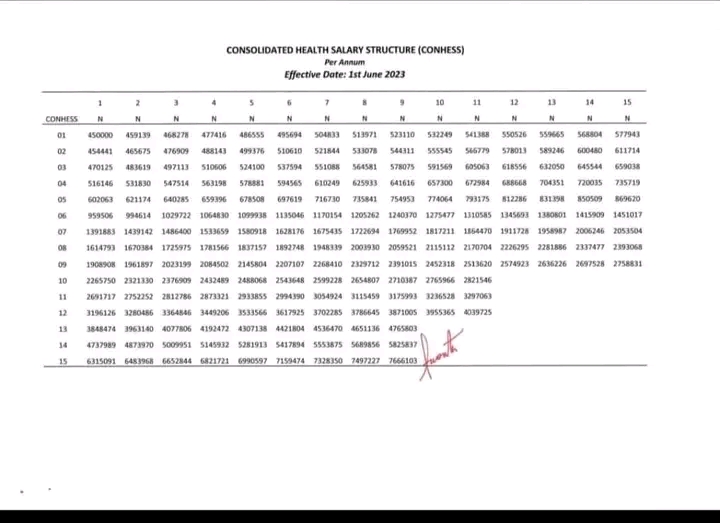
The new salary structure which is to take effect from the first of June 2023 was made known in a Circular dated 25th July 2023 by the National Salaries, Incomes and Wages Commission, NSWIC.

The Circular signed by Ekpo Nta, Chairman and chief executive officer of NSIWC stated that President Tinubu’s approval of the review of CONHESS was consequent upon the review of the health sector salary structure by the commission.

The commission also reveals the president  has approved 25,000 Naira accoutrement allowance for medical and dental doctors in hospitals, medical centres and clinics in the federal public service.

‘’Consequent upon the review of the health sector salary structures, the president, Commander-in-chief of the Armed forces of the federal republic of Nigeria has approved the review of the consolidated health salary structure (CONHESS) for Health professionals in the Federal Public service with effect from June 1, 2023.

‘’The new salary table is attached as Annex 1. 3. All enquiries concerning this circular should be directed to the National salaries, incomes and wages commission,’’ the salary review circular reads.

A separate circular of the commission titled,‘’ Accoutrement Allowance for Medical and Dental Doctors in Hospitals, Medical Centres and Clinics in Federal MDAs’’ dated 26th July 2023 and signed by Ekpo Nta, revealed the president has approved the payment of accoutrement allowance of 25 thousand Naira per quarter for medical and dental doctors in the public service.

‘’The federal government has approved the payment of Accoutrement Allowance of twenty-five thousand Naira (N25,000) per quarter to Medical and Dental Doctors in hospitals, medical centres, and clinics in the federal public service. The allowance is to be paid from the overhead budget,’’ It stated.

Recall that the Nigerian Association of Resident Doctors had earlier declared an indefinite strike effective Wednesday, 26th July 2023 due to its unmet demands by the government, part of which was the review of CONHESS.

With the upward review of the CONHESS a public health worker on Grade level 15 would be earning between N6, 315, 091 and N7, 666, 103.

See the new Salary structure here:

Samsung Reports 95% Profit Decline in Second Quarter 2023

0

Samsung, the world’s largest maker of random-access memory chips has reported a record 95% operating profit loss, following a 22% sales slip from the previous year.

This happened as a result of a significant decline in sales of consumer devices such as smartphones and computers. The dip was notable in the company’s report earlier this month, where it estimated second-quarter revenue to be 60 trillion Korean won and operating profit to be 600 billion Korean won, according to CNBC.

Samsung said in its earnings report that it hopes for a recovery as it shifts focus on higher-end products but expressed concern about macroeconomic risks.

“Global demand is expected to gradually recover in the second half of the year which should lead to an improvement in earnings driven by the component business,” Samsung said.

“However, continued macroeconomic risks could prove to be a challenge in such recovery in demand.”

Focusing on higher-end products means that Samsung will focus more on its memory business. The South Korean company said that robust artificial intelligence demand led to more DRAM shipments than expected in the second quarter, compared with the first quarter.

“The memory business saw results improve from the previous quarter as its focus on high bandwidth memory (HBM) and DDR5 products in anticipation of robust demand for AI applications led to higher-than-guided DRAM shipments,” said Samsung.

In its earnings report, Samsung said both DRAM and NAND flash memory chips also saw “more limited price drops” which improved second-quarter performance, compared with the first quarter.

“As server customers continued inventory adjustment, overall purchase demand had not yet recovered. Due to the strong demand for generative AI, however, investment from the data center sector was concentrated on AI servers,” said Samsung.

The explosion of AI-powered chatbots led by OpenAI’s ChatGPT expanded demand for high-performance memory chips as more companies rushed to compete in the emerging tech market. Memory is needed to help the AI language models to remember past activities including humanlike conversations required for future AI training.

According to Samsung, as the second half of the year progresses, the market is anticipated to move towards stability due to increasing production cuts in the industry and a winding down of inventory adjustments by customers.

To capitalize on the expected recovery in demand, Samsung plans to concentrate on high-value-added products like DDR5, LPDDR5x, and HBM. Additionally, the company intends to boost investments in infrastructure, research and development, and packaging technology to further support its growth prospects.

Competition in the electronics market has also posed a challenge to Samsung sales, as demand for its products weakens due to products from rival companies. But other factors such as inflation have also affected the company’s profit.

Samsung noted that the overall mobile phone market experienced a decline in demand during the second quarter, primarily due to ongoing macroeconomic challenges such as inflation.

Additionally, the initial excitement generated by the launch of the Galaxy S23 series in the first quarter subsided, contributing to the sales dip in the second quarter. Moreover, a delayed market recovery presented additional challenges for the company’s sales during this period.

“Nevertheless, the Galaxy S23 series was able to achieve higher results than its predecessor in the first half, in terms of both volume and value,” said Samsung, adding that it plans to lift sales of the Galaxy S23 and Galaxy A series.

CNBC, quoting data from global market intelligence firm International Data Corporation, reported that global shipments of smartphones are expected to decline 3.2% in 2023 to 1.17 billion units. The firm lowered its forecast from February, driven by factors such as “a weaker economic outlook” and “ongoing inflation.”

Smartphone and PC manufacturers are currently facing the challenge of dealing with surplus inventories of memory chips. During the pandemic, these manufacturers stockpiled memory chips to meet the rising demand for consumer devices.

However, due to inflationary pressures, consumers have started cutting back on purchases of such goods, leading to a decline in prices for memory chips. As a result, manufacturers are now grappling with excess supply, posing a new obstacle for the industry.

“Our conversations with channels, supply chain partners, and major OEMs all point to recovery being pushed further out and a weaker second half of the year,” said Nabila Popal, IDC’s research director.

“Consumer demand is recovering much slower than expected in all regions, including China.”

In its Thursday earnings call, Samsung told analysts that it would be making additional production cuts on certain DRAM and NAND products “to further accelerate inventory normalization,” per CNBC

Samsung’s plan to focus on higher-end products includes its premium foldable phones – the newly launched high-end Galaxy Z Flip 5 and Galaxy Z Fold 5 series. This is expected to cement its leading position in the global foldable smartphone market.

Bryan Ma, vice president of devices research at IDC, said on CNBC’s “Squawk Box Asia” on Thursday that the Galaxy S23 series still drives most of Samsung’s profits in the premium smartphone space.

“Despite how bad the memory business is, the good thing is at least the premium part of the market is helping to drive some of their profits or at least offset some of the damage caused by the memory side of the business,” he said.

Facebook Daily Active Users Top 3 Billion

0

Meta’s latest quarterly report reveals that Facebook’s monthly active users have surpassed 3 billion, indicating a significant rebound from the decline observed in the number of users, particularly among young people, over the past two years.

The social media company saw a massive decline in the number of young users, which cut across other platforms owned by its parent Meta. The social media behemoth’s family of apps consists of WhatsApp, Instagram, Messenger, and now Threads, which combined, have 3.88 billion monthly active users.

The current number of users across Meta’s platforms amounts nearly to half of the world population, underlying the company’s notable recovery from its abysmal performance since 2021, when it reported its first-ever quarterly decline in daily active users.

Facebook has 2.064 billion daily active users, up from 2.037 billion last quarter. The growth is to the delight of the company’s investors, who have had to endure about two years of losses following a massive drop in ad revenue spurred largely by user decline.

In 2021, Meta’s CEO Mark Zuckerberg unveiled a recovery plan centered around short-form videos, which was subsequently introduced across the company’s major platforms.

The growth is thought to be attributed, in part, to Reels, Meta’s TikTok-inspired feature that has been extensively promoted on Instagram and Facebook. Zuckerberg stated that Reels receive a staggering 200 billion plays each day across the entire family of apps.

Meta’s user base is rising amid the frenzy of Threads, its new text-based social platform that’s tied with Instagram which has seen millions of signups in its first week.

“I think we have the most exciting roadmap ahead that I’ve seen in a while,” Zuckerberg said enthusiastically. “We saw unprecedented growth out of the gate, and more importantly, we’re seeing more people coming back daily than I expected.”

Threads rapidly amassed 100 million users within just five days of its launch. While not all of these users may become dedicated Threads posters, Zuckerberg’s recent post indicates that “tens of millions” are returning daily, a remarkable achievement.

The CEO said the plan is to get Threads up to a billion users – offering an alternate real-time online conversation platform to thousands of people who feel dissatisfied about how Twitter is being run by its new owner Elon Musk.

“It will take some time, but I think there should be a public conversation app with 1 billion+ on it. Twitter has had the opportunity to do this but hasn’t nailed it. Hopefully, we will,” Zuckerberg said on Threads.

DCOMSIT Prize Award 2023: Opolo Global Partners University of Ilorin to Showcase Innovative Students’ Solutions

0

Opolo Global, in collaboration with the Computer Services and Information Technology Directorate of the University of Ilorin, has successfully organized the 2023 DCOMSIT Prize Award Final Presentation at the Faculty of Agriculture Lecture Theatre, University of Ilorin. The event, held on 25th July, 2023, attracted enthusiastic students, researchers, and faculty members from various disciplines. The Award was aimed to promote innovation, enterprise, and digital skills among participants and as well foster research commercialization in the university. The grand finale featured five innovative presentations from students among whom the top three solutions were awarded valuable prizes.

In her welcome speech, Prof. Oluwakemi Abikoye, Chairperson of the DCOMSIT Prize Award Committee, commended the Director of Computer Services and Information Technology, Prof. Dupe Ademola-Popoola, for initiating the event. She applauded Opolo Global’s support as the technical partner, which transformed the event into a resounding success beyond the original plan. Prof. Abikoye encouraged the participants to make the most of this rare opportunity to showcase their research ideas and entrepreneurial endeavors.

Representing the Chairman of Opolo Global, Dr. Segun Aina, OFR, Head of Special Projects, Mr. Deji Ajani, delivered a goodwill message and keynote address. In his address, Ajani emphasized the importance of focusing on innovative solutions that address both local and global challenges. He underscored the partnership between Opolo Global and the University which is aiming to provide platforms for innovators to build and scale solutions that benefit all stakeholders, including the University.

He noted that the proposed innovation hub is well underway, with numerous programmes that will benefit the entire University ecosystem. He emphasized Opolo Global’s commitment to nurturing young talents and entrepreneurial spirits of students and researchers as demonstrated by the partnership with the university. He then announced that the top five innovations presented at the event would gain admission to the prestigious Opolo Incubation Programme, a valuable opportunity worth millions of Naira. Furthermore, these innovations will be considered for admission to the esteemed 1st tier Opolo-UNILORIN Startup Ecosystem, opening up doors for further growth and development.

The distinguished panel of judges, consisting of experts in different fields, had the task of assessing the five presentations from students in the Colleges/Faculties of Health Sciences, Engineering as well as Communication and Information Sciences. The presentations covered a wide range of solutions, including Market Mate, an innovative WhatsApp bot designed to ease market visitation for busy individuals, and Tripa, a bus card payment app aimed at providing cashless transportation for students.

The ideas presented also included a Surveillance Drone, offering IoT-based security solutions, and an IoT-enabled Smart Water Management System for households.

Overall, Studconnect, an AI-based digital solution facilitating connections between students and property owners for apartment rentals emerged as the winning solution while Surveillance Drone and IoT-baased Smart Water Management System emerged first and second runners up respectively. The event was concluded with the presentation of gifts and awards to the top three winners by  Engr. Musiliu Adebayo Lawal and Prof. Dupe Ademola-Popoola.

The success of the 2023 DCOMSIT Prize Award presentation demonstrated the potential of the Nigerian students and researchers to create innovative solutions that address real-world challenges. With Opolo Global’s support and the University of Ilorin’s commitment to fostering entrepreneurship and digital skills, the future looks promising for innovative initiatives within the institution and beyond.