DD
MM
YYYY

PAGES

DD
MM
YYYY

spot_img

PAGES

Home Blog Page 3973

Notable Provisions of The 2023 CBN Guidelines For Contactless Payments in Nigeria

0

The Central Bank of Nigeria (CBN), pursuant to its powers guaranteed by the Central Bank of Nigeria Act  and in furtherance of its mandate to ensure the safety and stability of the Nigerian financial system as well as the promotion of a resilient and stable payments system, launches on the 27th of June,2023, a new set of guidelines for contactless payments in Nigeria.

Contactless payment technology provides an efficient payment option and consists of using payment instruments without physical contact with devices, thereby constituting an efficient and convenient cashless payment method for users whether it is in the form of prepaid debit and credit cards, stickers, fobs, tokens or mobile electronic devices operating in interaction with contactless payment devices.

This article will thus be looking at the guidelines governing the operation of contactless payment services in Nigeria.

What is the scope of the contactless payment guidelines?

The guidelines specifically cover the operations of contactless payments in Nigeria.

What are the objectives of these guidelines?

The guidelines were introduced to provide minimum standards and requirements for the operations of contactless payments in Nigeria as well as to specify the roles and responsibilities of stakeholders involved in contactless payments in Nigeria.

Who are the relevant stakeholders/participants in the contactless payment service chain/framework as identified by the guidelines?

The contactless payment system consists of :-

– Acquirers

– Issuers

– Payment schemes

– Card schemes

– Switching companies

– Payment Terminal Service Providers (PTSPs)

– Payment Terminal Service Aggregators (PTSAs)

– Merchants

– Terminal owners

– Customers

– Any other stakeholder as designated by the CBN.

What are the minimum standards for contactless payments set by the CBN guidelines?

The following are the minimum standards for contactless payments set by the CBN Guidelines :-

  1. PA DSS – Payment Application Data Security Standards
  1. PCI PED – Payment Card Industry PIN Entry Device
  1. PCI DSS – Payment Card Data Security Standard
  1. Triple DES – Data Encryption Standards shall be the benchmark for all data transmitted and authenticated between each party
  1. AES – Advanced Encryption Standards
  1. Minimum EMV requirements for contactless acceptance
  1. All required scheme certifications for contactless cards and terminals
  1. ISO 27001- Information Security Management System
  1. ISO 1443 – Identification cards, contactless integrated circuit cards and proximity card specifications

-Regarding these minimum standards, all terminals, applications and processing systems shall comply with the standards specified by the various payment schemes. 

-Also, each operator shall maintain valid certification compliance with these standards and shall regularly review the state of its systems, applications, networks and devices,to ensure they remain compliant at all times.

– Contactless devices shall be configured to work within a maximum of 2 cm from the terminal to manage the risk of data interception.

What are the prescribed roles and responsibilities of identified contactless payment stakeholders and participants under the CBN Guidelines?

Acquirers

– Only CBN Licensed institutions shall serve as acquirers for contactless payments in Nigeria.

– Acquirers who engage in contactless payments shall ensure their applications, tokens & devices meet current standards and specifications for contactless payments.

– Acquirers who engage in contactless payments shall be able to accept all cards or payment instruments used in Nigeria.

– Acquirers and processing entities shall switch all domestic contactless payments through a Nigerian switch for the purpose of seeking authorisation from the relevant issuer and shall not under any circumstance route transactions outside Nigeria.

– All acquirers’ contactless devices shall be connected to an account or wallet with a Bank Verification Number (BVN).

Issuers

– Only CBN Licensed institutions shall serve as issuers for contactless payments in Nigeria.

– Issuers shall ensure that activation of contactless payment is at the customer’s instance and with his full consent with evidence of this consent obtained before activation.

– Issuers shall provide opt-out options for customers who may no longer desire contactless payment products.

– Issuers shall ensure that all contactless payment instruments used in Nigeria shall be neutral and agnostic as to contactless payment devices to ensure interoperability.

Payment Schemes

– Payment schemes operating in Nigeria shall comply with these guidelines & other relevant CBN guidelines/circulars.

– Payment schemes shall ensure that all contactless transactions are processed online and/or submitted via current processing specifications.

– All payment schemes that engage in contactless payments shall ensure that the systems and schemes shall be interoperable.

– Payment schemes shall implement a documented risk management process to identify and treat risks associated with contactless payments.

Card Schemes

– Card schemes shall ensure that all contactless transactions are processed online and submitted via current processing specifications.

– Card schemes shall implement a documented risk management process to identify and treat risks associated with contactless payments.

Switching Companies

– Switching companies shall ensure that contactless transactions consummated by all payment instruments issued in Nigerian are successfully switched between acquirers and issuers.

– Switching companies shall carry out periodic risk assessment of their processes and have necessary measures to mitigate ML/TF /PF(Money-laundering/Terrorism Financing/Proliferation Financing) risks associated with contactless payments.

– Switching companies shall ensure that where they process contactless payments, these are executed with stakeholders meeting minimum requirements set by the CBN.

PTSPs

– PTSPs shall establish appropriate mechanisms to remotely detect device failures which shall be rectified or replaced within 48 hours.

– PTSPs shall have adequate support infrastructure that ensures support coverage for merchants and users 24/7.

– PTSPs shall ensure that all deployed devices and terminals for contactless payment have support service contact information.

– PTSPs shall prevent instrument clashes even when multiple contactless payment devices are present.

PTSAs

– PTSAs shall annually or more frequently, as may be required, certify POS terminals for contactless payments to ensure that the POS terminals meet standards approved for the industry.

– PTSAs shall implement a documented risk management process to identify and treat risks associated with contactless payments.

Merchants

– Merchants who engage in contactless payments shall ensure that deployed devices and applications are available for contactless payments of goods and services.

– The contactless payment device used by a merchant shall request the customer’s authorisation such as a Personal Identification Number (PIN), tokens or biometrics where the transaction amount is greater than stipulated limits per transaction/day.

– Merchants shall be held liable for fraudulent contactless payments arising from their negligence/connivance.

– Contactless payment transaction value and associated charges shall be clearly communicated to the customer prior to consummation of the transaction.

Terminal Owners

– Issuers,acquirers, merchants and PTSPs can be terminal/device owners.

– Terminal & device owners shall implement a documented risk management process to identify and treat risks associated with contactless payments. 

– Terminal owners shall ensure all terminals and devices procured by then are compliant with the appropriate minimum specifications for contactless payment terminals and devices. 

Value Added Services

– Stakeholders shall obtain the bank’s approval for contactless payment products.

– Stakeholders shall obtain the CBN’s approval for innovative use cases and value added services to deepen financial inclusion and promote efficient payment systems.

Customers

– Customers shall have the option to opt-in to contactless payments by applying and consenting to terms and conditions of contactless payment products and services.

– Customers shall have the option to withdraw from contactless payment agreements.

– Customers shall authenticate contactless payment transactions as may be required.

What do the guidelines say on contactless payment services display?

The guidelines provide that contactless payment service images, symbols, graphics and/or the words “contactless payment” (in Braille) shall be displayed on contactless payment instruments, devices and locations where contactless payments are accepted.

What are the transaction limits for contactless payment services in Nigeria?

Consult your lawyer on this.

What are the acceptable dispute resolution mechanisms under the guidelines?

– Disputes shall be resolved utilizing the existing payments industry dispute resolution system.

– Stakeholders or parties involved in dispute resolution may escalate any complaint to the CBN if the dispute remains unresolved in line with extant CBN dispute resolution guidelines.

What are the provisions of the guidelines on reporting and sanctions? 

Participants under the guidelines are required to render periodic returns on contactless payment transactions (including volume, value, fraud data, failed transactions,etc.) to the CBN in a format prescribed by it from time to time. 

Participants are also required to immediately report incidences of fraud, breaches and other security events.

Non-adherence to the guidelines shall attract appropriate sanctions and penalties as may be prescribed by the bank.

How Students Can Still Have Good Education in the Face of Increasing School Fees in Nigeria – Five Ways…

0

That subsidy has been removed from education making students pay more for tertiary education in Nigeria is no longer news. As a matter of fact, students are already getting used to this new reality as more universities are coming up with increments that range from 100% to over 200% depending on the course of study. Even before the removal of subsidy on education, tertiary institutions, especially universities, had announced an increment in their tuition fees citing rising cost and inflation. 

The removal of education subsidies and increasing school fees in Nigeria can present significant challenges for students and their families. To survive this situation and manage the burden of higher education costs, students can consider the following strategies:

Part-Time Jobs and Internships

Students can seek part-time jobs or paid internships while studying to supplement whatever comes from their sponsors. Increasing costs requires that students’ free time should be judiciously utilized to bring in income. Also embracing remote work that gives time to study and work is a good playbook.  Students should also consider part-time work or holiday jobs

Applying for Scholarships and Grants

Research and apply for scholarships and grants from government agencies, private organizations, or the university itself. Scholarships can significantly reduce the financial burden of education. Multinational companies, religious organisations, indigenous groups and even private individuals do have scholarship offers or grants to study. Leveraging this would go a long way to reduce the burden of the rising cost of obtaining education in Nigeria.

Becoming a student-entrepreneur

One of the most highly sustainable playbooks for survival on campus is to become a campus entrepreneur. Thus would allow for constant income generation and cash flow. Students should consider starting a small business or freelancing to generate additional income. It could be an online store, tutoring, graphic design, writing, or other skills that can be monetized. This explains the importance of co-working spaces on university campuses. Innovation hubs such as Opolo Global Innovation that provide co-working spaces across its locations come handy here. Students should leverage on such opportunities to improve their incomes.

Floating Students’ Cooperative Housing

One feature of many universities in Nigeria is the presence of student-focused organizations. Whether at the faculty or departmental levels, there are always groups of students who have come together to pursue common interests. These groups could form a students’ cooperative housing arrangement which can help reduce living expenses, such as rent and utilities, by sharing costs among multiple students. This is most importantly critical in universities where accommodation is sought outside the campus.

Accessing the Government Students’ Loan

This is a financing option that has been powered by the present President Ahmed Tinubu administration. Accessing such a loan, backed up by an act of parliament, requires some eligibility criteria. Once students found themselves eligible, they should apply bearing in mind that they would have to pay back after graduation. This should push them to acquire relevant skills, whether related to their course of study or their passion, which could bring them employment as soon as they graduate.

Understanding Arbitrage Trading in Cryptocurrency

0

Crypto arbitrage is a trading strategy that seeks to exploit price discrepancies in cryptocurrencies. Just like traditional arbitrage, where traders buy and sell the same asset in different markets for a profit, crypto arbitrageurs do the same with digital assets. They buy a cryptocurrency at a lower price on one exchange and sell it at a higher price on another, making a profit in the process.

For example, let’s assume Bitcoin is priced at $45,000 on Binance exchange and $45,200 on Coinbase Exchange. A trader can buy Bitcoin on Binance and then sell it on Coinbase, pocketing the $200 difference. This process may seem straightforward, but in practice, it requires careful execution, transaction fees, and an understanding of the crypto market dynamics.

How Does Crypto Arbitrage Work?

The workings of crypto arbitrage depend on the fact that different exchanges can have slightly different prices for the same cryptocurrency due to varying methods of determining those prices. These discrepancies emerge because the cryptocurrency market is highly volatile and active 24/7, leading to countless minute differences in asset prices across various exchanges.

To execute a successful arbitrage trade, traders need to identify these price differences quickly and act fast before the market corrects itself. The steps involved in crypto arbitrage trading include:

Identifying Opportunities: Traders continuously monitor various exchanges to spot price differences for specific cryptocurrencies.

Execution: Once an opportunity is identified, traders buy the digital asset on the exchange at a lower price and quickly sell it on the exchange at a higher price.
Profit: The difference between the buying and selling prices represents the profit earned from the arbitrage trade.

Types Of Crypto Arbitrage Trading Strategies

Crypto arbitrage comes in various forms, and traders can choose strategies that align with their risk tolerance and trading preferences. Some common types of crypto arbitrage strategies include:

Simple Arbitrage: The basic form of arbitrage where traders buy and sell the same cryptocurrency on different exchanges.

Triangular Arbitrage: Involves exploiting price differences between three different cryptocurrencies on a single exchange.
Statistical Arbitrage: Utilizes statistical models and historical data to identify potential arbitrage opportunities.

Convergence Arbitrage: Focuses on price differences between a cryptocurrency and its corresponding futures contract.

Inter-exchange Arbitrage: Involves trading across multiple exchanges to profit from varying prices.
Benefits Of Crypto Arbitrage Trading

Crypto arbitrage trading offers several advantages for traders looking to capitalize on market inefficiencies:

Low Risk: Compared to other trading strategies, arbitrage is relatively low-risk as it does not rely on market direction.

Consistent Returns: When executed properly, arbitrage trades can yield consistent profits.
Market Efficiency: Arbitrage helps to equalize prices across exchanges, promoting market efficiency.
24/7 Market: The cryptocurrency market operates around the clock, providing ample opportunities for arbitrage.

Considerations And Risks

While crypto arbitrage can be profitable, traders should be aware of the following considerations and risks:

Transaction Speed: Fast execution is essential in arbitrage trading, as price discrepancies can disappear quickly.

Fees: Transaction fees on exchanges can eat into potential profits, so traders must consider them while calculating gains.

Regulatory Differences: Different countries may have varying regulations on cryptocurrencies, affecting arbitrage opportunities.
Market Volatility: Crypto markets are highly volatile, and price fluctuations can affect the success of arbitrage trades.

Nigeria’s Bundle Africa Shuts Down Crypto Exchange to Focus on Its P2P Cashlink

0

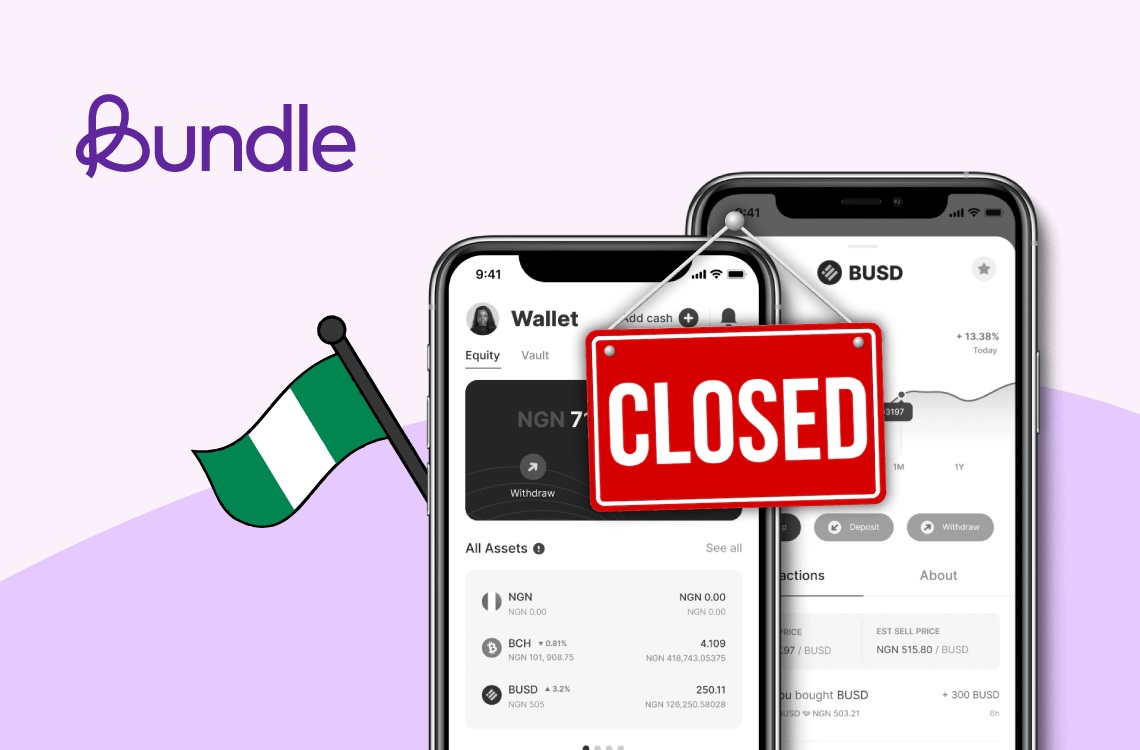
Africa-focused social payments app for cash and cryptocurrency, Bundle Africa, has shut down operations as part of a restructuring process to focus on another product called Cashlink.

As the Web3 and blockchain community continues to grow, Bundle disclosed that there is a need to focus on payment solutions that meet the ecosystem’s needs, which is the plan with Cashlink, as it is focused on expanding the services of Cashlink as a payment.

The company has therefore advised users to withdraw their assets from the app on or before the /12th of September 2023

It wrote via a press release,

For the past 3 years of our operations, you have been part of our success story, and we want to say a huge thank you. As we celebrate our achievements of the last 3 years, including Cashlink crossing over 3 million transactions and Bundle with more than 50,000 average monthly active users and over $50m monthly volume, we also want to announce that Bundle’s exchange services (Buy and sell/Deposits and withdrawals) are ceasing operations as we focus on expanding the services of Cashlink as a payment.

“Users are advised to withdraw their assets from the app on or before the /12th of September 2023. Why is Bundle leaving the Market? We will cease operations of our exchange services as part of the Shareholder’s decision to restructure the business to focus on Cashlink.

“As Web3 and the blockchain community continue to grow, there is a need to focus on payment solutions that meet the ecosystem’s needs, which is the plan with Cashlink”.

From the date of this announcement, users won’t be able to do the following on Bundle.

  1. Sign up on Bundle
  2. Deposit assets into your Bundle wallet.›
  3. Swap assets in your Bundle wallet (except USDT)
  4. Withdraw with Cashlink if you do not have NGN or fiat on Bundle.

Speaking on the shutdown of Bundle, the company’s CEO Emmanuel Babalola disclosed that the team has put in place plans to adequately support their users during this transition phase.

In his words,

“Irrespective of this early exit, Bundle Africa has made its mark on the African continent, providing our users with a best-in-class experience for crypto, making it easier and safer to access crypto services, Our users can withdraw their funds into any wallet. Over the next 60 days, we will provide our users and stakeholders with unparalleled support as we transition to Cashlink and other services”.

Bundle Africa was launched in August 2019 by Yele Bademosi and Emmanuel Babalola. It was developed within the Binance ecosystem.

The startup was a remote-first company that began as a startup inside Binance. The app had over 50 thousand downloads in the first four months following its release, with a 4.4 rating on Google Play and over $4.5 million in transaction volumes.

Bundle had a monthly transaction volume of $56 million with over 350,000 customers in its early years. It grew to 650,000 users in 16 months, mostly through networking, community marketing, as well as a little marketing budget.

Before its shutdown, the startup was committed to supporting customer and making meaningful connections flow through, which helped Bundle grow to serve over 700,000 users in 2 years.

Ripple’s Legal Victory Sends Shockwaves: Dogecoin, Polkadot Surge, And DogeMiyagi Rides The Meme Wave

0

A landmark ruling in the case against Ripple by the SEC has created ripples in the crypto world, leading to positive market movements. As Dogecoin (DOGE) and Polkadot (DOT) experience significant pumps, we explore the outcome of the case and how it may benefit the new token, DogeMiyagi (MIYAGI), as it joins the market.

Ripple: A Partial Win With Far-Reaching Implications

In its legal battle against the SEC, Ripple Labs celebrated a partial victory as Judge Analisa Torres ruled that XRP is not a security in programmatic sales on digital asset exchanges. However, the court also acknowledged that XRP could be deemed a security when sold to institutional investors. The outcome of this case carries significant weight in the crypto industry.

The ruling immediately affected Ripple’s XRP token, which experienced a surge of over 25% within minutes of the news. This win gives Ripple more clarity and room to operate, as the case sought to stop the offering of XRP because it is an unregistered security. With this legal victory, Ripple can proceed with more certainty in its operations, which may have positive implications for the broader cryptocurrency market.

Polkadot: Scaling New Horizons

Polkadot, founded by Gavin Wood, co-founder of Ethereum, has emerged as a leading cryptocurrency addressing scalability and interoperability. Its unique infrastructure allows different blockchains to interoperate, enhancing scalability and fostering innovation seamlessly. Polkadot’s ability to connect various blockchain networks creates new opportunities for decentralised applications (DApps) and smart contracts.

With its solid foundation and strong development community, Polkadot envisions a future where multiple specialised blockchains coexist, enabling efficient and secure data transfer. This vision positions Polkadot as a key player in shaping the future of the crypto industry, providing a robust and scalable framework for decentralised applications to thrive.

DogeMiyagi: Riding The Meme Wave

DogeMiyagi (MIYAGI), a new token inspired by meme culture, enters the crypto market during this exciting time. With its comical twist and community-driven initiatives, DogeMiyagi aims to capture the growing demand for meme coins. The token’s unique approach, emphasising decentralisation, transparency, and community engagement, appeals to investors seeking financial opportunities and entertainment value.

DogeMiyagi has made considerable strides during its presale, gathering a broad investor base and creating a lot of buzz. The project’s meme-inspired branding and community engagement create an engaging user environment, fostering a sense of belonging. As the meme coin wave continues, DogeMiyagi stands poised to ride the momentum, capitalising on the excitement surrounding meme-inspired cryptocurrencies.

Ripple’s legal victory against the SEC has brought positive market movements, with Dogecoin and Polkadot experiencing significant pumps. This landmark ruling sets important precedents for the crypto industry. As Ripple gains clarity, it opens doors for future growth and possibilities. Meanwhile, Polkadot’s focus on scalability and interoperability solidifies its position as a game-changer.

For DogeMiyagi, joining the market during this vibrant period provides an opportunity to leverage the growing interest in meme coins. As the crypto market evolves, these three tokens bring their unique strengths and perspectives, contributing to the ever-evolving landscape of digital currencies.


For More Information On DogeMiyagi:

Website: https://dogemiyagi.com

Twitter: https://twitter.com/_Dogemiyagi_

Telegram: https://t.me/doge