DD
MM
YYYY

PAGES

DD
MM
YYYY

spot_img

PAGES

Home Blog Page 3973

YOU ARE YOUR OWN LEGEND

0

‘Men are haunted by the vastness of eternity. And so we ask ourselves, will our actions echo across the centuries? Will strangers hear our names long after we’re gone and wonder who we were? How bravely we fought? How fiercely we loved ? . . .’

The intro-narative to TROY (2004),  https://www.youtube.com/watch?v=D0sy6-MfNVQ (No. 73 in Rankers ‘Epic Films of All Time’)
It’s interesting to look at how time changes.

Once, being a warrior leader was the only path to notoriety. Throughout history, we have seen the priorities for mass recognition cut across inventors, artists, writers, entertainers, political, religious and business leaders, astronauts, musicians, sports persons, social change activists, charity leaders … the list goes on.

Money has always bought influence, and by association, notoriety.

Some people’s names have gone down in history as creators and inventors but frequently, they were not the people that should have been credited.

People who have been in charge of projects are often people who provide leadership, technical cohesion, and deal with stakeholders, the press, and the wider political environment in which challenging projects live.

Robert Oppenheimer was credited with being the ‘Father of the Atomic Bomb’, but while he was definitely in charge of ‘The Manhattan Project’, several accounts exist suggesting defining breakthroughs made by people in his teams, whose names have never been remembered.

There are many stories about the Germans having got there first.

In written and spoken arts, ghost writers are often used. In some cases, work is even stolen without being paid for.

In 1990, an Italian music group ‘Black Box’ released a dance track ‘Ride on Time’. It shook the ground so much, live remix DJs recreate it, even now, more than 30 years later.

But it used unlicensed vocal samples from the 1980 single “Love Sensation” by Loleatta Holloway.

Once, many years ago, I was a leader under an owner in a large Telecoms/ISP company.

Another former leader who had left, was brought back. There were some parallels in solution design between both of our teams.

Several times, when I was discussing ideas with him on the way forward, he went to the owner and promoted the ideas as his own.

On one occasion, he had an architecture produced by his team. I told him it was wrong, and pointed out how it should be, through an amended drawing.  He disagreed. I told him to take it to the owner, (who was also technically well versed in these technologies).

Later that day, the owner called me in, and asked me how can I allow my team to produce such poor work. The other leader has somehow claimed ownership of the print out that was mine, and claimed his own teams work came from me.

I’m not going to get into how this ended.

What is important is that I know what belongs in my own portfolio of greatness. So does he.

We see films made about legends, but do the films really explain who they are as people?

The only thing that becomes attached to a name to give it breath through film, is some semblance of how a Producer Produces, a Scriptwriter Writes, a Director Directs, and Actors Act.

It is not that person.

Many who use a desktop computer at home or work, will be familiar with a pointing and selecting device. Some even use these by preference with laptops and tablets due to speed of movement and precision control. Everyone knows it is called a ‘mouse’, but who even knows it was invented by one Doug Englebart?

With the types of online media that have began from the end of the last millennium, we have new forms of social capital, but being built upon the same principles no different from buying influence with the senate of Rome in days of old.

The concept of paying for a premium service which will get your media in front of more eyes.

Today, many can claim to know Elon Musk as a person, far more can know him in a professional sense, and more still know his likeness and voice. None can say the same for Satoshi Nakamoto, but the question is… in a few hundred years, who will this matter to?

The tombstones of the future lie not in graveyards but in network archives.

But they are still tombstones that fail to convey the private person.

Whether warriors or not, some time we will all die.

Someday, also, there will be no-one of this life, who recalls us as somebody living and breathing.

You can’t walk away from who you are, so you have to work to make that person someone you are ok with.

You can choose whether past deeds bring you torment or solace.

Some may think me naïve, but I won’t subscribe to what another person’s version of success is.

So make peace with a legacy only to yourself.

Satisfy yourself in your final hour, that your brief struggle in boundless time was worth it.

You are your own LEGEND


9ja Cosmos is here!

Get your .9jacom and .9javerse Web 3 domains  for $2 at:

.9jacom Domains

.9javerse Domains

Visit 9ja Cosmos

Follow us on LinkedIn HERE

Background Sourced 25/11/23 from

Wikipedia, Ranker .com , The Guardian, IMDb,  and You Tube

 

Join Ndubuisi Ekekwe At Lagos Business School’s Naija Youth Sustainability Forum on Nov 28, 2023

0

Good People, I am very excited to announce that I will deliver a special presentation during the Lagos Business School, Pan-Atlantic University’s Naija Youth Sustainability Forum with the theme ‘The Resourceful Youth: Maximising Opportunities in Today’s Economy’.  The venue is LBS, and you’re invited.

Young People, there is abundance in the future, and never doubt the promises of tomorrow. But you have to take ACTION and be resourceful to unlock those promises.  Indeed, across human history, this is still the best time to be a young person because your opportunities are unbounded and unconstrained by geography.

For all the challenges you see, behind are opportunities for you.  We just have to propel with productive #action – and with that, success will become a constant in our careers. Yes, maximize the opportunities in today’s economy, because out of the visions and works of your hands, nations will re-emerge. #MakeItHappen. See you on Tuesday.

Master The Physics of Pricing And Grow Your Company

0

The greatest moment in a business is when a company discovers and operates a great business model. Why? It is through a business model that companies create value. Yes, a business model encapsulates the logic of a firm, and the way it combines and uses factors of production to create value for stakeholders.

But how do you create value for a profit company? Great question. Join me today as we discuss Pricing. Do you go cost plus or value-based pricing? How is that pricing going to help you scale, looking at your marginal cost? 

Good People, your pricing strategy affects value capture which can shape your unit economics. When the unit economics is bad, you are not SCALING, but growing, and will hit diminishing returns soon on making money! The greatest companies SCALE, not just grow. And that happens when revenue and profit grow faster than your cost. So, if you plot the transaction cost, distribution cost, fixed cost, revenue, and profit, against Growth, the first three will be largely flat even as the last two are shooting into space. Go exponential on PROFIT!

Amazing People, when marginal cost continuously tends towards zero (i.e. asymptotically to the horizontal line) even as growth happens, you have a GREAT company because growth becomes unbounded and unconstrained – and alpha comes. Welcome to a successful company!

Join me for the Physics of Pricing. This is Tekedia Institute, and we’re the #best. Pick a seat here for the next edition.

Caveat Emptor: In Practice And In Principle

0

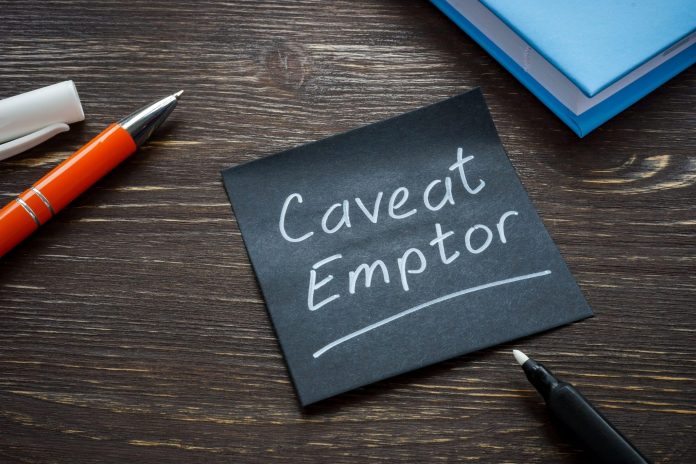
Caveat emptor is a Latin phrase that loosely translates to “let the buyer beware.” It simply means that an individual buys at their own risk. In principle, it means that the buyer is responsible for making sure that a product works to their satisfaction or that the item they are buying is genuine before buying it or paying for it. 

By the implication of Caveat Emptor, it serves as a disclaimer that the buyer must be confident about the product or the goods he wants to purchase because the seller will be under no obligation to provide a refund for it. 

In Nigeria, we see bold signs conspicuously written on the wall of the fence of the property which often read; “This house is not for sale, beware of fraudsters”. Sometimes you may see, “This property is a subject of a civil litigation in suit number….. before XYZ court”. I have even seen some hilarious disclaimers written on the walls of a building like “This House Is Not For Sale, Beware Of My Son Emeka”. 

This is for real estate transactions; potential buyers are warned to ensure that they are purchasing a good root of title or purchasing the property from the rightful owner, then in other forms of transactions like car purchase; the disclaimer admonishes buyers to ensure that the item they are purchasing is fit and proper to their satisfaction before they part their money to the seller because the seller will not be held liable for any issue that may arise out of the product once the transaction has been concluded and the buyer didn’t investigate very well to pinpoint such issue during the transaction. 

All these disclaimers make up what we call in law “caveat emptor”, it is simply sending warnings to prospective buyers for them to carry out their due diligence and be sure that the item they want to purchase is genuine and that they are buying from the right person. 

The importance of caveat emptor in high-value transactions is that whilst the parties to the transaction are expected and obligated to fully disclose every information relevant to the transaction, you the buyer are very much expected to up your guard and do your homework, gather independent information on the property because equity will not aid the sloppy or the indolent. 

Potential buyers are warned by the phrase to do their research and ask pointed questions of the seller because the seller will not be responsible for problems that the buyer encounters with the product after the sale.

In many jurisdictions, caveat emptor is the contract law principle that places the onus on the buyer to carry out due diligence before making a purchase but despite this disclaimer, in principle and in practice there are exceptions to it. Caveat emptor does not give sellers carte blanche or the legal coverage for them to promote a fraudulent transaction. For instance, if the seller lies or misrepresents facts during the transaction the seller will be liable even if the buyer fails to investigate and carry out due diligence. 

The Insurance of Property Under Nigerian Law

0

This article will be looking at the provisions of Nigerian law, specifically the Insurance Act Of Nigeria, regarding the insurance of property, with a focus on public building insurance, insurance of imports, and 3rd party property damage.

What are the provisions of the Insurance Act on the insurance of public buildings?

– No person shall construct any building of more than 2 floors without insuring with an insurer registered under the act, his liability in respect of construction risks caused by his negligence or the negligence of his agents, servants or consultants which may result in bodily injury or loss of life to or damage to property of any workman on the site or any member of the public.

– This duty to insure shall arise when a building is under construction.

– Every public building shall be insured with a registered insurer against the hazards of collapse, fire, earthquake, storms and flooding.

– A public building in this context includes a tenement house, hostel, a building occupied by a tenant, lodger or licensee and any building to which members if the public have ingress and aggress for the purpose of obtaining educational or medical services, for the purpose of recreation or transaction of business.

– Insurance policies in this context shall cover the legal liabilities of an owner or occupier of premises in respect of loss or damage to property or bodily injury or death suffered by any user of the premises and 3rd parties.

What does the law say on money insured on burned houses?

– Where a house or building insured against loss by fire is damaged or destroyed against loss by fire is damaged or destroyed by fire & there is no reasonable ground to suspect that the owner or occupier or other person who insured the house or other building is guilty of fraud in respect of the insurance, or of willfully causing the fire, the insurer who is liable to make good the kids may, on the request of any person entitled or interested in the insured house or building cause the insurance money payable to be paid out and expended as set out in the act.

What are the provisions of the act on the insurance of imports?

– An insurance in respect of goods to nr imported into Nigeria shall be made with an insurer registered under the act.

– Accordingly, the provisions of any law, contract or instrument shall be construed with such modifications, amendments and omissions, as would bring them into conformity with the general intendment of the act.

– Without prejudice yo yjr generality of the foregoing, every letter of credit or such similar document issued by any bank or other financial institution in Nigeria in respect of such goods shall be on a carriage and freight basis only.

What are the provisions of the act on the insurance of 3rd party property damage?

– No person shall use or cause or permit any other person to use a motor vehicle on a road unless a liability which he may thereby incur in respect of damage to the property of 3rd parties is insured with an insurer registered under this act.

– The insurance taken out in this regard shall cover liability of not less than 1 Million Naira.

Section II

This article instalment focuses on the provisions of the Insurance Act Of Nigeria regarding the settlement of claims, the time to settle claims, and the insurance requirement of  police reports regarding motor accident cases. 

What are the provisions of the act on the settlement of claims? 

– The act provides that where:-

a). Civil proceedings are taken in court in respect of a claim relating to any risk required to be insured against under this act or any other law, and 

a). A judgment is obtained against the person insured then, notwithstanding that the insurer may be entitled to avoid or cancel of may have avoided or canceled the policy, the insurer shall, subject to the act, pay to the person entitled to the benefit of such judgment, the sum payable (including costs and interest sums) not later than 30 days from the date of delivery of the judgment. 

– No sum shall be payable by an insurer under the provisions mentioned above – 

a). in respect of any judgment, unless before or within 7 days after the commencement of the proceedings in which the judgment was given, the insurer has notice if the bringing of the proceedings; 

b). in respect of any judgment, if execution thereon is stayed, pending an appeal, or

 c). in connection with any liability, if before the happening of the event which gave rise to the liability, the policy was canceled by mutual consent or by virtue of any provision contained therein. 

What does the act say on the time to settle claims? 

– Subject to the relevant provisions of the act, in every case where a claim is made in writing by the insured or any other party entitled thereto under insurance policy, the insurer shall – 

a). Where he accepts liability, settle the claim not later than 90 days after the insurance of discharge voucher. 

b). Where any claim remains unpaid as provided above, the insured may request the National Insurance Commission (NAICOM) to effect the payment from the statutory deposit of the insurer and the commission shall have power to effect such payment. 

c). Where he does not accept liability, deliver a statement in writing stating the reason for disclaiming such liability to the person making the claim or his authorized representative not later than 90 days from the date on which the person delivered his claim to the insurer.

 What does the act say regarding the dispensation of police reports in certain motor accident cases? 

– Without prejudice to any other mode of proof, it is sufficient evidence of proof of loss or damage for the purpose of this provision:- 

a). Where only one person is involved in an accident, the person delivers a statement of the facts to the insurer or insurers concerned together with a statement of an eyewitness to the accident, if any. 

b). Where more than one person is involved in the accident, such person delivers a statement of the facts to the insurer or insurers concerned and the alleged facts do not differ in any material particular.