DD
MM
YYYY

PAGES

DD
MM
YYYY

spot_img

PAGES

Home Blog Page 3978

Exploring The Best Crypto Wallets & Their Integration With Litecoin, Polkadot, and Scorpion Casino Token

0

Crypto wallets play a crucial role in the adoption and usage of digital assets. They provide a secure and convenient means of storing and managing cryptocurrencies. In this in-depth analysis, we will explore the landscape of the best crypto wallets that support Scorpion Casino Token (SCORP), Litecoin (LTC), and Polkadot (DOT).

By comparing the level of security, ease of use, and customer service offered by these wallets, we can gain insights into their impact on the popularity and usage of these cryptocurrencies. Additionally, we will delve into the unique potential of Scorpion Casino Token in a market crowded with meme coins and its long-term utility as the basis of an innovative gambling platform.

But before we explore the world of cryptocurrency wallets and their impact on Scorpion Casino Token, Litecoin, and Polkadot, it’s essential to understand the unique characteristics and investment potential of these digital assets!

Litecoin: Silver to Bitcoin’s Gold

Litecoin (LTC), often referred to as the silver to Bitcoin’s gold, was introduced in 2011 by Charlie Lee. Built on a similar blockchain structure as Bitcoin, Litecoin offers faster block generation times and a different hashing algorithm.

Its key strengths lie in its robust security features, widespread acceptance among merchants, and strong community support. Litecoin has established itself as a reliable and efficient payment solution, with lower transaction fees and scalability advantages over Bitcoin.

Polkadot: Connecting the Dots in the Blockchain Ecosystem

Polkadot (DOT), created by Ethereum co-founder Gavin Wood, is a multi-chain network that enables different blockchains to interoperate and share information. Its innovative design facilitates seamless communication and collaboration between different projects, fostering a connected and scalable blockchain ecosystem.

Polkadot’s key strengths include its interoperability, scalability, and ability to upgrade the network without causing disruptions. Its governance model empowers token holders to participate in decision-making, ensuring a decentralized and inclusive approach.

Introducing Scorpion Casino Token: Revolutionizing the Gambling Industry

Scorpion Casino Token (SCORP) represents an innovative digital currency designed to transform the online gambling industry. With a strong emphasis on secure and efficient transactions, Scorpion Casino Token leverages blockchain technology to provide transparency, fairness, and heightened security. Its key strengths lie in its integration of Ripple and Avalanche principles, which enable rapid and secure transactions, ensuring a seamless gambling experience for users.

Furthermore, In the midst of a market flooded with meme coins and other aimless tokens, Scorpion Casino Token emerges as a compelling opportunity, setting itself apart with its utility and long-term vision as the foundation of a revolutionary gambling platform. With a focus on secure and efficient transactions, Scorpion Casino Token leverages blockchain technology to offer transparency, fairness, and enhanced security within the online gambling industry.

Its innovative use case positions Scorpion Casino Token as a promising asset with the potential to disrupt and reshape how people engage in online gambling, making it an attractive investment prospect in the crypto landscape.

Comparing Cryptocurrency Wallets

When it comes to storing and managing Scorpion Casino Token, Litecoin, and Polkadot, choosing the right cryptocurrency wallet is crucial. Various wallet options cater to different user preferences and security requirements. While hardware wallets such as Ledger and Trezor offer the highest level of security by storing private keys offline, software wallets like Electrum and Exodus provide convenience through easy-to-use interfaces. Web wallets such as MyEtherWallet (MEW) and Trust Wallet offer accessibility from any device with an internet connection.

In terms of security, wallets supporting Scorpion Casino Token, Litecoin, and Polkadot prioritize the protection of user funds through encryption and secure storage mechanisms. Wallets like Electrum and Trust Wallet offer seamless user experiences with intuitive interfaces and user-friendly features. Customer service varies among wallet providers, with some offering responsive support channels and comprehensive user guides.

Top Cryptos Wallets Attract Top Cryptos

Cryptocurrency wallets form an integral part of the crypto ecosystem, impacting the popularity and usage of digital assets. In our exploration of Scorpion Casino Token, Litecoin, and Polkadot, we observed the strengths and unique features they bring to the table. Wallet choices play a vital role in safeguarding and managing these cryptocurrencies, and users must consider factors such as security, usability, and customer service when making their selections.

Moreover, with Scorpion Casino Token’s promising utility in the online gambling industry and its innovative approach, it presents an exciting opportunity in a market dominated by meme coins!


Scorpion Casino Token:

Presale: https://presale.scorpion.casino/

Twitter: https://twitter.com/ScorpionCasino

Telegram: https://t.me/scorpioncasino_official

7 Ways of Running Your Family as a Business in Nigeria’s Post-Fuel Subsidy Era

1

The recent removal of fuel subsidy in Nigeria has undoubtedly brought about challenging times for families across cities, towns, and villages. As the economic landscape shifts, household heads find themselves struggling to provide for their family’s basic needs.

In the face of these difficulties, it becomes crucial for families to adopt a business-like approach to manage resources efficiently and ensure their survival and well-being. In this piece, our analyst explores how families can run themselves as a business during these trying times, leveraging existing data about the issues of fuel subsidy.

Establish a Clear Vision and Strategy

Just like a successful business needs a clear vision and strategy to thrive, families must have a shared purpose and a well-defined plan to navigate through challenging times. Engage your family members in an open discussion about the situation and collectively set realistic goals that align with your family’s values and aspirations. Consider ways to optimize spending, prioritize essential needs, and explore additional sources of income.

Budgeting and Financial Management

Implementing effective budgeting and financial management practices is crucial in uncertain times. Track your family’s expenses, identify areas of potential savings, and cut down on non-essential spending. Encourage transparency and accountability among family members when it comes to managing finances. Consider setting up an emergency fund to provide a safety net in times of unexpected financial burdens.

Diversify Income Streams

Just as a business seeks to diversify its revenue streams, families should explore multiple sources of income. Encourage family members to explore their talents, skills, or hobbies that can be monetized. This might include freelancing, starting a small home-based business, or investing in income-generating ventures that align with your family’s capabilities and interests.

Adaptability and Resilience

In challenging times, adaptability and resilience are essential traits for both businesses and families. As fuel prices fluctuate and economic circumstances change, families must remain agile in adjusting their strategies and plans. Emphasize the importance of resilience and a positive mindset, encouraging each family member to support and uplift one another during difficult periods.

Communication and Collaboration

Successful businesses thrive on effective communication and collaboration, and the same holds true for families. Open and honest communication is vital to understanding each family member’s needs, concerns, and aspirations. Foster an environment where everyone feels heard and valued, encouraging them to contribute their ideas and perspectives.

Education and Skill Development

Investing in education and skill development is akin to investing in the growth of a business. Encourage family members to acquire new skills or enhance existing ones that can boost their employability or business opportunities. This investment not only strengthens the family’s financial standing but also enhances their overall well-being.

Supportive Networks

Just as businesses build supportive networks, families should seek support from their communities, friends, and extended family during challenging times. Leverage these networks for advice, assistance, and potential collaboration. Together, families can weather the storm more effectively.

The removal of fuel subsidy in Nigeria has undoubtedly introduced significant challenges for families across the nation because of the approach government adopted for reducing its immediate effects. However, as described previously, our analyst is of the view that adopting a business-like approach to family management can help navigate these difficult times more effectively.

By establishing a clear vision, practicing prudent financial management, diversifying income streams, fostering adaptability and resilience, promoting effective communication, investing in education and skill development, and seeking supportive networks, families can face these challenges head-on and emerge stronger together.

Our analyst further says it’s instructive to know that while the effects of fuel subsidy removal may be beyond the control of individual families, the way they respond to the situation is not. By treating the family as a business and taking thoughtful, strategic actions, families can weather the storm and create a better future for themselves and their loved ones.

Netting Under The Companies and Allied Matters Act (CAMA) 2020, Nigeria

0
CAC

This article will be talking about the practice of netting which involves the reduction of credit and settlement risks in financial contracts by the combination of 2 or more obligations to result into a reduced obligation. This article will be focused on the definition of relevant concepts associated with netting, the powers of relevant financial regulatory agencies, and the enforceability of qualified financial agreements.

Definition of Applicable Concepts

The Companies & Allied Matters Act CAMA 2020 defines the following concepts associated with netting as follows :- 

– “Financial regulatory authority” means:

(a) the Central Bank of Nigeria ;

(b) the Securities and Exchange Commission ;

(c) the National Insurance Commission(NAICOM) ;

(d) the National Pension Commission(PENCOM) ; and

(e) any other financial regulatory authority established by an Act of the National Assembly.

 – “Cash” means money credited to an account in any currency or a similar claim for repayment of money, such as a money market deposit .

– “Collateral” means any:

(a) cash in any currency ;

(b) securities of any kind, including debt and equity securities ;

(c) guarantees, letters of credit and obligations to reimburse ; and

(d) any asset commonly used as collateral in Nigeria .

– “Collateral arrangement” means any margin, collateral, security

arrangement or other credit enhancement related to or forming part of a netting agreement or one or more qualified financial contracts entered into thereunder, including-

(a) a pledge, charge or any other form of security interest in collateral, whether possessory or non-possessory ;(b) a title transfer collateral arrangement ;

(c) a security interest collateral arrangement ; and

(d) any guarantee, letter of credit or reimbursement obligation by or to a party to one or more qualified financial contracts, in respect of those qualified financial contracts .

– “Insolvent party” means the party in relation to which an insolvency proceeding under the laws of Nigeria has been instituted .

-“Liquidator” means the liquidator, administrator, nominee, supervisor, receiver, trustee, conservator or other individual, person or entity which administers the affairs of an insolvent party during an insolvency proceeding under the laws of Nigeria .

– “Netting” means the occurrence of the following:

(a) termination, liquidation or acceleration of any payment or delivery obligation or entitlement under one or more qualified financial contracts entered into under a netting agreement;

(b) calculation or estimation of a close-out value, market value, liquidation value or replacement value in respect of each obligation or entitlement or group of obligations or entitlements terminated, liquidated or accelerated under paragraph (a) ;

(c) conversion of any values calculated or estimated under paragraph (b) into a single currency ; and

(d) determination of the net balance of the values calculated under paragraph (b), as converted under paragraph (c), whether by operation of set-off or otherwise .

“Netting agreement” means any:

(a) agreement between two parties that provides for netting of present or future payment or delivery obligations or entitlements arising under or in connection with one or more qualified financial contracts entered into under the agreement by the parties to the agreement (a “master netting agreement”) ;

(b) master agreement between two parties that provides for netting of the amounts due under two or more master netting agreements (a “master-master netting agreement”) ; and 

(c) collateral arrangement related to or forming part of one or more of the foregoing .

– “Non-insolvent party” means the party other than the insolvent party; “party” means a person constituting one of the parties to a netting agreement .

-“Person” includes partnerships, companies, regulated entities such as banks, insurance companies and pension fund administrators, or any other body corporate (including statutory corporations or statutory bodies) whether organized under the laws of Nigeria or under the laws of any other jurisdiction, and any international or regional development bank or other international or regional organization .

– “Qualified financial contract” means any financial agreement, contract or transaction, including any terms and conditions incorporated by reference in any financial agreement, contract or transaction, pursuant to which payment or delivery obligations are due to be performed at a certain time or within a certain period of time and whether or not subject to any condition or contingency and includes:

(a) a currency, cross-currency or interest rate swap ;

(b) a basis swap ;

(c) a spot, future, forward or other foreign exchange transaction ;

(d) a cap, collar or floor transaction;

(e) a commodity swap ;

(f ) a forward rate agreement ;

(g) a currency or interest rate future;

(h) a currency or interest rate option;

(i) an equity derivative, such as an equity or equity index swap, equity forward, equity option or equity index option ;

(j) a derivative relating to bonds or other debt securities or to a bond or debt security index, such as a total return swap, index swap, forward, option or index option ;

(k) a credit derivative, such as a credit default swap, credit default basket swap, total return swap or credit default option ;

(l) an energy derivative, such as an electricity derivative, oil derivative, coal derivative or gas derivative ;

(m) a weather derivative, such as a weather swap or weather option ;

(n) a bandwidth derivative ;

(o) a freight derivative ;

(p) an emissions derivative, such as an emissions allowance or emissions reduction transaction ;

(q) an economic statistics derivative, such as an inflation derivative ;

(r) a property index derivative ;

(s) a spot, future, forward or other securities or commodities transaction ;

(t) a securities contract, including a margin loan and an agreement to buy, sell, borrow or lend securities, such as a securities repurchase or reverse repurchase agreement, a securities lending agreement or a securities buy or sell back agreement, including any such contract or agreement relating to mortgage loans, interests in mortgage loans or mortgage-related securities ;

(u) a commodities contract, including an agreement to buy, sell, borrow or lend commodities, such as a commodities repurchase or reverse repurchase agreement, a commodities lending agreement or a commodities buy or sell back agreement ;

(v) a collateral arrangement ;

(w) an agreement to clear or settle securities transactions or to act as a depository for securities(x) any other agreement, contract or transaction similar to any agreement, contract or transaction referred to in paragraphs (a) – (w) with respect to one or more reference items or indices relating to interest rates, currencies, commodities, energy products, electricity, equities, weather, bonds and other debt instruments, precious metals, quantitative measures associated with an occurrence, extent of an occurrence, or contingency associated with a financial, commercial or economic consequence, or economic or financial indices or measures of economic or financial risk or value ; 

(y) any swap, forward, option, contract for differences or other derivative in respect of, or combination of, one or more agreements or contracts referred to in the first 24 paragraphs above ) ; and 

(z) any agreement, contract or transaction designated as such by the financial regulatory authority under this Act . 

-“Security interest collateral arrangement” means “security financial collateral arrangement” as defined in Chapter 9 of CAMA (Debentures) of this Act and includes charges ; and 

-“Title transfer collateral arrangement” means a margin, collateral or security arrangement related to a netting agreement based on the transfer of title to collateral, whether by outright sale or by way of security, including a sale and repurchase agreement, securities lending agreement, or securities buy or sell-back agreement. 

Powers of a financial regulatory authority 

Under the act, a financial regulatory authority may, in relation to the relevant sector it regulates, by notice issued under this section, designate as “qualified financial contracts” any agreement, contract or transaction, or type of agreement, contract or transaction, in addition to those listed in this section. 

What does the CAMA 2020 say about the enforceability of a qualified financial contract? 

A qualified financial contract shall not be and shall be deemed never to have been void or unenforceable by reason of the Gaming Machines(Prohibition) Act or any other laws relating to games, gaming, gambling, wagering or lotteries.

What does the act say about the enforceability of netting agreements? 

-The CAMA 2020 provides that the provisions of a netting agreement is enforceable in accordance with their terms, including against an insolvent party, and, where applicable, against a guarantor or other person providing security for a party and shall not be stayed, avoided or otherwise limited by: 

(a) any action of the liquidator ;

(b) any other provision of law relating to bankruptcy, reorganization,

composition with creditors, receivership or any other insolvency proceeding an insolvent party may be subject to ; or 

(c) any other provision of law that may be applicable to an insolvent party, subject to the conditions contained in the applicable netting agreement.

-After commencement of insolvency proceedings in relation to a party, the only obligation, if any, of either party to make payment or delivery under a netting agreement shall be equal to its net obligation to the other party as determined in accordance with the terms of the applicable netting agreement. 

-After commencement of insolvency proceedings in relation to a party, the only right, if any, of either party to receive payment or delivery under a netting agreement shall be equal to its net entitlement with respect to the other party as determined in accordance with the terms of the applicable netting agreement. 

– Any power of the liquidator to assume or repudiate individual contracts or transactions will not prevent the termination, liquidation or acceleration of all payment or delivery obligations or entitlements under one or more qualified financial contracts entered into under or in connection with a netting agreement, and applies, if at all, only to the net amount due in respect of all of such qualified financial contracts in accordance with the terms of such netting agreement.

– The provisions of a netting agreement which provide for the determination of a net balance of the close-out values, market values, liquidation values or replacement values calculated in respect of accelerated or terminated payment or delivery obligations or entitlements under one or more qualified financial contracts entered into is not affected by any applicable insolvency law limiting the rights to set off, offset or net out obligations, payment amounts or termination values owed between an insolvent party and another party.

-The liquidator of an insolvent party may not avoid:

(a) any transfer, substitution or exchange of cash, collateral or any other interests under or in connection with a netting agreement from the insolvent party to the non-insolvent party ; or

(b) any payment or delivery obligation incurred by the insolvent party and owing to the non-insolvent party under or in connection with a netting agreement on the grounds of it constituting a preference by the insolvent party to the non-insolvent party, unless there is clear and convincing evidence that the non-insolvent party-

(i) made such transfer,

(ii) incurred such obligation with actual intent to hinder, delay, or defraud any entity to which the insolvent party was indebted or became indebted, on or after the date that such transfer was made or such obligation was incurred.

-Reasonable notice to interested parties, individuals, persons or entities shall be required for the realization, appropriation or liquidation of collateral under a collateral arrangement unless otherwise agreed by the parties provided that this provision is without prejudice to any applicable provision of law requiring that realization, appropriation or liquidation of collateral is conducted in a commercially reasonable manner.

-For the purposes of the act –

(a) a netting agreement is deemed to be a netting agreement notwithstanding the fact that the netting agreement may contain provisions relating to agreements, contracts or transactions that are not qualified financial contracts defined in the act, provided, however, that, for the purposes of the relevant section, such netting agreement shall be deemed to be a netting agreement only with respect to those agreements , contracts or transactions that fall within the definition of “qualified financial contract” under the act ;

(b) a collateral arrangement is deemed to be a collateral arrangement notwithstanding the fact that such collateral arrangement may contain provisions relating to agreements, contracts or transactions that are not a netting agreement or qualified financial contracts as defined by the relevant provision of this Act, provided, however, that, for the purposes of this section, such collateral arrangement shall be deemed to be a collateral arrangement only with respect to those agreements, contracts or transactions that fall within the definition of “netting agreement” or “qualified financial contract” as defined in the relevant section of this Act.

– A netting agreement and all qualified financial contracts entered into shall constitute a single agreement.

How Many People Can Consumer Tech Monetize in Nigeria Right Now?

1

My old thesis (2018) was that despite having about 200 million citizens, Nigeria’s monetizable population for most tech services and products was about 30 million people. Yes, from most indicators, those were people who earned decent incomes to buy some tech services; food and healthcare covered the full population. Read here 

For most analyses, across industries, I like to work with 30 million people since that number is close to the total unique bank account users in Nigeria. Technically, anyone that does not have a bank account in Nigeria at the moment is largely poor. And when I do models for markets, for most products, I rely on this 30 million because those are the full market potential at the moment, unless the product is free or in some sectors like food. Most banks excluding First Bank which has about 14 million customers have lower than 10 million customers. That is not what you expect in a country of 180 million citizens. Yes, everyone is circling around 30 million people.”

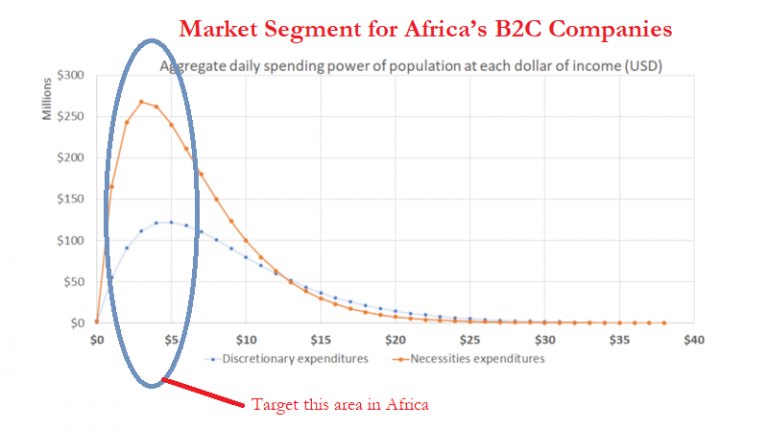
There was also the postulation that in B2C (business to consumer) products, the largest customer base falls within people who make between $4 to $8 per day:  “the most significant opportunity for African B2C startups lies with consumers who earn between $4 — $8 per day … This is largely because that income band holds the highest concentration of discretionary spending power on the continent, as the graph below shows.” Outside that range, capturing value becomes harder. Read here 

Now, the big question: what do you think the monetizable population is right now for most tech solutions in Nigeria? Greater than or lesser than 30 million? And WHY?

Comment on Feed

Comment on Feed

Comment 1: 30m for monetised market maybe ambitious Ndubuisi Ekekwe

My Response:  If you use the 41 million personal federal income payers, 30M is not that far away. Add state workers and SME owners, you can be hitting 60m. Discount by 50% as most are not up to decent income, to care about tech services, that 30m may even look low right now.

Comment 2: According to the data released by the Nigeria Inter-Bank Settlement System (NIBSS) in 2021, it showed that the number of active bank accounts in Nigeria increased to 133.4 million. (Nairametrics).
My only issue with the data is that we are far from reality in data analysis in Nigeria. However,
quite a number of them are only encouraged by the recent Fintech introduction like opay, palmpay etc.
Given the minimum wage of $35-$40 that we maintain in Nigeria at the current exchange rate and with less than 2% being able to save over N500,000.00 in their bank account, which shows that quite a large number of the population of bank users are living largely from hand to mouth especially in this crucial time when the savings we have is the one saving us.

Monetization of tech products may not work very well in Nigeria. Except for data consumption and some other few cheap and important products depending on the population preference.
Like you said, except for health and self development products, tech products will still largely have low patronage if monetized especially in this critical time where everyone is careful of spending.

Comment 3: Prof Ndubuisi, I do believe it’s higher. It should be about 55million because as of may this year BVN enrolment was at 57.4million according to CBN data. Therefore, most of these account owners can actually be reached with one sort of tech solution or another. From payments, to insurance, cheap communications mechanism, eCommerce, entertainment, edutainment, education, etc. Moreover why can’t we have a way of allowing people at scale to buy voucher and use it to make payment without need for bank account?

The Culpability and Liability of Influencers and Advertisers over a Product they Promote

0

Recently, a popular social media influencer who happens to be my client was engaged by a company to promote their product on his social media platforms. The company is into an online investment scheme where individuals are to invest and earn a particular percentage as a return on their investments within a particular time. The investment platform ended up being a Ponzi scheme: the platform subsequently crashed and the later investors lost all their money. The owners of the platform, as expected, disappeared and were nowhere to be found.

Since the owners of the platform were on the run, the investors decided to hold my client responsible and as a person of contact for their loss. They asked my client to refund them the money they lost which is running into several hundreds of millions or that my client should provide them with the owners of the platform. 

The investors claimed that they only got into the platform because my client being a person they trusted promoted and influenced the platform and he gave his word that the platform is legit as he has invested in the platform and he is cashing out. 

In our defense, our client claimed that he is not responsible for their loss, that he was merely engaged by the company as an influencer to promote the product for them, a task which he executed and nothing more. 

Scenarios like these keep playing out between advertisers/ influencers/promoters and users and the question has been, the culpability of an influencer or advertiser over a product he promoted which turns out to be a fake product or a scam or to what extent is an advertiser or an influencer liable or culpable in an instance like this?.

Rulings of the court have always been that Advertisers or influencers are ultimately responsible for the content of the adverts they shared and promoted and they are liable or culpable for any damage such advert caused or will cause. 

This rule notwithstanding, there are ways an influencer or an advertiser can limit his culpability or liability. 

An advertiser or a media house or an influencer promoting a product on their platforms must use a caption like; sponsored post, ad, branded post or paid partnership etc, this will serve as a caveat or a disclaimer to the general public that it is advertisement hence limiting your liabilities if the product you are advertising ends up failing or ended up a scam. Although these disclaiming captions won’t make you totally not guilty of the bad advertisement but will make you less guilty by only limiting how much responsible you are for the damages the content of your advertisement caused. 

As an influencer, you should also not use the words like “I have used the product and it worked”, if you haven’t used the product as that will amount to lies and deception and you will be held culpable by a user who took your words and used the product and it fails. You must let your followers know how much you know about the products and if you have tested or used them or not. 

You are therefore expected to do your due diligence on a product that you are contracted to influence or promote on your platform because no matter the caption you used as a caveat or disclaimer while promoting that product on your platform, it will not make you totally not guilty in the event of failure of the product. If the product ends up being an illegal or criminal product, you can be held culpable for promoting criminal activities or being complicit in the commission of a crime or aiding and abetting the commission of the crime by promoting it. Hence why you are expected to do your due diligence before accepting to promote any product on your platform 

In summary, if you want not to be held totally responsible by the law as a complicit, as an advertiser, a promoter or an influencer, you are expected to use any of these captions; ad, sponsored post, promoted, branded post, paid partnership or their likes, and you are also expected not to lie or overtly bluff about the product to your followers. You are not to use words that will overtly convince or persuade your followers or listeners, all you need is to put it out there letting your followers know that it is a branded post and let them make up their minds by themselves if they would patronize the product or not. 

Please note that no matter the procedure you follow or the disclaimer you put out, it does not slap all the liabilities off you but it limits how much liable you are in the event of the product failing or ending up being a fraud that is why you are expected to only promote and advertise products you trust and believe in.