DD
MM
YYYY

PAGES

DD
MM
YYYY

spot_img

PAGES

Home Blog Page 3978

Who Owns the Intellectual Property Rights of a Movie?

0

Let us take a break from intellectual property rights in music and talk about movies a bit: I had to tackle a brief earlier this week that posed the question; Who owns the intellectual property in a movie? The immediate answer to this question will be the producer or that the producers of the movie own the intellectual property rights to the movie but it is not always a straightforward answer, although generally speaking, it is the producer of the movie or the production company that owns that movie that owns the intellectual property rights in the movie but for you to answer you will always have to consider the unique circumstance or the unique facts of each case. 

There are some movies where both the actors and the movie producer co-own the intellectual property rights in the movie, there is even a possibility that an actor in the movie will be the owner of all the intellectual properties in the movie. It all depends on what was agreed upon and drawn up as a contract. 

I am currently working on a movie production contract; the production company wants to feature a Nollywood superstar who is a household name in the industry but due to financial constraints, the producers decided to propose to the actor that he will be a co-owner of the movie since they can not afford to pay him his rate and will be entitled to 10% of the total net profit of the movie.

Since the story is a good story, the actor accepted the proposal and he is also expected to join hands in the promotion of the movie before and after it has been released. In this instance, the actor is a co-owner of the intellectual property rights in the movie together with the producers of the movie. 

For Nollywood movie producers, the world has evolved more than what you think or used to know. Gone are the days when you just poached an actor and paid him or her to come and do a movie for you and that will be it.

Now actors and crew members outside the payment for the movie they got also want to and can legally be co-owners of the intellectual property rights in the movie, they want want more obtuse the immediate payment they got; this could be the case unless there is a contract duly drafted stating that the actor rights and obligations end on the movie shooting ground and since the actor has duly been paid for the movie shoot, he will and cannot claim the rights in the intellectual property of the movie. Nollywood film-makers need to start drawing up a contract with their casts and crews. The contract will specify the obligations and entitlement of a cast or a crew member. 

As for the actors or a crew member too, if you want to be a co-owner of the intellectual property rights in the movie, it is pertinent that you negotiate that with the movie producer and draw up a contract to that effect. 

Tyms Africa Helps Business Owners, CFOs, Accountants Streamline Accounting Processes

0

Last month, they raised significant capital from some Japanese investors. They are growing and adding users at scale. Tyms Africa, a Tekedia Capital portfolio startup, is helping African businesses manage their accounts payable and accounts receivable, along with their bookkeeping and general accounting activities through its Tyms Book product. 

Tyms Book’s all-in-one business financial management suite makes it possible for CFOs or Finance Managers to put the accounting department on auto-pilot, making it possible for the financial book to be closed faster, with real-time reporting and quicker decision-making that impact the organization’s growth and profitability. Across market sectors and segments, customers love Tyms.

When brahim Adepoju, a seasoned software engineer, and Chineye Ochem, a chartered accountant, came to Tekedia Capital, we knew something amazing was coming and we wrote the cheque. To request a demo, go here https://tyms.africa/request-demo. For partnerships, cross-marketing opportunities, integration partnership, etc, read below.


–Press Release

According to research, Nigerian accounting practices are still developing in relation to digitization. When conducting audit procedures, the bulk of audit practices in Nigeria still mainly rely on manual techniques.

Accounting offers financial data on a company or a nonprofit organization. For decision-making, owners, managers, investors, and other interested parties require financial information.

With the fast-growing rate of startups and small businesses rising in Nigeria and Africa at large, most of these business owners ignore the accounting aspect of their business at the early stage while putting more focus on their product development, sales and raising capital or grants. Whereas, the failure of many startups and small businesses has been traced to poor financial management and inefficient unit economics.

The assumption has always been that digital accounting and bookkeeping are needed more by micro-small enterprises whereas the need is higher in small-medium enterprises whose growth and decision-making are being slowed down due to the heavy volume of manual processes taking place in the finance and accounting departments.

Tyms Africa, a Tekedia Capital portfolio startup, is helping African businesses manage their accounts payable and accounts receivable, along with their bookkeeping and general accounting activities through her Tyms Book product. Tyms Book’s all-in-one business financial management suite will make it possible for the CFO or Finance Manager to put the accounting department on auto-pilot, making it possible for the financial book to be closed faster, with real-time reporting and quicker decision-making that impact the organization’s growth and profitability.

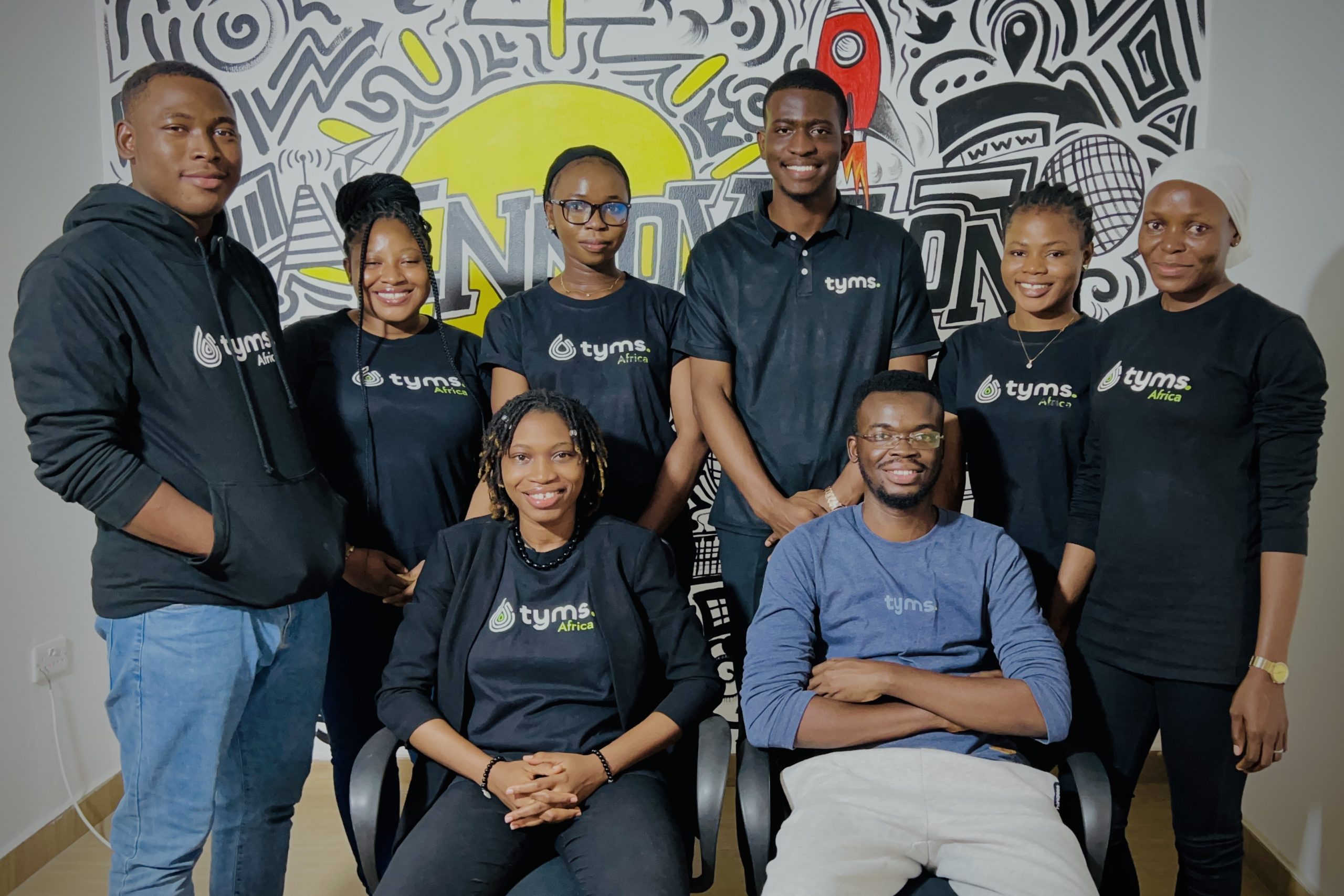
Founded in late 2021 by Ibrahim Adepoju, a seasoned software engineer and Chineye Ochem a chartered accountant. Both founders have extensive experience in information technology and financial accounting with experience working and consulting for organizations like PricewaterhouseCoopers International Limited (PwC), Sterling Assets Management and Trustees Limited, PagaTech Limited and a few others.

Tyms Africa, alongside its software as a service, also connects business owners who do not have a finance team with financial advisors and experts who leverage Tyms Book to help the business prepare their financial books, file taxes and get recommendations needed to improve their business performance.

Small business owners, accountants, bookkeepers and CFOs can use Tyms Book to power the following:

  • Quote generation and internal approvals.
  • Invoice generation and payment collection with direct integration with notable payment gateways in Africa such as Paystack and Flutterwave.
  • Recurring invoicing to customers, automatic payment collection, reminders, notifications and automatic receipt generation for customers.
  • Customer management portal and direct communication channel for negotiations and document signing.
  • Vendor purchase orders and bills or invoice management with real-time communication and negotiation channels.
  • Vendors’ automatic and scheduled bill payments.
  • Team expense claims and reimbursement with structured approval workflows.
  • Company budget preparation, approvals, tracking and forecasting.
  • Fixed assets management with real-time depreciation reporting and other computations.
  • Project management is associated with all organizational financial activities.
  • Real-time financial reports preparation such as balance sheets, trial balances, income statements, management reports and a lot more.
  • Bank reconciliation, transaction categorization and automated bookkeeping based on prepared bank rules.
  • Tax filing via a network of advisors and experts.
  • Integration marketplace for apps or startups in human resources, e-commerce, logistics, travels, insurance, payments, communication, lending and accounting industry. To help the finance unit sync with transactions in real time.
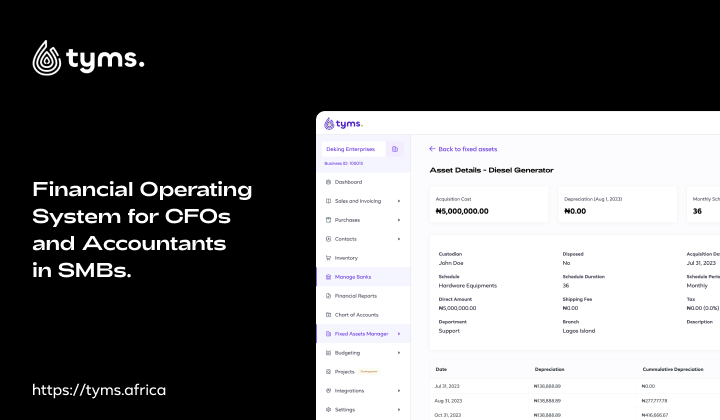
Tyms Africa, asides from having a product with top-notched quality and user experience, remains the most affordable and robust accounting system helping African businesses to cut-cost while streamlining their financial operations.

It takes only two minutes to sign up a business on Tyms Book while a demo session can also be scheduled ahead for guidelines and use case clarifications. Businesses using an existing accounting system can easily migrate to Tyms Book with just a single button click and with Tyms Book, businesses can save 40% in accounting system cost.

Tyms Africa has secured hundreds of thousands of dollars in pre-seed investment from notable local and international investors such as Tekedia Capital, Hoaq, SGGrow (Singapore), Azarel and angels like Hiro Mashita, Honda Yuzuru (CEO of Freakout Holdings Inc. Singapore) with a few other family and friends. The team has also participated in Seedstars and Google for Startup non-equity support programs.

Tyms Africa offers attractive recurring revenue sharing to partners such as accounting firms, consultants, sales teams and industry experts when they introduce other businesses to use Tyms Book. Interested parties can reach Tyms Africa via partnership@tyms.africa.

Also, the Tyms Africa integration marketplace is open to cross-selling and integration partnership with other digital platforms in the area of human resources, e-commerce, logistics, travels, insurance, payments, communication, lending and accounting. Interested parties can also reach Tyms Africa via partnership@tyms.africa.

Peter Obi Decries Exit of GlaxoSmithKline (GSK) from Nigeria

0

Peter Obi, the Labour Party’s candidate in the 2023 presidential election, has expressed his disappointment over the upcoming departure of British pharmaceutical giant GlaxoSmithKline (GSK) from Nigeria after five decades of operation.

He expressed the feeling in the wake of GSK’s declaration to cease its manufacturing of prescription medicines and vaccines within the country.

In a communication submitted to the Nigerian Exchange Limited, the multinational pharmaceutical corporation disclosed its intention to shift to a third-party direct distribution approach for its pharmaceutical offerings.

In response to this development, Peter Obi expressed his sentiments through a tweet on Friday evening. He lamented that the company’s decision to depart from Nigeria is particularly disheartening, indicating a lack of optimism in the country’s potential as a productive business environment.

He attributed these outcomes to the collective mismanagement of our economy over time.
“As a result, millions are losing their jobs and our poverty index is worsening, even though we’re already being perceived as the world’s poverty capital,” he said in the post.

He further noted that “The multinationals that are leaving our country have not only created jobs but have created immeasurable training that contributed immensely to our human capital development over the years.

“Now they are leaving our shores one after the other. GSK which has a manufacturing facility in Agbara, Ogun State on over 25 hectares of land had directly employed over 400 highly technical workers like pharmacists, microbiologists, biochemists, chemists, dentists, doctors etc, and also employed over 1000 other staff.

“It indirectly provided jobs and business opportunities for thousands of Nigerians across the nation. They are now leaving all these behind, and pushing more people back into unemployment.

“I have consistently maintained that in turning our nation around, we must move the economy from consumption to production, part of which included encouraging and supporting local and foreign investments, like GSK, in the country.

“The creation of an environment that creates and sustains multinationals to invest in our country is key to our dream of greatness. In the new Nigeria that we seek to create, the emphasis on production will encourage investors to stay and expand on our shores.”

The decision of GlaxoSmithKline, which was incorporated in Nigeria in June 1971, added to the growing number of multinational companies leaving Nigeria due to an unfriendly business environment.

The pharmaceutical multinational company is the producer of popular products like Panadol, Ribena, Lucozade, Macleans, augmentin, and Andrews Liver Salt, among others. Nigerians are concerned that its exit will result in a further hike of its pharmaceutical products.

Redbrick Secures Korean Patent for Open Metaverse Creation System

0

Redbrick, a leading company in the field of virtual reality and metaverse, has announced that it has obtained a patent for its innovative open metaverse creation system in South Korea. The patent, which was granted by the Korean Intellectual Property Office on July 31, 2023, covers the core technology of Redbrick’s platform that allows users to create, share, and monetize their own metaverse experiences.

The open metaverse creation system is a software framework that enables users to design and build immersive virtual worlds using various tools and assets provided by Redbrick. Users can also import and export their own content from other platforms, such as Unity, Unreal Engine, Blender, and Sketchfab.

The system supports cross-platform compatibility, meaning that users can access and enjoy the metaverse experiences on different devices, such as VR headsets, smartphones, tablets, PCs, and consoles. Redbrick’s CEO, Kim Min-jae, said that the patent is a significant milestone for the company and the metaverse industry.

“We are very proud to have secured this patent, which demonstrates our technological leadership and innovation in the field of metaverse. Our open metaverse creation system is a game-changer that will empower users to unleash their creativity and imagination in the virtual world. We believe that this will lead to the emergence of a new paradigm of entertainment, education, socialization, and commerce in the metaverse,” he said.

The open metaverse is a term that refers to a network of interconnected virtual spaces that are accessible to anyone, regardless of the device or platform they use. Unlike closed metaverses, which are controlled by a single entity or company, open metaverses are decentralized and open to innovation and collaboration from various stakeholders.

Redbrick’s system enables users to create their own open metaverse content using a simple drag-and-drop interface, and to publish it on the Redbrick network, where it can be accessed by other users across different devices and platforms. Users can also monetize their content by selling or renting it to other users, or by creating in-game economies and transactions.

To understand what the open metaverse is, we can think of it as an extension of the internet, where instead of browsing web pages, we can explore immersive 3D environments. The open metaverse is not limited by physical boundaries or geographical locations, and it can host various types of content, such as games, social media, education, entertainment, art, and more. The open metaverse also offers new possibilities for communication and interaction, as users can create and customize their own avatars, and interact with other users through voice, text, gestures, and emotions.

Redbrick’s CEO, Kim Min-jae, said that the patent is a significant milestone for the company and the open metaverse industry. “We are very proud to have obtained this patent, which validates our vision and technology for the open metaverse. We believe that the open metaverse is the future of the internet, where everyone can create and enjoy their own virtual worlds and experiences. Our system empowers users to unleash their creativity and imagination, and to benefit from their own creations. We hope that our system will contribute to the development and growth of the open metaverse ecosystem in Korea and beyond.”

Redbrick plans to launch its open metaverse creation system to the public later this year. The company has already partnered with several global brands and organizations, such as Samsung, LG, Hyundai, K-pop stars BTS and Blackpink, and the United Nations, to create various metaverse projects and events. Redbrick also aims to expand its presence in the global market by applying for patents in other countries, such as the United States, China, Japan, and Europe.

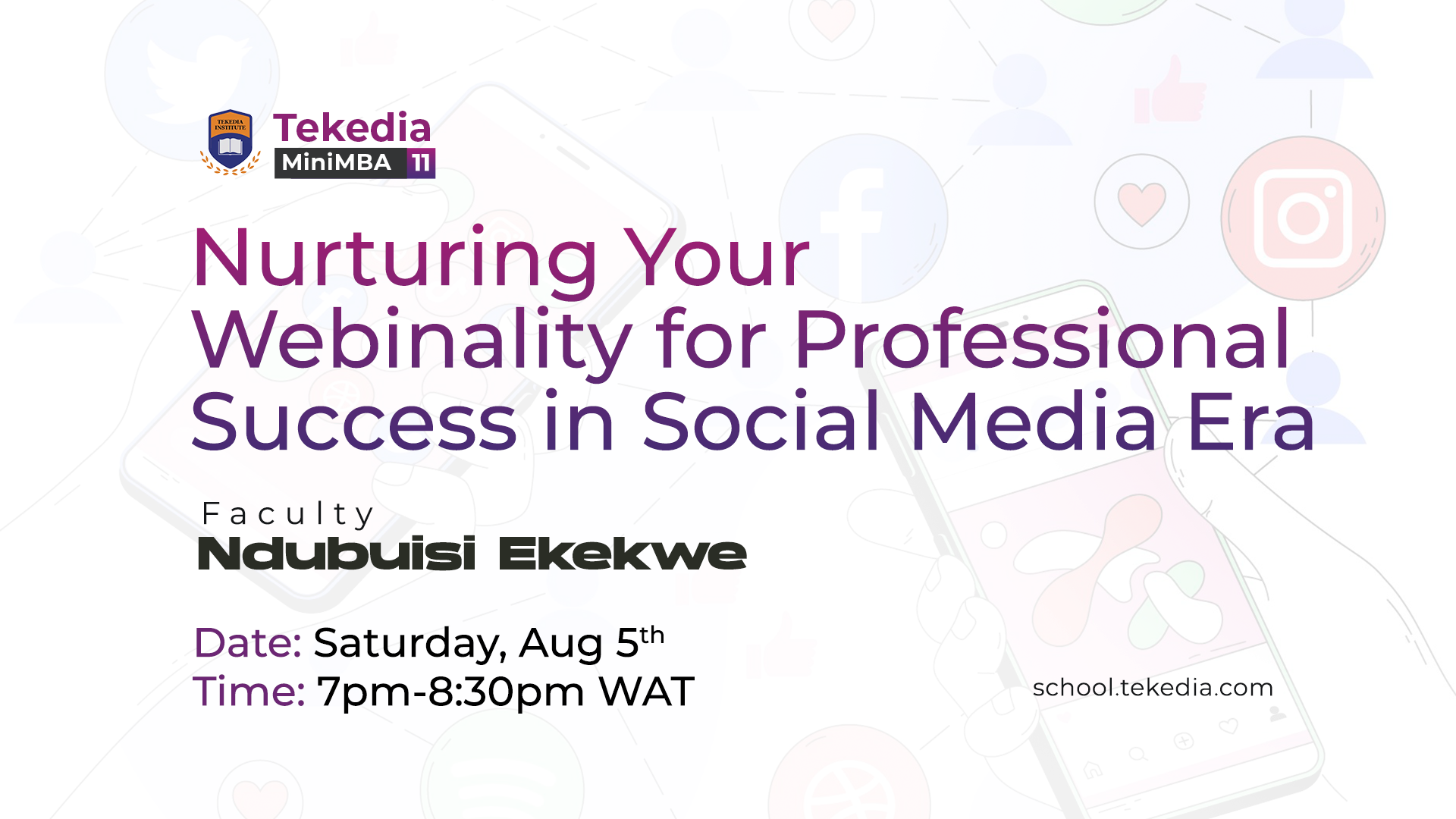
You must build your professional webinality, Join Tekedia Mini-MBA

0

Join us today at Tekedia Mini-MBA as we examine how to build webinality (web+personality). Yes, in this age, to ascend professionally, you need to find a creative way for people to know what you think you know. If you know it and keep it to yourself, you grow alone. But if you make it possible for others to know, wings emerge to carry you up. You must build your professional webinality

Tekedia Mini-MBA is an innovation management 12-week program, optimized for business execution and growth, with digital operational overlay. It runs 100% online. The theme is Innovation, Growth & Digital Execution – Techniques for Building Category-King Companies. All contents are self-paced, recorded and archived which means participants do not have to be at any scheduled time to consume contents. Besides, programs are designed for ALL sectors, from fintech to construction, healthcare to manufacturing, agriculture to real estate, etc.

Join us in Tekedia Mini-MBA