DD
MM
YYYY

PAGES

DD
MM
YYYY

spot_img

PAGES

Home Blog Page 3984

$225 million in USDT Linked to Human Trafficking Group Freezed by Tether

0

Tether, the company behind the popular stablecoin USDT, has announced that it has frozen $225 million worth of USDT that were allegedly linked to a human trafficking group. The freeze was requested by law enforcement agencies, who are investigating the criminal activities of the group.

According to a statement from Tether, the freeze affects 24 addresses that hold a total of 225,000,000 USDT. The company said that it is cooperating with the authorities and that it has a zero-tolerance policy for illicit use of its platform.

Tether is one of the most widely used cryptocurrencies in the world, with a market capitalization of over $70 billion. It is designed to maintain a 1:1 peg with the US dollar and is backed by reserves of fiat currency and other assets. However, Tether has also faced controversy and criticism over its lack of transparency, its susceptibility to manipulation, and its involvement in legal disputes.

The freeze of $225 million in USDT is not the first time that Tether has taken action against suspected criminals. In 2019, Tether froze $33 million in USDT that were connected to a Ponzi scheme called Plus Token. In 2018, Tether also froze $5.5 million in USDT that were linked to a cryptocurrency exchange called Bitfinex, which was accused of fraud and money laundering.

The use of cryptocurrencies by human traffickers is a challenge for law enforcement agencies.

While cryptocurrencies offer many benefits, such as lower transaction costs, faster processing, and greater privacy, they also pose significant challenges for law enforcement agencies. One of these challenges is the use of cryptocurrencies by human traffickers, who exploit them to facilitate their illicit activities and evade detection.

Human trafficking is a global crime that involves the recruitment, transportation, transfer, harboring, or receipt of persons for the purpose of exploitation. According to the United Nations, human trafficking affects every region of the world and generates an estimated $150 billion in profits annually.

Human traffickers use various methods to coerce, deceive, or manipulate their victims, such as violence, threats, fraud, or abuse of power. They also use various means to conceal their identity and operations, such as fake documents, encrypted communication, and money laundering.

Cryptocurrencies provide human traffickers with a convenient and anonymous way to transfer funds across borders and jurisdictions. Unlike traditional financial systems, cryptocurrencies do not require identification or verification of the parties involved in a transaction.

They also do not leave a traceable paper trail that can be used to track the source and destination of the funds. This makes it difficult for law enforcement agencies to identify and locate the perpetrators and beneficiaries of human trafficking, as well as to seize and recover their assets.

Moreover, cryptocurrencies enable human traffickers to access a global network of buyers and sellers of illicit goods and services. Through online platforms such as dark web marketplaces, human traffickers can advertise and sell their victims to customers who pay with cryptocurrencies. They can also use cryptocurrencies to purchase weapons, drugs, or other items that facilitate their criminal activities. These transactions are often conducted through peer-to-peer networks or intermediaries that provide anonymity and security for both parties.

The use of cryptocurrencies by human traffickers is a challenge for law enforcement agencies that requires a coordinated and comprehensive response. Law enforcement agencies need to enhance their technical capabilities and skills to monitor and analyze cryptocurrency transactions and networks.

They also need to collaborate with other stakeholders, such as regulators, financial institutions, cryptocurrency service providers, civil society organizations, and international organizations, to share information and best practices. Furthermore, they need to raise awareness and educate the public about the risks and harms of human trafficking and cryptocurrency abuse.

Cryptocurrencies are not inherently evil or illegal. They have the potential to create positive social and economic impacts for many people around the world. However, they also have the potential to be misused and abused by criminals who exploit their features for nefarious purposes. The use of cryptocurrencies by human traffickers is a challenge for law enforcement agencies that demands urgent attention and action.

The freeze of $225 million in USDT is a significant development in the fight against human trafficking, which is one of the most heinous crimes in the world. According to the United Nations, human trafficking affects millions of people every year, who are exploited for sexual or labor purposes. Human trafficking is also a lucrative business, generating an estimated $150 billion in annual profits for the traffickers.

The use of cryptocurrencies by human traffickers is a challenge for law enforcement agencies, who have to deal with the anonymity and decentralization of these digital assets. However, the freeze of $225 million in USDT shows that there are ways to track and stop the flow of illicit funds on the blockchain. It also shows that Tether is willing to comply with legal requests and to prevent its platform from being used for evil purposes.

SEC Charges Kraken for Operating an Unregistered Crypto Exchange, Tokenized Real-world Assets More Than Web3 Robinhood

1

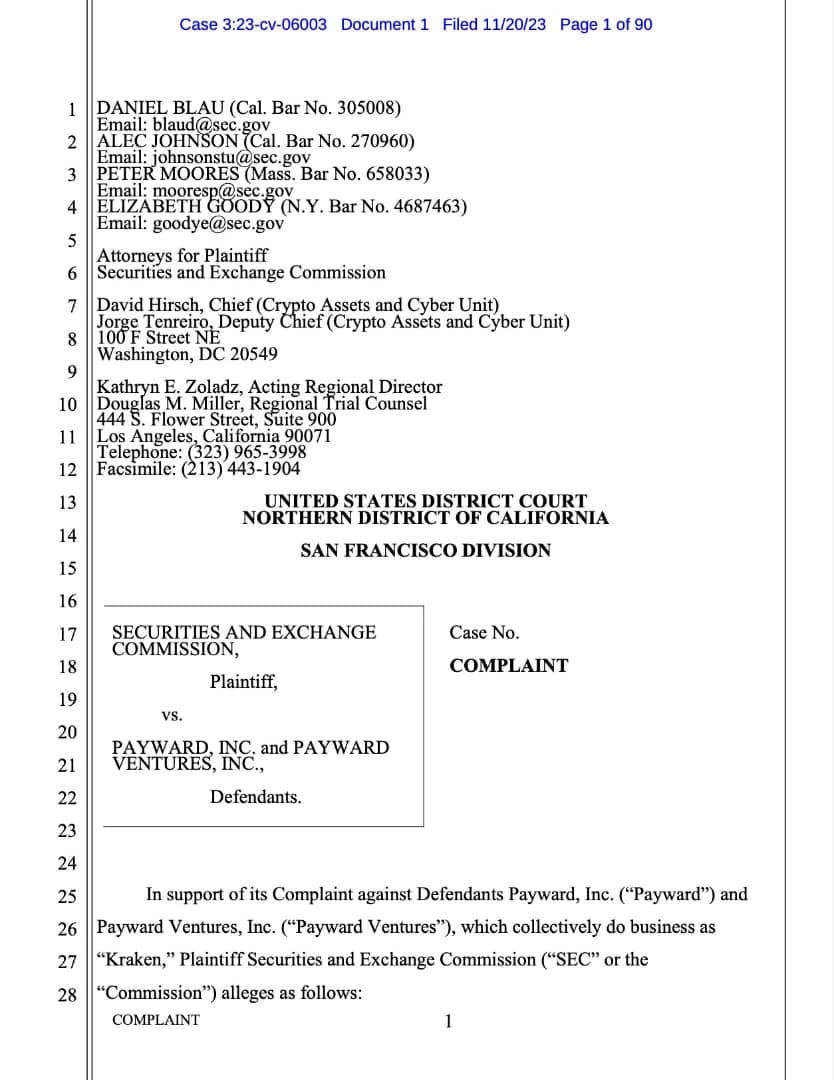
The Securities and Exchange Commission (SEC) has filed a lawsuit against Kraken, one of the largest cryptocurrency exchanges in the world, for allegedly violating federal securities laws. The SEC claims that Kraken operated as an unregistered securities exchange, broker, and dealer, and facilitated the trading of digital assets that are considered securities under the law.

According to the SEC’s complaint, Kraken offered trading services for more than 50 digital assets, including tokens that were issued through initial coin offerings (ICOs) and other fundraising schemes. The SEC alleges that some of these tokens were securities that required registration with the SEC or an exemption from registration. However, Kraken did not register as a securities exchange, broker, or dealer, nor did it seek an exemption or comply with any regulatory requirements.

The SEC also accuses Kraken of failing to implement adequate policies and procedures to prevent fraud, manipulation, and abuse in the digital asset market. The SEC alleges that Kraken did not conduct any due diligence on the digital assets it listed, nor did it verify the identity or suitability of its customers. The SEC claims that Kraken exposed investors to significant risks of losing their money and being defrauded by scammers and hackers.

The SEC is seeking a permanent injunction, disgorgement of ill-gotten gains, civil penalties, and other relief against Kraken and its owners and operators. The SEC warns investors to be cautious when dealing with unregistered platforms that offer trading services for digital assets.

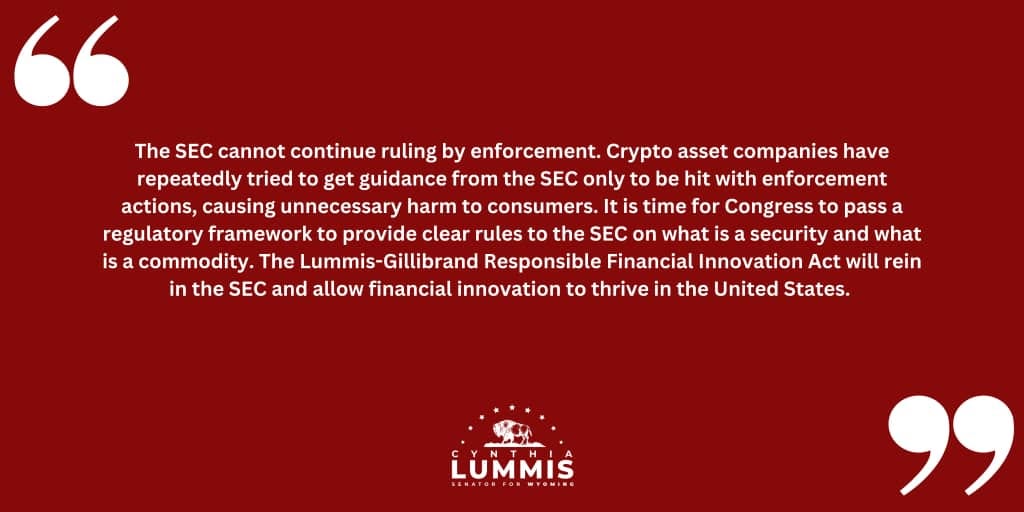
Senator Lummis wrote against Kraken’s suit by the SEC on X;

The Kraken lawsuit is a clear example of how the SEC is overstepping its authority and trying to regulate the crypto industry through intimidation and coercion. The SEC has no clear or consistent framework for determining what constitutes a security in the crypto space, and instead relies on vague and outdated guidance that does not reflect the innovation and diversity of this emerging sector. The SEC’s actions are harming not only the crypto companies and investors, but also the American economy and competitiveness.

As a senator and a crypto advocate, I strongly oppose the SEC’s approach and urge them to adopt a more constructive and collaborative attitude towards the crypto industry. The SEC should work with Congress and other stakeholders to develop a clear and sensible regulatory framework that fosters innovation, protects consumers, and respects the constitutional rights of all parties involved. The SEC should not use its enforcement powers to bully and harass the crypto industry, but rather to pursue actual fraud and misconduct.

The Kraken lawsuit is not only a legal battle, but also a political one. It is a test of whether the SEC will respect the will of the people and their elected representatives, or whether it will continue to act as an unelected and unaccountable bureaucracy that imposes its own agenda on the crypto industry. I stand with Kraken and the crypto community in this fight, and I will continue to use my voice and influence to defend our rights and freedoms in the face of the SEC’s overreach, Senator Lummis wrote.

The SEC claim its actions against Kraken Exchange is part of its ongoing efforts to protect investors and ensure compliance with the federal securities laws in the emerging and evolving digital asset space. The SEC has previously brought enforcement actions against other unregistered platforms that facilitated the trading of digital asset securities, such as Ether Delta, Bitqyck, BitConnect, and LBRY.

The Securities and Exchange Commission has charged the cryptocurrency firm Kraken with operating as an unregistered securities exchange, broker, dealer and clearing agency. It’s the latest suit in an SEC crackdown on crypto firms for violating U.S. securities laws. The agency has identified 16 tokens on the Kraken platform that it alleges are securities. It also accuses the company of mishandling customer funds, as well as inadequate internal controls and recordkeeping. Crypto exchanges have lobbiedfor industry-specific regulation, arguing that existing securities rules shouldn’t apply to cryptocurrencies.

Kraken’s chief legal officer said in a statement, “We disagree with the SEC’s complaint against Kraken, stand firm in our view that we do not list securities and plan to vigorously defend our position,” per Axios. The SEC has filed similar lawsuits against crypto trading giants Binance and Coinbase. Meanwhile, the Justice Department reportedly wants Binance to pay approximately $4 billion to resolve its probe into the world’s largest crypto exchange. (LinkedIn News)

Tokenized Real-world Assets Are More Than a Web3 Robinhood

If you are familiar with the concept of tokenization, you might think of it as a way to democratize access to financial markets and assets. By creating digital representations of real-world assets on the blockchain, tokenization allows anyone with an internet connection and a crypto wallet to invest in things like stocks, bonds, real estate, art, and more. This is similar to how platforms like Robinhood have enabled millions of retail investors to participate in the stock market with low fees and minimal barriers.

Tokenized real-world assets are digital representations of physical or intangible assets that are secured by blockchain technology. They allow for fractional ownership, increased liquidity, lower transaction costs, and greater transparency of the underlying assets. In this blog post, we will explore some of the benefits of tokenizing real-world assets and how they can create new opportunities for investors and asset owners.

However, tokenization is more than just a Web3 version of Robinhood. It is a paradigm shift that has the potential to transform the way we create, exchange, and manage value in the digital economy. Tokenization is not only about making existing assets more accessible and liquid, but also about creating new types of assets and value streams that were not possible before.

Tokenization enables the creation of fractional ownership rights for any asset, regardless of its size, value, or location. This means that investors can buy and sell fractions of an asset, rather than having to own it entirely. For example, someone could own a fraction of a painting by Picasso, a skyscraper in New York, or a share of Tesla, and benefit from its appreciation or income generation. Fractional ownership lowers the entry barriers for investors, increases the liquidity of assets, and creates more efficient markets.

Tokenization allows the embedding of smart contracts into the tokens that represent the assets. Smart contracts are self-executing agreements that can enforce the rules and conditions of the asset ownership and transfer. For example, a smart contract could automatically distribute dividends to token holders, execute buyback orders, or trigger payments based on certain events or milestones. Programmability adds functionality and flexibility to the assets and enables new business models and revenue streams.

Tokenization enables the integration and interoperability of different assets and platforms across the blockchain ecosystem. Tokens that follow common standards and protocols can be easily exchanged and composed with other tokens, creating new forms of value creation and exchange. For example, a tokenized real estate property could be used as collateral for a loan on a decentralized lending platform like Aave, or a tokenized art piece could be displayed in a virtual world or a metaverse like Decentraland.

Tokenization enhances the transparency and trustworthiness of the assets and their transactions. Tokens are recorded on a public and immutable ledger that can be verified by anyone at any time. This reduces the need for intermediaries and third-party verification services and eliminates fraud and manipulation.

Tokenization unlocks new possibilities for innovation and experimentation in the digital economy. By creating new types of assets and value streams, tokenization enables entrepreneurs and creators to explore new markets and niches, and to offer novel products and services to their customers.

What are the benefits of Tokenized real-world assets?

One of the main benefits of tokenizing real-world assets is that they enable fractional ownership, which means that an asset can be divided into smaller units or tokens that can be bought and sold by multiple investors. This lowers the barriers to entry for investing in high-value assets such as real estate, art, or collectibles, and allows for greater diversification and risk reduction. Fractional ownership also creates more liquidity in the market, as tokens can be traded more easily and quickly than traditional assets.

Another benefit of tokenizing real-world assets is that they reduce transaction costs and inefficiencies. By using smart contracts, which are self-executing agreements that are encoded on the blockchain, tokenized assets can automate the processes of verification, settlement, and compliance, eliminating the need for intermediaries such as brokers, lawyers, or regulators. This reduces the fees, delays, and errors that are often associated with transferring ownership of physical or intangible assets.

A third benefit of tokenizing real-world assets is that they increase transparency and trust among the parties involved. By using blockchain technology, which is a distributed ledger that records and verifies every transaction on the network, tokenized assets can provide a clear and immutable record of ownership, provenance, and performance of the underlying assets. This enhances the quality and reliability of the information available to investors and asset owners, and reduces the risks of fraud, manipulation, or disputes.

Tokenizing real-world assets can offer significant advantages over traditional forms of asset ownership and transfer. By enabling fractional ownership, increasing liquidity, lowering transaction costs, and improving transparency, tokenized real-world assets can create new possibilities for value creation and exchange in the digital economy. Tokenization also fosters collaboration and co-creation among different stakeholders in the blockchain space, as they can leverage each other’s assets and capabilities to create synergies and network effects.

Tokenization is more than a Web3 Robinhood. It is a powerful tool that can revolutionize the way we create, exchange, and manage value in the digital economy. Tokenization is not only about making existing assets more accessible and liquid, but also about creating new types of assets and value streams that were not possible before.

Changpeng Zhao Steps Down As Binance CEO

0

From LinkedIn News, this is the most current update:

Changpeng Zhao, the now-former CEO of Binance and one of the wealthiest and most influential figures in the cryptocurrency industry, pleaded guilty in federal court on Tuesday to a felony charge of violating U.S. money laundering rules. As part of the plea deal, which settles a yearslong investigation into Binance by the Justice Department, Zhao stepped down as head of the world’s largest crypto exchange and agreed to pay a $50 million fine. The Cayman Islands-based exchange also pleaded guilty to three separate criminal charges and agreed to pay fines totaling $4.3 billion.

  • Richard Teng, Binance’s former global head of regional markets, is the company’s new CEO. The government is seeking 18 months in prison for Zhao, whose sentencing hearing is scheduled for Feb. 23 but, per the Associated Press, will likely be delayed. According to an anonymous report from The Wall Street Journal, the plea deal allows Zhao to retain his majority stake but bars him from holding any executive roles at Binance, which will be allowed to continue operations.

In a surprising turn of events, Binance CEO Changpeng Zhao (CZ) appears that CZ is in talks with the board of directors to resign from his position as the head of the world’s largest cryptocurrency exchange. This comes after a long and tumultuous legal battle with several regulators and authorities across the globe, who accused Binance of facilitating money laundering, tax evasion, and other illicit activities through its platform.

CZ, who founded Binance in 2017 and led it to become a dominant force in the crypto industry, said that he is ready to step aside and let someone with more regulatory experience take over the helm. He said that he wants to focus on the innovation and development of the blockchain technology, rather than dealing with the constant regulatory pressures and scrutiny.

“I have always believed in the potential of blockchain and crypto to transform the world for the better. However, I also realize that with great power comes great responsibility. Binance has grown too big and too fast, and we have not been able to keep up with the evolving regulatory landscape.

I think it is time for me to pass on the torch to someone who can lead Binance to the next level of compliance and legitimacy, while I dedicate myself to the core mission of advancing the technology,” CZ said in a statement.

This announcement comes after a series of setbacks for Binance, which faced investigations and bans from several countries, including the US, UK, Japan, Germany, Italy, and Singapore. The exchange was accused of operating without proper licenses, offering unregistered securities, failing to implement adequate anti-money laundering and customer protection measures, and obstructing law enforcement inquiries.

Binance? CEO CZ pleads guilty to violating criminal anti-money laundering requirements.

According to the U.S. Department of Justice, Binance facilitated transactions involving illicit funds from criminal activities such as ransomware attacks, drug trafficking, and tax evasion. The DOJ also alleged that Binance deliberately ignored red flags and customer due diligence obligations, and even offered incentives to users who increased their trading volume regardless of the source of their funds.

As part of his plea agreement, CZ agreed to cooperate with the authorities and pay a hefty fine of $500 million. He also agreed to step down from his role as CEO and appoint a new leader who will oversee the compliance and governance of Binance. CZ expressed his regret and apologized for his actions, saying that he was unaware of the extent of the violations and that he trusted his team to handle the regulatory matters.

The plea deal marks a major blow to Binance, which has been under intense scrutiny from regulators around the world for its lax compliance standards and aggressive expansion strategy. The exchange has faced bans, warnings, and investigations in countries such as the UK, Japan, Germany, Canada, and Singapore. The future of Binance remains uncertain, as it faces potential lawsuits and sanctions from other jurisdictions and stakeholders.

The case also highlights the challenges and risks that the cryptocurrency industry faces in terms of regulation and oversight. While some argue that crypto offers a more decentralized and democratic alternative to the traditional financial system, others warn that it also enables criminal activities and undermines the rule of law. The balance between innovation and regulation is a delicate one, and one that requires more cooperation and dialogue between the industry and the authorities.

Binance has been trying to address these issues by hiring former regulators and compliance experts, launching new platforms that comply with local rules, and cooperating with authorities. However, these efforts have not been enough to appease the regulators, who have continued to crack down on Binance’s operations.

CZ said that he hopes that his departure will help Binance regain the trust and confidence of its customers, partners, and regulators. He also said that he will remain involved in Binance as an advisor and a shareholder, and that he will support the transition process.

“I am proud of what we have achieved at Binance in such a short span of time. We have built a global community of millions of users who share our vision of democratizing finance and empowering people. We have also contributed to the growth and innovation of the crypto ecosystem, by launching new products and services, supporting new projects and initiatives, and fostering education and adoption.

I am grateful for the support and feedback of our users, employees, investors, and partners. I am confident that Binance will continue to thrive under new leadership, and that we will overcome any challenges that come our way,” CZ said.

Africa Must Invest and Develop Boards of Directors

0

There is a realization: many companies in Africa struggle or fail primarily because of the quality of the Board. When wealthy people with limited knowledge capabilities in sectors control Boards, CEOs and executive management fade.

The case study of OpenAI and Sam Altman should challenge Africa’s Institute of Directors to invest more resources to develop Directors in the continent.  No company can rise above the capacities of its Board because Boards influence Executive Management.

As the men who orchestrated the own-goal coups in OpenAI apologize, we must understand that such do happen regularly across economies. With no media limelight, visions fade and companies collapse. OpenAI is lucky because it has a big profile; most firms do not, and collapse over time because Boards bolted.

Comment on Feed

Comment 1: Having a high-quality board is clearly crucial for any company’s success, including direct-to-consumer startups. Board members shape strategy and guide executive decisions.

For DTC founders and investors, prioritizing digital expertise on boards rather than just general business experience could make a big difference. As ecommerce scales, oversight on technology, marketing, data analytics etc. gets essential fast.

This reminds DTC leaders that everyone has blind spots – ourselves included.

Thanks Ndubuisi Ekekwe highlighting why board development merits more focus across sectors!

My Response: “For DTC founders and investors, prioritizing digital expertise on boards rather than just general business experience could make a big difference.” -indeed, domain experience is always important

Comment 2: Hi Nd, thanks for the submission! The concept and function of board membership is still highly undervalued, especially in Africa where it is deemed a honourary function.
Board membership should also be balanced across specialties, what I see in this instance is a composition of techies and funders, so to say. Well, it does not seem like we know the whole story yet, Let me grab my guguru and epa as the saga unfolds. Cheers.

My Response: “The concept and function of board membership is still highly undervalued, especially in Africa where it is deemed a honourary function.” – indeed with traditional rulers appointed to chair bluechip companies.

Comment 3: You’re right sir. Most board members of African companies are big belly rich men most of whom are politicians and understand nothing about risks and serious modern management issues. The same “either it’s my way or let everything scatter” approach they have used in African politics to stagnate African countries, that’s their approach in those boards.

OpenAI Investors Consider Suing the Board after firing Sam Altman amid 700 Staff Resigning

Returning of Bride Prices in Customary Marriages

0
Igbo traditional marriage

So there is this famous Instagram skit maker that was secretly married but many people had no idea that she is married because she has been posing as a single lady. The husband was the one managing her until she came into the limelight and became famous. 

Once she became famous and moved down to Lagos, she stated in her words that the husband was no longer on her level and that she was no longer interested in the marriage.

She started mingling and dating other famous Lagos-based entertainers; the husband cried and begged her for her to reconsider so that they could still make the marriage work but all the pleadings fell on deaf ears. 

The husband demanded that since she was no longer interested in marrying him and the marriage they did was customary marriage, she should return the bride price so that there could be some closure. The lady has been insisting that she will never return the bride price, reasons best known to her. 

The matter was recently brought to me for a legal opinion and here is my legal opinion on the issue of what is and will become of the marriage legally speaking since the lady has insisted on not returning the bride price. 

Customary marriage is recognized and acknowledged statutorily and the only valid way of entering into a valid customary marriage is by the payment of the bride price by the groom in accordance with the relevant cultural and traditional practices. 

Customary divorce is also recognized under the act and the only acknowledged way of dissolving a marriage customarily is by the returning of the bride price paid back to the groom. 

The court has upheld this custom of returning the bride price to validate a customary divorce in a plethora of cases. 

In the case of Eze v. Omeke (1977) 1 ANSLR 136 the Court while ordering the bride to return the bride price since she said she was no longer interested in the marriage held that “Any order dissolving any customary law marriage without a subsequent order for the return or acceptance of the bride-price or dowry is meaningless. In fact, I’m the case of Tabitha Bawa v. Bawa Waziri CCKJ/CV/14/2011 the Court did not just order the return of the bride price, the court also ordered the lady to return every other incidental pre-marital expense back to the man. 

Therefore, by the implication of court rulings, statutory provisions and acknowledged customary practices which has been judicially noticed, the returning of the bride price is what invalidates a customary marriage, so when the bride price is yet to be returned, the marriage is deemed to still be valid and existing and any of the parties who enters into another marriage can be held liable for bigamy. 

My legal advice to the famous entertainer here in question is for her to return the bride price since she is no longer interested in the marriage as the returning of the bride price will mean that the marriage has been dissolved, not until she does that, she is and will still be deemed to be the lawfully wedded wife of the man. 

Yet, read my perspective on this article as there are contradictions in the Nigerian laws.