DD
MM
YYYY

PAGES

DD
MM
YYYY

spot_img

PAGES

Home Blog Page 3994

How Many People Can Consumer Tech Monetize in Nigeria Right Now?

1

My old thesis (2018) was that despite having about 200 million citizens, Nigeria’s monetizable population for most tech services and products was about 30 million people. Yes, from most indicators, those were people who earned decent incomes to buy some tech services; food and healthcare covered the full population. Read here 

For most analyses, across industries, I like to work with 30 million people since that number is close to the total unique bank account users in Nigeria. Technically, anyone that does not have a bank account in Nigeria at the moment is largely poor. And when I do models for markets, for most products, I rely on this 30 million because those are the full market potential at the moment, unless the product is free or in some sectors like food. Most banks excluding First Bank which has about 14 million customers have lower than 10 million customers. That is not what you expect in a country of 180 million citizens. Yes, everyone is circling around 30 million people.”

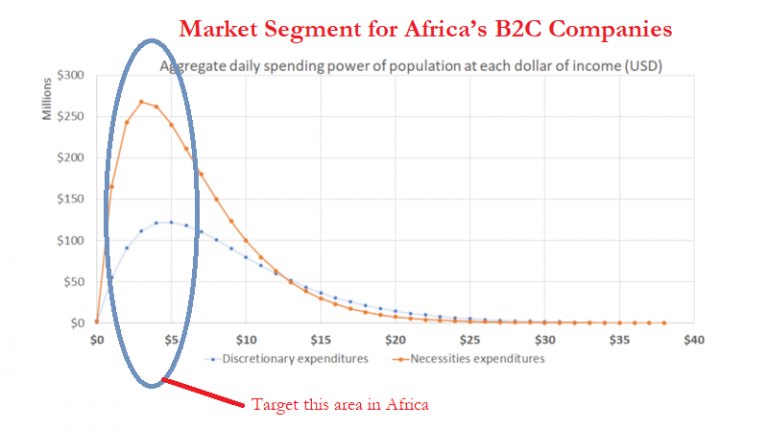
There was also the postulation that in B2C (business to consumer) products, the largest customer base falls within people who make between $4 to $8 per day:  “the most significant opportunity for African B2C startups lies with consumers who earn between $4 — $8 per day … This is largely because that income band holds the highest concentration of discretionary spending power on the continent, as the graph below shows.” Outside that range, capturing value becomes harder. Read here 
Now, the big question: what do you think the monetizable population is right now for most tech solutions in Nigeria? Greater than or lesser than 30 million? And WHY?

Comment on Feed

Comment on Feed

Comment 1: 30m for monetised market maybe ambitious Ndubuisi Ekekwe

My Response:  If you use the 41 million personal federal income payers, 30M is not that far away. Add state workers and SME owners, you can be hitting 60m. Discount by 50% as most are not up to decent income, to care about tech services, that 30m may even look low right now.

Comment 2: According to the data released by the Nigeria Inter-Bank Settlement System (NIBSS) in 2021, it showed that the number of active bank accounts in Nigeria increased to 133.4 million. (Nairametrics).
My only issue with the data is that we are far from reality in data analysis in Nigeria. However,
quite a number of them are only encouraged by the recent Fintech introduction like opay, palmpay etc.
Given the minimum wage of $35-$40 that we maintain in Nigeria at the current exchange rate and with less than 2% being able to save over N500,000.00 in their bank account, which shows that quite a large number of the population of bank users are living largely from hand to mouth especially in this crucial time when the savings we have is the one saving us.

Monetization of tech products may not work very well in Nigeria. Except for data consumption and some other few cheap and important products depending on the population preference.
Like you said, except for health and self development products, tech products will still largely have low patronage if monetized especially in this critical time where everyone is careful of spending.

Comment 3: Prof Ndubuisi, I do believe it’s higher. It should be about 55million because as of may this year BVN enrolment was at 57.4million according to CBN data. Therefore, most of these account owners can actually be reached with one sort of tech solution or another. From payments, to insurance, cheap communications mechanism, eCommerce, entertainment, edutainment, education, etc. Moreover why can’t we have a way of allowing people at scale to buy voucher and use it to make payment without need for bank account?
The Culpability and Liability of Influencers and Advertisers over a Product they Promote

0

Recently, a popular social media influencer who happens to be my client was engaged by a company to promote their product on his social media platforms. The company is into an online investment scheme where individuals are to invest and earn a particular percentage as a return on their investments within a particular time. The investment platform ended up being a Ponzi scheme: the platform subsequently crashed and the later investors lost all their money. The owners of the platform, as expected, disappeared and were nowhere to be found.

Since the owners of the platform were on the run, the investors decided to hold my client responsible and as a person of contact for their loss. They asked my client to refund them the money they lost which is running into several hundreds of millions or that my client should provide them with the owners of the platform. 

The investors claimed that they only got into the platform because my client being a person they trusted promoted and influenced the platform and he gave his word that the platform is legit as he has invested in the platform and he is cashing out. 

In our defense, our client claimed that he is not responsible for their loss, that he was merely engaged by the company as an influencer to promote the product for them, a task which he executed and nothing more. 

Scenarios like these keep playing out between advertisers/ influencers/promoters and users and the question has been, the culpability of an influencer or advertiser over a product he promoted which turns out to be a fake product or a scam or to what extent is an advertiser or an influencer liable or culpable in an instance like this?.

Rulings of the court have always been that Advertisers or influencers are ultimately responsible for the content of the adverts they shared and promoted and they are liable or culpable for any damage such advert caused or will cause. 

This rule notwithstanding, there are ways an influencer or an advertiser can limit his culpability or liability. 

An advertiser or a media house or an influencer promoting a product on their platforms must use a caption like; sponsored post, ad, branded post or paid partnership etc, this will serve as a caveat or a disclaimer to the general public that it is advertisement hence limiting your liabilities if the product you are advertising ends up failing or ended up a scam. Although these disclaiming captions won’t make you totally not guilty of the bad advertisement but will make you less guilty by only limiting how much responsible you are for the damages the content of your advertisement caused. 

As an influencer, you should also not use the words like “I have used the product and it worked”, if you haven’t used the product as that will amount to lies and deception and you will be held culpable by a user who took your words and used the product and it fails. You must let your followers know how much you know about the products and if you have tested or used them or not. 

You are therefore expected to do your due diligence on a product that you are contracted to influence or promote on your platform because no matter the caption you used as a caveat or disclaimer while promoting that product on your platform, it will not make you totally not guilty in the event of failure of the product. If the product ends up being an illegal or criminal product, you can be held culpable for promoting criminal activities or being complicit in the commission of a crime or aiding and abetting the commission of the crime by promoting it. Hence why you are expected to do your due diligence before accepting to promote any product on your platform 

In summary, if you want not to be held totally responsible by the law as a complicit, as an advertiser, a promoter or an influencer, you are expected to use any of these captions; ad, sponsored post, promoted, branded post, paid partnership or their likes, and you are also expected not to lie or overtly bluff about the product to your followers. You are not to use words that will overtly convince or persuade your followers or listeners, all you need is to put it out there letting your followers know that it is a branded post and let them make up their minds by themselves if they would patronize the product or not. 

Please note that no matter the procedure you follow or the disclaimer you put out, it does not slap all the liabilities off you but it limits how much liable you are in the event of the product failing or ending up being a fraud that is why you are expected to only promote and advertise products you trust and believe in. 

How Fintechs Are Leveraging Cutting-Edge Technology to Revolutionize Personal Finance

0

The evolution of Fintechs across several nations of the world has no doubt transformed the landscape of money transfer and international remittances, which has seen people around the globe choose FinTech services over any other.

With the advent of these Fintechs, there has been a gradual shift from the traditional banking system to online banking, which has brought about a major change in how money is transferred and received.

Leveraging cutting-edge technologies, while several of these Fintechs have launched to ensure the seamless transfer and receiving of funds, one notable thing about their emergence is how it has brought about a major improvement in personal finance.

Following the roll-out of innovative platforms that can be accessed directly from a smartphone or tablet, it has become easier than ever for individuals to create and track their budgets in real-time.

These startups have changed the game by offering user-friendly platforms that allow individuals to take control of their financial lives, which has also made budgeting very easy for them.

Unlike traditional banks that often send financial statements at the end of the month, most Fintechs track users spending and give them regular updates on their financial records.

These platforms analyze users’ financial data and provide insights, budgeting tools, and investment recommendations tailored to their specific needs. By offering personalized financial guidance, individuals are forced to make informed decisions and achieve their financial goals. This has reportedly impacted users spending habits as well.

Another area where Fintechs are revolutionizing personal finance is in the area of security. Traditional payment methods such as cash and checks are being replaced by digital alternatives that offer greater convenience and security.

These startups prioritize the security of financial transactions by implementing robust encryption techniques, multi-factor authentication, and advanced fraud detection systems. They comply with industry regulations and work closely with regulatory bodies to ensure the safety of user data and transactions.

In the area of loans, because traditional loan approval processes can be time-consuming and cumbersome, Fintech startups have revolutionized this process by leveraging technology to streamline loan applications and approvals.

Through online lending platforms, borrowers can submit their applications and receive loan approvals within minutes, significantly reducing the waiting time compared to traditional banks.

Notably, knowing full well that saving money and investing wisely are crucial aspects of personal finance, this has seen the rollout of more than a dozen reputable savings, investing, and budgeting apps, now available for individuals to save their money and grow their wealth.

These apps have saved individuals the stress of going to the banking halls, to just saving money from the comfort of their homes

Some of these savings apps are;

1.) Piggyvest:

Formerly called Piggybank. This platform was the first to blaze the trail for online savings platforms in Nigeria. Its flexibility allows anyone to custom save daily, weekly, or monthly depending on their preference.

Users can save towards a specific target or choose to place a withdrawal restriction on the account. There is a limit to the amount that can be saved on one’s account at a time.

2.) Cowrywise:

One of the best online savings platforms in Nigeria. Cowrywise not only gives higher interest rates, but users can also access investment plans on the platform.

A high saving score increases the chances of getting a loan on CowryWise. Interest on savings is paid daily.

Its saving option and interest are different from other savings platforms. With the main aim of helping users achieve financial freedom. The app helps users to save money using the periodic savings plan which enables them to save daily, and monthly with 10% interest per annum.

3.) ALAT by Wema Bank:

The first fully digital banking experience, ALAT by WEMA, not only offers basic banking services but is also one of the online savings platforms in Nigeria that offers a very good interest rate.

The bank’s debit card is delivered to the account holder’s address at no cost. As with traditional banks, ALAT charges a monthly debit card maintenance fee. The interest of 4.2% is on the condition that an account holder does not withdraw more than 3 times a month.

ALAT has some saving plans that offer up to 10%; one of them allows withdrawal of 50% of savings once every 30 days while another doesn’t allow withdrawal.

4.) Carbon:

Formerly Paylater which just offered collateral-free loans in Nigeria, Carbon has now transitioned into a digital bank in Nigeria that offers multiple banking services.

Carbon offers savings plans that are suitable for anyone in Nigeria. With Carbon, you can also create a bank account, create physical debit cards, and virtual cards in Nigeria. You can also make payments from the Carbon app, keep track of your credit history with the free carbon credit report and also access loans too.

Apart from the fact that Fintechs play a pivotal role in managing individuals’ finance, they have also been helpful in the management of companies’ finances.

These startups help businesses streamline their financial processes, by providing them with real-time financial data and insights that help them make better decisions.

Some of these apps can automatically categorize transactions and create financial reports, which reduces the risk of errors. They also enable businesses to track expenses, disburse payments, create spending accounts with approved limits, and several others.

By accurately tracking a business’ finances, entrepreneurs can avoid unnecessary or unproductive spending and possibly improve profitability in the long run.

Conclusion

The emergence of Fintech apps has come a long way in not just enabling seamless transfer and receiving of funds, it has also enhanced how individuals and businesses manage money.

These startups are democratizing investment opportunities, making it easier for individuals to grow their wealth. While these startups have disrupted the financial industry, they have also complemented traditional banking services by offering innovative and user-friendly alternatives.

As fintech continues to evolve, we can only anticipate more innovative solutions that revolutionize money management and make financial well-being accessible to all.

How Strategic Leaders Can Unleash Creativity and Innovation Leveraging the Power of Focus

0

American writer and psychologist, Daniel Goleman, brought a paradigm shift to the meaning and use of emotions, particularly in leadership and strategic management through his self-definitive work and best seller, ‘’Emotional intelligence: why it can matter more than IQ’’. His more recent work, ‘’Focus: the hidden driver of excellence’’ focuses on how strategic leaders and corporate organizations can navigate distractions, leveraging the matrix of emotional intelligence. Adopting concepts such as self-awareness, empathy and social intelligence from his previous work, Goleman reflects on how focus can be practiced at the different levels of social relation and organizational development.

The time to practice focus is now. The continuing digital revolution and its consequent information bubble on the internet have made it difficult for an average worker to focus or pay attention to details. Distraction is a reality for the individual as much it is for the corporate organization. An average worker is said to be distracted every 4-8 minutes for an average of 8-12 minutes. Therefore, embracing practices that improve focus is advocated for organizations to improve work performance and organizational efficiency.

Focus, simply put, is the act of directing and concentrating the self (both the mind and the body) towards the achievement of a particular goal. In an organisation context, focus may be described as the concentration of resources towards the execution of a plan or strategy that is expected to result in the organisation’s growth. The design and execution of a business model in itself implies focus in action.

The types of Focus

Goleman identified three types of focus, namely; Inner, Other and Outer focus.

Inner Focus: This entails self-awareness or ability to understand one’s thoughts and feelings, and leveraging same for personal or social benefits
Other Focus: This entails empathy or ability to understand other people’s thoughts and feelings, and leveraging the same for personal or social benefits.
Outer Focus: This entails system consciousness or ability to understand the complex web of environmental factors that affect or shape one’s realities.

At the corporate level, the ability to integrate these variants of focus can determine one’s progression through the corporate ladder. In fact, the survivability and the sustainability of a business derive from the combination of the inner, other and outer focus. In Goleman’s word, ‘’a well focused leader is one that balances an inner focus on the climate and culture with an  ‘’other focus’’ on the competitive landscape, and outer focus on the larger realities that shape the environment the outfit operates in.’’

Focus as the bedrock of innovation and creativity.

Creativity and innovation are constructive and demanding endearvours, requiring no meagre focus. According to Goleman, creativity and innovation are a function of the intertwined workings of creative intelligence and executive intelligence.

Creative Intelligence Vs Executive Intelligence

Creative intelligence is the hub of ideas found in the subcortical cortex of the brain or the subconscious mind. The creative intelligence can be unleashed and developed by recurrent exercising of the executive intelligence. This means that persistent practice actually leads to creativity. And this is why experts often advise people to consistently do what they love in order to unleash the creative intelligence in them.

The executive intelligence on the other hand drives conscious or effortful action, and the seat of this intelligence is the prefrontal cortex. Since the conscious mind is only short-lived with an attention span ranging between 10 -15 seconds, impressions on it can be held down or controlled through a nerve force popularly known as the will-power. The will-power is therefore the nucleus or basis of executive intelligence. Because the conscious mind is wired to be lazy, the will-power exists to goad it to action.

Without executive intelligence, the creative intelligence will produce little more than a day-dreaming effect. Also, without the creative intelligence, the executive intelligence will be directionless. Using the myth of the 10 thousand hours rule, Goleman makes a case of how the two types of intelligence work in sync. Thus, in a world full of distractions, a creative and innovative mind is one adept at exercising will-power.

The Bottom-up Vs Top-down Brain

The human brain has two systems, namely; bottom-up and top-down. The bottom-up system is the earliest brain developed in ancient man. It helps with basic survival skills such as eating, sensing danger and fight or flight. This brain is intuitive, involuntary and automatic. It is driven by emotions.

The top-down brain on the other hand is the mental activity mostly within the neocortex that can monitor and impose its goals on the bottom-up mind. The top-down brain evolved much later on (hundreds of thousands of years down the evolution of man) and adds talents like self awareness, reflection. It is slower, voluntary and effortful and rational rather than emotional. While we are conscious and are doing mentally demanding tasks, we are using the top-down system. But the mind can wander off and switch to bottom-up which usually helps us incubate ideas and spurs our creativity.

What Strategic Leaders should do

Give enough time for ideas to incubate: In a highly dynamic business climate where agility is highly desirable, the thought of taking things slow generally seems contradictory. However, some leaders have realized in the hard way that success does not necessarily answer to speed; rather, success answers to velocity which is speed + direction. Mostly, latching on to the direction to thread or run your ideas takes more time than the time taken for the initial conception or spark of the idea.

Constantly reflect and re-imagine the organisational values: Working with the grand purpose in mind ensures originality and definiteness of creativity. Strategy implementation must be anchored on the value proposition. Although, at some point, strategies may need to be adjusted based on the existing market realities, making reference to the original plan, ensures one does not veer too far off the line.

Encourage Open interaction and Brainstorming: Allowing members the liberty to express their feelings and thoughts without the fear of gaffing and being persecuted invariably generates a glimmer of wonderful ideas or what may be termed as honest creativity. It also allows the leader to see through the formal climate and uncover the informal condition that affects work and employee productivity; the leader is able to inquire into the inner desires and troubles of his subordinates and provide viable solutions to them.

Diversity and Inclusion: Having a heterogeneous or mixed team is highly desired to have a well rounded perspective and develop solutions that can significantly impact lives.

Use selective attention: The management understands and focuses only on the unique strengths and values of the organization in its prevailing competitive landscape. This helps the management to sift through the market noises and avoid waste of resources.


Resources:

Daniel Goleman. 2013. Focus: The Hidden Driver of Excellence. HarperCollins Publishers

Fintech Companies Urge For A Review Regarding Hidden Bank Fees For International Payment

0

Fintech companies in London, numbering up to fifteen have come together to urge for a review of legislation regarding hidden bank fees for international payments.

In an open letter to Chancellor of the Exchequer, Jeremy Hunt, these fintech startups alleged that consumers and Small and medium enterprises (SMEs) in the UK lost a total of £5.6 billion in 2022, mostly in hidden fees charges.

They further expressed concern about why the legislation still permits most financial providers to continue to earn profits majorly from hidden fees, which they describe as a misleading and unhealthy practice.

Part of the letter reads,

“There is widespread practice of firms showing currency conversion services as having ‘zero fees’ or ‘0% commission. This is highly misleading when a much larger charge is embedded in the exchange rate, ranging from 2.5% – 3.7% over the mid-market rate for a transfer to EUR or USD with a UK high street bank, but this is never communicated to the customer.”

These startups are calling for a stop to hidden fees, noting that burying additional costs in inflated exchange rates and labeling them as zero few is hurting the finances of people and businesses across the U.K.

They alleged that the UK’s major banks are overcharging and undeserving their SME customers, failing to give them the knowledge, transparency, and visibility they need to make an intelligent and informed decision.

This lack of transparency according to the fintechs is not only unfair and uncompetitive but is also costing the UK’s SMEs precious cash in unnecessary fees.

They, therefore, urged Chancellor Hunt to address the issue in the country’s payment services regulation review.

They made five (5) demands which include;

1.) The total cost of currency conversions needs to be shown upfront to consumers and SMEs before they make a payment.

2.) The legal definition of a currency conversion charge should include any markup over the mid-market rate.

3.) Firms must use an aggregated mid-market rate issued by a neutral provider (e.g. Bloomberg, Refinitiv, New Change FX), which is approved by the Financial Conduct Authority (FCA) as an official mid-market rate provider.

4.) These rules need to apply to global currency conversions to support Global Britain, and not just to EU currencies.

While the evolution of fintech has allowed both individuals and businesses to send their money across the world quickly and safely, the traditional methods of making global payments online are still plagued with the prevalence of hidden fees.

This highlights the lack of transparency by banks around the fees they charge individuals and SME’s, and how these fees are calculated.

Research shows that most consumers are unaware of hidden bank fees on remittances, which have seen billions lost on transfers annually due to fees and exchange markups.

Consumers often think that they are paying an upfront fee only, but what they do not understand is that these banks leverage currency exchange rates to make money.

While all international payments are subject to an exchange fee, some banks implement additional hidden markups and spending charges to remittances to widen their profit margin.

In the UK, a 2016 report disclosed that banks charge SMEs £4bn in hidden international money transfer costs each year, with over 96% of the costs hidden in the exchange rate.

This hidden charge is in addition to the upfront fee that banks disclose when making a transfer. Including fixed fees, the most expensive bank makes 3.70% on any transfer and the cheapest makes 1.14% for transfers over £100k.

For individuals and businesses who frequently make international money transfers, these hidden fees have negatively impacted their finances.

Without complete service transparency and a full breakdown of pricing, transactional fees, and exchange rates involved, it has become difficult to know which financial institution to trust.