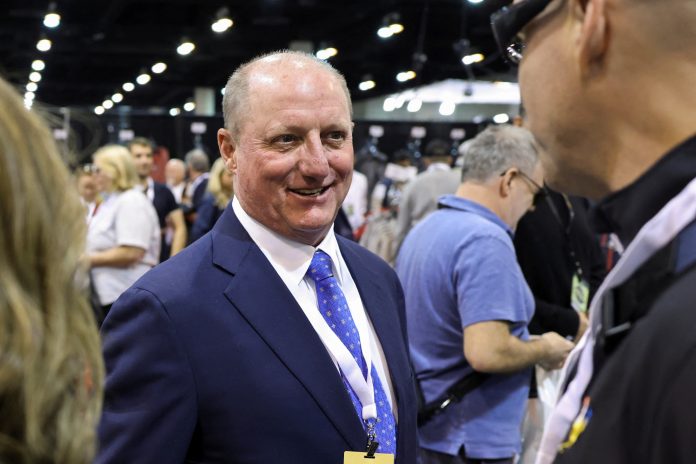
FIFA President Gianni Infantino has suffered the most significant political setback of his decade-long leadership after abandoning a controversial plan to sell a stake in the commercial operations of the FIFA World Cup, a dramatic reversal that has exposed deep divisions within world football and cast fresh uncertainty over his bid for another term in office.
The collapse of the proposal, which came after an extraordinary backlash from football’s most powerful governing bodies, marks the first time Infantino has been forced to retreat on a flagship initiative under coordinated pressure from multiple continental confederations. It also raises broader questions about FIFA’s governance, consultation process and the limits of the president’s authority despite overseeing the governing body’s strongest financial period.
In a statement issued on Friday, FIFA confirmed it was withdrawing plans to establish a separate commercial entity that would have managed the World Cup and other major tournaments, with a proposed 20% stake to be sold to private equity investors.
A statement from Infantino in the early hours of Saturday read: “The FIFA Forward Enterprise project was intended to provide a basis for further strengthening our FIFA member associations and our sport worldwide, especially in those countries where support is most needed.
“And more so, as we said from the outset, to do this only if a majority of the FIFA member associations were in support and always subject to a consultation process with them, the FIFA Council, the confederations and wider stakeholders.
“Having listened carefully to all the views, it has become clear that the project has created divisions of a nature that, regardless of the level of support, are no longer in the interest of the objective set out in the first place. Our purpose has always been – and will always be – to unite and improve.
“As a result, this proposal will not proceed. Moving forward, my intent is to bring all interested parties back together in the coming days and weeks in the spirit of shared interest in our game, and with the objective to continue growing football everywhere, particularly in those countries that mostly need our support.”
The concession effectively ended three days of intense conflict within global football that culminated in UEFA threatening to boycott FIFA events unless the proposal was abandoned.
The plan had been one of Infantino’s most ambitious commercial initiatives, coming less than two weeks after FIFA staged what it described as its most financially successful World Cup.
Political Standing Weakened
Until this week, Infantino had appeared firmly in control of FIFA’s political landscape. His stewardship of record-breaking revenues and expanded World Cup competitions had positioned him as the overwhelming favorite to secure a fourth presidential term at the FIFA Congress in Morocco next March, with no credible challenger having emerged, according to Reuters.
That political certainty has now been shaken.
“A week ago, Infantino’s riding high and was almost certain to get elected overwhelmingly because he’s run against such a financially successful tournament,” Victor Matheson, professor of economics at the College of the Holy Cross in Massachusetts, told Reuters.
“That’s all in jeopardy now.”
The failed proposal has transformed what looked like a routine re-election into what could become FIFA’s most competitive presidential contest since Infantino succeeded Sepp Blatter in 2016 following FIFA’s corruption crisis.
Several football administrators now expect rival candidates to enter the race after the controversy exposed growing dissatisfaction with Infantino’s leadership style and decision-making process.
Resistance to the proposal extended well beyond Europe.
UEFA, widely regarded as FIFA’s most influential confederation because of its commercial strength and sporting influence, led the opposition by threatening to boycott FIFA competitions.
That stance was subsequently reinforced by the Asian Football Confederation, which publicly backed UEFA and CONCACAF.
“The AFC stands in solidarity with UEFA and CONCACAF in expressing serious concerns over FIFA’s proposal to introduce private investment into FIFA’s flagship competitions,” the confederation said.
Representing 47 member associations, including Australia, China, Japan and Saudi Arabia, the AFC warned that the mere prospect of a World Cup boycott demonstrated the seriousness of the crisis.
“The fact that the situation has reached the point where the real possibility of a FIFA World Cup boycott has entered public discourse should concern everyone who cares about the future of our game.”
The united front from multiple continental confederations represented one of the strongest institutional challenges Infantino has faced during his presidency.
The controversy also exposed rare public disagreement within FIFA’s senior leadership.
After FIFA defended the proposal by arguing it would unlock billions of dollars in additional funding for national football associations, several senior figures publicly distanced themselves from the initiative.
Senior adviser Carlos Cordeiro resigned, describing the proposal as “a bad deal for football.”
Chief Operating Officer Kevin Lamour reportedly accused Infantino of misleading FIFA staff and characterized the project as “a project of one person.”
Those public criticisms are significant because Infantino has generally maintained tight control over FIFA’s executive structure throughout his presidency.
Sources familiar with FIFA’s internal operations told Reuters that the Swiss administrator has often frustrated colleagues through an independent leadership style, although his ability to generate record revenues had previously allowed him to overcome internal opposition.
Familiar Strategy Fails
The setback contrasts with previous controversies that Infantino managed to survive.
In 2018, he abandoned plans for a $25 billion private investment vehicle linked to the Club World Cup after opposition from UEFA.
He also weathered sustained criticism surrounding Qatar’s hosting of the 2022 FIFA World Cup, including widespread scrutiny of his defense of the tournament and controversial public remarks made before the competition.
This week’s proposal, however, appears to have failed because key stakeholders said they were not consulted before FIFA announced the initiative.
According to Reuters, many football officials first learned of the proposal after details leaked to the media, fueling accusations that FIFA had bypassed its traditional governance processes.
The controversy intensified after reports that Infantino had selected Thrive Capital, the investment firm founded by Joshua Kushner, to lead the proposed investor group.
Trump Links Add Political Dimension
The involvement of Thrive Capital also drew attention because of Infantino’s close relationship with U.S. President Donald Trump. The relationship has attracted scrutiny since FIFA awarded Trump its inaugural Peace Prize last December.
Former FIFA vice-president Jim Boyce suggested Infantino’s growing proximity to political power may have influenced his leadership approach.
“I think what has happened here is that fame appears to have gone a little bit to Gianni’s head and his relationship with Donald Trump during that World Cup is nothing more than astounding,” Boyce told the BBC.
Questions about political influence also resurfaced after Trump publicly revealed during the World Cup that he had asked Infantino to overturn the suspension of U.S. forward Folarin Balogun following a red card.
Although Balogun was ultimately cleared to play by FIFA’s independent disciplinary body, the episode fueled criticism over the perceived closeness between FIFA’s leadership and the White House.
Sports marketing analyst Bob Dorfman said the Kushner connection compounded those concerns.
“It didn’t help that you had a Kushner involved in this whole thing,” Dorfman told Reuters.
“Especially what was going on during the World Cup with Balogun and Trump. To have a Trump relative involved in this only made the whole thing much worse.”
Trump said Friday that he did not discuss the proposed World Cup stake sale with Infantino.
Re-Election Battle Becomes Less Certain
Despite the political damage, analysts caution that it may be premature to conclude that Infantino’s presidency is nearing its end. His proposal was partly designed to generate additional funding for FIFA’s 211 member associations, many of which rely heavily on financial support distributed by FIFA and have benefited from increased development funding under his leadership.
Those national federations, rather than UEFA or other continental bodies, will ultimately determine the outcome of the presidential election.
To secure another four-year term through 2031, Infantino would need a two-thirds majority in the first round of voting or a simple majority in subsequent rounds.
Dorfman believes the FIFA president could still recover politically if he acknowledges mistakes made during the process.
“I know that’s not in his manner to do things like that but maybe he has to start apologising a little bit and say: ‘Maybe I handled this wrong’.”
Like this:
Like Loading...