
DD
MM
YYYY

PAGES

DD
MM
YYYY

spot_img

PAGES

Home Blog Page 4

SpaceX’s Earnings Reveal the True Cost of Building an AI Infrastructure Giant

0

SpaceX’s first financial results since its June Nasdaq IPO sent a mixed signal to the market. The company delivered impressive growth, but continued to post losses amid an unprecedented level of investment.

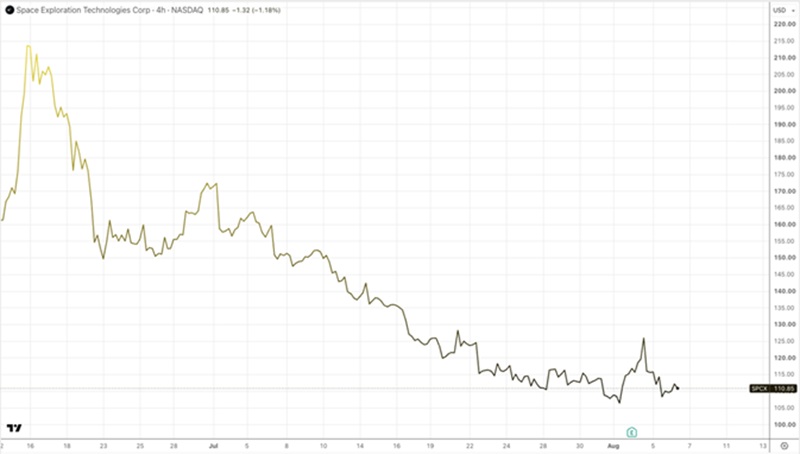
It was the scale of capital expenditures, not the revenue dynamics, that became the main factor putting pressure on the stock. After the report was published, the SpaceX stock chart showed a 10% increase, but those gains were quickly erased.

In the second quarter, SpaceX’s revenue grew by 92% year?on?year, reaching $7.8 billion. However, capital expenditures surged more than sixfold to $18.4 billion, significantly exceeding analysts’ consensus estimate of $11.2 billion. About 80% of these expenses were related to the development of AI infrastructure after the merger of SpaceX with xAI.

The company’s main source of revenue remains unchanged — Starlink satellite internet. Revenue from the telecommunications division grew by 66% to $4.3 billion, and operating profit reached $1.66 billion. In just one quarter, the service attracted a record 1.7 million new users, increasing its subscriber base to 12 million people. At the same time, the average monthly revenue per customer remained at $66, despite the recent price increase.

The aerospace segment looks quite different. Despite 29% revenue growth to $962 million, it ended the quarter with an operating loss of $542 million. SpaceX is directing more and more resources to its own projects, primarily Starlink. While in 2020 about half of Falcon 9 launches were for the company’s satellites, that share has now approached 80%. Commercial customers are already facing a shortage of launch slots, with virtually none available until 2028–2029.
The economic logic behind this strategy is clear. Each additional Starlink satellite launch can generate significantly higher long?term profits for SpaceX than fulfilling a third?party commercial order. Even now, the satellite network accounts for about 60% of the company’s total revenue, while the traditional space business accounts for a smaller share.

The AI segment is expanding just as aggressively. Its revenue grew by 247% to $2.6 billion, although the division remains deeply unprofitable. Most of its revenue comes from renting out computing power. In the quarter, the company secured contracts for computing capacity worth $14.1 billion, but under accounting rules, only $1.6 billion was recognized as revenue.

Elon Musk stated that by the end of the year, SpaceX will have more than 2 GW of computing capacity, compared to the current 1.4 GW, and by the end of next year, this figure could reach 15-20 GW. All new data centers will be built exclusively on the Nvidia Vera Rubin architecture, which the company’s CEO described as the best platform for AI development.

At the same time, SpaceX’s investments are not limited to building computing infrastructure. The company is gradually transforming Starlink from a purely satellite network into a full?fledged mobile operator. SpaceX President Gwynne Shotwell confirmed plans to create ground infrastructure that will support the rollout of its Starlink Mobile service, allowing the company to compete directly with the largest American telecommunications operators. This network will be deployed gradually using existing Starlink facilities, which should help contain additional capital spending.

The next stage in the network’s development will be the introduction of Starlink V3 satellites. The company plans to deploy them into orbit during the 14th Starship test flight. The new generation of satellites will provide gigabit data transfer speeds, but to fully roll out the service, it will be necessary to build a constellation of approximately 1,000 V3 satellites, a target SpaceX expects to reach in the second quarter of next year.

Despite the record revenue, SpaceX’s net loss for the quarter amounted to $541 million. Nevertheless, this was less than half the loss recorded a year earlier. The company ended the quarter with $100 billion in cash and highly liquid assets, and contracted future revenue reached $47.5 billion.

For investors, the main question is not about current profits, but about SpaceX’s ability to turn large?scale investments into sustainable cash flow. So far, the market is cautiously assessing such an aggressive development strategy, but if the company manages to simultaneously scale Starlink, maintain its leadership in space launches, and bring its AI business to self?sufficiency, today’s investments could become the foundation for the next stage of growth in its market capitalization.


The Growing Importance of Precious Metals in Africa’s Economic Future

0

Africa has supplied precious metals to the world for generations, but their economic role is beginning to change. Gold, silver, platinum, and related metals could become more important not only as exports, but also as building blocks for investment, manufacturing, infrastructure, and broader economic development.

More Than a Source of Raw Materials

For much of modern history, Africa’s mining relationship with the rest of the world has followed a familiar pattern: minerals are extracted locally and shipped elsewhere for processing. The producing country earns export revenue, but much of the higher-value economic activity happens abroad.

That model is increasingly being questioned. Global interest in metals has grown alongside investment in renewable energy, electronics, electric vehicles, data centers, and advanced manufacturing. Precious metals have a place in many of these industries, giving African producers an opportunity to rethink what mining can contribute to their economies.

The conversation is also influenced by changing commodity markets. Investors following a silver price prediction, for example, may focus mainly on whether the metal could rise or fall. For an African country with mineral resources, however, the bigger issue is what happens before that silver reaches the global market. Mining, refining, transportation, financing, and manufacturing can each generate economic activity.

The real opportunity, therefore, may be less about selling more metal and more about capturing a greater share of its value.

Gold Remains an Important Economic Asset

Gold continues to occupy a special position across Africa. Countries including Ghana, South Africa, Mali, Tanzania, and Burkina Faso have significant gold industries, while exploration continues in other parts of the continent.

Gold can provide governments with export earnings and tax revenue while supporting thousands of direct and indirect jobs. Mining operations also require transportation, engineering, security, equipment, financial services, and other local suppliers.

There is another reason gold matters. Unlike metals that depend heavily on a single industrial application, gold attracts demand from several directions. It is used in jewelry and technology, while investors and central banks also hold it as a financial asset. This gives gold a distinctive role within the broader commodities market.

Still, simply having gold underground does not guarantee widespread prosperity. The economic impact depends heavily on how projects are managed and how revenues are used.

Platinum Could Gain New Strategic Value

Southern Africa has an especially strong position in platinum-group metals. South Africa holds an exceptionally large share of global platinum resources, making the region difficult to ignore in discussions about future metal supply.

Platinum is associated with automotive catalysts, but its uses extend into chemicals, electronics, medical equipment, and other industrial applications. It could also play a role in technologies connected with hydrogen production and fuel cells.

This creates both an opportunity and a challenge. Demand patterns can change as technology evolves. African economies that depend heavily on exporting one mineral can therefore be exposed when industries shift or commodity prices decline.

Building industries around minerals rather than depending entirely on their extraction could help reduce that vulnerability.

Processing Could Make the Bigger Difference

One of the central questions for Africa’s economic future is where minerals are processed.

Shipping unprocessed material abroad usually captures only part of the potential economic value. Refining and processing metals domestically can support skilled employment, industrial investment, technical knowledge, and local supplier networks. The International Energy Agency estimates that Africa currently captures less than 1% of the value generated from manufacturing clean-energy technologies and their components, despite its major role in supplying several important minerals.

Changing this situation will not happen simply by building more mines. Reliable electricity, transportation links, ports, skilled workers, financing, and predictable regulation are all necessary if countries want companies to invest further down the value chain.

Regional cooperation could matter as well. Instead of every country attempting to build a complete industry independently, neighboring economies could specialize in different parts of production and trade with one another.

Mining Can Support Wider Development

Large mining projects often require infrastructure that can benefit industries beyond mining itself. Roads, railways, electricity networks, water systems, and ports built partly to support mineral production may also lower costs for manufacturers, farmers, and other businesses.

The same principle applies to human capital. A more sophisticated mining and metals industry requires geologists, engineers, technicians, software specialists, financial professionals, and skilled tradespeople. Developing these capabilities can create knowledge that eventually spreads into other parts of the economy.

There are risks, of course. Poor environmental practices, corruption, unstable regulations, and excessive dependence on commodity exports can weaken the benefits of mineral wealth. Governments also have to balance attracting investment with ensuring that communities and national economies receive a reasonable share of the returns.

A Chance to Build Around Africa’s Natural Advantage

Africa’s mineral resources give the continent an important position at a time when global supply chains are being reconsidered. The World Bank has highlighted the potential for mineral development to encourage investment not only in extraction, but also in processing, infrastructure, innovation, and employment.

The next chapter, however, does not have to repeat the old pattern of digging resources out of the ground and sending them overseas.

If African economies can develop stronger local industries around gold, silver, platinum, and other valuable minerals, precious metals could contribute to something much larger than export income. They could help finance infrastructure, expand industrial capacity, create skilled employment, and give African countries a stronger position in the global economy.

Peacock Raises Streaming Prices Again as Subscriber Base Reaches 48 Million

0

Peacock is raising subscription prices for the fourth time in four years, adding to a broader wave of price increases across the streaming industry as platforms seek to improve profitability while continuing to spend heavily on sports, original programming and new technology.

Starting August 18, Peacock’s cheapest ad-supported Select plan will increase to $8.99 a month from $7.99. The ad-supported Premium plan will rise to $12.99 from $10.99, while the ad-free Premium Plus tier will increase to $19.99 from $16.99.

New and returning subscribers will pay the higher rates immediately. Existing customers will see the increases applied at their first billing date after September 17.

Peacock said the increases are intended to support its content and technology investments.

“These price changes allow Peacock to continue to create the best experience for its viewers, remain competitive in the marketplace, and deliver unique content across all genres,” the company said on a support page.

Annual subscribers and customers with active promotional offers will retain their existing prices until their plans or promotions expire.

The latest increase comes after Peacock reported its first profitable quarter last month, marking an important milestone for NBCUniversal’s streaming business. The platform ended the period with 48 million subscribers, with growth supported by major sporting events including the NBA playoffs and FIFA World Cup, as well as programming such as “Love Island.”

The price increases suggest NBCUniversal is now focused on turning that growing audience into a more profitable business.

Peacock Bets on Sports And AI

Peacock has been adding features beyond conventional on-demand streaming as it tries to differentiate itself in a crowded market.

The service recently introduced an AI-powered “Bravoverse” vertical-video feed featuring clips from franchises including “The Real Housewives” and “Vanderpump Rules.” The format is designed around mobile viewing and brings Peacock closer to the short-form video experience popularized by platforms such as TikTok and Instagram.

The company is also developing a feature that will allow users to watch live sports in a vertical format. The system will use real-time AI-powered cropping to adjust broadcasts for smartphone screens, potentially allowing Peacock to repurpose conventional live sports footage for mobile-first viewing.

Sports have become particularly important to Peacock’s growth strategy. The platform benefited from the NBA playoffs and FIFA World Cup, giving NBCUniversal an opportunity to use its broader sports rights portfolio to attract subscribers.

Peacock is also experimenting with interactive entertainment. It recently launched two mystery games, “Law & Order: Clue Hunter” and “Public Eye,” developed by AI gaming startup Wolf Games.

The moves reveal a broader strategy in which Peacock is attempting to make its service more than a traditional library of television shows and films.

Streaming Economics Are Changing

Peacock’s latest price increase comes as streaming companies increasingly pursue higher revenue per subscriber after years of prioritizing subscriber growth.

Netflix and HBO Max have also raised prices, while advertising-supported tiers have become a more important part of the streaming business. By offering both cheaper ad-supported plans and more expensive ad-free packages, services aim to capture revenue from different segments of their audiences.

Peacock’s latest changes widen that pricing structure. The Select plan remains the entry point at $8.99, while customers seeking fewer advertising interruptions and additional features face a substantially higher monthly bill. The Premium Plus increase is particularly notable because at $19.99 a month, it moves Peacock closer to the price levels charged by premium streaming services while increasing the gap between the cheapest and most expensive Peacock plans.

The company last raised prices in July 2025, when its plans increased by $3. The latest increase means Peacock has raised prices four times since launching in 2020.

For consumers, the cumulative effect is significant as multiple streaming platforms raise prices at roughly the same time. The industry has increasingly shifted away from the early streaming model of low prices and aggressive subscriber acquisition toward a model that emphasizes profitability and higher average revenue per user.

Peacock’s challenge is to raise prices without weakening subscriber growth.

The company will also have to justify the higher rates against an increasingly competitive market in which consumers can switch between services relatively easily. Its investments in live sports, AI-powered features, short-form video and interactive entertainment are intended to give customers more reasons to remain subscribed.

NBCUniversal is also expanding Peacock’s distribution. Last month, the company announced a deal to make Peacock Premium available to YouTube Premium subscribers in the U.S. beginning in early 2027. That partnership could provide another avenue for subscriber acquisition at a time when Peacock is trying to balance audience growth with profitability.

Meta’s Landmark Trial With 29 U.S. States, Over Claims Facebook, Instagram Harmed Children, Kicks Off

0

Meta Platforms went on trial in California on Tuesday in one of the most consequential legal challenges yet over the impact of social media on children, as 29 U.S. states accuse the company of designing Facebook and Instagram to keep young users hooked while failing to adequately protect them.

The six-week trial in federal court in Oakland could force Meta to make significant changes to two of the world’s most widely used social media platforms and expose the company to potentially enormous financial penalties.

Opening the states’ case, Megan O’Neill, a deputy California attorney general, told an eight-person jury that Meta’s business model was to “hook the users, hold them for as long as they can, harvest their data, and then hide the truth from the public.”

“It worked especially well for kids,” O’Neill said.

The states are seeking to establish that Meta deliberately designed features of Facebook and Instagram to encourage compulsive use among children and teenagers, contributing to problems including anxiety, depression and suicide. They also allege that Meta misled parents and other consumers about the safety of its platforms.

The case is being led by California, Colorado, Kentucky and New Jersey as part of a bipartisan coalition of 29 states. The lawsuit also accuses Meta of violating federal law by improperly collecting and using children’s personal information while they used its services.

O’Neill sought to frame the case as one about corporate conduct rather than an attempt to eliminate social media.

“This case is not about whether social media has some benefits for some people. It does,” she told jurors.

“It is about whether Meta deliberately designed its platforms to addict children and whether it misled parents about the safety of those platforms.”

A Potentially Massive Financial Risk

The financial stakes are unusually high. Meta has said potential penalties could reach $1.4 trillion, roughly equivalent to the company’s market value. State attorneys general have not formally specified the amount they are seeking, but said at a hearing last week that the figure could be closer to $200 billion. That would represent roughly three years of Meta’s after-tax profit, making the case a significant financial risk even for one of the world’s largest technology companies.

The states are also seeking changes to how Facebook and Instagram operate. Among the measures sought are age restrictions, removal of infinite scrolling and other design changes intended to reduce the amount of time children spend on the platforms.

The jury is expected to issue an advisory verdict. U.S. District Judge Yvonne Gonzalez Rogers will ultimately determine whether Meta is liable and, if so, what penalties or remedies should be imposed. That gives the judge considerable influence over the case’s eventual consequences. A finding against Meta could go beyond financial penalties and force changes to product design, data practices, and the way the company manages young users.

Meta’s Defense

Meta is expected to argue that it has invested heavily in protecting teenagers and that the states have failed to demonstrate that residents were actually harmed by the company’s conduct.

The company has also rejected claims that it misled consumers about safety.

“The AGs offer no proof anyone in their states was misled, claim benign features like having an additional Instagram account somehow harmed their residents, and attempt to penalize Meta for industry-wide challenges like age verification,” a Meta spokesperson said before the trial.

“Rather than sticking to the facts or the law, the states have instead decided to chase an outlandish payout.”

Meta’s defense will put particular emphasis on the broader challenges facing social media companies, including age verification and the difficulty of determining which users are minors.

Meta co-founder and CEO Mark Zuckerberg and Instagram chief Adam Mosseri are expected to testify, putting two of the company’s most senior executives directly in the spotlight.

From Whistleblower Revelations to Courtroom Battle

The lawsuit was filed in 2023 following a multistate investigation into Facebook and Instagram’s effects on young users. The investigation gained momentum after former Meta employee and whistleblower Frances Haugen told the U.S. Senate in 2021 that the company knew its products could harm young users and had information about ways to make them safer, but failed to make sufficient changes.

The states are expected to present internal Meta documents, company research and testimony from former employees and outside experts as they seek to establish that concerns about young users were known inside the company.

The trial comes as Meta and other major social media companies face a much broader wave of litigation over children’s online safety. Snap, TikTok parent ByteDance and YouTube parent Alphabet are among the companies facing hundreds of lawsuits from states, municipalities, school districts and individuals alleging that their products can contribute to harmful or addictive patterns of use among young people.

Recent rulings have increased the pressure on the industry. In March, a Los Angeles jury ordered Meta and Google to pay $6 million to a 20-year-old woman who said she became addicted to Instagram and YouTube as a child.

Earlier this month, a New Mexico judge ordered Meta to pay $567 million into a mental health fund for teenagers after the state’s attorney general argued that the company’s platforms constituted a public nuisance.

Anthropic Revenue Surges Past $65 Billion, Fueling Expectations for Record AI IPO

0

Anthropic’s revenue growth is accelerating at a pace that is reshaping expectations for the artificial intelligence industry, with the Claude maker’s annualized revenue run rate surpassing $65 billion by the end of July, according to people familiar with the company’s financial performance cited by Bloomberg.

The latest figure represents a dramatic increase from roughly $47 billion in May and about $9 billion at the end of 2025. The acceleration is striking because Anthropic is now generating the reported revenue at a scale where sustaining the same percentage growth becomes progressively more difficult.

Investors are betting that the momentum will continue. The Financial Times reported that Anthropic investors expect the company to reach an annualized revenue run rate of between $100 billion and $120 billion by the end of 2026.

That would put Anthropic’s projected run rate at roughly 11 to 13 times its level at the end of last year, underscoring how quickly demand for advanced AI systems is translating into commercial sales. The figures also put Anthropic ahead of rival OpenAI on the latest reported annualized revenue figures. OpenAI’s annualized revenue has reached about $40 billion, according to recent reports.

The comparison needs some caution because the companies may calculate and report their revenue metrics differently. More importantly, an annualized run rate is not the same as revenue actually generated over the preceding 12 months. It extrapolates recent performance over a full year, meaning it can rise sharply when sales accelerate and can fall just as quickly if growth slows.

Even with that qualification, Anthropic’s trajectory is significant.

Enterprise AI Is Becoming A Major Revenue Engine

Anthropic’s growth underpins that the AI industry’s leading model developers are moving beyond consumer chatbots toward enterprise applications where companies are willing to pay substantially more for advanced models, coding tools, agents, and other AI services. This matters because enterprise customers can generate recurring revenue at a scale that is difficult to achieve through individual consumer subscriptions alone.

Anthropic has increasingly positioned Claude as a business and developer tool, particularly for coding and other complex professional workloads. As companies integrate AI into software development, customer service, research and internal operations, model usage can become embedded in day-to-day business processes rather than remaining an occasional productivity tool.

That creates the possibility of a much larger and more durable revenue base, provided customers continue increasing their AI usage.

But the revenue surge is also raising the stakes for Anthropic’s expected public offering.

Both Anthropic and OpenAI have filed confidential paperwork for potential IPOs. Anthropic is widely expected to reach the public markets first, potentially as soon as this autumn. Investors have told the Financial Times they expect Anthropic to seek a valuation of $2 trillion or more, potentially making it the largest IPO ever.

That would represent an extraordinary increase from Anthropic’s latest private valuation of $96.5 billion following its May funding round.

A $2 trillion valuation would mean investors were valuing Anthropic at more than 30 times its current $65 billion annualized revenue run rate. If the company reaches the projected $100 billion to $120 billion run rate by year-end, that multiple would fall to roughly 17 to 20 times revenue.

That distinction is important. A $2 trillion valuation becomes considerably easier to justify if investors believe the $100 billion-plus figure is not a peak but another step in a much larger revenue curve.

The public market will ultimately force investors to scrutinize that assumption.

Growth Is Only One Side of The Equation

Anthropic’s revenue figures are impressive, but they do not establish profitability.

Frontier AI companies face unusually high costs because serving advanced models requires large amounts of computing power. The more customers use Claude, the more Anthropic must spend on chips, data centers, networking, and electricity unless improvements in model efficiency and pricing allow revenue to grow faster than computing costs.

This creates a critical distinction between revenue growth and economic efficiency.

An AI company can increase revenue rapidly while still consuming enormous amounts of capital. The next stage of the market will therefore be judged increasingly on gross margins, cash burn, infrastructure commitments and the cost of serving each additional unit of AI usage.

That is likely to become one of the most important issues surrounding Anthropic’s IPO. Investors will want to know whether the company’s extraordinary revenue growth is accompanied by improving economics or whether rising sales are requiring a proportionate increase in infrastructure spending.

Anthropic’s reported lead in annualized revenue also changes the dynamics of its competition with OpenAI.

OpenAI remains one of the most valuable AI companies in the world, but Anthropic’s faster reported growth gives it a stronger position going into the public markets. The two companies are competing for enterprise customers, developers, computing capacity, and long-term relationships with major technology companies.

The rivalry also extends beyond the models themselves. Both companies need enormous amounts of computing infrastructure to serve customers. Their ability to secure chips and data-center capacity could become as important as model performance as AI adoption expands.

That creates an unusual capital cycle in which rising AI demand generates more revenue, which supports greater infrastructure investment, which allows companies to serve more customers and generate still more demand.

The sustainability of that cycle will be a central issue for public-market investors.

Anthropic’s potential listing is bigger than a single company’s debut. This is because a $2 trillion valuation would provide public investors with one of the clearest opportunities yet to determine how much they are willing to pay for a leading frontier AI company. The pricing of the IPO is expected to influence valuations across the AI ecosystem, from model developers and cloud providers to chipmakers and data-center operators.

A strong debut could reinforce the view that AI has developed into a massive commercial market capable of supporting technology companies at unprecedented valuations. But a weaker reception could have the opposite effect, particularly if investors conclude that the revenue growth of frontier AI companies does not justify the capital required to produce it.

Some analysts believe that’s what makes Anthropic’s accelerating revenue particularly important. The company is not entering the public markets with a conventional startup growth story. It is approaching an IPO with reported revenue at a scale that would place it among the world’s largest technology businesses if converted into actual annual revenue.

The challenge now is proving that the extraordinary growth is durable. Anthropic’s reported rise from a $9 billion annualized run rate at the end of 2025 to more than $65 billion seven months later demonstrates the explosive commercial demand for Claude and advanced AI services. But the next $65 billion will be considerably harder to generate than the first.