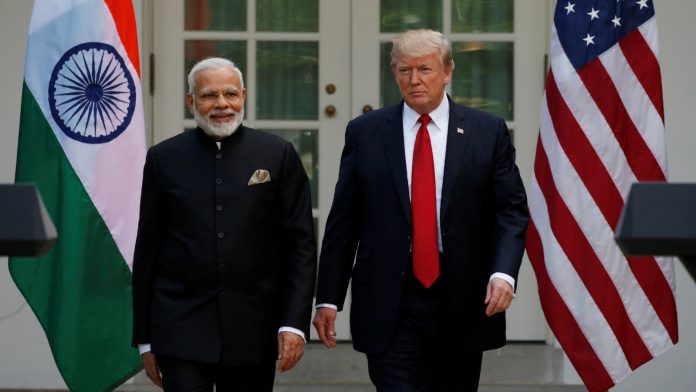
U.S. President Donald Trump’s announcement that Washington has reached a trade deal with India has landed with clear geopolitical intent, coming just days after Europe sealed its own long-awaited free trade agreement with New Delhi and amid a flurry of new trade pacts among major global economies.
The agreement, disclosed by Trump on Monday via his Truth Social platform, cuts U.S. tariffs on Indian goods to 18% from 25% and removes an additional 25% levy imposed last summer in response to India’s continued purchases of Russian oil. Trump said India had agreed to halt those purchases and would instead buy more than $500 billion worth of U.S. energy, technology, agricultural, and coal products, while also easing barriers faced by American exporters.
Although no official joint statement or detailed framework has yet been released, the speed of the announcement has drawn attention. The deal follows closely on the heels of the EU-India free trade agreement, which both sides hailed as historic after decades of stalled negotiations. The timing underscores Washington’s determination not to be eclipsed by Europe in one of the world’s fastest-growing major economies.
Since the start of the year, several global trading partners have moved ahead with new agreements, including the EU with India and China with Canada, at a time when the United States has relied heavily on tariffs as leverage. That approach had raised concerns that Washington was drifting to the margins of global trade diplomacy. The U.S.-India deal appears designed to counter that perception.
Terry Haines, founder of Pangaea Policy, said the agreement was a direct response to Europe’s momentum. He described it as a national-security-driven economic pact that ties trade more closely to strategic alignment, arguing that it shows the U.S. is capable of advancing major deals even amid broader geopolitical tensions.
The role of top-level political engagement has also been highlighted. Farwa Aamer, director of South Asia Initiatives at the Asia Society Policy Institute, noted that India-U.S. negotiations had been underway for some time, but said the EU’s breakthrough may have injected urgency into Washington’s efforts. In her assessment, leadership-level involvement was decisive in pushing the deal across the line.
Indian Prime Minister Narendra Modi confirmed the agreement on Monday, welcoming the reduction in tariffs on Indian exports and thanking Trump for his leadership. His statement, however, did not address the question of Russian oil, leaving uncertainty over how quickly, or to what extent, India would alter its energy sourcing.
For New Delhi, the deal fits into a broader strategy of diversifying economic partnerships. The EU agreement offers long-term access to a massive market, even though its tariff reductions will be phased in gradually. Securing a parallel arrangement with the United States strengthens India’s position within Western supply chains and provides a counterbalance amid global trade volatility.
Ranen Banerjee, partner and economic advisory leader at PwC India, said the combination of agreements with Europe and the U.S. could give a meaningful boost to jobs and manufacturing. He described the outcome as mutually beneficial, particularly if it translates into higher exports and sustained investment inflows.
The strategic implications may outweigh the immediate economic effects. Arpit Chaturvedi, South Asia adviser at Teneo, said the U.S. deal carries greater geopolitical weight than the EU pact alone. In his view, stabilizing trade ties with Washington reinforces India’s place in Western strategic thinking and helps reset bilateral relations on a more equal footing.
Still, economists are urging caution until more details emerge. Samiran Chakraborty, Citi’s chief economist for India, pointed out that key elements remain unclear, including the timeline for India’s proposed purchases of U.S. goods and the scope of any reductions in India’s own tariffs and non-tariff barriers. Without that clarity, assessing the deal’s long-term impact remains difficult.
There is also skepticism about how much relief the agreement will bring to U.S. consumers. Paul Donovan, chief economist at UBS Global Wealth Management, said Indian imports account for less than 3% of total U.S. imports, limiting the potential for tariff cuts to ease domestic price pressures. He added that tariff reductions are often less likely to be passed on to consumers than increases.
Overall, the deal appears as much about signaling as substance. By moving swiftly after the EU-India agreement, Trump has sent a message that the United States intends to remain central to global trade negotiations and strategic partnerships.