DD
MM
YYYY

PAGES

DD
MM
YYYY

spot_img

PAGES

Home Blog Page 4

China Tightens Exit Controls, Can Bar Citizens from Leaving Over Technology Security Risks

0

China has unveiled sweeping new exit-and-entry regulations that will allow authorities to prevent citizens from leaving the country if they are deemed a potential threat to national technology security.

The new rules underline Beijing’s aggressive efforts to safeguard strategic technologies, intellectual property and high-value talent amid intensifying geopolitical competition.

The regulations, published Friday by the State Council, broaden the government’s authority to impose travel restrictions on Chinese citizens and foreign nationals in cases involving national security, export controls and technology-related violations.

The new rules will take effect on September 15, adding another layer to China’s expanding legal framework aimed at protecting sensitive industries, particularly artificial intelligence, semiconductors, quantum computing and other technologies that Beijing considers critical to national development.

Under the regulations, Chinese citizens may be prohibited from leaving the country if they are found to have violated export control laws or technology import and export regulations in ways that could endanger China’s industrial or technological security.

The measures significantly expand the circumstances under which authorities can restrict international travel, reflecting Beijing’s growing emphasis on preventing the transfer of sensitive technologies, proprietary research and strategic know-how overseas.

The rules also allow authorities to impose exit bans on Chinese nationals who committed illegal or criminal acts abroad that harmed China’s national security or national interests. Those restrictions can remain in place for periods ranging from six months to three years after an individual returns to China.

While the regulations do not specify the precise criteria authorities will use to determine what constitutes a threat to technological security, the broad language provides regulators with considerable discretion in enforcing the measures.

Tougher Scrutiny for Foreign Nationals

The regulations also tighten entry requirements for foreign citizens. Under the new framework, foreign nationals may be barred from entering China for between one and five years if they provide false information or make fraudulent declarations when applying for Chinese visas either overseas or at ports of entry.

The measures reinforce China’s broader effort to strengthen border controls while giving authorities greater flexibility to deny entry on national security grounds.

The new regulations form part of China’s steadily expanding national security architecture, which in recent years has extended into the technology sector. Beijing has introduced a series of laws covering data security, cybersecurity, anti-espionage, export controls and intellectual property protection as competition with the United States over advanced technologies intensifies.

Chinese authorities have repeatedly emphasized the need to protect critical technologies, strategic industries and highly skilled personnel from foreign acquisition or unauthorized transfers.

The latest rules further demonstrate that talent mobility has become an increasingly important element of China’s national security strategy, particularly as AI, semiconductor design and advanced manufacturing emerge as central pillars of economic and military competitiveness.

The regulations come months after Chinese authorities prevented two co-founders of AI startup Manus from leaving the country during a regulatory review of the company’s proposed acquisition by Meta.

According to earlier reports, officials examined whether Meta’s approximately $2 billion acquisition complied with China’s investment regulations governing sensitive technologies.

Beijing subsequently ordered the transaction to be unwound in late April, signaling its determination to prevent foreign companies from acquiring Chinese artificial intelligence expertise, intellectual property and strategically important talent.

The case highlighted China’s growing intervention in cross-border technology transactions that could affect national technological competitiveness.

Technology Rivalry Drives Tighter Controls

The regulations are believed to have been inspired by technological competition between China and the United States, which has continued to intensify.

Washington has imposed increasingly stringent export controls targeting advanced semiconductors, AI accelerators and chipmaking equipment, while expanding restrictions on Chinese access to critical technologies. China has responded by accelerating efforts to achieve technological self-sufficiency and strengthening legal tools designed to protect domestic innovation, research and industrial capabilities.

Against that backdrop, personnel working in strategically important industries are now seen as national assets, making talent retention an important component of Beijing’s long-term industrial policy.

China has steadily expanded the use of exit bans over the past decade, applying them in cases involving criminal investigations, civil disputes, financial crimes and national security matters. Legal experts have noted that the country’s evolving national security framework gives authorities broad powers to restrict international travel in cases deemed to affect state interests.

The latest regulations mark one of the clearest extensions of those powers into the technology sector, revealing Beijing’s growing concern over the protection of advanced technologies and highly skilled personnel.


Funding Rates and Liquidation, Explained: What VALR’s New Perpetual Futures Product Means for Traders

0

VALR, the continent’s largest crypto exchange by trading volume, launched a Hyperliquid-powered perpetual futures product in July 2026, giving African traders direct access to leveraged derivatives that were previously mostly reached through offshore platforms. VALR’s own announcement warned that leverage “can magnify both profits and losses, making proper risk management essential” without explaining what that risk management actually involves.

Two mechanics do most of the work: funding rates, which keep a perpetual contract’s price anchored to the spot market, and liquidation, which is what happens when a leveraged position runs out of room to be wrong.

What Changes When a Trade Has No Expiry Date

A dated futures contract settles on a fixed day. A perpetual contract, the type VALR just launched, never does – it can stay open indefinitely as long as the trader keeps enough margin in the account. That convenience is exactly why funding rates exist: without an expiry date forcing the contract’s price back toward the spot price, exchanges need another mechanism to stop the two from drifting apart.

How Funding Rates Actually Work

Every few hours, typically eight, the exchange calculates the gap between the perpetual contract’s price and the underlying spot price. Depending on which side of that gap the market sits on:

  • If the perpetual price trades above spot, traders holding long positions pay a funding fee to those holding short positions.
  • If it trades below spot, the payment flows the other way, from shorts to longs.
  • The size of the payment scales with how far the perpetual has drifted from spot, so it self-corrects: expensive funding discourages piling further into the crowded side.

On a position worth $10,000 with a 0.01% funding rate, that’s a $1 payment every eight hours – small on its own, but it compounds over a multi-week hold the same way any recurring fee does.

None of this requires a trader to do anything – funding is deducted or credited automatically, whether or not a position is being watched at the time.

Margin Is the Third Term VALR Didn’t Explain

Margin is the collateral backing a leveraged position, and it comes in two thresholds that matter. Initial margin is what’s required to open the position in the first place; maintenance margin is the lower amount that has to stay in the account to keep it open. The gap between the two is what liquidation actually measures – not price movement in the abstract, but how much of that margin buffer has been eaten through.

A wider gap between initial and maintenance margin gives a position more room to be wrong before it’s closed automatically. A trader who only glances at the leverage number when opening a position never sees that gap until the moment it matters.

Liquidation: What VALR’s Own Warning Actually Means

Nigeria alone saw Bitcoin liquidations of $124.33 million in a single 24-hour period during a recent bout of volatility, according to market data – a reminder that this isn’t a theoretical risk on a new product, it’s a routine event in crypto derivatives markets generally.

Liquidation happens when a leveraged position’s losses eat through the margin backing it. The exchange doesn’t ask first; it closes the position automatically once account equity drops below the required maintenance level, to stop the loss from exceeding what the trader put up. Before opening a leveraged position, running the numbers through a liquidation calculator – entering position size, entry price and leverage – shows the exact price at which that happens, rather than finding out in real time.

Why the Basics Matter More in a Market New to Derivatives

Sub-Saharan Africa took in more than $205 billion in on-chain crypto value in the year to mid-2025, with Nigeria alone accounting for over $92 billion of it – but the bulk of that activity has historically been spot trading and stablecoin use for payments and savings, not leveraged derivatives. That matters here: a trader base with less built-in exposure to funding rates and liquidation mechanics is more likely to learn them the expensive way, on a live position, rather than beforehand.

VALR’s move mirrors a broader pattern already playing out on Hyperliquid and other perpetual platforms globally: as access expands, so does the gap between traders who understand the mechanics and traders who only understand the leverage number on the button.

The Bottom Line

A new perpetual futures product being available on a familiar local exchange doesn’t change what perpetual futures actually are underneath. Funding rates and liquidation aren’t fine-print disclosures to skim past on the way to placing a trade – they’re the two mechanics that ultimately determine whether a leveraged position stays manageable or turns into a countdown. Understanding both before funding an account costs nothing but a few minutes. Learning them for the first time from a liquidation notice costs considerably more.

Why It’s So Hard to Kill a Project That Isn’t Working

0

Every founder or business owner ends up staring down some version of the same uncomfortable question eventually, a product line, a hire, a market that isn’t converting, a partnership that keeps needing rescuing, and the honest answer about whether to keep going usually has less to do with the numbers than with how much has already gone into it. Economists have a specific name for the bias sitting underneath that hesitation, the sunk cost fallacy, the tendency to let money, time, or effort already spent influence a decision that should really only be about what happens next. A short round of Playsolitaire has become my own way of stepping back from exactly that kind of call for a few minutes before making it, since the pull of “we’ve already come this far” tends to be strongest right when a decision needs the clearest head.

Why Past Spending Keeps Getting Treated Like a Reason to Continue

Formal economic logic says only future costs and benefits should factor into a forward looking decision, since money or time already spent is gone regardless of what happens next. In practice, decades of research show people do the opposite fairly reliably, continuing to fund a struggling project specifically because of how much has already gone into it rather than despite it. Part of the pull, according to the researchers who first documented the effect carefully, is that walking away can feel like formally admitting the earlier spending was wasted, and most people would rather keep spending than sit with that admission. The bias shows up so consistently across contexts, and even across species in controlled lab studies, that it looks less like a personal failing and more like a basic feature of how decision making tends to work under pressure.

A Famous, Expensive Example

The clearest illustration is also one of the most expensive, the Concorde supersonic jet program, a joint effort between the British and French governments that continued receiving funding for years after it was clear the plane would never be commercially profitable. The pattern was so recognizable that economists sometimes call the sunk cost effect the Concorde fallacy specifically because of it. What makes the example useful for a much smaller business is the size of the mistake being roughly beside the point. A two person startup protecting a failing feature because of six months of engineering time already spent is running the identical piece of flawed logic as a government protecting a billion dollar aircraft program, just at a different scale.

A Cleaner Way to Ask the Question

The practical fix researchers and strategists tend to recommend is less about willpower and more about changing the question being asked. Instead of weighing how much has already been invested, the more useful version asks whether you would choose to start this project today, from scratch, knowing everything currently known about it. If the honest answer is no, the money or time already spent is not a reason to keep going, it is simply the cost of the information now available, and that information is what should be driving the next decision rather than the invoice history behind it. It is a simple reframe to state and a genuinely difficult one to apply in the moment a real project is on the table.

Making Space to Ask It Properly

None of this makes the decision itself painless, and it shouldn’t, a real team and a real amount of work are usually attached to whatever gets cut. It does help to have a clean break built into the process somewhere before the final call gets made, a few minutes away from the spreadsheet and the sunk cost pulling at the decision from underneath it. Stepping away, even briefly, tends to make it easier to ask the only question that was ever actually relevant, which is what happens next rather than what already happened.

What Software Evolution Reveals About the Future of Digital Infrastructure

0

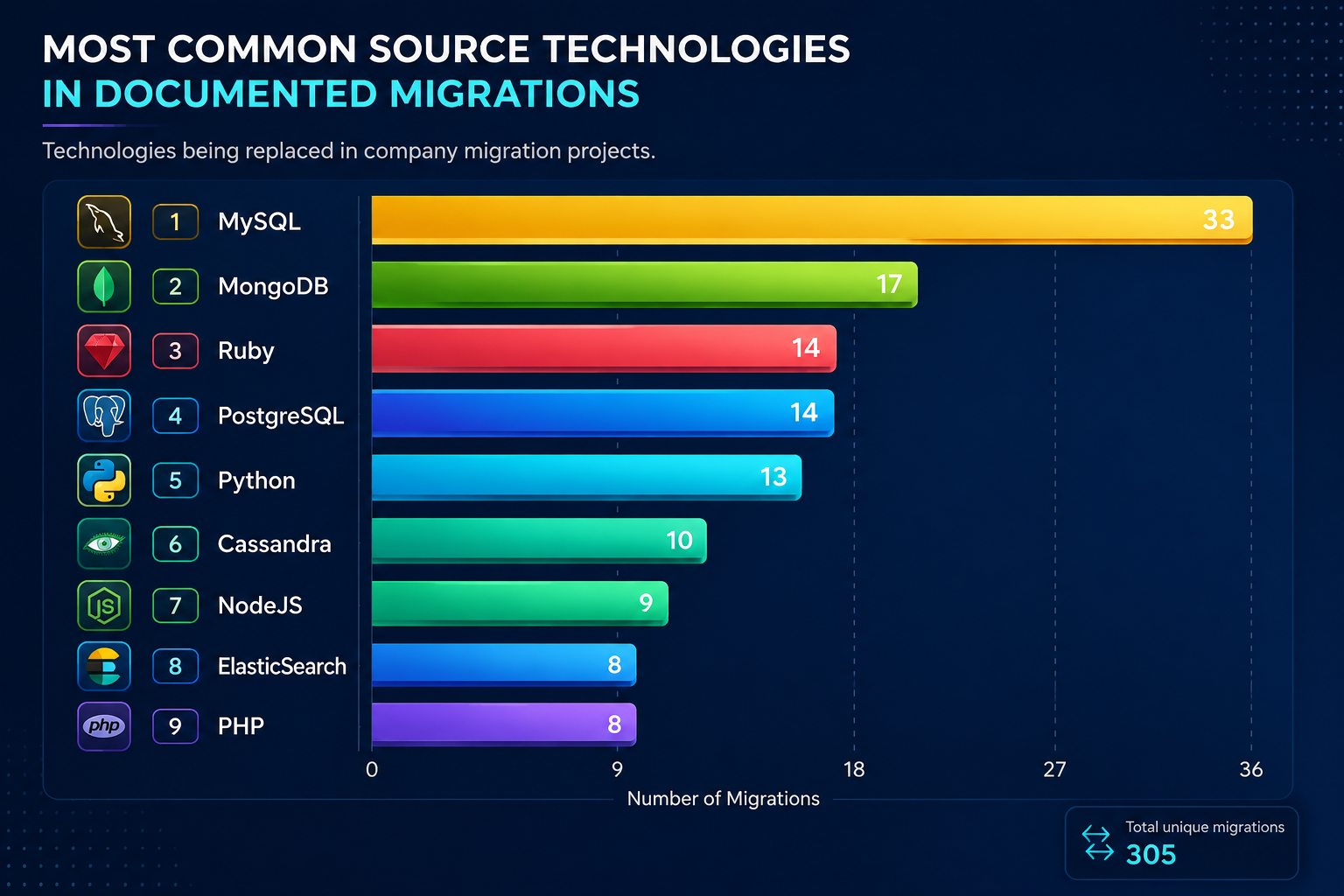
Over the past decade, the technology industry has witnessed one of the most significant waves of infrastructure transformation in its history. While much attention is often given to the emergence of new programming languages, databases, and cloud platforms, a more revealing story lies in the technologies that companies have chosen to migrate to. Technology migration is more than a technical exercise, it is a strategic decision that reflects changing business priorities, evolving customer demands, and the relentless pursuit of scalability, performance, and resilience.

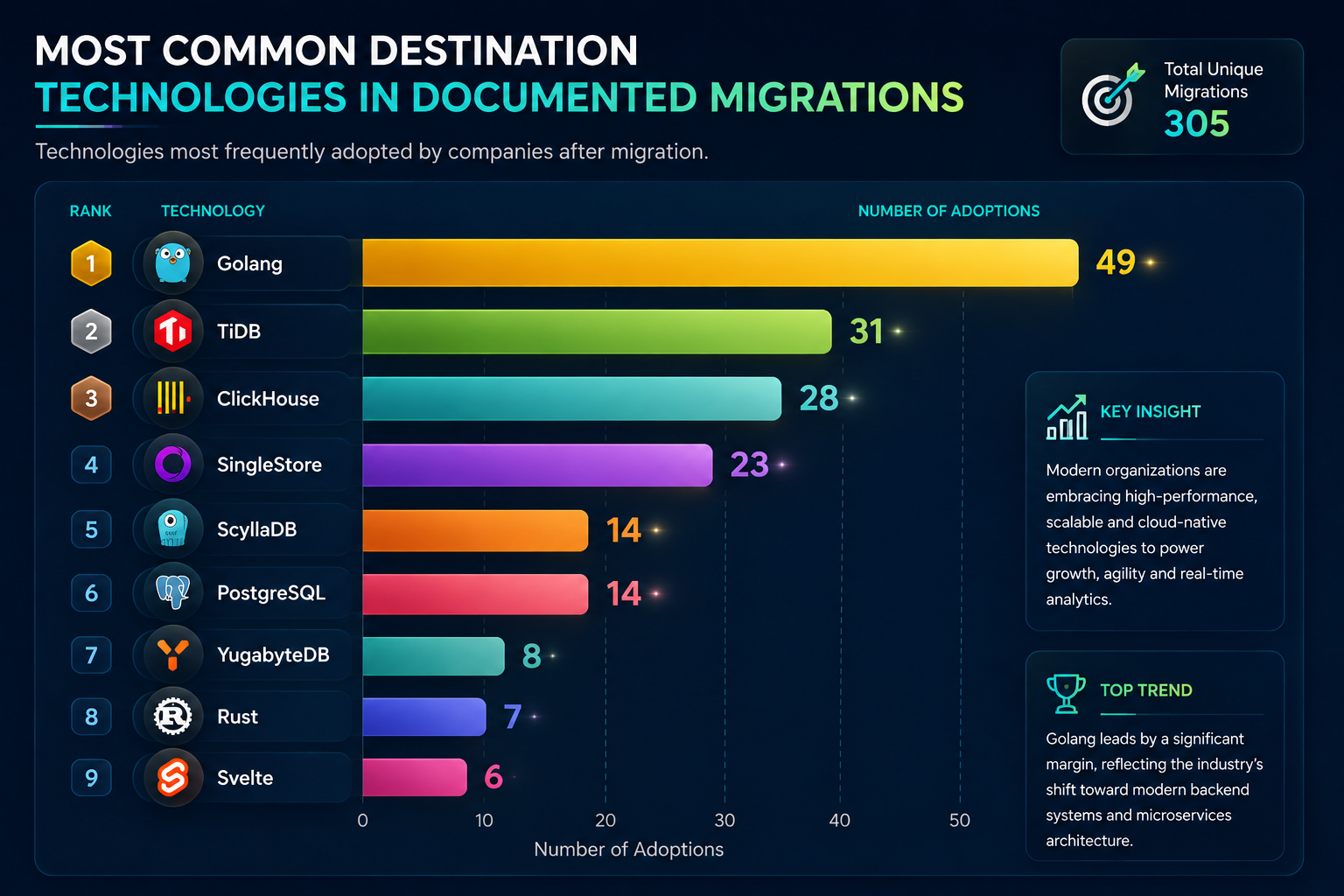
An analysis of more than 300 publicly documented technology migration cases between 2011 and 2025 reveals clear patterns in how ICT companies have modernised their technology stacks. The findings show that organisations are increasingly moving away from traditional monolithic architectures and toward cloud-native, distributed, and highly scalable technologies capable of supporting modern digital services.

Perhaps the most striking trend is the dominance of Golang as the preferred destination technology. Nearly fifty documented migrations involved organisations replacing existing backend technologies with Go, making it the most frequently adopted programming language in the dataset. This trend reflects a broader industry shift towards high-performance, concurrent programming that supports microservices, containerisation, and cloud-native application development. As digital platforms expand to serve millions of users, organisations increasingly value technologies that deliver predictable performance while reducing operational complexity.

The database ecosystem has experienced an equally profound transformation. Traditional relational and NoSQL databases such as MySQL, MongoDB, and Cassandra frequently appeared as technologies organisations migrated away from. In their place, companies increasingly adopted distributed databases such as TiDB, YugabyteDB, ScyllaDB, SingleStore, and analytical databases like ClickHouse. These migrations are not necessarily indictments of legacy databases. Rather, they illustrate the natural evolution of organisations as their data volumes, transaction rates, and analytical requirements outgrow the capabilities of earlier systems.

One important lesson emerging from the data is that technology choices are closely linked to organisational maturity. Start-ups and rapidly growing companies often begin with proven technologies that enable rapid product development and lower development costs. As user bases expand and business operations become more sophisticated, these same organisations encounter new challenges involving scalability, availability, fault tolerance, and operational efficiency. Technology migration therefore becomes an inevitable stage in organisational growth rather than an admission of previous technological failure.

The years between 2020 and 2021 represent the peak period of documented technology migrations. This surge coincided with accelerated digital transformation across industries, driven by cloud adoption, remote work, increased online transactions, and heightened demand for digital services. Organisations could no longer rely solely on systems designed for traditional enterprise workloads. Instead, they required architectures capable of supporting distributed teams, continuous deployment, real-time analytics, and global-scale applications. The migration wave during this period demonstrates how external disruptions often accelerate technological innovation.

Another noteworthy finding is the growing emphasis on performance engineering. Technologies such as Rust and Go continue to attract organisations seeking greater computational efficiency, lower memory consumption, and improved reliability. As computing costs continue to rise alongside increasing user expectations, software performance is no longer viewed as a purely technical concern but as a strategic business advantage. Faster applications reduce infrastructure costs, improve customer experiences, and strengthen competitive positioning.

Equally significant is the emergence of analytical databases as mainstream infrastructure. The increasing adoption of ClickHouse demonstrates that organisations are placing greater emphasis on real-time business intelligence, observability, event processing, and data-driven decision-making. In today’s digital economy, organisations are no longer satisfied with storing data; they seek technologies capable of transforming vast volumes of operational data into actionable intelligence almost instantaneously.

The migration patterns also highlight the growing importance of distributed computing. Technologies designed specifically for horizontal scalability and fault tolerance increasingly dominate destination platforms. This reflects the reality that modern applications must remain available across multiple geographic regions while supporting continuous growth without significant downtime. High availability has become a business expectation rather than a technical luxury.

These migration patterns carry important strategic implications. First, no technology should be viewed as a permanent investment. Successful organisations continuously evaluate whether their infrastructure aligns with evolving business objectives. Second, migration planning should become an integral component of long-term technology strategy rather than an emergency response to system limitations. Finally, organisations should recognise that digital transformation extends beyond adopting new technologies; it requires building architectures capable of adapting to future technological change.

Our analyst notes that the technology migration data provides valuable insights into the evolution of the global software ecosystem. It reveals how innovation diffuses across industries, how organisations respond to technological disruption, and which technologies emerge as foundational infrastructure for the digital economy. Such evidence can also inform curriculum development, workforce planning, and national digital transformation policies by highlighting the skills and technologies that are increasingly shaping modern software engineering.

Specifically, our analyst observes that every migration represents an organisation responding to new realities, whether those realities involve millions of additional users, increasingly complex data environments, or heightened demands for speed, reliability, and scalability. As digital transformation continues to accelerate, the technologies companies choose to migrate to today provide valuable clues about the architecture of tomorrow’s digital economy. Organisations that understand these patterns will be better positioned not only to keep pace with technological change but to lead it.

Nigeria’s AI Research Boom Signals a New Era of Scientific Innovation

0

Nigeria is experiencing a remarkable transformation in artificial intelligence (AI) research, with scholarly publications reaching unprecedented levels over the past decade. A review of publication data covering journal articles, conference papers, working papers, and preprints with English-language titles or abstracts shows that the country’s research output has grown from just 161 publications in 2016 to 1,369 in 2024. This represents an increase of more than 750 percent in nine years, highlighting Nigeria’s emergence as one of Africa’s leading contributors to AI scholarship.

The data indicates a total of 5,687 AI-related publications between 2016 and 2024. On average, Nigerian researchers produced about 632 publications annually during the period. While the early years were characterised by modest research activity, the pace of scholarly production has accelerated significantly since 2019, reflecting growing institutional interest, international collaboration, and wider application of AI technologies across different sectors.

The journey began with 161 publications in 2016. Research output increased to 229 in 2017 before experiencing a slight decline to 220 publications in 2018. Although the decrease was relatively small, it suggested that AI research in Nigeria was still developing and had yet to establish consistent momentum. At the time, AI remained a specialised field with limited participation from universities, research institutes, and industry.

A dramatic shift occurred in 2019 when the number of publications almost doubled to 437. The increase of 217 publications represented the highest annual growth rate in the dataset at 98.6 percent. This marked a turning point for AI scholarship in Nigeria. Researchers increasingly embraced machine learning, data science, natural language processing, and other AI applications, while collaborations with international partners became more common.

The upward trend continued despite the disruptions caused by the COVID-19 pandemic. Nigeria produced 559 AI publications in 2020, representing a further increase of nearly 28 percent over the previous year. Rather than slowing research activity, the pandemic highlighted the importance of AI in addressing complex challenges in healthcare, education, economic planning, and digital communication. Researchers explored AI-driven solutions for disease surveillance, remote learning, predictive analytics, and public service delivery, contributing to sustained scholarly growth.

The momentum strengthened in 2021 as publication output climbed to 777 articles. This increase of 218 publications demonstrated that AI research was becoming firmly established within Nigeria’s academic landscape. Universities expanded postgraduate research in AI-related fields, while government agencies, private organisations, and international development partners increasingly recognised the strategic importance of AI for national development.

Although growth moderated slightly in 2022, with publications reaching 844, the overall trajectory remained positive. The slower annual increase of 8.6 percent reflected consolidation rather than stagnation. During this period, researchers diversified the application of AI across agriculture, financial technology, environmental management, cybersecurity, governance, transportation, and media studies. AI was no longer confined to computer science departments but had become an interdisciplinary research area attracting scholars from medicine, engineering, economics, education, and the social sciences.

The most impressive expansion occurred during 2023 and 2024. Nigeria crossed the milestone of 1,000 AI publications for the first time in 2023, recording 1,091 scholarly outputs. Just one year later, the total increased again to 1,369 publications. Together, these two years contributed 2,460 publications, accounting for more than 43 percent of all AI research produced during the entire nine-year period.

This rapid increase reflects broader global developments in artificial intelligence. The widespread adoption of generative AI technologies, increased availability of open-source AI tools, improved computing resources, and growing international funding opportunities have encouraged more researchers to pursue AI-related studies. Nigerian institutions have also benefited from stronger research partnerships, enhanced digital infrastructure, and expanding postgraduate programmes that focus on data science and artificial intelligence.

The publication trend suggests that Nigeria has moved beyond the stage of being an emerging participant in AI research. Instead, the country is becoming an important contributor to scientific knowledge within Africa and beyond. The consistent increase in publication output demonstrates not only greater research productivity but also improved capacity for innovation and knowledge creation.

The implications extend well beyond academia. Stronger AI research can support evidence-based policymaking, stimulate technological entrepreneurship, improve industrial productivity, strengthen healthcare systems, modernise agriculture, and enhance public service delivery. As AI continues to shape economies and societies around the world, Nigeria’s expanding body of scholarly work provides a foundation for developing locally relevant technologies capable of addressing national and regional challenges.

Despite the encouraging progress, sustaining this growth will require continued investment in research infrastructure, funding, digital resources, and human capital. Strengthening collaboration between universities, government, industry, and international partners will be essential for translating research findings into practical innovations that benefit society. Equally important is the need to develop ethical and regulatory frameworks that ensure responsible AI development while encouraging innovation.

The figures tell a compelling story of transformation. From fewer than 200 publications annually less than a decade ago to well over 1,300 in 2024, Nigeria’s AI research ecosystem has undergone a remarkable expansion. The country’s scholars are producing knowledge at an unprecedented pace, positioning Nigeria as an increasingly influential voice in Africa’s AI landscape. If the current trajectory continues, the coming years could see Nigeria become not only a regional leader in AI research but also a significant contributor to global conversations on artificial intelligence, innovation, and sustainable development.