DD
MM
YYYY

PAGES

DD
MM
YYYY

spot_img

PAGES

Home Blog Page 4007

US Lawmakers urge SEC to Reconsider its Approach to Crypto Regulation

0

In a letter sent to the Securities and Exchange Commission (SEC) on July 18, 2023, a bipartisan group of 12 US lawmakers expressed their concerns about the agency’s stance on crypto regulation and urged it to adopt a more balanced and innovation-friendly approach.

The letter, which was signed by representatives from both the House Financial Services Committee and the House Energy and Commerce Committee, highlighted the potential benefits of crypto innovation for the US economy and national security, as well as the risks of falling behind other countries that are more supportive of the emerging industry.

The lawmakers argued that the SEC’s current approach, which relies on applying existing securities laws to crypto assets, is inadequate and inconsistent, creating uncertainty and confusion for market participants and hindering innovation. They cited several examples of the SEC’s actions that they deemed problematic, such as:

The SEC’s lawsuit against Ripple Labs, which alleges that the company’s XRP token is an unregistered security, despite the fact that other regulators, such as the Department of Justice and the Financial Crimes Enforcement Network, have treated XRP as a currency.

The SEC’s delay in approving a Bitcoin exchange-traded fund (ETF), which has resulted in US investors missing out on the opportunity to access the crypto market in a regulated and transparent manner, while Canada and other countries have already approved several Bitcoin ETFs.

The SEC’s lack of clear guidance on how to determine whether a crypto asset is a security or not, which has led to inconsistent enforcement actions and deterred many projects from launching or operating in the US.

The SEC’s refusal to engage with the crypto industry and provide regulatory clarity, despite repeated requests from lawmakers, industry leaders, and investors. The letter urged the SEC to reconsider its approach and adopt a more constructive and collaborative attitude towards crypto regulation. The lawmakers suggested that the SEC should:

Work with other regulators, such as the Commodity Futures Trading Commission (CFTC) and the Office of the Comptroller of the Currency (OCC), to establish a coordinated and coherent regulatory framework for crypto assets. Provide clear and timely guidance on how to classify and regulate different types of crypto assets, based on their functionality and characteristics, rather than applying a one-size-fits-all approach.

Foster innovation and competition in the crypto space by creating a safe harbor or sandbox program for emerging projects that comply with certain standards and best practices. Engage with the crypto industry and stakeholders in a constructive and transparent manner, by holding regular meetings, hearings, workshops, and consultations.

The letter concluded by stating that the lawmakers are ready to work with the SEC and other regulators to ensure that the US remains a global leader in crypto innovation, while protecting investors and consumers. They also expressed their hope that the SEC will respond to their letter within 30 days and provide an update on its plans and actions regarding crypto regulation.

How Fintech Can Help Drive Revenue Generation for the New Nigerian Government

0
  • By Samson G. SIMON, Ph.D., CPLP
  • Head, Research & Hubs Coordination,  @Opolo Global Innovation Limited, Ikoyi-Lagos.

INTRODUCTION & BACKGROUND

Nigeria’s fiscal mess will definitely require the new Tinubu’s government to take urgent and far-reaching measures to fix the problem. For it is unsustainable to continue on the particular trajectory it met when it came to power few weeks ago. Opinions seem divided: One side of the divide; populated mainly by the led as well as professional economists; thinks Nigeria has a debt problem. However, the other side of the divide; where you have the fiscal authorities, most especially the crop in charge of the policy for the last eight years; believes that Nigeria’s problem is a revenue one, not a debt one.

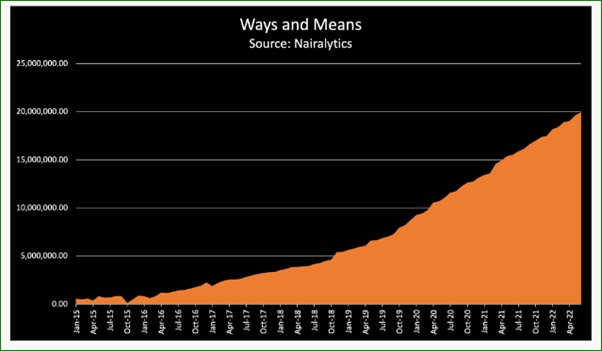
On the whole, Nigeria’s problem is clearly both. It has over N12.1 trillion in fiscal deficits in the 2023 budget alone, with overall national debt projected at a whopping N77 trillion when CBN’s Ways and Means of N23 trillion is securitized by the end of the last dispensation. The CBN advances attract N1.8 trillion yearly in interest payments, and in 2022, a whopping 81% of revenue was used to service debts. Debt service to revenue ratio even exceeded 100% in the first quarter of 2022. Similarly, as it is projected now by the World Bank to be in the region of 102. 3% for the current year.  Furthermore, the World Bank is projecting the same ratio to double what was experienced in 2022 to be 160% by 2027. Hence, the problem is both revenue and debt.

The new administration should deploy all tools to ensure fiscal sustainability by broadening the tax base and reducing leakages and the unnecessary costs of tax administration. Urgent reforms are needed to avert the looming danger as Nigeria approaches a fiscal cliff, if it is not there already.

When the public sector embarks on borrowing to fund its budget that will crowd out the private sector.  This is possible as a result of increase in the costs of borrowing. This ultimately reduces demand for borrowing hence spending by corporates and individuals.

More so, if a government is raking in huge revenues, there may be no need to borrow as it has a surfeit of resources to meet its needs. And to boost this income, the authorities can deploy technology. Financial Technology (FinTech) can be maximised to increase government revenue. The new government can use FinTech to set up a system that helps it in formulating, implementing, and executing its fiscal policy, particularly for those ones around non-tax collections, taxes and even spending in an efficient way.  

TYPES OF FINTECH

There are three types of FinTech. One type is mobile money; an example can be found in Kenya using M-Pesa by Safaricom etc. M-Pesa accounts for a whopping 85% of non-cash transactions. Mobile money is different from mobile banking. While the former can be done even without a bank account, the latter has to do with e-transactions using bank accounts.  The second type of FinTech is an internet-based payment system (e-payment). This type is better than mobile money because it can transact much larger amounts than what mobile money will normally allow. This is so because the internet and digitisation not being available to mobile money. Third, digital money such as CBDC (Central Bank Digital Currency), e-Money, and stablecoins are assets that have the properties of traditional money like cash and bank deposits.

FinTech can be deployed by the government to boost financial inclusion which the monetary authority has tried so far but does not seem to be making much headway. FinTech helps financial inclusion for the unbanked or underserved communities. When the financial exclusion of people is reduced through the deployment of financial technology, this will widen the tax net and the tax base hence improving government revenue. The authorities can rake in non-tax revenue for royalties on the extractive industries, dividends from Government Owned Enterprises (GOE) payments for government delivery of goods and services such as passport issuance, port fees, fines, and penalties, health, and education. FinTech will help accelerate the financial inclusion rate which at present is at a pathetic 0.09% per year while almost 40 million Nigerians remain excluded from the financial system. Hence, including them will boost the economy and bring about more revenue for the government.

CBDC will help improve efficiency, access and cut costs for transactions; help expand tax base, combat illegal activities, and optimise government disbursement of its benefits.

HOW FINTECH CAN HELP THE GOVERNMENT

Setting up tax collection platforms just like India did in creating a portal for non-tax revenue where all fees, fines, and charges are paid. No cash transactions should be encouraged, as making all payments cashless will cut down to almost nothing the chance of money being stolen or any other leakages. It will also make the population have confidence in the process and the institutions rendering the service or providing the good. Rwanda and the Dominican Republic equally have deployed FinTech to reduce waste and ensure any income meant for the government gets to the government unfailingly. Tanzania too has deployed technology in its public finances to improve and modernise tax collection. Brazil too with its PagTousoro has helped it improve its non-tax income. Senegal’s M-Tax (Mobile Tax) uses SMS and USSD for businesses to pay taxes. It has digitised tax payments hence making it more efficient, transparent, and seamless. FinTech can help reduce the rate of tax evasion which is one of the major problems for the taxman.

Other benefits accrue as a result of bringing in financial technology. The deployment of Financial Technology (FinTech) helps the government to substantially increase the speed of its transactions such as making and receiving payments. It helps facilitate government interactions with citizens in areas like Governments-to-People, People-to-Governments, Governments-to-Businesses, and Businesses-to-Government.   It will help in the collection of tax and non-tax revenue as well as debt management. Generally strengthening public finance management. FinTech will help strengthen accountability, make reliable audit trails, enhance financial data collection, and improve budget planning. When tax collection is digitised this will lead to: better compliance hence higher revenue; automation leading to low costs of tax administration; greater accountability and transparency in tax administration; broader tax base as it will reduce Nigeria’s informal economy; and an abundance of data for effective decision-making.   

NIGERIA’S DEBT SERVICE TO REVENUE RATIO

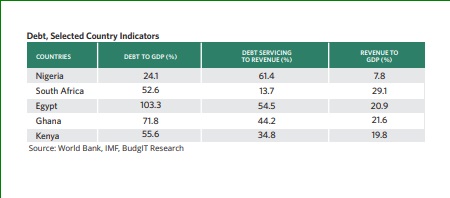
Nigeria’s debt-to-GDP ratio is relatively low. As the table shows, Nigeria’s public debt is less than a quarter of GDP which is clearly below the DMO’s self-imposed limit of 40%. Way below the IMF/World Bank’s recommendation of 55% for countries within Nigeria’s peer group. While the Debt-to-GDP ratio is clearly not a problem, debt servicing to revenue ratio as well as revenue to GDP are clearly huge problems. For example on the table above, Nigeria has the least percentage points for revenue to GDP. This means it is the worst performer amongst this set of its African peers like Egypt, South Africa, Ghana and Kenya. Nigeria has a value below 8% while South Africa has almost four times to arrive at 29%. For the debt service to revenue ratio relative to other African nations; Nigeria is at 61.4% almost twice Kenya’s level at 34% and almost 5 times South Africa’s which at 13.7% is relatively extremely measly. This shows Nigeria uses 61 cents of any currency 1 dollar to service debts.  As if the numbers are not bad enough they even got worse at over 80% last year.

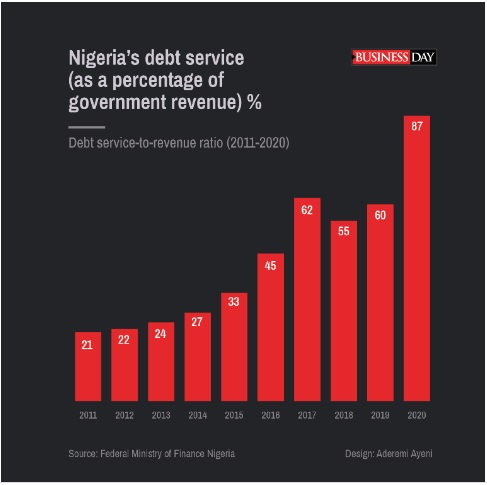
As shown above, Nigeria’s debt service costs as a percentage of its revenues have not only been climbing but also spiking in recent times. Meaning, it’s in fiscal distress with less and less fiscal space. This calls for drastic changes to stop the slide in its tracks. And financial technology can help with a lot of these challenges.

CBN’S WAYS & MEANS AS WELL AS NIGERIA’S DEBT STOCK

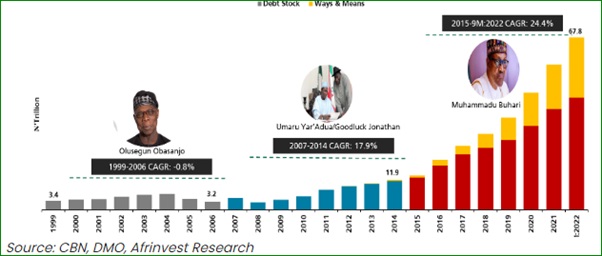
While the CBN ACT 2007 allows the government to take out loan from the monetary authority to solve urgent financial difficulties, however, this has been obviously abused by the current government. The tables below show how the current dispensation has come to rely too much on the CBN for the financing of its activities.

The law says only 5% of previous year’s revenues should be owed by the government at any particular time. Nonetheless, the government has not only disregarded that and now owes several folds of the previous year’s revenues. The law also says, if the government doesn’t pay back, the powers by the CBN to lend to it cannot be  exercisable. The CBN still lends to the government. Thirdly, the law says these borrowings from the CBN should not be securitised. Nevertheless, the government has done just that!

CONCLUSION

While deploying financial technology (Fintech) can help the new government plug leakages; raise more revenue; spend better; and provide the dividends of democracy in great measure. This does not mean that it is all sunshine as challenges too abound. The privacy of the participants concerned as well as the danger of cyber crimes can be daunting.

Increasing Minimum Wage in Nigeria Will Not Solve It

0

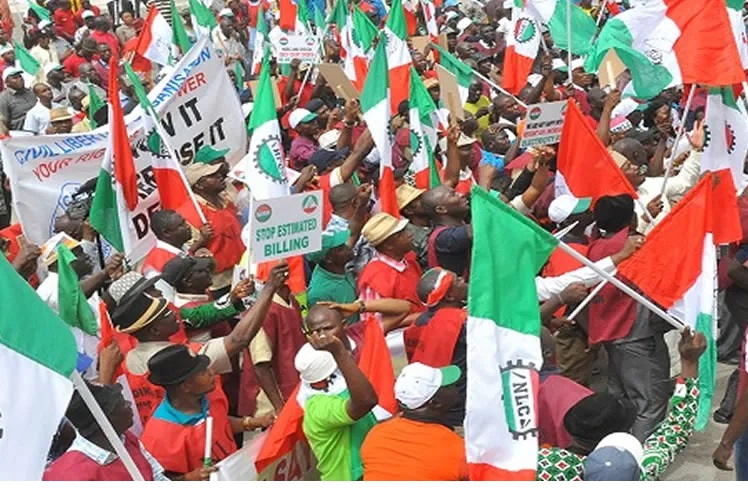
There’s news, although unverified, that has been trending since last weekend that the federal government is considering increasing the minimum wage to N200,000 a month. I, in all honesty, do not believe this news to be true but let us even assume that there is an atom of truth in it, increasing the national minimum wage is not the right step to be taken by the federal government. It will not solve any problem, rather it will further fan the amber of inflation.

The federal government in unverified news also claimed that they want to distribute 8000 naira to twelve million families as a palliative to cushion the effect of the economic hostility. They have scratched this plan as they are no longer moving forward with it, maybe they found out by themselves or listened to some of us that it is also a very wrong and nasty move.

No matter how much you earn as an individual and no matter how much you are given as a financial palliative by the government,  if your cost of living is high you will always remain broke; the best policy to implement are policies that will reduce the cost of living; everything should be geared towards reduction of the cost of living and not to increase minimum wage. No matter how much increment in salary an employee gets, if things are still very expensive and constantly on the rise, the money will never be enough. This is why in financial management you are thought that if your expenditure or your cost of living is above your income you will always be broke and in debt

Even if the government are serious about increasing the minimum wage, it may only favour the civil servants at the federal level and civil servants of some states because another problem that will likely arise will be how the federal government will ensure or enforce that the minimum wage be increased across the board, especially at the private sectors which are the highest employers of labour in Nigeria.


Increasing the minimum wage will never solve the problems, reducing the cost of living will be the best step. The question is how then will the government reduce the cost of living?; by opening borders for more importation of consumer goods, reduction of taxes on consumer goods, removal of import restrictions, reduction of import clearance fees on essential commodities, easing the cost of doing business in Nigeria, etc. They are this simple, direct and straightforward.

If we are being honest, things to do to make Nigeria’s economy start recovering speedily are not rocket science, they are simple economic moves but due to the complexity of the Nigerian political space and the bureaucracy involved in everything it does take time to be implemented and some greedy politicians will rather frustrate the plan to implement any policy that will make the economy work if it is not favouring them directly.

People defending this government are making the excuse that the government just started and making the economy work is not going to be an overnight miracle, but the government is just a few days away from completing a whole two months in office and there is nothing to show for it yet, there is no sign that they are making any move in the right direction rather they are using trial and error form of governance.


Survey finds 47% of Investors expect Ethereum to ‘Surpass’ Bitcoin in Market Cap

0

A recent survey conducted by Finder, a comparison platform and cryptocurrency information provider, revealed that 47% of the respondents believe that Ethereum will overtake Bitcoin in terms of market capitalization in the future. The survey polled 42 experts from the cryptocurrency industry, including CEOs, analysts, professors, and journalists.

The majority of the experts agreed that Ethereum has more potential for growth and innovation than Bitcoin, citing its scalability, functionality, and network effects as key factors. Some of the experts also pointed out that Ethereum is more environmentally friendly than Bitcoin, which consumes a lot of energy for its proof-of-work consensus mechanism.

However, not everyone was bullish on Ethereum. 35% of the respondents said that Bitcoin will remain the dominant cryptocurrency, while 18% were undecided. The Bitcoin supporters argued that Bitcoin has a stronger brand recognition, network security, and store of value proposition than Ethereum. They also noted that Bitcoin is more resistant to regulatory pressures and censorship than Ethereum, which is more centralized and influenced by its developers.

The survey also asked the experts about their price predictions for both cryptocurrencies by the end of 2021 and 2025. The average forecast for Ethereum was $4,596 by the end of 2021 and $17,810 by the end of 2025, representing an increase of 234% and 1,005% respectively from the current price of $1,374. The average forecast for Bitcoin was $66,284 by the end of 2021 and $318,417 by the end of 2025, representing an increase of 122% and 583% respectively from the current price of $29,861.

The survey results indicate that there is a growing sentiment among investors and experts that Ethereum could challenge Bitcoin’s supremacy in the cryptocurrency market. However, there are also many uncertainties and risks involved in both projects, such as technical issues, regulatory hurdles, and market volatility. Therefore, it is advisable to do your own research and exercise caution before investing in any cryptocurrency.

Ripple Invests in AI and Metaverse Startup

Ripple, the company behind the XRP cryptocurrency, has announced a strategic investment in a new startup that aims to create immersive and interactive experiences in the metaverse using artificial intelligence.

The startup, called MetaAI, is developing a platform that will allow users to create and share their own virtual worlds, characters, and stories using natural language and voice commands. MetaAI’s vision is to enable anyone to become a creator and storyteller in the metaverse, without the need for coding or design skills.

MetaAI’s platform will leverage Ripple’s blockchain technology and XRP ledger to enable fast, secure, and low-cost transactions and settlements across the metaverse. Users will be able to buy, sell, and trade digital assets and services using XRP, as well as access decentralized applications (DApps) and smart contracts built on Ripple’s network.

Ripple’s investment in MetaAI is part of its broader strategy to support innovation and adoption of blockchain and cryptocurrency in various sectors and use cases. Ripple has previously invested in startups such as Coil, Forte, Flare Networks, and Mintable, among others.

Ripple’s CEO, Brad Garlinghouse, said in a press release: “We are excited to partner with MetaAI, a visionary team that is pushing the boundaries of AI and metaverse. We believe that the metaverse will be a huge opportunity for blockchain and crypto, as it will create new ways of value creation and exchange. By integrating XRP into MetaAI’s platform, we hope to accelerate the growth and adoption of the metaverse economy, as well as showcase the benefits of XRP as a bridge currency for the internet of value.”

MetaAI’s CEO, Alice Chen, said in a press release: “We are thrilled to receive Ripple’s strategic investment and support. Ripple is a leader and innovator in the blockchain and crypto space, and we share their vision of building a more open, inclusive, and sustainable future. With Ripple’s technology and network, we will be able to offer our users a seamless and secure experience in the metaverse, as well as empower them to create and monetize their own content and stories. We look forward to working with Ripple to bring AI and metaverse to the mainstream.”

Ripple says Banks will want to use XRP

Ripple, the company behind the XRP cryptocurrency, has recently made a bold claim: banks will want to use XRP in the near future. In this blog post, we will explore the reasons behind this statement and what it means for the future of cross-border payments.

XRP is a digital asset that was created by Ripple to facilitate fast, cheap and secure transactions across different currencies and networks. Unlike other cryptocurrencies, XRP does not rely on a decentralized network of miners to validate transactions. Instead, it uses a network of trusted validators that follow a consensus protocol. This allows XRP to achieve faster transaction speeds and lower fees than other cryptocurrencies.

One of the main use cases for XRP is to serve as a bridge currency between different fiat currencies. This means that XRP can be used to convert one currency into another without the need for intermediaries or multiple exchanges. For example, if a bank in Japan wants to send money to a bank in Brazil, it can use XRP to convert yen into reais in seconds, instead of going through multiple steps and paying high fees.

Ripple claims that this use case is very attractive for banks and financial institutions that deal with cross-border payments on a daily basis. According to Ripple, banks will want to use XRP because it can help them reduce costs, increase efficiency and offer better customer service. Ripple also says that XRP can help banks access new markets and customers that are currently underserved by traditional payment systems.

Ripple has been working hard to convince banks and regulators of the benefits of using XRP. It has partnered with over 300 financial institutions around the world, including MoneyGram, Santander and SBI Holdings. It has also launched several products and initiatives that leverage XRP, such as On-Demand Liquidity (ODL), RippleNet and PayID. Ripple hopes that these efforts will increase the adoption and demand for XRP in the global payment market.

However, not everyone is convinced by Ripple’s claims. Some critics argue that banks have no incentive to use XRP, as they already have established relationships and systems for cross-border payments. They also point out that XRP faces regulatory uncertainty and legal challenges in some jurisdictions, such as the US, where the Securities and Exchange Commission (SEC) has sued Ripple for allegedly selling unregistered securities. They also question the environmental impact of XRP, as it consumes a significant amount of energy to maintain its network.

In conclusion, Ripple says that banks will want to use XRP in the near future because it can offer them many advantages over traditional payment methods. However, there are also many challenges and uncertainties that may hinder the adoption and growth of XRP. It remains to be seen whether Ripple’s vision will become a reality or not.

Nigerian to Clamp Down on Market Associations Over High Food Prices

0

The Federal Government of Nigeria has announced the decision to clamp down on members of market associations responsible for the high cost of food items by their anti-competitive practices.

The move was announced on Tuesday by the Federal Competition and Consumer Protection Commission during a forum titled; ‘Fair food prices in Nigeria: A high-level forum for better competition’, organized by the commission to discuss fair food prices.

Chief Executive Officer of the FCCPC, Babatunde Irukera, said the commission will begin to hand out sanctions against members of trade associations found responsible for the indiscriminate and irrational hike of food prices.

“We will continue to monitor the market, and where we find that prices are excessive or find exploitative conduct, or find that consumers are being taken advantage of, we will intervene. One of the ways of intervening is unlocking the bottlenecks.

“That is what I just said, associations that come together to determine at what price beans should be sold, associations that come together to decide that nobody in a particular market should take yam, beans, or rice from any other person except their members, we will proceed against them,” he said.

Irukera explained that the move has become necessary because some trade unions had constituted cartels to engage in anti-competitive practices that have led to price gouging of basic food items.

He said that it has become crucial to take a firm stance against indiscriminate food price hikes, especially in light of the president’s recent declaration of food security as a national emergency last week.

“Competition regulation and consumer protection is not only to regulate the big companies. It is not only to regulate the formal sector. It is also to regulate the informal sector. In a place like Nigeria, it is even more critical to find a strategy to regulate the informal sector because; at the end of the day the vast majority of our economy is informal,” he said.

However, the move has drawn criticism from business leaders who believe it portends price control that will harm market growth.

The move has come on the heels of the government’s decisions to remove fuel subsidy and float the Nigerian forex market, which has resulted in a significant increase in the cost of goods and services. The removal of fuel subsidy and the floating of the naira mean that the cost of Premium Motor Spirit (PMS), and the naira’s value, will now be determined by market forces.

Critics of the FCCPC’s move said it will cause more harm than good as the high price of petroleum products is forcing market members to increase food prices. They said it will amount to injustice and economic sabotage if the government allows market fundamentals to drive the cost of petroleum products while it regulates the price of food items.

Currently, Nigeria is going through a food crisis that its food production capacity is significantly deficient to quell. Nigeria produced 8,435,000 tonnes of rice, the country’s major staple, in 2021, according to data from Statista. But due to insecurity, production has seen a major decline in the past year, compounding the insufficiency bolstered by rapid-growing population.

With insecurity stymieing farming efforts in many parts of the country, the government has been urged to remove food import restrictions in the short term to allow the nation to attain food security.