DD
MM
YYYY

PAGES

DD
MM
YYYY

spot_img

PAGES

Home Blog Page 4008

The Doctrine of Necessity in the Nigerian Politics and in Law

0

The doctrine of Necessity 

When you mention this phrase “the doctrine of necessity”, what comes to mind of anyone who has been following up on the Nigeria political scene is the incident of February 2010 when the National Assembly took the drastic decision to empower the then Vice President Goodluck Jonathan to become president when then president Yar’adua was away on medical leave but didn’t put the Vice President in charge of affairs. 

The constitutional protocol as provided in section 145 of the constitution stipulates that the president is to transmit a letter to the national assembly informing them of his temporary handover of power to the Vice if the president will be away for a long time but the then president Yar’adua embarked on his medical vacation without following this constitutional protocol and the National Assembly had to step in through the doctrine of necessity and on February 9, 2010, empowered the then Vice President to act as president temporarily pending when the president will be back, unfortunately, the president never came back. 

More on that later but there are other ambits to this doctrine of necessity that will interest you. 

Basically, in politics or governance, the doctrine of necessity is the basis upon which extraordinary (unlawful but necessary) actions of the executive are permitted. Unlawful administrative actions which are designed to restore order or uphold fundamental constitutional principles are considered to be lawful even if such action contravenes established constitutions, laws, norms, or conventions. This means that unlawful acts by an executive can be permitted so as to restore law and order. This means that the doctrine of necessity in governance advocates that when the occasion demands, the law should bend its eyes and permit some unlawful acts of the executive at the time being so as to restore law and order. 

This doctrine is often quoted during wartime or civil unrest. The executive is expected as a response to civil unrest to declare a state of emergency or dusk till dawn curfew thereby restricting citizens’ fundamental human rights so as to restore peace and civility.

In legal jurisprudence, there is another aspect of the doctrine of necessity which advocates that a person is allowed to do some illegal act when the occasion demands and he will not be prosecuted for it.

For instance, killing another human is a crime and it attracts capital punishment in most jurisdictions but killing another person in a “kill-or-be-killed” situation can be an example of the doctrine of necessity. You only killed to defend yourself from getting killed hence your act although unlawful can be permitted in law on the basis of self-defense. 

But there are some clear exceptions to this doctrine of necessity, one of them being that you cannot kill another man just to survive. This means that you cannot kill another man who poses no threat to you solely because your survival depends on killing that fellow. 

Here is an interesting old English case story that treated this exception to the jurisprudential doctrine of necessity. 

Some sailors got lost in the sea. While they spent days sailing around to find their way, all their food got exhausted and they became hungry and sick. The situation then becomes clear that it is either they kill one of them, feed on the corpse to survive or they all die of hunger at the sea. They decided amongst themselves to kill the weakest and sickest amongst them. They did that and fed on the corpse of one of their colleagues. Days later they were found and rescued and they were later charged for the murder of the colleague. They raised the defense of the doctrine of necessity claiming that the occasion demands that they kill and feed on one of them so as to survive instead they all die. The court threw out this defense while holding them for murder and stating that the doctrine of necessity does not permit you to kill another man so that you can live as long as that other man poses no threat to you. All lives are equal and the law expected them all to die instead of killing another person to survive. 

In layman’s terms, the doctrine of necessity advocates the choosing of the lesser evil over the greater evil, ie, when posed with two evils, pick the lesser evil and run with it but there are exceptions to this. 


THREE BITES OF THE CHERRY – BUT WE’RE GOING TWO ROUNDS!

0

BITE 1: NEW FRACTIONAL TOKENIZATION PROGRAM – DIAMONDS IN RUSSIA

Expobank (Russia) is about to embark on a diamond tokenization program under the Federations digital financial asset (DFA) regime.

The protocol involves ‘fractionalization’ and will see each diamond split into 5000 tokens. The first one is a 9 million roubles ($97,500) diamond resulting in tokens worth slightly less than $20 each.

On redemption in November 2026, the repayment amount depends on diamond values using the Alrosa cost calculator.

BITE 2: EUROPEAN COMMISSION PLAYS RESEARCH METHODOLOGY MANIPULATION GAMES AHEAD OF CBDC

X’s Transparency Report shows that the European Commission used ‘microtargeting’ to ensure that their ads canvassing opinion, did not appear to population segments they think would care about privacy.

They used various X member deselection techniques bypassing people interested in Julian Assange;  Eurosceptics (people interested in ‘nexit’, ‘brexit’ and ‘spanexit’ or in Victor Orbán, Nigel Farage, or the German political party AfD).

For unclear reasons, people interested in Christianity were also excluded. After excluding critical political and religious groups, X’s algorithm was set to find people in the remaining population who were indeed interested in the ad message, resulting in an uncritical echo chamber.

This microtargeting on political and religious beliefs violates X’s advertising policy, the Digital Services Act – which the Commission itself has to oversee – and the General Data Protection Regulation.

BITE 3: MIDJOURNEY HAS A NEW ‘STYLE TUNER’.

The image generator, Midjourney, has added a new feature – ‘Style Tuner’.

The tool allows the creation of an individual ‘style’, which can then be selectively applied to other images they want to generate at other times, without having to reflect the style in prompt authoring.

Going into the Midjourney Discord server, the user can simply type “/tune” followed by their prompt to begin the process of tuning their styles.

Midjourney pays to run GPUs (Graphic Processing Units) to support image rendering. Users select from a range of subscription options based on the number of GPU-hours the user needs for work, on a monthly basis.

The ‘style tuner’ feature is expected to be GPU-hour intensive.

BITE 4: STARTUP FOUNDER RESIGNS CEO POSITION ON BLOWBACK FROM INNAPPROPRIATE COMMENTS AIMED AT TECH WOMEN

GiveTree founder and CEO Sam Joel posted a series of offensive comments on LinkedIn.

His comments denigrated a series of high-profile women in Australia’s tech scene, which included Venture capital investor Elaine Stead.

Joel apologised and resigned from the crypto-based charity on Tuesday and has subsequently taken the offending material down.

BITE 5: BITCOIN EXPLODES IN THE GLOBAL MARKET CAP INDEX.

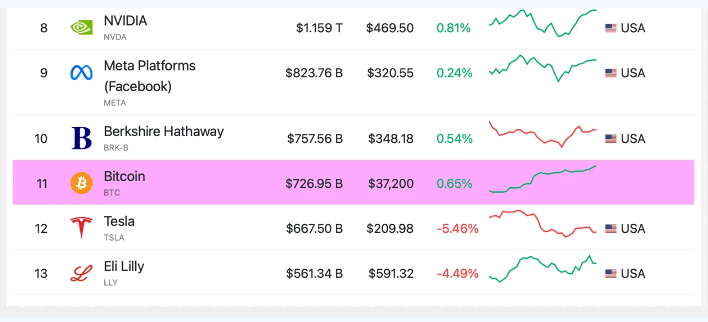
Bitcoin’s market cap has risen to No. 11 in the global market capitalization index. Currently, BTC boasts a market valuation of approximately $726.95 billion, with trading prices hovering just above the $37,000 mark.

The market anticipates that the U.S. Securities and Exchange Commission (SEC) will soon have multiple spot Bitcoin exchange-traded funds (ETFs).

Bitcoin futures exchange-traded funds (ETFs) are pools of bitcoin-related assets offered on traditional exchanges by brokerages to be traded as ETFs. The intent behind these ETFs is to give retail and other investors exposure to cryptocurrencies without needing to own them

A spot Bitcoin ETF brings all the benefits of a futures ETF, such as investing in Bitcoin without using an exchange, paying less in fees than on a crypto exchange, and streamlining the process overall. But a spot ETF invests in Bitcoin on the spot.

Bitcoin is currently sitting just below Berkshire Hathaway and above Tesla on the index.

BITE 6: INVENTOR OF THE FLOATING GATE MOSFET DIES

Professor Simon Sze, the inventor of the Floating Gate MOSFET, a key technology that revolutionized modern computing forever, and so, without which Web 3 would not even exist, died on Monday (6th) at the age of 87.

Simon Min Sze was born in Nanjing, Jiangsu province, China, in 1936 and grew up in Taiwan. After graduating in Taiwan, he did a masters at Washington in 1960 and a doctorate at Stanford University in 1963.

He worked at Bell Labs up to 1990 whereafter he was given a Professorship at National Chiao Tung University.

Sze was also concurrently a Visiting Professor to University of Cambridge, Delft University, Soochow University, Swiss Federal Institute of Technology, and Tokyo Institute of Technology.

Professor Simon Min Sze received many awards in his lifetime and was a fellow of many Associations and Societies. May he rest in peace.

Professor Sze

Get your .9jacom and .9javerse Web 3 domains  for $2 at:

.9jacom Domains

.9javerse Domains

Visit 9ja Cosmos

Follow us on LinkedIn HERE


Background Sourced 11/11/23 from:

cointelegraph.com/news/blackrock-argues-sec-has-no-grounds-to-treat-crypto-futures-and-spot-etfs-differently

youtube.com/watch?v=K96OYpqMD-w

investopedia.com/investing/bitcoin-etfs-explained/

venturebeat.com/ai/midjourneys-new-style-tuner-is-here-heres-how-to-use-it/

dannymekic.com/202310/undermining-democracy-the-european-commissions-controversial-push-for-digital-surveillance

www.afr.com/technology/start-up-founder-resigns-after-offensive-comments-to-women-on-linkedin-20231107-p5eiai

www.ledgerinsights.com/tokenize-diamonds-russia-expobank/

news.bitcoin.com/bitcoin-soars-to-become-11th-largest-global-asset-nearing-berkshire-hathaways-valuation/

eenctu.nctu.edu.tw/en/teacher/p1.php?num=127&page=1

How To Secure Commercial Air Operations Licensing for Foreign Air Operators in Nigeria

0

Nigeria is a signatory to the Chicago Convention and as a result , has the right to lay down binding regulations for entry into & flight operations into, from or within Nigeria.

Usually, international commercial air transport flights are permitted into a contracting state by virtue of the terms contained in international agreements that grant the permission to operate in that state and require the safe operation of aircraft.

In Nigeria, the Nigerian Civil Aviation Authority (NCAA) is the government agency statutorily empowered to make regulations regarding the terms and conditions under which Nigeria ensures aviation safety via constantly verifying the airworthiness & personnel or foreign operations.

This article will be looking at the provisions of the NCAA Regulations on foreign airlines seeking to operate in, from or within Nigeria.

What is the applicability scope of the NCAA foreign airline regulations?

The regulations prescribe requirements applicable to the operation of any civil aircraft that is :-

– used for commercial air transportation operations by any air operator whose AOC is issued; and

– controlled by an authority other than Nigeria.

These regulations do not apply to aircraft when used by military, customs & police services, which are not used for compensation or hire.

What are the provisions of the NCAA Regulations on compliance?

– A foreign air operator shall not operate an aircraft in commercial air transportation operations into Nigeria contrary to :-

a). The requirements of NCAA Regulations.

b). Standards set by the Chicago Convention.

c). Any other requirements that the authority may specify.

What are the provisions of the regulations on the authority to inspect?

– A foreign air operator in Nigeria is required to ensure that any person authorised by the NCAA shall be permitted at any time, without prior notice, to board any aircraft operated for commercial air transportation to Nigeria :-

  1. To inspect the documents and manuals requested by the NCAA
  1. To conduct an inspection of the aircraft
  1. To take appropriate action when necessary to preserve safety

What are the provisions of the Regulations on approval for foreign air operators to operate in Nigeria?

– A foreign air operator from the territory of another state shall not operate an aircraft in Nigeria unless it is so authorised by the NCAA & holds associated operations specifications containing the special limitations & specific approvals issued to it by the authority.

– A foreign operator intending to operate in Nigeria shall submit an application to the NCAA in a form & manner prescribed by the Regulations.

– An application for approval to operate in Nigeria shall be accompanied by:-

  1. A Certified True copy of an AOC license & associated operations specifications issued to the foreign air operator by the foreign authority.
  1. A copy of the approval page for an MEL for each aircraft type intended to be operated by the foreign air operator in Nigeria.
  1. A copy of the current certificate of aircraft registration & certificate of airworthiness issued for each aircraft type proposed to be operated by the foreign air operator in Nigeria.
  1. A copy of the insurance certificate.
  1. A copy of the operational procedures and practices of the foreign air operator.
  2. A copy of a document identifying the maintenance checks that are required to be performed for the aircraft of the foreign air operator while they are operated in Nigeria.

What is the minimum share capital requirement for foreign air operators seeking to do business in Nigeria?

The minimum share capital for operation in Nigeria is as follows :-

– International Air Operations :- 2 Billion Naira

– Regional Air Operations :- 1 Billion Naira

– Domestic/Local Air Operations :- 500 Million Naira

What are the provisions of the regulations on the issuance of documents of authorizations along with their conditions and limitations?

The NCAA will issue operations specifications to a foreign air operator to conduct commercial air transportation operations in Nigeria :-

  1. Where the authority is satisfied and has confident in :

a). the validity of the certificate and licenses associated with the operator;

b). the operator’s personnel & aircraft;

c). the level of certification & oversight applied to the activities of the operator by the foreign authority.

  1. Following approval of the foreign air operator’s application to operate into Nigeria.
  1. Upon a satisfactory administrative review of the documentation provided by the foreign air operator under the regulations and :-

a). When it has established bilateral or multilateral agreements with the state of the operator that includes in the agreement the safety clause prescribed by the regulations, or 

b). When it has not established bilateral or multilateral agreements with the state of the operator, the NCAA receives no significant safety findings or major deficiencies from available safety related information relevant to the foreign air operator.

What are the flight rules within Nigeria that foreign air operators must be cognizant of as outlined by the NCAA Regulations?

General

– A foreign air operator shall ensure that its flight crew members have the appropriate licenses & ratings for the operations to be conducted into Nigeria.

Age Limitations

– Foreign operators shall ensure that the required PIC(Pilot-in- Command) engaged in single pilot operations in aircraft operating into Nigeria shall be less than 60 years of age.

– For aircraft engaged in operations into Nigeria requiring more than 1 pilot and a flight crew, foreign air operations shall ensure that if one pilot is between 60&65 years of age, the other pilot is less than 60 years of age. 

Language Proficiency

– Foreign air operators shall ensure that flight crew operations aircraft into Nigeria meet the language proficiency requirement of at least the ICAO operational level (Level 4) fot the English language & such proficiency is endorsed on the license.

The Payment Privacy Act, Self-custody Crypto Bill, Grupo Cuscatlán Payments

0

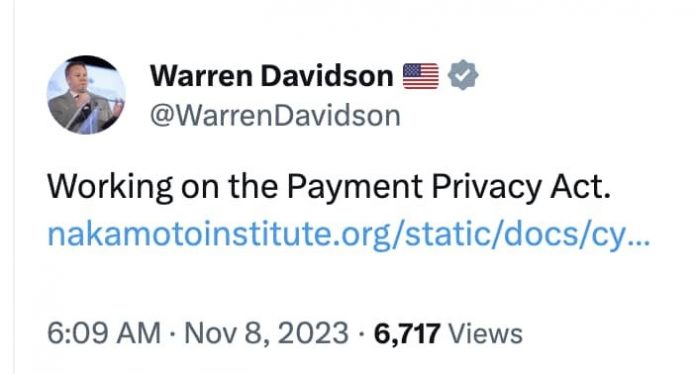
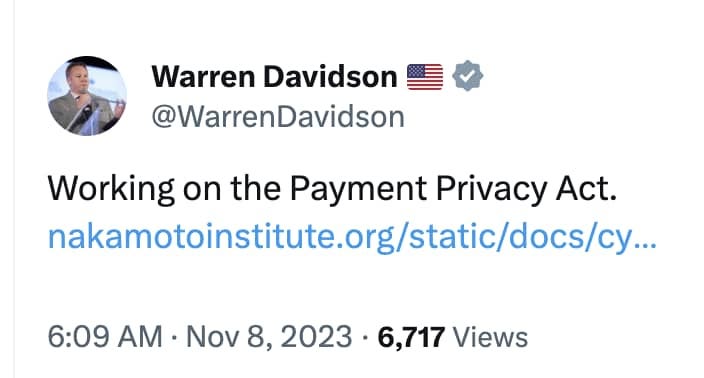
In a surprising move, US Congressman, Warren Davidson has announced that he is working on a new bill that would protect the privacy of online payments and promote the adoption of Bitcoin. The bill, dubbed the Payment Privacy Act, would prevent the government and other third parties from accessing or collecting information about users’ online transactions, such as their identities, locations, amounts, and purposes.

The Congressman said that he was inspired by the Nakamoto Institute, a research organization dedicated to advancing the ideas of Bitcoin creator Satoshi Nakamoto. He shared a link to the institute’s website, where he said he learned about the benefits of Bitcoin as a decentralized, censorship-resistant, and sound money system.

“I believe that privacy is a fundamental human right, and that online payments should be no exception. The Payment Privacy Act would ensure that Americans can use the internet to transact freely and securely, without fear of surveillance or interference. It would also encourage the innovation and adoption of Bitcoin, which is the most secure, transparent, and democratic form of money ever created,” he said in a statement.

The Congressman added that he hopes to introduce the bill in the next session of Congress, and that he welcomes feedback and support from his colleagues and constituents. He said that he believes that the Payment Privacy Act would benefit not only individual users, but also businesses, charities, and the economy as a whole.

“This bill is not only about protecting privacy, but also about promoting prosperity. By allowing people to use Bitcoin as a medium of exchange, store of value, and unit of account, we can unleash the full potential of this revolutionary technology. Bitcoin is not only a currency, but also a network, a protocol, and a platform for innovation. It can enable new forms of commerce, governance, and social interaction that are more efficient, fair, and inclusive than ever before,” he said.

US Congressman Tom Emmer has launched a scathing attack on SEC Chair Gary Gensler, accusing him of being ineffective and incompetent in regulating the crypto industry. In a blog post published on his official website, Emmer said that Gensler’s lack of clarity and leadership has created uncertainty and confusion for innovators and investors in the digital asset space.

Emmer argued that Gensler’s approach to crypto regulation is based on outdated and rigid frameworks that do not reflect the dynamic and evolving nature of the technology. He also criticized Gensler for ignoring the calls from Congress and the industry for a balanced and collaborative regulatory framework that fosters innovation and protects consumers.

Emmer said that Gensler’s failure to provide clear guidance and rules has left the US behind other countries that have embraced crypto and blockchain as a source of economic growth and opportunity. He urged Gensler to listen to the voices of the stakeholders and work with them to create a regulatory environment that supports the development and adoption of crypto in the US.

US Senator Ted Budd introduces bill to protect the right to self-custody Bitcoin and crypto.

In a major development for the crypto industry, US Senator Ted Budd has introduced a bill that aims to protect the right of individuals to self-custody their own digital assets. The bill, titled the “Financial Technology Protection Act of 2023”, would prohibit any federal agency from requiring individuals to use a third-party custodian or intermediary to access or control their own crypto assets.

The bill also establishes a FinTech Leadership in Innovation and Financial Intelligence Program, which would provide grants and incentives for research and development of blockchain and other financial technologies. The program would also support efforts to combat illicit use of crypto and enhance national security.

Senator Budd, who is a member of the Senate Banking Committee and the co-chair of the Congressional Blockchain Caucus, said that the bill is a response to the growing demand for crypto and the need to protect the rights and privacy of users.

“Crypto is not only a revolutionary technology, but also a powerful tool for financial inclusion and empowerment. Millions of Americans are using crypto to store their wealth, make payments, access financial services, and participate in the digital economy. They deserve to have the freedom and security to self-custody their own assets, without fear of government interference or coercion,” he said.

He added that the bill also recognizes the importance of innovation and leadership in the FinTech sector, and the potential of blockchain and other technologies to enhance efficiency, transparency, and security in the financial system.

“The US cannot afford to fall behind in the global race for FinTech innovation and adoption. We need to foster a regulatory environment that supports innovation and protects consumers, while also addressing the national security challenges posed by malicious actors who abuse crypto for illicit purposes. This bill will help achieve these goals and ensure that the US remains at the forefront of the FinTech revolution,” he said.

The bill has been referred to the Senate Banking Committee for further consideration. It has also received support from several industry groups and advocates, such as the Blockchain Association, Coin Center, and the Chamber of Digital Commerce.

Grupo Cuscatlán in El Salvador now accepts Bitcoin Payments

In a major milestone for the adoption of Bitcoin in El Salvador, the second-largest distributor of consumer goods in the country has announced that it will accept Bitcoin payments for its products and services. The company, Grupo Cuscatlán, operates in various sectors, including food, beverages, personal care, household items, and pharmaceuticals. The company has over 2,000 employees and more than 500 distribution points across El Salvador.

Grupo Cuscatlán said that it decided to embrace Bitcoin as a way to support the government’s initiative to make the cryptocurrency legal tender, as well as to offer more convenience and choice to its customers. The company has partnered with OpenNode, a Bitcoin payment processor, to enable fast and secure transactions using the Lightning Network. Customers can pay with Bitcoin using their Chivo wallet or any other compatible wallet.

The company’s CEO, Carlos Hernández, said that he believes that Bitcoin will bring many benefits to El Salvador’s economy and society, such as financial inclusion, innovation, and entrepreneurship. He also said that he hopes that other businesses will follow Grupo Cuscatlán’s example and adopt Bitcoin as a payment option.

This news comes after El Salvador became the first country in the world to make Bitcoin legal tender on September 7, 2021. The move was met with mixed reactions from the international community and the local population. Some praised it as a bold and visionary step, while others criticized it as risky and irresponsible. The implementation of the law also faced some technical and logistical challenges, such as network outages, protests, and legal disputes.

However, despite the difficulties and controversies, El Salvador’s experiment with Bitcoin is still ongoing and attracting attention from other countries and regions that are interested in exploring the potential of the cryptocurrency. According to President Nayib Bukele, more than 2.1 million Salvadorans are using the Chivo wallet, which represents about 32% of the population. He also claimed that Bitcoin transactions have saved the country $400 million in remittance fees.

What are the challenges and opportunities of using bitcoin in El Salvador?

The adoption of bitcoin in El Salvador has been met with mixed reactions from different stakeholders. On one hand, some supporters of the initiative have praised it as a bold and innovative step that could empower millions of people and transform the country’s economy.

They argue that bitcoin offers a more democratic, transparent, and efficient alternative to the traditional financial system, which is often plagued by instability, inflation, and exclusion. They also point out that bitcoin could help El Salvador diversify its sources of income and reduce its reliance on foreign aid and debt.

On the other hand, some critics of the initiative have raised concerns about its feasibility, legality, and impact. They contend that bitcoin is too volatile, risky, and complex to serve as a reliable medium of exchange or store of value. They also question the readiness of the country’s infrastructure, regulation, and education to support such a radical change.

They warn that bitcoin could expose El Salvador to money laundering, tax evasion, cyberattacks, and sanctions from international institutions and partners. They also fear that bitcoin could undermine the country’s monetary sovereignty and fiscal policy.

The implications for the future of cryptocurrency and financial inclusion?

The adoption of bitcoin in El Salvador is a historic experiment that could have significant consequences for the global cryptocurrency market and the broader financial system. Depending on its outcome, it could either inspire or discourage other countries to follow suit or adopt their own digital currencies. It could also influence the development and regulation of cryptocurrency technology and innovation around the world.

Moreover, the adoption of bitcoin in El Salvador could have important implications for financial inclusion and development. It could either expand or limit the access and opportunities of millions of people who are currently excluded or underserved by the formal financial sector. It could also either enhance or erode their financial literacy, security, and rights.

Ultimately, the success or failure of El Salvador’s crypto drive will depend on how well it addresses the needs and expectations of its people and stakeholders, as well as how it adapts to the challenges and opportunities that arise along the way.

It remains to be seen how Bitcoin will impact El Salvador’s economy and society in the long term, but for now, it seems that more and more businesses and individuals are willing to give it a try. Grupo Cuscatlán’s announcement is a clear sign that Bitcoin is gaining traction and legitimacy in the country, and that it may soon become a common and accepted way of paying for goods and services.

African Development Bank Allocates $1.5 Billion to Promote Food Processing, Export Across Africa

0

The President of the African Development Bank (AfDB), Dr. Akinwumi Adesina, announced at the 2023 Africa Investment Forum (AIF) Market Place in Marrakesh, Morocco, that the bank has provided $1.5 billion to support the export of value-added agricultural products through the Special Agro-Industrial Processing Zones (SAPZs) initiative.

The announcement was made during the inauguration of the Alliance for SAPZs.

Adesina emphasized the importance of Africa moving away from the export of raw agricultural commodities and focusing on exporting value-added products. He stated that SAPZs play a crucial role in providing the necessary infrastructure to support agro-industrial development in Africa.

“Africa must end the export of raw agricultural commodities. We must recognize that the fastest way to poverty is via the export of raw commodities, while the highway to wealth is from the export of value-added products,” he said.

“And that is why SAPZs are important. They provide critical infrastructure to support agro-industrial development in Africa.”

The partners in the Alliance for SAPZs include the Islamic Development Bank, the International Fund for Agricultural Development, the Arab Bank for Economic Development, the European Union, and the Korean Export-Import Bank. The collective effort of these partners has mobilized $1.5 billion in support of establishing 25 SAPZs in 11 African countries.

To further expand SAPZs across the continent and leverage the Africa Continental Free Trade Area (AfCFTA), Adesina emphasized the need for countries to scale up resources, partnerships, and alliances. He expressed excitement about the growing number of partners joining forces to rapidly scale up SAPZs across Africa.

The Alliance aims to mobilize at least $2 billion in financing and investment commitments from its members and partners over the next five years. Achieving this goal will lead to an additional 15 to 20 SAPZ projects in various countries across the continent.

“The Alliance will raise funds through various investment windows for project preparation, project development and construction, and financing for tenant companies,” Adeshina said.

The AfDB president announced last week at the Norman E. Borlaug Dialogue organized by the World Food Prize Foundation, that Africa’s food and agricultural industry is projected to be worth an estimated $1 trillion by 2030. This underscores the AfDB’s push to bolster food production and export in the continent.

During the inauguration of the SAPZs, partners pledged an additional commitment of about $3 billion to support the initiative. The SAPZs’ initiative is seen as a strategic move to enhance agricultural value chains, promote industrialization, and contribute to economic development in Africa.

Tackling the challenges

Despite efforts by the AfDB and stakeholders to promote the SAPZs initiative, several challenges have stood in the way. Dr. Benedict Oramah, the President of the African Export-Import Bank (Afreximbank), highlighted political instability in Africa as a significant obstacle to funding major projects, including those related to agro-industrial development. He emphasized the need for the development of comprehensive project financing ideas and proposals for the continent.

Oramah also pointed out that budgetary constraints are a primary obstacle to facilitating financing and project implementation. He stressed the importance of resource allocation and suggested the establishment of continental regulations that countries should respect. Additionally, he emphasized the significance of justice for initiatives beneficial for business.

While there is a commitment from partners to support the SAPZs initiative with an additional pledge of about $3 billion, addressing political instability and budgetary constraints remains crucial for the successful implementation of projects aimed at promoting agricultural value chains and industrialization in Africa.