DD
MM
YYYY

PAGES

DD
MM
YYYY

spot_img

PAGES

Home Blog Page 4034

A Complete Guide To Use Creative Suite

0

Are you looking for an easy yet in-depth guide to explore this newly emerging all-in-one Creative Suite? You are at the right place. This article will help you dig deep into the CapCut creative suite which is a collection of online editing tools. Its main components include the online photo and video editor, free personal/commercial templates, no watermarks, cloud backup, smart tools, etc. In this article, each of the main components of this incredible creative suite has been discussed in detail. So, let’s have a look at them below!

Main Components of Creative Suite

CapCut Creative Suite is not just a single tool but a combination of tools in one place. In simple words, it is an all-in-one online package where you can make dramatic edits to your photos and videos. The following details about these components can help you gain a better idea about them.

  • Online Video Editor

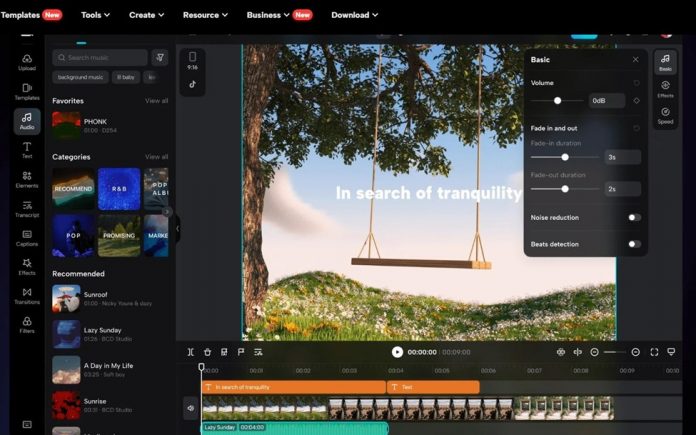
The top of the main component of this Creative Suite is its video editor which is available online and free. Yes, you can use it without making any payments to this Creative Suite. It doesn’t even ask you to make a one-time subscription payment or anything like that. Besides, you will find all the premium and professional-level video editing tools in this editor. For example, it is enriched with tools such as background remover, background changer, captions generations, and color adjustments.

It also allows you to edit, crop, and resize the video and add different audio or sound effects, video effects, and other elements to the video.

  • Online Photo Editor

The second most important component of this Creative Suite is its photo editor which is also available online. You don’t need to make any downloads to start using this editor for photo editing. Similarly, none of its editing tools requires any payment or subscription. Instead, all the AI tools and features of this online photo editor are free to use for all people.

By using this, you can replace the dull background of your image with an interactive one. You can also optimize the colors of your photo to uplift its visuals and make it aesthetically beautiful. In addition, there are several other impressive features of this online image editor e.g. adding frames, filters, text effects, etc.

  • Templates for Commercial and Personal Use

This Creative Suite also includes a huge variety of templates for commercial and personal use. No matter whether you are an organization, a company, or a single person, these templates are free for you. You can browse through their impressive variety to pick up the one you need. In addition, this Creative Suite also allows you to edit any chosen template for free. Regardless of the template you choose, you can apply many or all of the editing features to it. So, feel free to edit your desired template in any way you want and save it to your device.

  • No Watermark

Upon saving the final results to your device, you will notice that it doesn’t contain any watermarks on it. Yes, this incredible Creative Suite doesn’t take any credit for making transformations to your photos or videos. The absence of watermarks on your transformed photos and videos gives you the full choice to share them anywhere you want. It also gives you full ownership to use or further edit these images or videos in any way you like.

  • Smart Tools

Another impressive component of this Creative Suite is the availability of its smart tools. All these tools (text to speech free converter or image/video Upscaler) are based on AI technology which gives accurate and instant results. There is no room for mistakes as the machine learning algorithms are more accurate and precise in making the desired transformations.

  • Creative Cloud and Team Collaboration

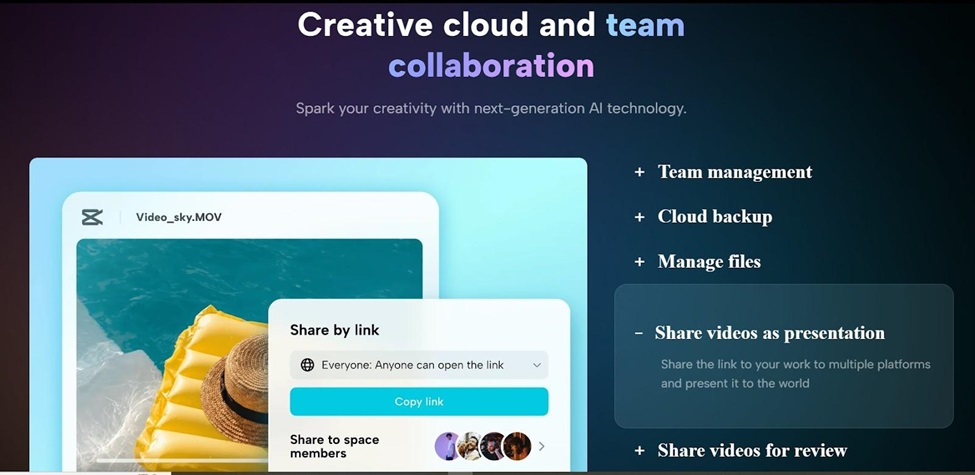
Finally, this amazing Creative Suite comes with the Creative Cloud and team collaboration to spark your creativity. It allows you to interact with your teams by inviting them to this space. Then, you can assign them different roles such as editor, collaboration, owner, etc., and work together. You can also share your videos for review or share them as presentations to present to others.
How to Use CapCut Creative Suite?

If you have not used this incredible Creative Suite before, the following guide will help you a lot. It will lead you through a step-by-step simple process to use this Creative Suite for making dramatic transformations to your photos and videos. So, here are these simple, easy, and quick steps!

  • Step 1: Signup

Just visit the CapCut Creative Suite URL which is https://www.capcut.com/creative-suite and click on the “Signup for Free” button. Enter only the required basic information and avoid putting on your bank account details, credit card details, home address, etc. This editor doesn’t ask you for any of such information. So, refrain from adding anything like this which is not asked in the signup form. After submitting the form and verifying it through your email, sign in to this newly created account.

  • Step 2: Upload

Click on the online video editor and use the upload button to upload any of your videos to this space. There are also some sample videos in this editor that are free to use. If you feel reluctant to use your video first, take any of these sample videos and try the results. Then, upload your video through the upload button or simply by drag and drop feature.

  • Step 3: Transform

When your video is here at the editors’ workspace, start making interactive edits to it. For this purpose, the must-use feature here is to generate the captions for your videos. The editor has an auto-captions generate button that you can use for instant creation of captions. Otherwise, it also allows you to add the captions manually if you want. Besides captions, there are many other impressive features such as changing the background of your video.

You can also add text effects, video effects, transitions, and filters to your video. There are also options to add different interactive and suitable soundtracks behind your videos. Moreover, you can also resize, crop, and trim your video to the desired size. Try exploring tons of professional features at this editor and come up with the most impressive end results.

  • Step 4: Export

In the end, you will have to go to the top right blue colored export button and then click on download. Your video will then start downloading to your device.

Conclusion

Without having adequate knowledge about an editor, you can take the maximum benefits out of it. When you don’t know which tools and features it brings for you, how would you use them in accomplishing your goals? Therefore, it is crucial to learn about editing before you start using it. So, if you are someone who loves editing photos and videos but is in search of the best editor for this purpose, this article is for you. Make sure to read it thoroughly to explore what components this amazing Creative Suite brings for you and how you can use it. Follow the steps discussed above to start using this incredible Creative Suite and cherish yourself through the mindblowing results.


NMDPRA Regulations On Inspection, Enquiries, Governance on Gas Exchanges & Clearing Houses, etc in Nigeria

0

Gas Trading – Inspection, Enquiries & Enforcement In Nigeria

This article is focused on the provisions of the regulations of the Nigerian Midstream & Downstream Petroleum Regulatory Authority (NMDPRA) on gas trading, specifically the topics of inspection, enquiries and enforcement.

What are the provisions of the NMDPRA regulations on market oversight?

– The NMDPRA may cause an investigation into the affairs of a gas exchange or clearing house to maintain market oversight & surveillance as well as to check market integrity.

– An investigation shall be conducted where the authority reasonably suspects that there has been :-

a). Manipulative or attempted manipulative activity.

b). Anti-competition and anti-competitive behaviour.

c). Transactions that are misleading or deceptive, or are likely to mislead or deceive.

d). Unwarranted speculation leading to market volatility.

e). Price distortions.

f). Any form of cartelization.

g). Any form of market abuse.

h). Abuse of dominant position by any market participant.

– The NMDPRA may after investigation issue directives, as it considers appropriate to maintain market oversight & surveillance to check market integrity.

What are the other circumstances requiring intervention by the NMDPRA?

– The NMDPRA may, by an order, give such directives as may be necessary when it is satisfied that any of these circumstances exist or is likely to occur in the market :-

a). Abnormal increases or decreases in the price of gas.

b). Sudden or unreasonable fluctuations or unwarranted changes in the prices of gas and high volatility.

c). Sudden high transaction volumes on a gas exchanges.

– The NMDPRA may, without prejudice to the first paragraph above, by order in writing –

a). Suspend transaction activities for a cooling off period, in case of increased volatility.

b). Suspend transaction of any specific contract in the gas exchange.

c). Increase the margin for contracts transacted on gas exchanges, in a case of high volatility of prices or high speculation.

d). Allow trade only for trade settlement.

What are the provisions of the regulations on the power to demand for information?

– The NMDPRA may demand for any information, documents or records from a gas exchange or clearing house.

What is the provision of the regulations on the power of inspection?

– The authority may at any time undertake inspection, conduct inquiries and audit of any gas exchange or clearing house, or/and any associate or affiliate of such exchange or clearing house.

Do the regulations confer any further power on the NMDPRA regarding interim orders?

– Where during an investigation or intervention, the NMDPRA is satisfied that an act in Contravention of these regulations has been committed or continues to be committed or that such act is about to be committed, the authority can by order, temporarily restrain any person from carrying on such act until the conclusion of such investigation or intervention or until further orders, but such order shall not be made without giving notice and opportunity of being heard to such a person.

The Governance Structure of Gas Exchanges & Clearing Houses in Nigeria

This article will be looking at the provisions of the Nigerian Midstream Downstream Petroleum Regulatory Authority NMDPRA Regulations on the Governance Structure of The Gas Exchange in Nigeria.

What is the governance structure of the exchange under the regulations?

– The governance structure of the gas exchange shall be in compliance with the rules and regulations governing the registration and operation of an exchange as prescribed by the Securities and Exchange Commission (SEC).

What are the provisions of the NMDPRA regulations on disclosure and corporate governance norms?

– The disclosure requirements and Corporate governance norms provided in the regulations shall apply to a gas exchange and a clearing house in addition to those specified by the Securities and Exchange Commission (SEC) for listed companies.

– The board or directors of a gas exchange or a clearing house shall confirm compliance with these regulations in writing on a quarterly basis to the NMDPRA within 2 months from the end of each calendar quarter.

– A gas exchange and clearing house shall disclose to the NMDPRA its resources committed towards strengthening regulatory functions and ensuring compliance with regulatory requirements applicable to the gas exchange or clearing house, as the case may be.

-The fees and charges levied by a gas exchange or a clearing levied by a gas exchange or clearing house shall be placed for review and approval before the oversight committee of such gas exchange or cleaning house.

What is the default remedy mechanism on gas exchanges and clearing houses under the regulations?

– A member may be declared a defaulter by direction or circular of the gas exchange or clearing house, if the member :-

a). Is unable to fulfill its clearing or settlement obligations.

b). Admits or discloses its inability to fulfill or discharge its duties, obligations and liabilities.

c). Fails or is unable to pay within the specified time the damages and the money difference due on a closing-out effected against him under the bye-laws of gas exchange or clearing house.

d). Fails to pay any sum due to the gas exchange or clearing house which may be prescribed by the authority competent for such purpose. 

– In the event a member is declared a defaulter and the member fails to meet Its clearing and settlement obligations, upon crystallisation of claims in accordance with the bye-laws of the gas exchange, or jr claim amount shall be set aside from deposits of the defaulting member and the recovered amount shall be distributed fairly and proportionately among the affected parties including transporter, seller, buyer, pipeline system operator and gas exchange or clearing house, from the deposits of the member or client.

What is the prescribed delivery procedure under the NMDPRA regulations?

– The scheduling and delivery of contracts on the gas exchange shall be in accordance with the network code, pipeline and virtual pipeline system rules.

– Subject to the provision of these regulations, operationalisation of scheduling of transactions through the gas exchange shall be in accordance with the detailed procedure issued by NMDPRA under the network code or virtual pipeline system rules.

– The charges or penalties for defaults shall be in accordance with the network code or other rules issued by the NMDPRA.

What is the grievance redressal mechanism stipulated by the regulations?

– The NMDPRA may call for information on the redressal of any specific complaints and grievances by the gas exchange.

Notable Regulatory Provisions on Gas Trading Licenses & Clearing House Authorizations

This article is focused on the regulatory framework governing gas trading licenses and clearing house authorisations, from license applications to renewals. 

What is the regulatory agency in charge of gas trading and clearing house authorisations?

Gas trading licences and clearing house authorisations are under the jurisdiction of the Nigerian Midstream & Downstream Petroleum Regulatory Authority (NMDPRA). 

What are the provisions of the NMDPRA on the duty to obtain licenses or authorisations?

– A person shall not establish or operate a gas exchange without a gas trading license issued by the NMDPRA in accordance with its regulations.

– A person shall not act as a clearing house for a gas exchange without the prior authorization of the NMDPRA.

– A qualified person under the NMDPRA regulations shall only be entitled to participate in the exchange where the person holds a valid and approximate license or permit issued by the NMDPRA.

What are the provisions of the NMDPRA on applications for licenses or authorisations?

– An application for a gas trading license or clearing house authorisation shall be submitted to the NMDPRA in the form as prescribed in guidelines issued by the Authority, subject to compliance with its regulations.

What are the conditions for granting a gas license?

– An application for a gas trading license in the NMDPRA regulations shall comply with the rules of the Securities and Exchange Commission (SEC) in relation to commodities trading.

– An applicant for a gas trading license shall :-

a). Be a company limited by shares

b). Be demutualised

c). Ensure its directors are fit and proper persons as specified in these regulations

d). Satisfy the requirements relating to the ownership and governance structure specified in these regulations and other appropriate government regulations

e). Satisfy financial & technical capabilities

f). Have the necessary infrastructure for the orderly execution of trade

g). Have an online screen-based trading system

What are the conditions for granting a Clearing house authorisation?

– An applicant seeking authorisation as a clearing house  shall – 

a). Have necessary infrastructure and resources to ensure timely clearing and settlement of trades.

b). Have adequate risk management mechanisms.

c). Have the capacity to establish and publish a settlement procedure including netting, novation and guarantees for settlement of trades in place, as specified by the NMDPRA.

d). Demonstrate the establishment of an applicable settlement guarantee fund to guarantee settlement of trades.

e). Demonstrate a wide network of clearing members and have adequate facility to admit and regulate its members.

f). Have the facility to disseminate information about trades, quantities and quotes in real time.

g). Establish connectivity with the clearing banks, gas exchange and clearing members.

h). Satisfy other conditions as may be specified by the NMDPRA.

What is the extent of the NMDPRA’s power go make inquiries & call for information?

– The NMDPRA may , before granting a gas trading license or clearing house authorisation, make inquiries and require the applicant to furnish such further information or documentation as it may deem necessary.

What is the duration of a license in this regard?

– The validity of a gas trading license shall not exceed 10(Ten) years from the date of issuance unless such license or authorisation is withdrawn or cancelled.

What is the provision of the NMDPRA regarding license or authorisation renewal?

– A gas exchange or clearing house, desirous of renewing its license or authorisation may make an application not later than 12 months before the expiration of the validity period of such license or authorisation, in the manner prescribed by the NMDPRA.

Experience Russia’s 161 Days of Global Techno-Culture Driven Exhibition

0
Visitors experiencing modern technologies from Russian companies and regions at the exhibition Source: Russia Expo, 2023

Exhibitions serve as platforms for promoting culture, trade, investment, and industry, featuring an array of both physical and non-physical products from individuals, businesses, and government entities. These events play a vital role in fueling economic growth in specific regions. In fact, exhibitions have a rich historical legacy that dates back to the display of artworks and historical materials in the pre-modern era.

In today’s postmodern world, exhibitions have evolved, utilizing diverse strategies to captivate and engage visitors. From Shanghai to Messe Hannover and Messe Frankfurt, sprawling venues spanning thousands of square meters have hosted countless exhibitions. But from November 4, 2023, to April 12, 2024, a remarkable addition takes the stage as Russia joins this elite league. VDNH, a legendary tourist, cultural, and entertainment hub at the heart of Moscow, opens its doors to a global exhibition spanning over 3 million square meters.

The grand opening saw a staggering turnout of over 190,000 visitors, making it a spectacular event that showcased Russia’s cultural richness and innovative spirit. The day was filled with concerts, educational events, mesmerizing choreographic dance performances, and the unveiling of new pavilions, along with a series of captivating presentations. The gastronomic festival “Russia – Territory of Taste” added a delightful culinary dimension, featuring dishes from the diverse cuisines of Russia. On the same day, a gala concert titled “Wind Rose – Achievement of Russia” and a VK concert featuring a lineup of talented performers were also held.

At the heart of this exhibition is the noble goal of showcasing Russia’s achievements, celebrating its rich history and promising future, and highlighting key projects and developments from Russian companies, organizations, and regions. VDNH plays host to 89 Russian regions, all executive bodies, major corporations, state entities, and public organizations, offering visitors the opportunity to explore 131 exhibitions featuring over 1,500 captivating objects. This exhibition is a must-visit for anyone eager to discover the vast tapestry of Russia’s cultural and industrial accomplishments.

Discover Russia’s Vibrant Progress in 10 Thrilling Themes

Comfortable Urban Environment. Dive into the transformation of Russia’s urban landscapes. Explore the innovative strides taken by urban administrators, the Russian government, and stakeholders in creating comfortable urban environments. Witness how these spaces adapt to climate change, urbanization, and densification strategies across 89 regions, from Moscow to Saint Petersburg and beyond. Innovative Development and Entrepreneurship. Witness the groundbreaking innovations that have made Moscow a top-rated city for innovation. Discover the contributions of the Skolkovo Innovation Center and the Moscow Innovation Cluster, fostering a culture of sustainable innovation and entrepreneurship. Moscow’s influence reaches far beyond Russia’s borders, impacting nations worldwide. Youth Policy and Education. Unleash the potential of Russia’s youth as they shape the nation’s future. Explore the strategy behind expanding opportunities for young people through initiatives like the Youth Assembly and the Civic Youth Chamber. Seven distinct projects focus on youth empowerment, encouraging socialization and self-realization.

Local Transport Framework. Navigate the intricacies of Russia’s public transport system, shaped by federal, regional, and local legislation. Major cities like Moscow and Saint Petersburg offer a network of bus routes, metro lines, and tramways, complemented by extensive infrastructure development, ensuring efficient transportation within and beyond urban centers. Smart City. Delve into the ranking of 171 cities to identify Russia’s smart city leaders. Discover how Moscow, St. Petersburg, Balashikha, Krasnodar, and Kazan have excelled in implementing smart city criteria, enhancing the quality of life for their residents. Industry and Digitalization for Economic Growth. Explore the measures undertaken to support Russian businesses and the population. From prioritizing Russian software in state procurement to banning foreign industrial goods, these strategies fuel economic growth and digitalization.

Uniting People. Witness the unifying spirit of the Russian people, a nation with a rich history of state-building. Their mission is to unite and bring civilization together, and their legacy is a testament to the strength of the human spirit. Creating the Future. Embrace a commitment to shaping humanity’s future. Join us as we express our desire to actively participate in the evolving future of our world. Healthy Moscow. Experience a revolution in healthcare in Moscow, featuring modern polyclinics, digital advancements in cancer treatment, and accessible health checks. Life-cycle contracts ensure the upkeep of medical equipment, delivering top-notch healthcare services. Moscow of the Future. Immerse yourself in the grand spectacle of Moscow’s evolution through the centuries. Witness how Moscow has become a leading megacity with cutting-edge infrastructure and social facilities. Discover innovative solutions for schools, kindergartens, hospitals, and more, setting new standards for the entire country.

Cultural and Outreach Programmes

Explore the rich tapestry of Russia’s 160 ethnic groups, all conversing in a fascinating array of nearly 100 languages at the EXPO! Our cultural program offers an enticing lineup of concerts, festivals, guided tours, and master classes to enrich your experience. Don’t miss the ‘Russia, the Territory of Flavor’ festival, a culinary extravaganza that unveils the splendid diversity of Russian gastronomy. While you’re here, you will discover a treasure trove of products from over 700 manufacturers at our department store, featuring exclusive Russian clothing brands. For the food enthusiasts, we’ve got vibrant farmers and winemakers markets to tantalize your taste buds.

Experience the future with ‘Russian Achievements,’ a captivating 166-meter tunnel that illuminates Russia’s groundbreaking contributions across various fields. Immerse yourself in the ‘Living Map of Russia’ installation, featuring a captivating array of Russian-themed videos. ‘Regional Days,’ taking place from November 9 to January 14, will be a spotlight on the remarkable achievements and the economic and cultural potential of the Russian Federation’s constituent entities.

The outreach programme is your gateway to knowledge, offering lectures, workshops, training sessions, roundtables, seminars, quizzes, master classes, presentations, and other engaging events. Best of all, admission is free, so everyone can partake in this enriching experience.

Towards Financial Securities of Nollywood Legends; We Must Write The Scripts

0

Seeing the video of Mr Amaechi Muonagor seeking financial aid days after Mr John Okafor (Ibu) also asked for financial help to clear his medical bills, I felt bad. It doesn’t just make sense that a person who has been acting since the 80s and has featured in hundreds of movies with fame spread across the world, cannot afford basic medical bills. This is saddening as it tells a lot about how meagrely Nollywood producers and movie makers pay these actors.

Truth be told, we can largely attribute the low earnings of these actors to piracy because to be fair, most producers are struggling as well because of praters who are stealing from them. Before cinema movies and online streaming platforms like Netflix etc became popular in Nigeria, Movie producers and actors barely made a dime from their movies due to piracies hence why it appears that after decades of acting some of these actors barely have savings to swing from in time of emergencies. 

But piracy cannot be solely responsible for actors being broke after decades of putting in hard work. The lack of knowledge of intellectual property rights and their protection in the Nigerian creative industry is also a contributor. Most of these old actors have no idea that there is another form of earning called royalties which they are entitled to in every movie they were featured in and the royalties accrue to them even to their descendants after their lifetime.

Most Nigerian entertainers do not know that they have the legal right to make demands from persons or brands who use their faces, names, memes or slogans, especially for marketing or promotional purposes. When you are an entertainer or a celebrity, your intellectual property is a goldmine and there is no limit to what you can earn from it. 

As an actor, especially as the lead actor, you should insist on signing a joint ownership agreement of your intellectual properties in the movie with the producer, you should even insist that your intellectual properties in the movie reverts fully to you after some years of the release of the movie. 

I remember Josh2funny telling me that after he popularized the slogan “All My Guys All Ballers” some big brand used it for adverts without paying him a dime; at that point he had no idea that he ought to be paid because that slogan could be ascribed as his intellectual property and anybody who uses it without his consent can be sued for infringement or better still, passing off.

“Na Dem dey rush us” by Charles Inojie spread like wildfire and is still trending to date. Brands used that mantra for marketing and promotion of their products but I know for a fact that Mr Charles Inojie didn’t earn a dime from it, maybe because he is not aware that he is entitled in law to lay claims on it as his intellectual property or he was not just interested. 

Mantras like “Nna anyi sacrifice” which can be ascribed to Mr Kanayo O Kanayo, “Na Dem Dey Rush us” by Charle Inojie, “You are doing Well/Fantabulous” by Mr Macaroni, “Shey You won Collect” by OGB recent, “Something Hooge” by Sabinus and the most recent one which is currently my favorite, “Ah greet you bros” by Wizdom247 comedian can be a money fetcher to these entertainers that it can be ascribed to even after they retire because once a mark or a slogan can be ascribed to you and you take the further step to trademark such mark or slogan, it legally becomes your property and you are to make money off it.

Entertainers on the other hand need to arm themselves with Intellectual property lawyers like myself or arm themselves with a management that understands and appreciates Intellectual property rights and its protection because the intellectual properties of a popular person can be a money generating fountain if well-guarded. 

Remedies Available To Consumers Against Manufacturers of Defective Products, Goods and Services in Nigeria

0

INTRODUCTION:

Nigeria has so many laws and regulatory agencies aimed at protecting consumers from hazardous products, goods and service as well as securing rights of consumers from sharp practices of some manufacturers, service providers and product dealers in Nigeria.

From telecommunications to digital satellite television to electricity supply to imported and exported goods to market commodities to health care facilities and aviation services; citizens earnestly yearn for improvement in the quality of products, goods and services which they obtain in the course of their daily need for survival.

Just recently, the government of Nigeria promulgated the Federal Competition and Consumer Protection Act, 2019 (FCCPA), and this new piece of legislation have a propensity to introduce new developments in our economy while promoting fair, efficient and competitive markets in the Nigeria with a view to eliminating monopolistic practices of manufacturers of products and services. It also safeguards citizens from hazardous products, goods and services while encouraging competitive price rates among various brands of commodities in the market and most importantly, opens up channels for companies to invest in areas of business that has been monopolized by some companies such as digital satellite television and power supply.

In this article, we explore the rights and remedies available to a consumer as well as explore the various legal frameworks that guide a consumer who has suffered damages, loss or injury as a result of consumption or use of defective products or services to seek redress.

WHO IS A CONSUMER?

According to Webster’s Dictionary, a consumer is a person who purchases goods and services for personal use and not for manufacture or resale. It went further to define a consumer as someone who can make the decision whether or not to purchase an item at the store and someone who can be influenced by marketing and advertisements. The dictionary also referred a consumer as a purchaser, buyer, customer, client, user and shopper.

From the above definition, a person, company, firm, community, village, agency, department, state and federal government can be a consumer so long as they need or affected by products, goods or services from manufacturers.

WHAT ARE THE RIGHTS OF A CONSUMER?

The fundamental rights of a consumer are:

  1. Right to basic needs: This guarantees survival, adequate food, clothing, shelter, health care, education and proper sanitation,
  2. Right to safety: This places emphasis on safety of products and guards against production, advertisement and circulation of harmful products, goods and services,
  3. Right to information and education: Before any product, good or services are made available for public consumption or use, adequate awareness and sensitization campaign are to be carried out,
  4. Right to choose and healthy environment: To avoid monopoly, the consumer has a choice to patronize diverse brands, sizes and colours from different manufacturers at a competitive price rate and most importantly, in a healthy environment.
  5. Right to redress: In line with section 36 of the 1999 Constitution of the Federal Republic of Nigeria, every consumer has a right to approach any court, tribunal or committee to seek redress over any injury, loss or damage arising from defective product or misrepresentation and be adequately compensated in the event that a manufacturer is found guilty.

The above rights relates to the reason why it is often said that “customer is king” and without a consumer, there would be no need to produce or manufacture any goods or provide services.

LAWS PROTECTING NIGERIAN CONSUMERS:

Apart from regulatory agencies such as National Agency for Food Drug Administration and Control (NAFDAC), Standard Organization of Nigeria (SON), Nigeria Communications Commission (NCC) and Nigerian Civil Aviation Authority (NCAA), the Consumer Protection Council Act CAP C25 Laws of the Federation of Nigeria, 2004 was promulgated to protect consumers from hazardous products, goods and services which are in the market and by virtue of section 2 of the Act, the Council is empowered to carry out the following oversight functions such as:

  1. Provide speedy redress to consumers’ complaints through negotiation, mediation and conciliation;
  2. Seek ways and means of removing or eliminating from the market hazardous products and causing offenders to replace such products with safer and more appropriate alternatives;
  3. Publish from time to time, the list of products the consumption and sale of which have been banned, withdrawn, severely restricted or not approved by the federal government or foreign governments,
  4. Cause an offending company, firm, trade, association or individual to protect, compensate and provide relief and safeguards to injured consumers or communities from adverse effects of technologies that are inherently harmful, injurious, violent or highly hazardous,
  5. Organize and undertake campaigns and other forms of activities as will lead to increased public awareness,
  6. Encourage trade, industry and professional associations to develop and enforce their various fields quality standards and designs to safeguard the interest of consumers,
  7. Issue guidelines to manufacturers, importers, dealers and wholesalers in relation to their obligations under the Act,
  8. Encourage the formation of voluntary consumer groups or associations for consumers wellbeing,
  9. Ensure that consumer’s interest receive due consideration at appropriate forums and provide redress for obnoxious practices or the unscrupulous exploitations of consumers by companies, firms, trade associations or individuals,
  10. Encourage adoption of appropriate measures to ensure that products are safe for either intended or normally safe use,

In addition to the above highlighted functions of the Consumer Protection Council, the Act by virtue of section 3 also empowers the Council to:

  1. Apply to court to prevent the circulation of any product which constitutes an imminent public hazard,
  2. Compel a manufacturer to certify that all safety standards are met in their products,
  3. Cause, as it deems necessary, quality tests to be conducted on a consumer product,
  4. Demand production of labels showing date and places of manufacture of a commodity as well as certificate of compliance,’
  5. Compel manufacturers, dealers and service companies, where appropriate to give public notice of any health hazards inherent in their products,
  6. Ban the sale, distribution, advertisement of products which do not comply with safety or health regulations

Flowing from the above functions and powers of the Consumer Protection Council, it is apparent that the Council has been adequately empowered to ensure that consumer rights are protected and enforced, but complaints from consumers is an everyday occurrence from the available products and services in the market.

REMEDIES AVAILABLE TO CONSUMERS WHO HAVE SUFFERED INJURY, LOSS OR DAMAGE ARISING FROM CONSUMPTION AND USE OF DEFECTIVE OR HAZARDOUS PRODUCTS, GOODS AND SERVICES:

By virtue and pursuant to section 6 of the Consumer Protection Act, where a consumer or community has suffered a loss, injury or damage as a result of the use or impact of any goods, products or service may make a complaint in writing to or seek redress through a State Committee. Although this process of seeking redress through a State Committee as provided by section 6 of the Act may appear cumbersome due to bureaucratic bottlenecks; however, the courts have always thrown its doors wide open to entertain complaints and cases relating to loss, injury and damages arising as a result of the use or impact of any defective or hazardous goods and services from manufacturers as well as order payment of the necessary compensation where needed.

One important manifestation of this case of consumer protection is the liability of manufacturers to consumers who fall victim of loss, injury and damages arising from the consumption or use of defective or hazardous products, goods and services. Thus, in the case of Donoghue v. Stevenson (1967) 1 W.L.R 912 the court held that:

“A manufacturer of products which her sells in such a form as to show that he intends them to reach the ultimate consumer in the form in which they left him with no reasonable possibility of intermediate examination and with the knowledge that the absence of reasonable care in the preparation or putting up of the products will result in an injury to the consumer’s life or property, owes a duty to the consumer to take reasonable care” see also (1932) A.C 562, 599.

Instances where heavy costs have been paid as compensation by manufacturers to consumers for consumption and use of hazardous products are as highlighted below:

Sometime around 1996 in Kano State, Nigeria, in a bid to protect the welfare of consumers from hazardous products by manufacturers, an action for damages and compensation in the sum of US6.95 Billion was instituted against Pfizer pharmaceutical company in the celebrated case of Abdullahi v. Pfizer Inc, 2002 WL 31082956 at 2 (S.D.N.Y 2005) over the illegal trial of an unregistered drug which led to the deaths of some children. However, the company reached an out of court settlement in the sum of USD75 Million to the affected families.

Also in the case of Bodo Community & Others v. Shell Petroleum Development Company of Nigeria Ltd (2014) EWHC 1973 TCC, some communities in the Niger Delta instituted an action for compensation and damages in the sum of £300 Million over an oil spill from Bomu-Bonny pipeline in Bodo Community belonging to Royal Dutch Shell which affected people living in the area. However, Shell offered the sum of £55 Million as compensation to the affected farmers and communities.

In essence, the ultimate remedy available to consumers is always to seek redress in appropriate courts, tribunal or committee set up to inquire about product liabilities and apply for relief in damages and compensations from the manufacturers of defective products.

HOW TO PROVE DAMAGES, LOSS AND INJURY ARISING FROM THE CONSUMPTION AND USE OF DEFECTIVE PRODUCTS, GOODS AND SERVICES:

It is an established doctrine that where a reasonable injury, damage or loss is foreseen, no matter how slight to the consumer, assuming him to be a normal person before the consumption and use of the products, goods or services, then the manufacturer is answerable for the full extent of the injury which the consumer may sustain owing to such consumption or use.

In order for consumers to prove cases of compensations and damages, against any manufacturer as a result of the consumption or the use of any product, goods or services, product liability law under Torts Law has been developed by our courts to mitigate the loss and injury as well as ensure that adequate compensations and damages are paid to consumers as remedy in situations where such cases are proved to have occurred.

Thus, these are the 3 (three) grounds needed to prove a case of injury or loss arising from consumption and use of defective products, goods and service:

  1. The product was defective,
  2. The consumer suffered damage, and
  3. There was a causal link between the defective product and the damage suffered.

However, a product is said to be defective if the safety of the product is not what persons are generally entitled to expect, taking into account these factors:

  1. The manner in which and the purpose for which the product has been marketed,
  2. Any instructions for use of warning,
  3. What might reasonably be expected to be done with or in relation to the product, and
  4. The time when the product was supplied (that is, a product is not unsafe just because a safer product was subsequently developed or because industry safety standards were raised after the products was supplied). In support of this ground is the case of Wilkes v. Deputy (2016) EWHC 3096 QB.

It is important to note that, the evidence that a consumer will need to prove a case of product liability will largely depend on the particular circumstances of the case. In defective product liability suits, there are basically 4 (four) key grounds which are as follows:

  1. The consumer must prove that he has been injured or suffered some loss or damages,
  2. The consumer must prove that the product, goods or services involved was defective or lacked proper warning or instruction, the result of which led to the injury, loss or damage he/she suffered,
  3. The consumer must prove that the defect or lack of warning or instructions was the specific cause of the injuries, loss or damages being suffered, and
  4. The consumer must prove that when he/she was injured or suffered the loss or damage, he/she was using the injury-causing product, goods or service in the manner in which it was intended to be used. In support of this ground are the cases of Longbrook Properties Ltd. v. Surrey County Council & Ors (1970) 1 W.L.R 161 at 1778, Williams v Beesley (1973) 1 W.L.R 1295.

DEFENCE TO PRODUCT LIABILITY:

There are various defences to a product liability claim and these are some of the grounds upon which a manufacturer may not be held liable for a defective product:

  1. Where the manufacturer issued a warning notice,
  2. Where the consumer discovers the defect, but proceeds to use the product, goods or service,
  3. Where the product left the manufacturer in good condition and there is no reason to anticipate it would become dangerous between the time it left the manufacturer to the time it got to the consumer,
  4. Where a property is completely dilapidated and the defect existed before it was sold, the seller will not be held liable as a result of any injury arising after sale,
  5. There will not be any liability if the use to which a product, goods or services is put, is different from that which it was intended by the manufacturer,
  6. The action is time barred.

An important case in support of defence to product liability is Howmet Ltd v. Economy Drives Ltd & Ors (2016) EWCA Civ 847 where the court held that a user’s knowledge of the defect in the product before any damage occurred could be used by the producer to exclude liability if the user voluntarily continued to use that product.

TIME LIMIT IN PRODUCT LIABILITY CASES:

The time limit in which proceedings can be brought is set out in the Limitation Act, 1980, which stipulates that there is a limitation period of six (6) years for action in respect of simple contracts and actions in tort occasioning claims for damages other than personal injury.

For Consumer Protection Act claims, the Limitation Act states that the general rule is that a claimant must bring an action against a defendant within three years of either:

The date on which the cause of action came into existence.

The date of knowledge of the claimant or of any person in whom the cause of action was previously vested, if earlier.

There is a shorter limitation period of three (3) years from the date on which the cause of action came into existence or the date on which the injured person gained knowledge of the injury, where damages claimed include damages in respect of a personal injury to the consumer.

There are a few exceptions to this general rule (for example, any period in which the person seeking to bring an action was under a legal disability for unsoundness of mind is not counted). However, an absolute long-stop exists of ten years from when the defective product was first put into circulation. Generally, “put into circulation” is accepted to mean when the product is taken out of the manufacturing process and enters a marketing process in which it is offered to the public to be consumed.

CONCLUSION:

Consumption is the main essence of production of goods and services without which human needs cannot be met. But where products, goods and services have been provided for consumption and use by consumers, albeit defectively; product liability arises to mitigate the loss or injury that may adversely affect the health, property and lives of consumer.

However, where an injury, damage or loss arises; recourse to file a complaint, petition or institute an action in court against a manufacturer of such products, goods and services without being armed with verifiable evidence and substantial proof to back up such allegations of defective product causing injury, may attract dire consequences on the part of the consumer.

To ensure that consumer meets the legal requirements to back up a claim of defective product before filing an action, it is advised that such consumer should consult with a lawyer to seek legal advice and determine the appropriate cause of action.

For further legal assistance on property and real estate transactions, do not hesitate to contact the author:

Kingsley Izimah, Esq.

Principal Partner,

SK Solicitors

0806-809-5282

www.sk-solictorsng.com

sksolicitors.ng@gmail.com or

info@sk-solicitorsng.com