DD
MM
YYYY

PAGES

DD
MM
YYYY

spot_img

PAGES

Home Blog Page 4091

The Critique of Nigeria’s 17-Point Agenda on Food Sufficiency

0

The 17-point agenda presented by the Nigerian government under the leadership of President Bola Ahmed Tinubu in response to food insecurity demonstrates a comprehensive approach to address food insecurity. Our analyst examines each point and discusses their implications on food sufficiency in the country.

Inclusion of food and water availability and affordability issues within the purview of the National Security Council

This recognition of food and water security as national security concerns highlights the gravity of the issue. By involving the National Security Council, the government aims to prioritize and coordinate efforts to address these challenges effectively.

Deployment of initiatives to reverse the inflationary trend and ensure future supplies of affordable foods

Addressing inflation is crucial for ensuring food affordability and accessibility. By implementing initiatives to reverse the inflationary trend, the government aims to stabilize prices and make food more affordable for the population.

Short-term strategy to use savings from fuel subsidy removal to revamp the agricultural sector

Redirecting savings from fuel subsidy removal towards the agricultural sector demonstrates a commitment to invest in agriculture. This strategy can provide the necessary resources to improve infrastructure, research, and development in the sector, leading to increased food production and self-sufficiency.

Release of fertilizers and grains to farmers and households (free) as immediate intervention

By providing fertilizers and grains free of charge to farmers and households, the government aims to alleviate immediate food shortages. This intervention can help address the immediate needs of vulnerable populations and support agricultural production.

Urgent synergy between the Ministry of Agriculture and the Ministry of Water Resources to ensure adequate irrigation and all-year-round farming

Ensuring synergy between the Ministry of Agriculture and the Ministry of Water Resources is vital for sustainable agriculture. Adequate irrigation and all-year-round farming can enhance crop productivity, reduce dependence on rainfed agriculture, and contribute to long-term food sufficiency.

Creation of a National Commodity Board to review food prices and maintain a strategic food reserve

Establishing a National Commodity Board can facilitate monitoring and regulation of food prices. This measure aims to prevent excessive price fluctuations and stabilize the market. Additionally, maintaining a strategic food reserve can act as a buffer during times of scarcity or emergencies.

Engagement of security architecture to protect farms and farmers

Protecting farms and farmers from security threats is crucial for ensuring food production and agricultural activities. By engaging security architecture, the government aims to create a safe environment for farmers, which can boost agricultural productivity.

Role of the Central Bank in funding the agricultural value chain

Involving the Central Bank in funding the agricultural value chain highlights the importance of financial support for the sector. Adequate funding can promote investment in agriculture, including research, technology adoption, infrastructure development, and access to credit for farmers.

Activation of land banks and increase of available arable land for farming

Activating land banks and increasing available arable land can expand the agricultural production capacity. This measure can address the issue of limited land for farming and enable the cultivation of more crops, leading to increased food production and food sufficiency.

Collaboration with mechanization companies to clear more forests and make them available for farming

Collaboration with mechanization companies can enhance land clearance processes, making more land available for farming. By clearing forests efficiently, the government aims to open up new areas for cultivation, which can contribute to increased food production.

Usage of river basins for irrigation to ensure continuous farming

Utilizing river basins for irrigation purposes is a sustainable approach to ensure continuous farming. This measure can mitigate the impacts of climate variability and enhance water availability for agriculture, promoting year-round production and food sufficiency.

Deployment of concessionary capital/funding to the sector, especially towards fertilizer, processing, mechanization, seeds, chemicals, equipment, feed, labor, etc.

Providing concessionary capital and funding to various components of the agricultural sector is essential for its development. Investments in fertilizer production, processing facilities, mechanization, seed development, and other inputs can enhance productivity and contribute to food sufficiency.

Improvement of transportation and storage methods for agricultural products to reduce costs and food prices

Improving transportation and storage infrastructure for agricultural products can reduce post-harvest losses, minimize spoilage, and decrease transportation costs. This measure can contribute to lower food prices and enhance market efficiency, ultimately benefiting consumers.

Increase in revenue from food and agricultural exports

Boosting revenue from food and agricultural exports can have positive effects on the overall economy and agricultural sector. It can incentivize farmers and agribusinesses, promote investment, and contribute to the availability of foreign exchange, which can be used for importing necessary inputs.

Improvement of trade facilitation by working with Nigerian Customs to remove bottlenecks

Streamlining trade facilitation and working with Nigerian Customs to remove bottlenecks can enhance the efficiency of agricultural trade. This measure can promote export opportunities, attract foreign investment, and ensure timely access to imported agricultural inputs, benefiting the overall food system.

Massive boost in employment and job creation in the agricultural sector

Increasing employment and job creation in the agricultural sector can have multiple benefits. It can alleviate poverty, reduce rural-urban migration, and enhance the livelihoods of rural communities. Additionally, a well-supported agricultural workforce can contribute to increased food production.

Target to double the percentage of employment in agriculture to about 70% in the long term

Setting a target to increase the percentage of employment in agriculture demonstrates a long-term commitment to the sector. This goal signifies the recognition of agriculture as a vital source of employment and economic development. Achieving this target can help drive agricultural productivity and enhance food sufficiency.

By focusing on various aspects, including affordability, infrastructure, investment, security, and employment, the government aims to enhance food sufficiency in the country. However, the successful implementation of these measures will require effective coordination, adequate funding, and continuous monitoring and evaluation to ensure their impact on the ground.
Nigeria Plans To Return To The Old Path With State of Emergency On Food Insecurity

0

It was a great tradition and never a luxury for every family in Ovim, Abia State: in the morning, give the boy/girl a FULL loaf of 15 kobo Ezioma bread with Peak milk, 2 cubes of St. Louis sugar, and Lipton, to blend. It was so affordable that it did not require a lot of prayers because those prayers have already been answered!

Then every big Oriendu Market day, Our Society Bread, produced by a legendary Ovim businessman, Chief Umunna, in far away Enugu, would also be available. He made the bread in Enugu, transported it to Ovim, but it was still cheaper in Ovim than what he was selling in Enugu! You begin with Ezioma, you upgrade to Our Society!

But those days have disappeared. Ezioma and Our Society Bread brands had since folded along with many other things. But today, we are reading that Nigeria wants to return to the old path – abundance of food on family tables:

“Nigeria’s Bola Tinubu has declared a state of emergency on food security, following soaring prices of food items in the country. The move follows increasing outcry by Nigerians over the rising cost of living that has made life in the country unaffordable for many.”

This is a good policy and Nigeria must make sure it works.  The #7 “Engagement of security architecture to protect farms and farmers” in the 17-point plan is right on the money. Good Luck, Nigeria.

The 17 steps are as follows:

  1. Inclusion of food and water availability and affordability issues within the purview of the National Security Council.
  2. Deployment of initiatives to reverse the inflationary trend and ensure future supplies of affordable foods.
  3. Short-term strategy to use savings from fuel subsidy removal to revamp the agricultural sector.
  4. Release of fertilizers and grains to farmers and households (free) as immediate intervention.
  5. Urgent synergy between the Ministry of Agriculture and the Ministry of Water Resources to ensure adequate irrigation and all-year-round farming.
  6. Creation of a National Commodity Board to review food prices and maintain a strategic food reserve.
  7. Engagement of security architecture to protect farms and farmers.
  8. Role of the Central Bank in funding the agricultural value chain.
  9. Activation of land banks and increase of available arable land for farming.
  10. Collaboration with mechanization companies to clear more forests and make them available for farming.
  11. Usage of river basins for irrigation to ensure continuous farming.
  12. Deployment of concessionary capital/funding to the sector especially towards fertilizer, processing, mechanization, seeds, chemicals, equipment, feed, labor, etc.
  13. Improvement of transportation and storage methods for agricultural products to reduce costs and food prices.
  14. Increase in revenue from food and agricultural exports.
  15. Improvement of trade facilitation by working with Nigerian Customs to remove bottlenecks.
  16. Massive boost in employment and job creation in the agricultural sector.
  17. Target to double the percentage of employment in agriculture to about 70% in the long term.

Comment on Feed

Comment 1: One of the reasons why “religious ignorance” thrives in Nigeria is because of bad leadership. In fact, most of the religious gatherings in Nigeria are organised for seeking the created than the creator. When there is an abundance of food, a lot of our religious jamboree and unnecessary prayers would stop.

Similarly, it’s not enough to declare a state of emergency on food. I wish to see words aligned with actions. Declaring a state emergency when farmers cannot transport their products to the city because of bad roads, a lot of tomatoes are spoiling because of the bad preservation process is like a roar of a toothless Lion.

We should move from vivid imagination to engaging in active and proactive measures. Till then, all political speech will be tagged propaganda and manifesto.

My Response: Sure – I did not write that in the context that it was praying for expectation. I wrote in the context that it had been given. In other words, those prayers were answered that “asking” moved to “thanking”.

Your statement “One of the reasons why “religious ignorance” thrives in Nigeria is because of bad leadership.” may not be correct. The most prosperous and most dynamic era in England was when it prayed most and was exceedingly religious. At the peak of the industrial revolution, England was the global leader in prayers, from John Wesley to all. In other words, they prayed and they had great leadership and they believed. Your statement is not factual.

Nigeria’s problem is not prayers. Our problem is that we do not practice the tenets of even what we pray for.

Comment 2: The news about Bola Tinubu declaring a state of emergency on food security in Nigeria is indeed a positive step. China did this years ago to revive the nerves of her economy. The rising cost of living and the struggles faced by many Nigerians make it crucial to address the issue promptly.

My Response: It depends on the way the program is implemented. You can still do that and put that under the domains of LGAs and states. It must not be by the federal government. I do not see any issue there.

Tinubu Declares State of Emergency on Food Security in Nigeria

1
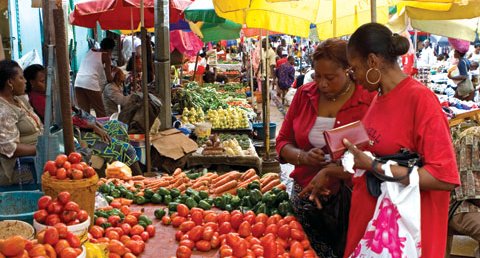
Spices in markets

Nigeria’s Bola Tinubu has declared a state of emergency on food security, following soaring prices of food items in the country. The move follows increasing outcry by Nigerians over the rising cost of living that has made life in the country unaffordable for many.

In a statement issued on Thursday, the President said the state of emergency will tackle the rising cost of food and tame food inflation.

“Today, we declared a state of emergency and unveiled a comprehensive intervention plan on food security, affordability, and sustainability, taking decisive action to tackle food inflation. These are steps towards a more food-secure Nigeria for all.

“Our new initiatives will tackle rising food costs, enhance agriculture, and boost job creation. No one will be left behind in our efforts to ensure affordable, plentiful food for every Nigerian,” the statement said.

Food inflation has risen to 24.82% as of May 2023, compounding the struggle of Nigerians to provide adequate food for their families.

Tinubu said his administration remains committed to ensuring every Nigerian has access to affordable food.

Under his ‘Comprehensive Intervention Plan for Food Security, Affordability, and Sustainability,” Tinubu outlined 17 steps his government will take to ensure food security, having “acknowledged that affordability, not availability, is the key issue for Nigerians.”

The 17 steps are as follows:

  1. Inclusion of food and water availability and affordability issues within the purview of the National Security Council.

  2. Deployment of initiatives to reverse the inflationary trend and ensure future supplies of affordable foods.

  3. Short-term strategy to use savings from fuel subsidy removal to revamp the agricultural sector.

  4. Release of fertilizers and grains to farmers and households (free) as immediate intervention.

  5. Urgent synergy between the Ministry of Agriculture and the Ministry of Water Resources to ensure adequate irrigation and all-year-round farming.

  6. Creation of a National Commodity Board to review food prices and maintain a strategic food reserve.

  7. Engagement of security architecture to protect farms and farmers.

  8. Role of the Central Bank in funding the agricultural value chain.

  9. Activation of land banks and increase of available arable land for farming.

  10. Collaboration with mechanization companies to clear more forests and make them available for farming.

  11. Usage of river basins for irrigation to ensure continuous farming.

  12. Deployment of concessionary capital/funding to the sector especially towards fertilizer, processing, mechanization, seeds, chemicals, equipment, feed, labor, etc.

  13. Improvement of transportation and storage methods for agricultural products to reduce costs and food prices.

  14. Increase in revenue from food and agricultural exports.

  15. Improvement of trade facilitation by working with Nigerian Customs to remove bottlenecks.

  16. Massive boost in employment and job creation in the agricultural sector.

  17. Target to double the percentage of employment in agriculture to about 70% in the long term.

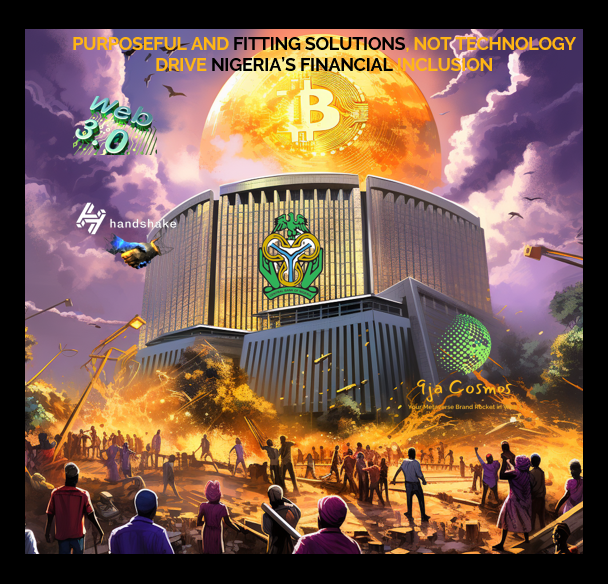
Purposeful and Fitting Solutions, not Tech, drive Nigeria’s Financial Inclusion

0

What really is ‘Financial Inclusion’ ?

Most dictionaries, or AI summaries, will define ‘Financial Inclusion’ as making financial products and services accessible and affordable to all individuals and businesses, regardless of their personal net worth or company size.

They will claim it aims to remove barriers that exclude people from participating in the financial sector and using these services to improve their lives.

Access to a transaction account can be a first step towards broader financial inclusion.

In 2021, 30% of women in Latin America had no checking accounts, credit cards, or savings, compared to 23% of unbanked men. Boosting financial inclusion requires digital tools and training to help connect women with financial services that meet their needs, aiming to close the gender gap in financial access and foster equitable economic growth around the Caribbean.

Financial inclusion is seen as a key enabler to reducing poverty and boosting prosperity.

Though ‘Financial Inclusion’ can be interpreted differently. Is it just about the access to services, or equity of opportunity among citizenry to generate personal wealth?

The two things are not the same, and there is a moment of inertia that sits at a base level below even the most basic strata of financial tools – below the first rung on the ladder.

Last year, Nigeria overtook India in the list of countries in the world with the largest % of the population living below the poverty line. Even among the employed, it is not uncommon to find people doing jobs that barely cover their commuting expenses.

The component of the Nigerian populous that are unbanked is more acute in the north of the country, where many of the states operate under Shariah Law.

Religious compliance in Shariah states create obstacles to retail banking in the North. Newer ‘Shariah compliant’ services do exist, but leaders aren’t doing enough in Northern Nigeria to educate the masses on difference.

For 10 years+, affordable ‘PoS’ terminals in ‘kiosks’ abound in even small villages in Nigeria, giving the unbanked means of sending money remotely, or paying bills, also Microfinance banks.

I assisted at submission compliance level with the formation of a Microfinance bank in Ikeja, Lagos, almost 15 years ago.

Stand alone rechargeable payment cards also exist. These work similarly to a retail bank debit card. They however do not have the extended services of a retail bank account appended to them. Operators simply have a ‘ledger’ integrated with settlement systems, and cash deposits can be made to the card at any shop or retail outlet acting as the operators agent.

Blockchain and Financial Inclusion in Nigeria.

Every once in a while, someone comes along with a new article about what ‘Blockchain’ can bring to Nigeria regarding ‘Financial Inclusion’.

It is important to understand Blockchains on their own, only offer better security but do not make the availability of many services easier. In the ‘Closed Naira’ market, blockchain cannot offer a ‘game changer’ over the ‘ease of movement’ of funds INSIDE Federal Nigeria, already been served by a mix of PoS outlets, Microfinance Banks, payment cards, and other free-market  non-blockchain digital services.

In 2021 Nigeria tightened banking regulations, deeming crypto-trading services illegal, not by saying crypto-trading is illegal per se, but by interpreting existing law to deduce that locally based CEXs are in effect, operating as a retail bank, without the licence and charter from CBN to do so. CBN then also sent circulars to existing retail banks, instructing them not to offer services to CEXs.

Hot on the trail of this, Nigeria became the second country globally (after China) to have a CBDC – (Central Bank Digital Currency).

Challenges of businesses.

Many businesses, particularly FMCG manufacturers, were FOREX starved, inhibiting their manufacturing productivity.

In a mirror of the ‘cryptoban by legal interpretation’, CBN had previously banned many raw materials that needed to be imported from abroad. This was not through an outright ban, but by declaring those materials ineligible for the issuance of FOREX. As manufacturers only earnt in Naira, the result was the same.

The ‘Tech’ instead of the Purpose and Fit.

CBDC bears many of the hallmarks of a blockchain product, but its’ important to understand the product is not in any way similar to a free-market coin or token. Nigeria’s ‘e-Naira’ is worth the same as a regular Naira and exhibited the same challenges in being exchanged for FOREX.

The popularity of  Bitcoin and its ilk, was twofold –

  1. A hedge for liquidity against the constantly fall in value of the Naira.
  2. A FOREX proxy to facilitate imports of goods on CBNs’ FOREX exclusion list.

Nigerians were not ‘speculating’ on cryptocurrencies to appreciate against hard currencies like the US Dollar, because they could not get US Dollars!

CBDC could not help to do any of these things. It was the ‘tech’ but lacking the Purpose and the Fit. In the words of Ndubuisi Ekekwe – it was failing to ‘Fix the Friction’.

If we go on much of the detailed information and videos online, a world full of CDBCs is something we should not look forward to.

When did the solution arrive?

On 15 June, Nigeria ‘floated’ the Naira, which now takes its place next to the South African Rand as the only two ‘freely convertible’ currencies on the continent according to the provisions of IMF Article IV.

This ended a longstanding ‘grey market’ or ‘parallel market’  practice unofficially trading the local Naira at a discount to international currencies. This took place outside of the retail banking network being supported by those who were desperate.

This doesn’t mean there won’t be still hiccups with FOREX, as the stranglehold of decades of restricted currency dynamics unravels –

Samuel Nwite for Tekedia Institute only five days ago reported that Dangote Cement and Ethiopian Airlines swapped USD $100m of trapped revenue between Ethiopia and Nigeria. We can still expect these challenges to persist in the medium term.

Given recent meeting around the Pan African Payment and Settlement System, the development positions Nigeria extremely well for establishing itself as ‘the USD$ of Africa’, especially given Nigeria has a GDP of 1.7x and a population more than 3x the home of the only other ‘freely convertible’ currency – South Africa.

It does beg the question though – Why didn’t Nigeria just float the Naira two years ago, instead of wasting massive investment on a CBDC that nobody wanted, needed, and for the large part, do not use?

Nigeria is inching very marginally in the direction of the Financial Inclusion people can still barely dream of… but taking the step two years late, with much wasted effort and investment.

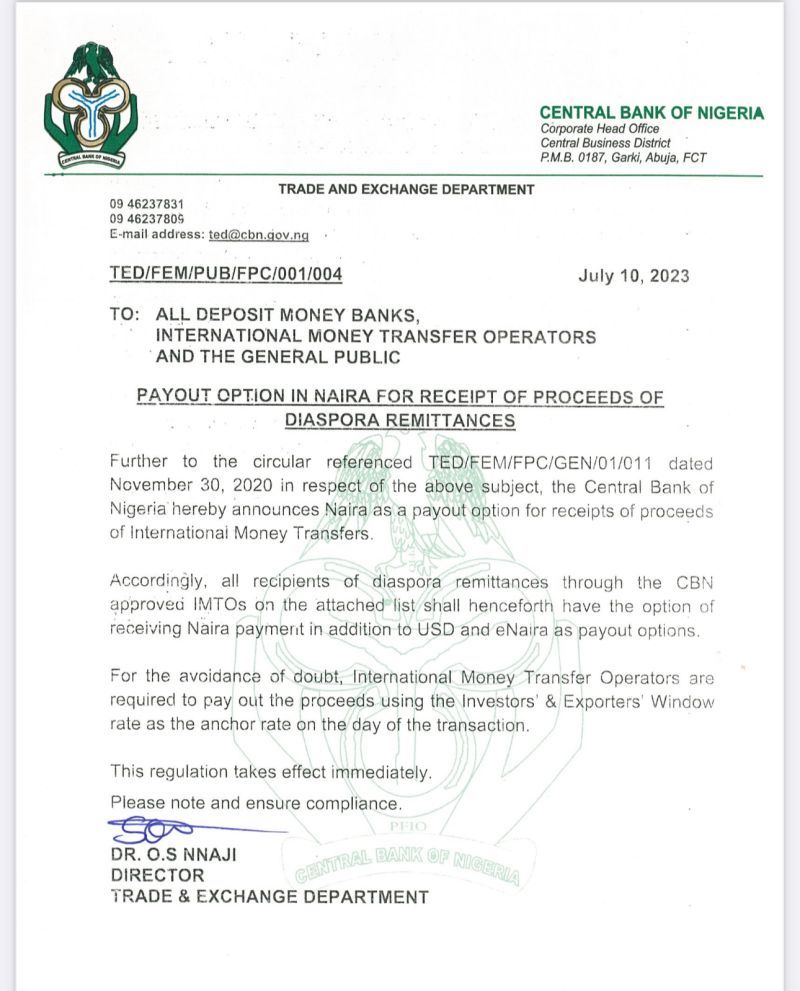
Following from the decision to ‘float’ the Naira as of 15 June, CBN sends a further circular allowing diaspora remittances to be resumed in Naira, a reversal of a decision taken in 2020 to only allow those remittances to be sent to Nigeria in USD$

9ja Cosmos is here…

Get your .9jacom and .9javerse Web 3 domains  for $2 at:

.9jacom Domains

.9javerse Domains

Visit 9ja Cosmos

Follow us on LinkedIn HERE


All reference sites accessed 13/07/2023

b2bpay.co/fully-convertible-currencies

cbn.gov.ng/

search.brave.com (Financial Inclusion)

nairametrics.com/2022/03/14/top-10-microfinance-banks-in-nigeria

oxfam.org/en/nigeria-extreme-inequality-numbers

en.wikipedia.org/wiki/Islamic_banking_and_finance

tekedia.com/ethiopian-airlines-dangote-cement-swap-100m-in-trapped-revenue/

trade.gov/market-intelligence/pan-african-payment-and-settlement-system

Criticism Trails House of Reps’ Approval of N8k Monthly Subsidy Palliative for 60m Nigerians

1

The plan by the federal government of Nigeria to disburse N500 billion to 12 million households as a palliative measure to mitigate the impact of the removal of fuel subsidy on Nigerians, has stirred widespread criticism. 

The federal government got the approval of the House of Representatives on Wednesday to seek out the fund to be shared among the poorest Nigerian households as the cost of living soars, following a letter by President Bola Tinubu to that effect.

The lawmakers swiftly passed the amendment of the N819 billion Supplementary Appropriation Act, which the N500 billion will be drawn from. The lawmakers, who have asked for salary increase to cushion the effects of subsidy hardship, also approved N70 billion to support the “working condition” of new members.

The money is to be shared N8,000 monthly for 60 million people for the period of six months. 

But Civil Society groups have criticized the move, seeking instead a 300% upward review of minimum wage. The Nigerian Labour Congress and the Trade Union Congress had earlier outlined for the government, measures it needs to implement to ameliorate the economic hardship that the subsidy reform has brought. 

The labor unions have called for the implementation of tax holidays for employees in both the public and private sectors who earn less than N200,000 or $500 per month. 

They have also emphasized the necessity of introducing a petrol allowance for individuals earning between N200,000 and N500,000 or $500 and $1,200 annually, whichever amount is higher.

Furthermore, the unions have demanded that the Nigerian government provide mass transit vehicles accessible to all segments of the population. They have also called for an immediate review of the National Health Insurance Scheme to extend coverage to a larger number of Nigerians.

In the medium term, the labor unions have urged the government to fulfill its previous commitment by implementing the nationwide deployment of Compressed Natural Gas (CNG).

The major concern of the labor unions, which most Nigerians share, is that the fund will be looted given the country’s pedigree of corruption. Many believe that the N500 billion will benefit Nigerians more if it is used to pay for petrol subsidy. 

They referenced ex-President Mohammadu Buhari’s humanitarian programs, such as TraderMoni, which involved disbursing money to poor Nigerians but were riddled with corruption, as a basis for their criticism.

“Like the Subsidy script now we have the Tradermoni script.

“1984 used subsidy and Tradermoni to scam Nigerians.

“The Illegal Govt in 2023 is now using the same Subsidy and Tradermoni script to scam Nigerians of Billions right before their eyes.

“Judiciary should wake up,” a Twitter user wrote.

“”Tinubu has been preparing to be President for 20 years, he is a master strategist, and he will change Nigeria for good.” Tunubu gets into office and immediately reactivates Buhari’s Trader Money, the only difference is that it is N8000 for households. Is this your strategist?” Kelvin Odanz asked.

“This is being done to; 1. Perpetuate a racket.

“2. Convince IMF, World Bank, USAID, DFID etc. “development economists” who will use data, no matter how bad, or contrived – to conduct “studies”, that something is being done about “poverty alleviation”,” Onye Nkuzi wrote.

“Why not start with an effective transport system at a subsidized rate? Use Lagos and Abuja as a pilot…. Subsidize fertilizer, and built PHCs, rails, bridges, schools, and roads! Increase salaries of public servants by 100%! These are sustainable developments,” Taha Adam wrote.

“A lazy solution to a difficult problem. The first thing is to audit to see if the National Social Register of 15.7m people is not filled up with ghost people whose identities cannot be verified by NIN. Secondly, using virement to move funds from one line item to another thru a supplementary amendment is good when you fund something that is sustainable. 

“I understand that for the sake of optics, this might be politically expedient. But the President should understand that the $800m from the World Bank he is asking the National Assembly to approve is a loan the former minister of finance negotiated by staking 535m units (17.1%) of Nigeria’s special drawing rights at the International Monetary Fund with the International Development Association of the World Bank as collateral for an $800m loan. It makes sense to invest it,” Kelvin Emmanuel wrote.

Besides criticism that N8,000 per month will do little to ameliorate peoples’ suffering, there is concern that there is no way to ensure that the fund will get to the “poorest Nigerians” due to lack of reliable data.

Socio-Economic, Transparency & Accountability Project (SERAP) said it is “issuing an FoI request to compel the Tinubu administration to publish details of the proposed transfer of N8,000 monthly to 12 million poor households for six months, such as the list of intended beneficiaries, how they will be selected, and the methods of payments.”

The civil rights group also asked the federal government to “immediately withdraw the unlawful allocation of N70 billion to the National Assembly” or face legal action.