
DD
MM
YYYY

PAGES

DD
MM
YYYY

spot_img

PAGES

Home Blog Page 4101

Implications of Innovation Information Availability and Innovation Seeking Behaviour in Nigeria

0

Whether for personal growth or societal advancement, performing certain tasks without the prerequisite information can prove challenging for individuals or groups responsible for these tasks. This analogy underscores the importance of having the right information on how to innovate and foster greater innovation. It serves as the cornerstone for ensuring a sustainable innovative society. In our experience, access to information, whether through media or non-media sources, plays a vital role in helping individuals take on innovation challenges and avoid what we refer to as the “information-deficient innovation trap” in nearly all sectors and industries in Nigeria. However, our analysis reveals that over the years, innovation-focused information on the Internet for the Nigerian market has been quite diverse and, in many cases, follows both backward and forward-looking trends.

Available Innovation Information

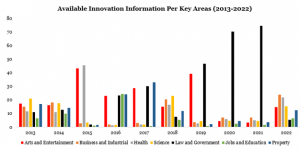
Utilizing the Google Search Engine, Nigeria’s and the world’s most widely used search platform, we discovered that there were 7.5 billion pieces of information related to innovation available for Nigeria between 2013 and 2022. Our analysis reveals that almost half (31.4%) of this information pertained to innovation within the field of law and government. Following closely at 25.3% of the total were arts and entertainment. Property accounted for 14.8%, and health comprised 10.5% of the information available. Jobs and education represented 7.9%, while science accounted for 4.8%, both totalling less than 10% of the overall information.

Our year-by-year analysis indicates that the volume of information available to the Nigerian public varied significantly during this period. Information availability exceeded one billion between 2015 and 2017 [2015 (1.1 billion), 2016 (1.9 billion), 2017 (1.3 billion)], only to drop to 222 million in 2018. This decrease was followed by a return to previous levels, with results recorded in 2013 (194.4 million) and 2014 (199.8 million). Subsequently, there was a significant increase in 2019, surpassing one billion, before reverting to previous levels in 2020 (632.7 million), 2021 (648.9 million), and 2022 (179.8 million).

As depicted in the figure below, the law and government sector held a higher percentage of the total available information between 2019 and 2021. Arts and entertainment also demonstrated relatively consistent performance between 2015 and 2019. Surprisingly, the percentage of information available for business and industrial, health, science, jobs, and education exhibited irregular patterns, indicating lower contributions from stakeholders in these sectors and industries related to the information categories.
Source: Google Trends, 2023; Opolo Global Innovation, 2023

Innovation Information Seeking Behaviour

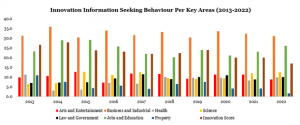
The Nigerian public consistently expresses a keen interest in the annual Global Innovation Index, prompting us to conduct an analysis of the country’s innovation scores from 2013 to 2022 along with their innovation information seeking behaviour. When it comes to seeking information on innovation, particularly with the goal of understanding innovation and potentially fostering innovative practices, the majority of inquiries were directed towards the business and industrial category throughout the entire analysis period with the different volume of searches [2013 (n=2679), 2014 (n=2416), 2015 (n=2621), 2016 (n=2494), 2017 (n=2366), 2018 (n=2119), 2019 (n=2645), 2020 (n=1833), 2021 (n=2280), and 2022 (n=2729)]. Following closely behind was the jobs and education category, which initially had a lower percentage of available information. Despite a substantial amount of information being accessible for arts and entertainment throughout the period, it emerged that people sought information in this category less frequently.

People in Nigeria have become increasingly curious about the meaning of innovation in the realm of arts and entertainment. They are eager to explore how innovation manifests in the arts and entertainment industry, including product innovation and the role of institutes like the Prime Innovation Institute of Technology. In the world of business and industry, innovation has become a buzzword. Nigerians have shown a keen interest in understanding what innovation means in a business context. Entrepreneurship, as a driving force behind innovation, has also garnered attention. People sought information about sources of innovation with the intention of grasping the concept of disruptive innovation. The dynamic nature of innovation and its relationship with change were the topics that piqued curiosity in this field. Within the realm of health, the focus was on the meaning of innovation. People were eager to understand how innovation can lead to advancements in healthcare, whether in medical treatments, technology, or healthcare delivery systems. In the fast-evolving domain of science and technology, innovation remains a central theme. Nigerians were interested in how innovation drives technological advancements. This interest related to emerging technologies, scientific discoveries, and their practical applications in various sectors.

In the context of law and government, innovation was a topic that captured attention. Citizens wanted to comprehend how innovation can be harnessed to improve governance, public services, and legal systems. Curriculum innovation was also a matter of interest, potentially indicating a desire for educational reform within this sector. When it comes to jobs and education, innovation was a recurring theme. People were keen to explore the meaning of innovation in the context of curriculum development and implementation. Institutions like the Innovation Institute of Technology in Akure may be contributing to this heightened interest. Additionally, agencies of curriculum planning and innovation are being sought after, suggesting a desire for educational reforms and advancements.

Throughout this decade, the search for the meaning of innovation was constant, reflecting a nation’s quest for progress and development. Whether in arts and entertainment, business and industry, health, science and technology, law and government, or jobs and education, Nigerians have shown a clear appetite for innovation and its transformative potential. The steady increase in information-seeking behaviour indicates a society eager to embrace change and stay at the forefront of innovation in the global landscape.
Source: Google Trends, 2023; Opolo Global Innovation, 2023

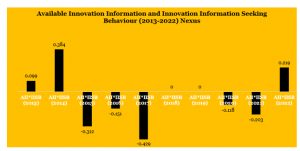
To increase our understanding of how the Nigerian public sought information between 2013 and 2022 in the context of the categories listed earlier, we further analysed the link between the availability of innovation information and innovation information-seeking behaviour. Our analysis reveals a -28% linkage. In this case, as the availability of innovation information increases, the level of innovation information-seeking behaviour decreases. On an individual level, this insight resonates with available innovation information and seeking behaviour from 2015 to 2021.

It’s possible that the available information does not always align with what individuals are seeking. Even though there might be a vast amount of information, its relevance and quality might not meet the needs of those seeking it, leading to a disconnect between availability and behaviour. For those involved in disseminating innovation-related information, this finding suggests the importance of understanding the ebbs and flows of public interest. It’s essential to tailor communication strategies to match the shifting dynamics of information-seeking behaviour. It also emphasizes the importance of adapting communication and information dissemination strategies to match the evolving interests and needs of the audience.
Source: Google Trends, 2023; Opolo Global Innovation, 2023

In speaking to this data, it is important to call the attention of government to the need for appropriate dissemination of innovation information to quench the thirst of Nigerians seeking to know more about the concept. In recent times, especially between 2015 to 2019, there is heightened discussion of innovation as a result of attention it is getting from the government in terms of policies and activities. However, as the new government is taking the focus higher and seeing how the digital economy could be harnessed for skills development and job creation, we advise that the information on innovation should be more contextualized. There should be a deliberate plan on communicating innovation in the local languages.  It is established that information couched in indigenous languages not only pique the interest of the receiving audience but also boosts comprehension.

This also does not leave out the private sector as making people understand innovation in their local languages has the potential to birth more innovative solutions to local problems. The media should also play more prominent roles in democratizing and decolonizing the language of discussing innovation. The Nigerian media landscape is rich and robust enough to take care of this charge if the actors are ready.


 

The Mode Of Breaking Into Skales’ Apartment By The EFCC Is A Crime

0

Whenever I hear of EFCC on the news again for the wrong reasons I always quickly rush to the ECONOMIC AND FINANCIAL CRIMES COMMISSION (ESTABLISHMENT) ACT 2004 which is their establishment act to check especially section 6 of the act that provides for their functions but as expected, all you need to know is that law enforcement agencies and their agents in Nigeria have a thing for acting beyond their power; ie acting ultra vires. 

We woke up yesterday to a famous Nigerian musician, Skales ranting and complaining bitterly about how the agents of the EFCC pulled up with sophisticated weapons to his home, forcefully broke into his apartment at 3 am-midnight, ransacked his home while pointing guns at him and his family members and that got his wife and six months old baby to traumatized. 

Be it as it may, by the provisions of section 148 of the Administration of the Criminal Justice Act (ACJA) 2015, a search warrant may be issued and executed at any time on any day, including a Sunday or public holiday. This is to say that a search or an arrest warrant can be executed at midnight by a law enforcement agent, so the EFCC agents knocking on people’s doors at midnight and using force to gain entry if the owner of the house fails to open up is still within the bounds of the law so far as they have been issued with a search and arrest warrant on that particular person or on that particular house by a court of competent jurisdiction. This is the condition precedent; they must have obtained a search or arrest warrant for the particular assignment but the bitter pill to swallow is that they always do not approach people’s houses and break into peoples’ apartments with any valid search warrant against that house. 

Knocking on people’s doors or breaking into people’s houses while brandishing sophisticated weapons at midnight without any valid search warrant as a law enforcement agent especially on a mufti makes you an armed robber or a kidnapper and the house owner is legally allowed to use any force necessary to defend himself and to resist you to ensure you do not break into his apartment. This implies that if the house owner has a licensed firearm he can shoot you on the grounds of self-defense and he will be permitted by our laws. 

Interestingly, the men of the EFCC (just to let you know that they know what they are doing) only execute this kind of Gestapo style of midnight arrests in the houses of alleged young boys and petty internet fraudsters. They dare not try it in a house of politicians or someone who knows his rights and is ready to stand for it because they know that the person’s first point of action is to raise a preliminary objection against his mode of arrest and seek proper damages against the agency and the agents that executed it. 

In fact, a friend who is a senior officer at the EFCC told me that the only reason the EFCC agents prefer to go after the petty Yahoo boys and petty financial criminals instead of going after big-time corrupt politicians is because the Yahoo boys are so easy to prosecute. A politician is always ready to fight in court but an alleged Yahoo boy will always chicken out and beg for a plea deal and people do not know that just as bankers or salesmen have sales targets, EFCC agents or EFCC sessions are also given targets of number of prosecutions they must meet at a particular time hence they opt for the easier way of meeting the target by going after petty yahoo boys whom they know are easier to prosecute. 

There is no justification for crime, so this is not me justifying internet fraud or making a case for the internet fraudsters but this is me as a lawyer standing against breaking into people’s homes at midnight without search warrants or court order to that effect. I am talking from experience as a lawyer that 99% of those homes men of the EFCC break into at midnight they do so without a proper search and arrest warrant. Some agents are always quick to tell you when you ask them to show you their warrant that their Identity card is a valid search and arrest warrant but that is not what our law says; there is no law in Nigeria that says that an ID card of an operative of an EFCC is a search or an arrest warrant.

The EFCC totally needs overhauling. Touts are now joining the forces and making a mess of why the force was established in 2004. You don’t have to break the law to execute another law; when you break a law to execute another law you have also become a criminal. You can carry out an arrest and execute a search by going through the proper channels of the law. 

What happened in Skale’s apartment last night is totally uncalled for. Seeing the CCTV footage of operatives of the EFCC heavily armed breaking into his apartment will send chills to the shiver of everyone. You will be forced to think that the residents of the apartment are boko haram bandits hence why the agents are heavily armed like that to flush them out. 

The Lesson from Julius Berger on Brand Reputation (video)

0

Things happen in Nigeria. Yes, men and women see the Julius Berger logo and start singing. This was in Aba as the government opened the playbook to fix Aba – Port Harcourt Road.

The greatest companies in the world are known for great products or services. And the best among them have the capacity to turn their customers into FANS. And when a company can get into that fandom, creating a new basis of competition, its success becomes assured. Julius Berger seems to have achieved that fandom level in  Nigeria and is reaping enormous goodwill.

The message is clear: it goes beyond meeting the needs and expectations; it pushes for the perceptions of road users on product quality and durability. My kinsman, Admiral Ndubuisi Kanu (RIP Ogboo), built a road in my village in Ovim, Abia State in the mid 1970s, as the Governor of Imo State. That road served for decades until it got a make-over when General Ihejirika served as Nigeria’s Army Chief.

Quality builds empires and there is a lesson here. To my big Boss, Governor Alex Otti, we salute as he continues to execute the playbook, for the RISE of All Abians. Yes, everyone will be positively impacted in God’s own state of enterprise and opportunity.

CEO, Founder, etc: how do people feel when they see your logo? Julius Berger has something to teach us here.

Ndubuisi Ekekwe, PhD

Co-Chair, Abia State Economic Transformation Council

Comment on Feed: A great play book indeed my Prof….you ought to be in this government of Alex otti to further the dividend of good governance and policy execution for a better Abia… atleast one portfolio as a commissioner in the state will help

My Response: Not interested in being a commissioner. I have politely declined that twice. I want to be a minister, period and I have my playbook ready. I do hope one day that opportunity will come. President Buhari extended a DG position which I also politely declined. Ndubuisi is not for every job because he is Ndubuisi.

My Response: This is not acceptable. Are you telling me that Uhuhu people do not have a town union? When did government start fixing schools in Igbo Nation? In Ovim, we build and update our schools; no one waits for any government. So, I am not going to tell Mr. Governor. I want you to tell your kinsmen to do their jobs. With N30m, the school could be fixed. This is pure evil from the sons, daughters and elders of Ohuhu if this photo is real. I am trying to hold my anger here: what did they discuss during the August meeting if the Great Ohuhu could have this dilapidated school? Not acceptable. 

Creating and Executing Digital Personality Transformation Strategy

0

In the age of digital personality, it’s not only about what you add to your online presence but also about what you remove. An unfavourable online footprint can tarnish your professional reputation. Thus, it’s essential to be mindful of your digital behaviour, including the content you post and the comments you make.

Adjust privacy settings on social media to control who can see your posts and interact with you. This allows you to strike a balance between personal expression and professional reputation. Practice good online etiquette. Avoid engaging in heated debates or posting content that could be perceived as offensive. Remember that the Internet has a long memory.

If you find outdated or unflattering information about yourself during your Google search, take action to have it removed or updated. This may involve contacting website administrators or social media platforms. Invest time in learning how to leverage digital products effectively. Consider taking courses on personal branding, social media management, and online reputation management. To illustrate the transformative power of managing one’s digital persona, let’s consider a couple of case studies:

Case Study 1: The Job Seeker

John is a recent college graduate looking for his first job. He Googles himself and finds that the search results are disorganized, with some outdated social media profiles taking centre stage. To enhance his digital personality, John created a LinkedIn profile that highlights his education, internships, and relevant coursework. He also started a professional blog on his personal website, discussing industry trends and sharing his insights. Within a few months, his digital personality has transformed into that of a motivated and knowledgeable job seeker. He begins receiving interview requests and job offers.

Case Study 2: The Entrepreneur

Sarah is a budding entrepreneur trying to establish her brand in the health and wellness sector. She Googles herself and realizes that her online presence is scattered and inconsistent. Sarah invests in a professional website that showcases her products and services. She also initiates a focused social media strategy, sharing informative content related to health and wellness. Within a year, Sarah’s digital personality has evolved into that of a credible and authoritative figure in her niche. Her business experienced significant growth as a result.

You Are What You Google

In the age of digital personality, your online presence is an extension of your real-world identity. Your Google search results are not just a collection of links; they represent your digital persona. Googling yourself and taking control of your online narrative is an essential step in personal and professional development. The Internet provides us with an unprecedented opportunity to craft and curate our digital personalities, and with the right strategy, you can leverage it to capture social and professional capital. So, ask yourself: when you Google yourself, do you like what you see? If not, it’s time to take action and shape your digital destiny.

When People Google Your Name, What Do They Find?

0

In the digital age, the Internet has transformed into a powerful tool for self-presentation and professional branding. With countless platforms and digital products at our disposal, individuals have the unprecedented opportunity to shape their digital personalities and harness the potential for social and professional capital capturing. However, the reality is that many people are still unsure of how to effectively communicate their presence on the Internet. In this piece, our analyst delves into the concept of Googling yourself and explore the profound impact it can have on your digital personality in the age of the Internet.

The Digital Age and Personal Branding

The rise of the Internet has not only reshaped our daily lives but has also revolutionized the way we present ourselves to the world. In today’s interconnected world, personal branding is not just for celebrities or influencers; it is a skill that anyone can leverage to unlock opportunities and enhance their social and professional capital. Your online presence, often referred to as your “digital personality,” is a critical component of this process. The digital age has bestowed upon us an array of tools and platforms, from social media to personal websites, that enable us to craft our digital personas. These digital products offer an opportunity to define ourselves in a manner that aligns with our personal and professional goals.

The Power of Perception

In the digital world, perception is everything. Whether you are a job seeker, a small business owner, or a creative professional, the way you are perceived online can have a significant impact on your success. When people Google your name, what do they find? Is it a well-crafted narrative that reflects your expertise and aspirations, or a disjointed collection of outdated information and social media blunders? Googling yourself is more than just vanity; it is an exercise in self-awareness and personal branding. It provides you with valuable insights into how the world sees you, allowing you to take control of your digital personality and present yourself in the best possible light.

Digital Products for Self-Presentation

The arsenal of digital products available for self-presentation is vast. From social media profiles to personal websites and online portfolios, these tools empower individuals to showcase their skills, experiences, and achievements in a dynamic and engaging manner.

LinkedIn: Building a Professional Identity

LinkedIn has emerged as the go-to platform for professional networking and self-presentation. Your LinkedIn profile is essentially your digital resume, allowing you to detail your work history, skills, endorsements, and recommendations. It’s a dynamic tool for building your professional identity and connecting with like-minded individuals in your industry.

Personal Websites: Your Digital Showcase

Creating a personal website is like owning a piece of real estate on the Internet. It is a space where you have full control over your narrative. Here, you can showcase your portfolio, blog about your expertise, and offer a comprehensive view of who you are professionally.

Social Media: Crafting Your Image

Social media platforms like Twitter, Instagram, and Facebook offer opportunities to express your personality and interests. However, it’s essential to remember that these platforms are also scrutinized by potential employers and colleagues. Consistency in your online behaviour is key to maintaining a positive digital personality.

Online Portfolios: Showcasing Your Work

For creative professionals, artists, photographers, designers, and writers, online portfolios are indispensable. They allow you to exhibit your best work, offering a visual and interactive representation of your skills.

The Importance of an Up-to-Date Digital Persona

Your digital persona is not a one-time creation; it’s an ongoing project. Regularly updating and curating your online presence is vital to reflect your growth and evolving professional identity. Google yourself periodically to see if your online image aligns with your aspirations and the image you want to project. In a world where remote work, online networking, and virtual interactions have become the norm, your digital personality is often the first impression you make. Inaccurate or outdated information can cost you valuable opportunities. Thus, maintaining an up-to-date and polished digital persona is critical.