DD
MM
YYYY

PAGES

DD
MM
YYYY

spot_img

PAGES

Home Blog Page 4115

FEC Approves Nigeria’s $1.5bn and $80m Loan Requests from World Bank, AfDB

0

Wale Edun, the Minister of Finance and Coordinating Minister of the Economy, has disclosed that the Federal Executive Council (FEC) has given its approval for a $1.58 billion loan request, one day after he confirmed that the federal government was in the process of securing the loan.

The minister explained that the approved loan request consists of two components: $1.5 billion from the World Bank and $80 million from the African Development Bank (AfDB).

He further elaborated that the $1.5 billion from the World Bank will be channeled through the International Development Association (IDA), a branch of the World Bank that extends interest-free loans to low-income nations.

“We also approved today the application for financing from the World Bank. And in particular, the International Development Association which is really the virtually free or zero interest lending arm or financing arm of the World Bank,” he said.

“The total is $1.5 billion. And the background is just as you heard from the Minister of Planning and Budget.”

Edun on Saturday assured that the loan would come with a near-zero interest rate, alleviating concerns about escalating Nigeria’s debt service commitments. He clarified that there would be no negative connotations associated with obtaining World Bank funding to support developmental projects.

Edun noted that the loan request is significant as it arrives at a time when borrowing costs are increasing, primarily due to developed nations hiking interest rates and implementing tighter monetary policies to combat inflation.

“What that means is that interest rates for everybody else, become not just high but very painful, if not on (sic) affordable within that context,” he said.

Edun said the World Bank is willing to lend to Nigeria because of some tough policies made by President Bola Tinubu. This loan is expected to support Nigeria in managing its finances, especially the nearly $7 billion backlog in FX obligations.

He emphasized that the firm measures taken by the government have garnered the backing of multilateral development institutions. Consequently, the World Bank is poised to facilitate $1.5 billion in concessional financing on Nigeria’s behalf. This funding will be both relatively affordable and swiftly disbursed.

Regarding the $80 million loan from the African Development Bank (AfDB), Edun disclosed that it will be allocated for the Ekiti Knowledge Zone (EKZ) project. This initiative aims to equip the youth in Ekiti with crucial technological skills, particularly given the increasing contribution of the technology sector to the nation’s economy.

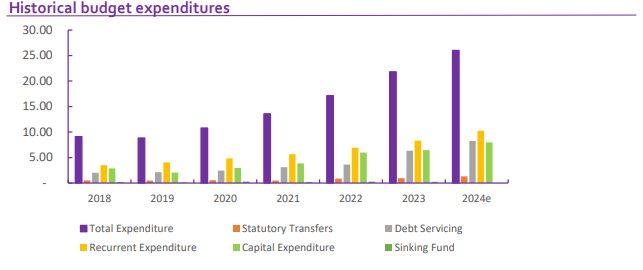
However, increasing borrowing amid unsustainable public debt stock and dwindling revenue remains a huge concern for Nigerians, especially as the government is believed to be borrowing for consumption. Nigeria is said to be spending more than 90 percent of its revenue on debt servicing currently.

Nigeria’s Federal Executive Council Approves N26tn for 2024 Budget

0

The Federal Executive Council, headed by President Bola Tinubu, has ratified a budgetary benchmark of N26 trillion for the 2024 fiscal year during their meeting on Monday.

Atiku Bagudu, Minister of Budget and National Planning, shared a brief overview of the meeting, which marked the second since Tinubu’s presidency.

Briefing State House correspondents at the end of the FEC, alongside his colleagues from the Ministry of Information and National Orientation, Mohammed Idris, Minister of Finance and Coordinating Minister of Economy, Wale Edun, Works Engr. Dave Umahi, Industry, Trade and Investment, Doris Uzoka-Anite, Labour and Employment, Simon Lalong as well as the Minister of State for Labour, Nkeiruka Onyejecha, Bagudu said Council has approved the 2024-2026 Medium Term Expenditure Framework, MTEF, and Fiscal Strategy Papers, FSP.

The FEC sanctioned the 2024-2026 Medium Term Expenditure Framework (MTEF) and Fiscal Strategy Papers (FSP), as confirmed by Bagudu.

Among the MTEF’s assumptions, the FEC set a crude oil price of $73.96 and an exchange rate of N700 per US dollar.

“Now, it was presented on the background of the commendable measures that have been taken since June in order to restore macroeconomic stability, particularly the deregulation of petroleum prices, for which we maintained that subsidies are gone and indeed the regulation of the foreign exchange market,” Bagudu said.

“So Council deliberated, as well as the implication of this and all measures promised in the renewed hope agenda, consumer credits, mortgages, reversed or dismissed institutions, as well as funding the newly aligned institutional changes, particularly ministries with specific functions that are able to generate growth, so that would be better for our country.

“The council members acknowledge the medium term expenditure framework, and it is agreed that we can go ahead to the next step of consultation and presentation to the National Assembly.”

The executive is expected to present the document to the National Assembly before December 31, 2023, after the ministries and parastatals saddled with the responsibilities of perfecting the budget estimates have done their job, in line with the Fiscal Responsibility Act.

The Fiscal Responsibility Act stipulates that the executive must present the Medium Term Expenditure Framework (MTEF) to the National Assembly before submitting the budget proposal. The MTEF serves as a comprehensive document outlining the medium-term economic outlook for the nation.

However, the N26 trillion budget proposal has been described as unrealistic by many who pointed at the nation’s current economic turmoil. Nigeria’s oil revenue has seen a significant drop in recent years, scuttling the country’s capacity to fund its budget without borrowing. For instance, net earnings from crude oil and gas as at the first quarter of the year stood at N486 billion, while net earnings from solid minerals was N1.99 billion.

Personnel cost at the same period was N978 billion – creating a huge revenue deficit. Against this backdrop, which has fueled calls for cuts in the cost of governance, funding the budget is seen as mission impossible and leaves the government with no other option than to borrow more.

LinkedIn to Lay Off 668 Employees in Another Round of Job Cut

0

LinkedIn has announced its second round of job cuts in 2023, with 668 employees set to be laid off from the company. The layoffs will affect various departments, including engineering, talent, and finance, and amount to over 3% of LinkedIn’s 20,000-strong workforce.

These job cuts are reflective of the broader trend in the technology sector, which has seen tens of thousands of job losses this year due to economic uncertainty.

“Talent changes are a difficult, but necessary and regular part of managing our business,” the company said in a statement.

“While we are adapting our organizational structures and streamlining our decision making, we are continuing to invest in strategic priorities for our future and to ensure we continue to deliver value for our members and customers.”

“We are committed to providing our full support to all impacted employees during this transition and ensuring that they are treated with care and respect.”

LinkedIn generates revenue through advertising sales and subscriptions for recruiting and sales professionals. However, the company has faced challenges such as a slowdown in hiring and a decline in advertising spending, resulting in slower revenue growth.

LinkedIn’s revenue increased by 5% year-on-year in the fourth quarter of its fiscal 2023, down from 10% in the previous quarter.

Microsoft, which owns LinkedIn, has identified these challenges as headwinds for the platform. Despite this, LinkedIn continues to add new members to its extensive community of 950 million users.

This recent round of layoffs follows a previous cut of 716 jobs in May, which focused on sales, operations, and support teams. These cuts are part of LinkedIn’s efforts to streamline its operations and remove layers within the organization to facilitate quicker decision-making.

The recent job cut aligns with the prevailing trend in the technology sector, where numerous companies are substituting employees with artificial intelligence.

Earlier this month, LinkedIn introduced a range of new AI-driven product features, which encompass AI-assisted candidate discovery for recruiters. These features include improvements in natural language searches, reduced emphasis on university qualifications and job titles, as well as prompts on how a job role can be customized to match a candidate’s strengths and limitations, such as location.

LinkedIn has also incorporated AI-powered coaching into its subscriber-only LinkedIn Learning platform and introduced a chatbot service to guide workers through challenging situations or their career development.

That Phone Call and The Wisdom from Uwadiegwu for Ukraine

1

A fairly decent Igbo novel – Uwadiegwu – reminded readers to borrow from kinsmen because if the loan goes bad, and they lock you up, the same people will be responsible for your family care. Unoka, Okonkwo’s father in Chinua Achebe’s Things Fall Apart, while responding to Okoye, clearly demonstrated that the debts were to clansmen, and that he was safe! As Okoye was reminded that his debt was even small, Unoka knew that the debt was home and within Umuofia. Yes, debts are better when localized. 

As a new theater of war opens in the Middle East, the wisdom in the axiom becomes a palpable one. That takes me to Ukraine where it seems the world has moved on, and magically, their president has to confront new realities. Indeed, after Israel and Hamas, would they return and pay attention? Assume, they do not return, what happens? Losing 20% of your country?

Good People, when the whisperer comes, telling you never to find a way to broker peace with your neighbour, do not fall for it. At the peak of Obasanjo’s presidency, when Cameroon came, and was messing up, many asked Obasanjo to take Nigeria to war over the oil-rich Bakassi. Despite being a military man, Obasanjo showed wisdom, and allowed sleeping dogs to just be. Yes, in trying to keep Bakassi oil, Nigeria could have LOST all of its oil wells, afterall, it was another war that even triggered the loss of Bakassi to start with, as promises were made to global dealers.

I wrote on Feb 27, 2022: “As bombs drop in Ukraine, it is time for the President of Ukraine, Volodymyr Zelenskyy,  to open a channel and speak directly with his Russian counterpart, Putin. When a war is fought on your land, you are losing despite whatever anyone tells you! Speaking with Putin is not a sign of weakness; it is understanding asymmetric capabilities and saving the lives of citizens.” 

I do hope he does that despite whatever any consultant is telling him because Russia will remain a neighbour, and debts are better closer home, irrespective of whatever anyone tells you!

Zelenskyy has no choice but to make this call. In the Igbo axiom, friends come and go, but you live with brothers and kinsmen. America has watch, Putin has time in Ukraine.

How To Set Up A Licensed Ground Handling Services Company In Nigeria

0

Ground Handling involves services aimed at facilitating air flights, ground operations including but not limited to repositioning, and pre/post- flight services which according to one opinion devolves around 5 categories which are :-

– Aircraft appearance & provisioning

– Catering

– Ramp servicing

– Passenger services

– Field operation services

This article deals with the provisions governing licensing for ground handling services in Nigeria which is regulated by the Nigerian Civil Aviation Authority(NCAA)

What are the requirements for ground handling license applications in Nigeria?

-An applicant seeking Licence to operate ground handling services in Nigeria shall be required to forward a written application to the Director General, Nigerian Civil Aviation Authority (NCAA) on or before a date not less than six(6) months to the desired commencement of operations.

-This application letter for the Licence must contain the following particulars:

  1. Name and official company;
  2. address(es) of applicant;
  3. Applicant’s CAC Registration Number (RC);
  4. Contact telephone numbers;
  5. Valid e-mail address(es);
  6. Names and nationalities of Directors of the company at the bottom of the page;
  7. The type of ground handling services to be provided;
  8. Proposed airport or airports where applicant intends to provide the service(s).

What are the stages of ground handling services licensing in Nigeria?

– The Pre-qualification Stage

At this stage the applicant is expected to fulfill the following requirements:

 (i)    Payment of One Million Naira (N1, 000,000) non-refundable processing fee to NCAA.  (Bank Draft             made payable to the NIGERIAN CIVIL AVIATION AUTHORITY);

(ii)    Obtain and complete pre-qualification processing forms and return same to NCAA with evidence of payment of the One Million Naira (N1, 000,000) non-refundable processing fee;

(iii)  The following supporting documents must be submitted to the NCAA before processing of the application  can commence:

(a) A copy of the Certificate of Incorporation of the company;

(b)  A copy of the Memorandum and Articles of Association of the company with minimum authorize                     share capital of Five Hundred Million Naira (N500, 000,000.00);

 (c)        Copies of Tax Clearance Certificates of the company and of each of the Directors for the last three(3)  years;

(d)   Company exposition detailing the ownership and management structure, applicant’s experience  in  the area of the proposed services it intends to provide, name and experience of technical partners (if any) etc;

(e)    Comprehensive details of technical partner including name, address, experience, nature of partnership arrangements etc. Documentary evidence should be provided;

(f)    A copy of a detailed Business Plan on the operation indicating, among other things:

  • Proposed services to be rendered such as passenger handling, baggage handling, ramp services, freight and mail services, flight operations, crew services, surface transport services, aircraft services, catering, etc.
  • Marketing analysis including market segments, target market & customers, customers characteristics, customers needs, etc.
  • Competitive analysis such as industry overview, nature of competition, primary competitors, competitive products/services, opportunities, threats and risk, etc
  • Marketing and Sales. These should address who the major customers will be and how they will be reached, marketing strategies to be used etc
  • Scope of applicant’s Operations giving comprehensive details of facilities & equipment required and their cost, management structure, staffing plan (employment plans, training and remuneration), operational procedure etc.
  • List of key personnel (including the safety and security Managers) with details of their qualifications, skills, experience etc. Copies of their curriculum vitae should be provided;
  • Financial plan including estimated costs of setting up the business, Projected revenue, scheme of charges, profit and loss projection, cash flow projection, balance sheet projection, etc (the assumptions used for the computations should also be stated).
  •  Operational Manual containing the company’s proposed Standard Operating Procedure on the services to         be rendered. This should contain details of how the operations will be conducted in accordance with IATA  Ground Handling Manual. This should also contain a sample of the Service Level Agreement (SLA) the applicant intends to have with the airlines;
  •  Applicant’s Manual on Safety Management System (SMS);
  • Applicant’s Security Manual which should show its understanding of the relevant provisions of ICAO        Annexes such as Annex 9 on Facilitation and Annex 17 on Security; and
  •  Dangerous Goods Manual which should also be in accordance with ICAO Annex 18 on Safe Transportation of Dangerous Goods.
  •  The applicant may be required to provide additional documents and information depending on the          type(s) of services(s) it intends to provide.

– The NCAA upon receipt of these documents and evaluation of same shall:

(a)      Invite the Promoters/Directors of    the company to a meeting with the NCAA officials;

(b)      Seek the comments of the Airport Operator/Owner on the proposed operation;

THE  QUALIFICATION STAGE

An applicant shall be qualified for this stage if the Authority is convinced that the applicant-company has the potential to carry out the business and comments are received from the Airport Operator/Owner about the proposed operation.

(i)      Evidence of financial capacity to undertake the business;

(ii)     Proposed commensurate Insurance Policy and/or insurance arrangement being put in place; and

(iii)    Duly completed Personal History Statement (PHS) forms and two(2) passport photographs  in  respect  of each of the Directors of the company (the PHS forms  are available at NCAA). The NCAA will seek security clearance from the Presidency on behalf of the applicant.

Upon satisfactory fulfillment of these requirements by the applicant, NCAA will request the applicant to acquire the necessary equipment and demonstrate its capability to carry out efficient services.

The Demonstration Stage 

The applicant will be required to demonstrate its ability to offer efficient services in accordance  with the provisions of ICAO Annex 9 on Facilitation and Annex 17 on Security.

License Issuance  

 A substantive Licence shall be issued to an applicant by the NCAA, upon satisfaction that the  applicant has demonstrated its ability to offer safe and efficient services.

What is the validity period of a ground handling services license?

The validity of a Ground Handling Services Licence is Ten (10) years.

What are the next steps to follow upon the issuance of a ground handling services license?

-Subsequent upon receipt of Licence, a utilization fee of Two Hundred and Fifty Thousand Naira( N250,000.00) shall be paid to the Nigerian Civil Aviation Authority annually.

 -Audit of ground handling company shall be carried out yearly to ensure that set standards are  maintained.