Good People, it is happening, the future of work is being redesigned. Yes, Facebook’s parent company, Meta, wants to fire more workers from next week: “The third wave is going to happen next week. That affects everybody in the biz teams, including in my organization. It’s just a time of great anxiety and uncertainty. I wish I could have some easy way of providing solace or comfort. It is uncertain. And, it’s increased my admiration for the way that everyone notwithstanding that uncertainty you’re just displaying such resilience and professionalism.” – Meta President of global affairs Nick Clegg.
Clegg added that the layoffs will follow a similar process to April’s cuts, in which 4,000 roles were eliminated from Meta’s tech departments.
The afternoon before the layoffs happen, Meta’s head of people will post a note to employees with details about when the layoff process will begin and which teams will be affected. Employees impacted by the layoffs will then be notified, followed by non-impacted employees.
An Igbo proverb says “oge adighi eche mmadu” [time and tide will not wait for any person]. And that means we must pay attention to how new technologies, and specifically AI, will make it easier for companies to become more efficient. Simply, these companies may not need a lot of workers. Your bank may not need many staff. Your insurer may not need many workers. And the list keeps growing.
Is it time to require mandatory payment where even if you have no staff, you have to commit a certain percentage of your revenue which will be used to distribute to citizens as a “wage” alternative?
Giant tech company Meta has revealed plans to implement another round of layoffs next week, which was revealed by executives at the company during a Q&A session with employees.
Reports reveal that the layoffs would predominantly target Meta’s business departments and could potentially impact a significant number of employees.
Speaking on the layoffs, Meta President of global affairs Nick Clegg during the company-wide meeting said,
“The third wave is going to happen next week. That affects everybody in the biz teams, including in my organization. It’s just a time of great anxiety and uncertainty. I wish I could have some easy way of providing solace or comfort. It is uncertain. And, it’s increased my admiration for the way that everyone notwithstanding that uncertainty you’re just displaying such resilience and professionalism.”
Clegg added that the layoffs will follow a similar process to April’s cuts, in which 4,000 roles were eliminated from Meta’s tech departments.
The afternoon before the layoffs happen, Meta’s head of people will post a note to employees with details about when the layoff process will begin and which teams will be affected. Employees impacted by the layoffs will then be notified, followed by non-impacted employees.
While Clegg did not confirm the number of people that will be impacted, Meta’s proposed round of layoffs is coming after the company’s CEO Mark Zuckerberg had earlier hinted at possible job cuts in May, to eliminate 10,000 positions, following an initial reduction of 11,000 positions in November.
Meta’s incessant round of layoffs is occurring after the company declared year 2023 “The Year of efficiency” as it focuses on becoming a stronger and more nimble organization.
The company disclosed that since it reduced its workforce last year, one surprising result is that many things have gone faster. The company’s CEO Mark Zuckerberg via a memo stated that he underestimated the indirect costs of lower priority projects, noting that a leaner organization will execute its highest priorities faster.
He added that people will be more productive, their work will be more fun and fulfilling, and Meta will become an even greater magnet for the most talented people. The company in its Year of Efficiency is focused on canceling projects that are duplicative or lower priority and making every organization as lean as possible.
In the coming year, Meta has disclosed that it may incur additional restructuring charges as it progresses further in its efficiency efforts. The company has noted that it expects to record about $1 billion in restructuring charges in 2023 due to its efforts to consolidate its footprint.
Meanwhile, Zuckerberg doesn’t expect the financial outlook for Meta to dramatically improve any time soon. He believes that the company should prepare for the possibility that the new economic reality will continue for many years.
He however added that Meta has put together a financial plan that enables the company to invest heavily in the future while also delivering sustainable results as long as it runs every team more efficiently.
Zuckerberg said he is still committed to building the metaverse and that Meta’s single largest investment is in advancing Al and building it into every one of its products.
If you are a fan of Pudgy Penguin NFTs, you will be delighted to hear that they have launched a new product: Pudgy Toy. Pudgy Toy is a plush toy that looks like your favorite Pudgy Penguin NFT. You can scan a QR code on the toy to access your NFT on the blockchain and see its unique traits and rarity.
Pudgy Penguins are one of the most popular NFT collections on the Ethereum blockchain. They are cute and colorful penguin avatars that have different traits and rarities. There are 8888 Pudgy Penguins in total, and they have been selling for high prices on the secondary market. Some of the rarest Pudgy Penguins have fetched over $400,000.
Pudgy Toy is more than just a cute collectible. It is also a way to support the Pudgy Penguin community and the environment. For every Pudgy Toy sold, 10% of the proceeds will go to the Pudgy Penguin Foundation, which supports various causes such as wildlife conservation, climate change awareness, and education. The toys are also made from recycled materials and are eco-friendly.
But Pudgy Penguins are not just digital art. They are also a brand that is expanding into the physical and virtual worlds. Recently, the Pudgy Penguins team announced two exciting new projects: Pudgy Toy and Pudgy Gaming. The project has also attracted many celebrities and influencers, such as Logan Paul, Steve Aoki, and Paris Hilton, who have shown off their penguin NFTs on social media.
Pudgy Toy is a collaboration with Funko, the leading creator of pop culture collectibles. Funko will produce a series of vinyl figures based on the Pudgy Penguins NFTs. The figures will be available for purchase online and in select retail stores. Each figure will come with a unique code that can be redeemed for a digital NFT of the same penguin on the Pudgy Penguins website.
Pudgy Gaming is a partnership with Animoca Brands, the global leader in blockchain gaming. Animoca Brands will develop a mobile game featuring the Pudgy Penguins characters and their arctic adventures. The game will integrate the Pudgy Penguins NFTs and allow players to use them as playable characters, accessories, and items. The game will also have its own economy and rewards based. Users will be able to use their NFTs as in-game assets and customize their penguins with accessories and outfits.
Pudgy Toy is available for pre-order now on the Pudgy Penguin website. You can choose from 10 different designs, each corresponding to a different Pudgy Penguin NFT. The toys are limited edition and will only be produced in the same quantity as the NFTs. The delivery is expected to start in December 2023.
With the launch of their toy and gaming line, Pudgy Penguins NFT is aiming to expand their brand and reach new audiences. They are also creating more value and utility for their NFT holders, who will be able to enjoy their penguins in different ways. Pudgy Penguins NFT is proving that NFTs are not just digital art, but also a gateway to immersive experiences and communities.
President Muhammadu Buhari has approved the appointment of Dr. (Mrs) Oluwatoyin Sakirat Madein as the new substantive Accountant-general of the Federation (AGF).
This was made known in a statement by the Head of the Civil Service of the Federation, Dr. Folasade Yemi-Esan on Friday in Abuja.
In the statement that was signed by the director of communications in the Office of the Head of Service of the Federation, Mohammed Abdullahi Ahmed, Madein’s appointment is with effect from Thursday, May 18, 2023.
“The new appointee is to resume immediately,” he stated
Madein who is the former Director of Finance and Accounts in the Office of the Head of the Civil Service of the Federation, OHCSF, is stepping in to take over from Mr. Sylva Okolieboh, who had been in acting capacity as the AGF following the suspension of Idris Ahmed from office over allegations of corruption and embezzlement of public funds.
“Ahmed is currently being prosecuted by the Economic and Financial Crimes Comission (EFCC) on various corruption charges,” the leadership reported.
We saw it coming;yes, “Sabi, a Lagos-based B2B e-commerce startup providing digital commerce infrastructure to Africa’s informal economy, has raised $38 million in Series B funding at a valuation of $300 million”. From local and international investors, one thing is clear: B2B ecommerce is part of the future. I have personally called B2C a hopeless business model until sub-Saharan Africa could fix its postal services.
(Note, Sabi’s market cap now is bigger than Jumia’s $283 million. Jumia runs a B2C ecommerce model which is very challenging due to logistical paralysis)
So, left and right, investors have concluded that the future is B2B ecommerce and that is what everyone is investing in. We expect two companies in this category to hit a valuation of $500 million by August of this year. The class is big with Wasoko, TradeDepot, Alerzo, MaxAB, Chari, Omnibiz, Chari, MarketForce and Jabu. Some are asset-light while some are asset-heavy with their warehouses and logistics infrastructure. Some run hybrid.
Two companies within Tekedia Capital are growing rapidly using the B2B commerce model. TradeGrid, which is Nigeria’s largest oil & gas marketplace, is hitting huge numbers. Cinderbuild which focuses on construction and building material is also scaling rapidly. These companies work on great models which deliver solid unit economics, guaranteeing the capacity to scale in a sustainable way.
Yes, the investors have decided what they will invest in, and if you are paying attention, here is it: B2B ecommerce which can originate credit transactions and pick cuts on those transactions.
This was an email conversation which I think will deepen this post:
Question: I’m a bit intrigued by your take about Sabi’s fundraising on Tekedia.
Sabi has achieved less than 15 000 downloads of its only app, on. Google Play. It’s not even a micro drop in the water. It has less than 1,000 followers on Instagram (the informal digital
selling tool of choice in Africa). It runs no ads (digital or otherwise) and there isn’t even a signup button on their website, which is completely empty. So I would be keen to understand how SAbi can raise $38m on a $300m valuation…”
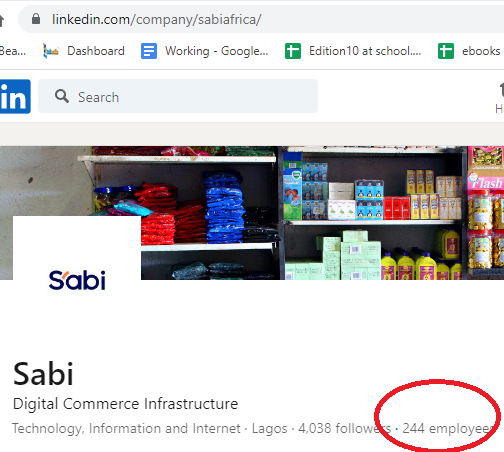
My Response: You may be measuring the wrong things for the informal sector. You ought to have seen the 244 employees on LinkedIn. They have hundreds of workers who manage regions in markets. Winning Africa is having a physical presence. Those online metrics mean not much for the informal sector.
Q Response: I had seen them, actually. But then it’s not a tech startup, it’s just a wholesaler with a granular network of representatives…
My Response: If you have that argument, Amazon is not a tech company with more than 1 million workers.
You can also make the same case for Google with thousands of workers in Africa.
Labour is cheap in Africa where you can pay someone $150 per month. You can have that person to coordinate a market for you, putting order to the central system, for all vendors in that market. You can also decide to outsource that to agent networks.
Having an app is great but more than 90% of transactions cannot come from the app. Most of those users do not have confidence in relating with apps when it comes to payments. It is a B2B ecommerce but the most critical part is offline. If you cannot manage the vendors, you have no mission. Investors like such businesses because they cannot be automated out.
Q response: Well, over 40% of Amazon’s profit comes from its AWS unit… and its customers actually use its digital platform.
I take your point about the importance of agent networks to organise informal markets, but that’s not a tech company, and it does not command a tech company valuation…
70% of Nigerians don’t have a bank account, but it’s mandatory to have a bank account in order to use Sabi… So I was a bit puzzled.
My Response:” Well, over 40% of Amazon’s profit comes from its AWS unit… and its customers actually use its digital platform.”
Possibly, more than 90% of Sabi’s profit will come from its financing, and not from ecommerce margin. In other words, it can buy soap for $10 and asks customers to pay $10.01. But as that happens, it offers credit which will generate higher returns. In the Harvard Business Review, I called that a double play strategy. What makes Sabi great is not ecommerce but the banking credit operation which makes that possible.
“but that’s not a tech company, and it does not command a tech company valuation…” – the ecommerce business is not useful as I have written for Jumia. But the credit business (which remains hidden) is where the gold is. They will not discuss that but if you see their numbers, that is the deal. If you can facilitate $100m and take 5-10% monthly as fees, you have a great business. And you have no default since the goods are the collaterals. If they do not pay, you take what remains and give it to another vendor!
“70% of Nigerians don’t have a bank account, but it’s mandatory to have a bank account in order to use Sabi… So I was a bit puzzled.”
You may not understand what Sabi does. This is a B2B business, not B2C. It does not send to end users. Its vendors are fairly businessmen and women who run operations. In a market, you may have 300 of them even as that market serves 100,000 people. So, these 300 do have bank accounts. You cannot use the general Nigerian population because Sabi focuses on merchants and vendors and not consumers.
In TradeGrid which does a similar thing but for gas stations, it is the same model. We invested in the team and the numbers are doing great, no default or anything because you are financing inventory!
Q Response: Thanks for the very clear explanation!