DD
MM
YYYY

PAGES

DD
MM
YYYY

spot_img

PAGES

Home Blog Page 4233

VC Firm Ascend Raises $25 Million Pre-Seed Fund to Invest in AI Startups

0
Fund, money cash dollar

Venture Capital firm Ascend has raised a $25 million pre-seed fund to invest in Artificial Intelligence (AI) startups.

The company’s pre-seed fund raising was led by seasoned startup operator and angel investor Kirby Winfield. With the new fund, Ascend is placing a bigger bet on artificial intelligence, joining other venture capital firms investing money into the growing sector boosted by recent generative AI advancements.

Founding General Partner at Ascend Kirby Winfield disclosed that the firm will invest in pre-seed AI and Machine learning (ML) companies largely based in the Pacific Northwest.

Speaking on investment in AI startups, Winfield said,

AI is having a platform-shift moment. It would be irresponsible not to double down. I would imagine that is probably another downward correction in valuations in the next year. We have become even more convicted around investing at pre-seed. This is where we want to play. We want to take more ownership at that stage. We have really found some conviction around our thesis”.

The fund raised in the pre-seed round was 100% from individuals and consists of two vehicles, one that raised $22.5 million and another that raised $2.5 million from existing portfolio company founders. Ascend CEO Windfield raised a majority of the new fund at the beginning of 2022, just before the startup funding dried up amid the tech downturn.

Speaking on his investments in AI startups, Wingfield said that he isn’t looking for AI companies to invest in, but instead is focused on startups that will utilize the tech to find a better solution to problems.

In his words, “AI doesn’t matter, what matters is the solution you are selling to your customers. Many founders and investors are getting wrapped around the axle and putting the technology and solution before the benefit”.

Winfield expects to invest in around 40 companies from the new fund, which will also target startups building e-commerce infrastructure and B2B software. It is interesting to note the AI industry has been poised to grow to an estimated $126 billion by 2025. Today, AI has become essential for an increasing number of businesses as remote work and reliance on technology are the new daily norm.

According to a survey conducted by Accenture last month, 63% of organizations are now prioritizing AI over all other digital technologies. The survey shows that more than half of companies are investing more than 5% of their digital budgets in AI. Sixty-three percent, meanwhile, say that they expect their investment to increase over the next three years.

Subsequently, generative AI startups are rapidly gaining traction, and venture capital investors are keen to capitalize on their potential. Investors this year have been pouring funds into companies specializing in generative AI systems that can create humanlike conversation, imagery and computer code.

Major tech companies such as Meta, Google, and Microsoft are investing heavily in generative AI research in hopes of achieving a breakthrough that would put them at the forefront of the race. 

The heat around AI deals has intensified so much that many investors are worried the startups will falter due to the pressure to deliver. Several investors have disclosed that startups raising seed rounds are pushing for valuations of tens of millions of dollars or more. Some companies are raising back-to-back rounds of funding. 

Analysts at research firm PitchBook predict that venture investment in generative AI companies will easily be several times last year’s level of $4.5 billion. 
The Twitter’s New Offense Is A Better Strategy for Its Survival

0

They taught us in economics that companies have to specialize and build core competencies. They need to do things really well, and be the best possible in the domains. But today, we think that does not make a lot of sense in the digital space.

For technology companies, everyone is doing everything, even at top-level. Alphabet, Google parent company, is a car company, a search company, a medical company, an advertising juggernaut, etc. Amazon.com is an e-commerce firm, a publisher, a movie producer, a drone maker, etc.

Today, Twitter is going after Skype, WhatsApp, etc even as Bluesky and others are coming after it: “Twitter CEO Elon Musk has announced new features that will allow users of the social media platform to make voice and video calls, marking a new entrant in the chat and instant messaging business.”

Elon Musk is playing offense, making it clear that he would not stay here frozen for his blue bird to be attacked and eaten alive. This is the new age: offense is the best defense and no company is safe. Meta (parent of WhatsApp and Facebook) will now have to update a line in its competition sheet, with a new company named Twitter!

Comment on Feed

Comment 1: In the tech industry, fierce competition is ubiquitous, and companies are always on the lookout for ways to distinguish themselves. As a result, new entrants are constantly disrupting the market, prompting established players to elevate their game and bring fresh ideas to the table. This perpetual cycle of innovation and adaptation ultimately culminates in users having the final say on which companies emerge victorious.

How China is Changing the Narrative of the Struggle for World Power

0

Since the cold war era, the global economy has been highly driven by western capitalism, and the United States of America has been the vanguard of the hegemony and the power dynamics of the increasing globalization. Before the second world-war, Americans such as, John D. Rockefeller, Andrew Carnegie, Cornelius Vanderbilt etc had characterised the American value and work ethic, creating the path for the next generation entrepreneurs to achieve incremental innovation.

However, in recent periods, much has been said about the imminent rupture of the American hegemony and the Western Capitalism largely due to the daunting acceleration of China which has been leading development from the Eastern part of the world. Over the last two decades, China has been seen to continuously demonstrate grit and innovate toward changing the narrative.

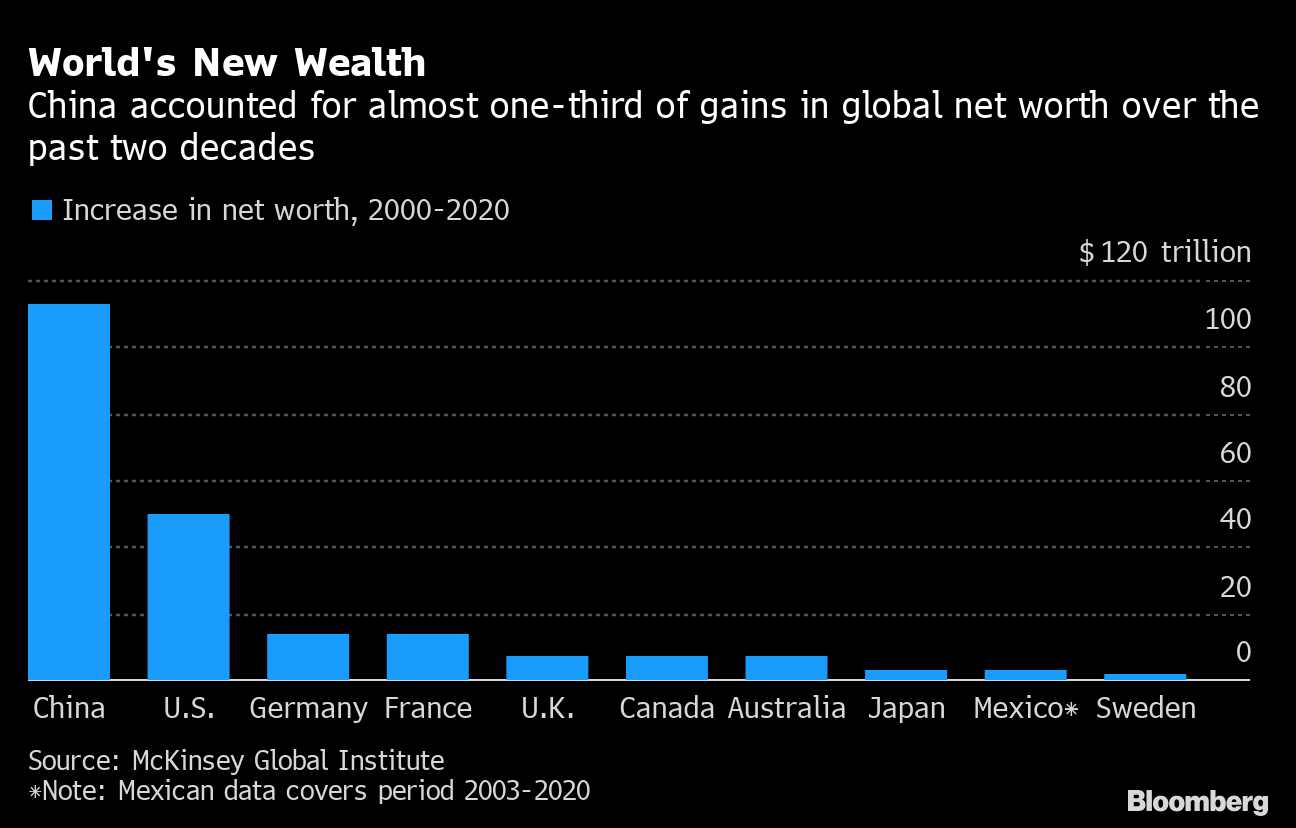
According to a 2021 McKinsey report, the global wealth more than tripled in the year 2020 rising to $514trillion from $156trillion in 2000. Over the course of this period, China has significantly advanced its economic strength to displace the US from the top spot worldwide after many years in 2020. The report shows the national balance sheets of ten countries (i.e. USA, China, Germany, France, UK, Japan, Sweden, Mexico, Canada, and Australia) which represent more than 60 percent of the world’s economies were analysed, and China emerged as accounting for almost one-third of the gains in the global net worth over the last 20 years.

‘’As net worth worldwide rose to $514trillion in 2020 from $156trillion in 2000, china wealth plunged to 120 trillion from 7 trillion in 2000 and the US experienced muted increase property prices but almost doubled its net worth to 90 trillion over the same period’’ McKinsey analysis as reported by Bloomberg reveals.

The report goes further to show that in the two biggest economies, USA and China, more than two-thirds of the wealth is concentrated in just 10 percent of the richest households

In another analysis, Yu Minhong, Chairman of New Oriental Education and Technology Group presents his view of the Chinese economic expansion which implies much of the great things that have been witnessed or said about China may represent only an insignificant achievement compared to what have yet to be discovered. According to him:

‘’…the upside is even greater. For the private sector in China only 10 percent of the potential has been tapped into. For thousands of years, businessmen were prevented from doing business. Now they are making up for the lost time with a vengeance, capitalizing on the size and quality of the workforce, China’s lower cost base and huge hunger for industrial consumption.’’

Twitter to Introduce Voice and Video Calls, Encrypted Messaging – Musk

1

Twitter CEO Elon Musk has announced new features that will allow users of the social media platform to make voice and video calls, marking a new entrant in the chat and instant messaging business.

Musk, who has been exploring ways to make Twitter better and profitable since he acquired the platform late last year, said the latest changes, which include encrypted message, will come with the latest version of Twitter that will be released on Wednesday.

“With latest version of app, you can DM reply to any message in the thread (not just most recent) and use any emoji reaction.

“Release of encrypted DMs V1.0 should happen tomorrow. This will grow in sophistication rapidly. The acid test is that I could not see your DMs even if there was a gun to my head.

“Coming soon will be voice and video chat from your handle to anyone on this platform, so you can talk to people anywhere in the world without giving them your phone number,” Musk said.

This new feature means that WhatsApp, which dominates the instant messaging industry with more than 2 billion monthly users globally, has a new competitor. Twitter has about 400 million monthly users; a huge number that analysts believe can disrupt the status quo.

Musk said Tuesday that WhatsApp cannot be trusted as allegations mount that the chat app has been spying on users.

Musk has maintained that he bought Twitter mainly to promote free speech by making it the platform that upholds truth and gives everyone uncensored liberty to speak.

“On this platform, unlike the one-way street of broadcast, people are able to interact, critique and refute whatever is said,” Musk said on Wednesday in response to a video posted by Tucker Carlson, which called the mainstream media out for lies, propaganda and manipulations.  Musk added that anything misleading on Twitter will get @CommunityNotes

However, while Twitter users have applauded some of the new features, Musk has acknowledged that the company has been under severe financial strains and was close to bankruptcy – underscoring the need for more revenue generation – especially as newly-made changes sparked mass exodus of advertisers from the platform.

The billionaire has made several changes on Twitter, including the monetization of verification marks that resulted in removal of blue ticks under the legacy verification, to generate more revenue.

One of Musk’s biggest moves so far is the incorporation of Twitter into his everything app dubbed X. An idea he plans to develop by also making Twitter a payment platform.

Microsoft Partners Builder AI to Develop AI-Powered Solutions For Businesses

0

Tech giant Microsoft has partnered with Builder.ai, an artificial intelligence-powered software development engine to develop AI-powered solutions for businesses.

The collaboration, which includes an equity investment from Microsoft, is expected to accelerate Builder.ai’s mission to empower businesses globally to build software without requiring any technical expertise.

This will also accelerate the go-to-market growth of Builder.ai platform through deep product connections across the Microsoft product ecosystem.

Speaking on the partnership with Microsoft, product marketing manager at Buidler.ai Abhishek Srivastava said,

For Builder, it’s imperative to be on the cutting edge of technology and thereby provide the best possible services available on multi-cloud platforms to our customers. The Microsoft partnership opens up new routes into the market for us to address the ever-growing demand for digital transformation.

This partnership is more relevant than ever in the post-COVID-19 world. All in all, we are pleased and humbled by the confidence Microsoft has shown in our vision of the global technology market by granting us the Tier 1 Partner Status.”

Also speaking on its collaboration with Builder.ai, Corporate Vice President, Business Development at Microsoft Jon Tinter said,

Our collaboration with Builder.ai is an extension of our mission to empower every person and every organization on the planet to achieve more. Our new deeper collaboration fuelled by Azure AI will bring the combined power of both companies to businesses around the world”.

The partnership includes the integration across Azure OpenAI service and other Azure Cognitive Services with Builder.ai’s software assembly line and the adoption of Microsoft Cloud and Artificial Intelligence (AI).

Also, Builder.ai is now authorized to resell all of Microsoft’s cloud offerings. This includes both Microsoft Azure and SaaS offerings like 0365, D365, and M365.  The software company also plans to integrate Microsoft services into its overall offerings to help users cloud better.

This collaboration for Builder.ai is centered around alignment with its core mission to help businesses and beyond become digitally inclined. Founded in 2012, Builder.ai is an AI-powered composable Software next-generation app development platform for every idea and company on the planet.

The platform along with human-assisted AI helps enterprises, small businesses, and entrepreneurs to build, run, and scale their software without requiring technical expertise and any lines of code. Its mission is to make it easy for users/ businesses to build the software they need.

The software company keeps users’ software fresh forever. With Studio One, they take care of all the bugs, fixes, and third-party updates so that they can focus on what really matters in growing their business. Also, the company’s product experts are with users every step of the way to help them project and manage their custom app.