DD
MM
YYYY

PAGES

DD
MM
YYYY

spot_img

PAGES

Home Blog Page 4236

BOOK REVIEW: (Mis)conception of Communication, Media and Mass in the Age of Modernity

0

As a sociology professor with an interest in contemporary society and media, John B. Thompson made significant contributions to how media is shaping modern society and how modern society is shaping various forms of media being used by people and organisations for different communication purposes in his 1995 book, “The Media and Modernity,” published by Cambridge University Press. Thompson develops a communication media interactional theory that distinguishes three basic types of interaction: face-to-face interaction, mediated interaction, and mediated quasi-interaction. Through these interactions, Thompson stresses the place of various forms of media, especially technical media with constant reference to television, in a modern society. Thompson argues that each type has inherent benefits for social life transformation within space and time. While the book has eight chapters, in this paper, our analyst reflects on Chapter 1, which focuses on communication and social context. Like other chapters, this chapter also has different themes explored using various examples to illustrate the interplay and overplay of media and modernity with respect to social contexts.

The first critical assumption Thompson made was that social phenomenon can be viewed as purposive action carried out in a structured social context where power and knowledge are desirable in knowing who wins and loses a communication battle or game. Thompson succinctly captures this with the exemplification of four forms of power that are needed for accomplishing one’s aims and interests. From economic power to symbolic or cultural power and coercive power to political power, Thompson argues that purposive communication and action exist in structured social contexts. These powers, according to Thompson, are interrelated and contribute to the enactment and maintenance of any communication act. Thompson further illustrates how these powers could be discerned from the attributes of technical media such as films, books, and television programmes among others. Our analyst stresses that his degree of fixation on the symbolic form as one of the attributes resonates with the symbolic or cultural power, which indicates the possession of certain cultural elements or values by someone that others do not have. When such a person further fixes or preserves the elements or values in any technical medium for commercial purposes, he gains more. However, Thompson notes that when the person pays attention to the copyright aspect of the commercialisation for sustainable revenue capture, commercial exploitation emerges, and those who lack the power are more likely to suffer for it.

Social interaction evolves and sustains in line with space and time. This is another critical assumption Thompson makes. He uses space-time distanciation to illustrate the level of outcomes or effectiveness of a communication act that is driven by technical media. For instance, space-time distanciation hardly exists when face-to-face social interaction occurs. Whereas, communicating using mass media usually generates high space-time distanciation. In this regard, our analyst notes that the high space-time distanciation leads to the conclusion that ‘mass’ in mass communication is elusive to define, having used technical media to illustrate how communication shapes society and society shapes it as well towards people’s everyday life experiences. He argues that the term ‘mass’ is misleading because of its fixation on the idea that any technical medium is actually targeted at a heterogeneous audience. He questions the relevance of this to a book or magazine being read by an individual.

However, he was quick to mention that the term could be appropriate for describing the audience of television programmes. But, in our analyst’s view, this position is still not valid for broadcast content because, in some situations, one person might be the audience. This largely explains why some television presenters in the current era of using technical media address the television audience as ‘viewer’. The second assumption he makes about the misleading nature of the term is its inability to challenge audiences’ critical thinking faculties. In other words, audiences cannot be seen as “passive onlookers whose senses have been permanently dulled by the continuous reception of similar messages”. The term ‘communication’ is also misleading because communication is of different types. Our analyst points out that in order to avoid being always seen as “passive onlookers”, users of technical media need to consciously or unconsciously adopt encoding and decoding rules by bringing knowledge and background assumptions about any message or symbolic form to bear, as Thompson suggests. This is imperative as it ‘unfixes’ media content ‘and frees it up to the ravages of time’.

The little attention Thompson pays to computer-mediated communication channels despite having modernity as a key term in the title of the book points to the need to be cautious in using some of his critical assumptions for appreciating contemporary media in relation to people’s actions and communication acts. Therefore, the notions of mass communication he exemplified need further exploration with respect to demarcating overlap terms towards understanding how purposive action and interaction occur in a structured computer-mediated social context.
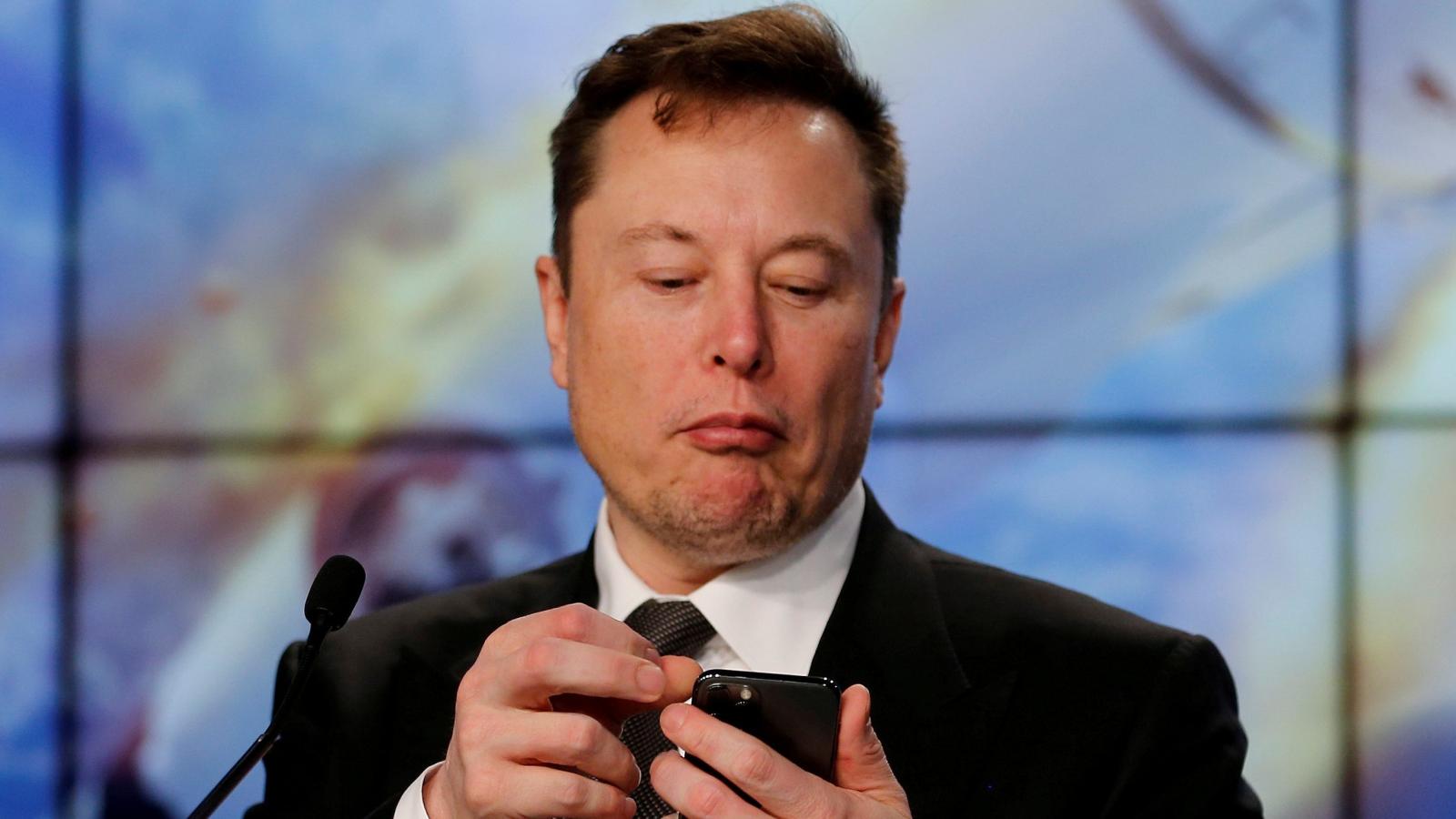

Elon Musk: The Master of the Physics of Pricing – And Winning With It

1

Another price cut by Tesla: “Tesla has slashed the prices of all of its electric vehicles in the U.S. for the fifth time this year, Reuters reports, as it tries to woo new drivers. The biggest price cuts went to its most expensive but slowest-selling models..” But look deeper, pricing is Elon Musk’s finest skill in business.

Tesla pioneered new pricing models, making selling cars to mirror the ways the world sells software. They have this business model where a buyer of your car must call Tesla to acquire new “licenses'” since the ones you have are not transferable.

More so, if you want more “capacity” in that car, you can send more money to Tesla and they will add more. If you check it, Tesla has a Basic Plan, Premium Plan and Enterprise Plan – and it is a car company. But if you open the books, that is how you price software.

People, the main reason why Tesla is valued more than most companies in the world combined is because of pricing innovation, not just the engineering feats! It makes selling cars look like selling software. Because of that, investors give it the same multiples as software companies because every car produced by Tesla will keep earning money until it is moved to landfill. No other car brand can say that at scale. So, when it is playing with cuts, do not think it is coming from the angle of pure weakness.

Of course, if Musk succeeds in the new pricing model he is pioneering in the social media world through subscriptions in Twitter, that would be another big one. The blue tick is no more free and if that works, expect Facebook, Instagram and others to copy it at scale. LinkedIn does not give ticks that much and it may not even have to do that. But my point is this: Elon Musk is using Pricing Strategies to Win in markets.

Tesla has slashed the prices of all of its electric vehicles in the U.S. for the fifth time this year, Reuters reports, as it tries to woo new drivers. The biggest price cuts went to its most expensive but slowest-selling models, the S sedan and the X SUV, which were reduced $5,000; it’s bestselling Y crossover SUV was cut by $2,000; and the 3 compact sedan was reduced $1,000. Some analysts have expressed concerns that the price cuts will eat into Tesla’s healthy profit margin.

Innovation does not end in engineering; pricing innovation could be catalytic.

Comment on Feed

Comment (inmail): Interesting article – aren’t around 84% of new autos financed in the USA? How are the USA based Auto funders reacting to the large pricing movements? In the U.K. the sudden discounting has materially impacted the residual value of the vehicles.

Tesla has reduced the vehicles by a similar value in GBP to $. But the lease value has barely moved (ie not dropped) as the funders have seen the residual value move by a similar amount – this doesn’t yet look like pricing mastery.

How is the used market for Tesla in the USA – the used market in the U.K. is not really supported in the same way as over OEMs meaning that they are not yet an attractive used buy in the U.K. as the servicing cost is much higher than the other OEMs.

It’s not yet looking like pricing mastery in the U.K. – how did you think it will evolve?

My Response: Tesla has limited choices right now because its products are largely expensive. It is not doing this in the position of strength. Yet, since Wall Street has focused on the number of vehicles shipped or sold to value the worth of the company, it can do this and get away with it. The core playbook is to increase volume even if the margin drops.

Tesla will lose a huge market cap if investors think no one wants to buy its cars. So, to avoid that, it has to make sure it can sell, and then can use inflation to explain margin challenges.

On the second hand value issue, that is for current owners, not for NEW owners who are getting better deals to drive Tesla. More so, by absorbing this margin hit, it forces Ford, GM, etc who are unveiling EVs to struggle to differentiate on price. Many people who did not consider Tesla in Dec for an EV, will not put it there.

EV will become a commoditized class in years. Tesla will use pricing to compete. Tesla is not built for the used market. Most drivers will like to have the new thing since relatively most Tesla owners have more cash to spare.

What Tesla could do is to buy these used vehicles via trade-in and open new markets in Africa and LatAm where it can get a premium. But for price conscious second hand buyers, I do not see that evolving at scale in the US.

Comment 1RIt will be interesting to see how it plays out….

I guess the issue though could be that no one will want to finance Tesla’s as the RV becomes too unpredictable, which becomes a problem for them if 84% of the USA auto market is financed (similar in the U.K.).

If Tesla is not managing and considering it’s used values or providing market aligned pricing for its servicing (this makes it high risk for anyone offering residual value based pricing) which in the U.K. is the vast majority of the new car retail finance market.

So this quickly becomes a problem for the new car buyer wanting to sell their car or for the funder taking the RV risk – the new and used car market are very closely aligned. I am not sure an OEM can just think about the new market and ignore what happens in the used market (for any period of time)

Ie Will the new car market for Tesla be sustainable if they can’t be sold at a value comparable in percentage depreciation terms to its peers?

A 3 year old Tesla Model S has a residual value of c £30k – is there is a market for this value of car in the markets you suggest?

Ps There was a really interesting article in the FT on Tesla’s problems in China – I suspect it will be the Chinese OEMs that give Tesla the biggest headache in the future

“Tesla’s price war in China backfires as BYD sales surge” on 28 March

My Response: Tesla’s moat is not forever. Very soon, this market will become a commoditized one.

Sui, Aptos, and Linera: Who will be the first dark horse on Layer 1

0

Diem is a blockchain-based licensed stable coin payment system As a crypto project launched by social giant Meta, Diem has attracted attention since its debut.

The market has placed high expectations on Diem and believes its launch will change the world’ s payments landscape. Social media, e-commerce, ride-sharing, music, travel, payments and other supergiants, such as Visa, Uber, eBay, Spotify, Coinbase and others, have become Diem’s partners.

But the project provoked strong opposition from government regulators in the EU, the US and other countries based on issues of monetary sovereignty, financial stability, privacy and anti-monopoly. Diem, which was due to be released in 2020, was renamed, suspended and finally retired at the end of January.

But Diem left behind a number of important technical “legacies”, the most important of which is its design of a new programming language, Move.

The Programming language — — Move

Move is a rust-based programming language originally developed by Facebook for the Diem blockchain. Currently, Move’s Github code base is mainly managed by Mysten Labs. Aptos and Sui team members are also the core development team of Move.Move wants to be the Javascript of Web3, enabling more developers to quickly build blockchain products.

While Three protocols under review is promising not to use any Diem IP owned by Silvergate in building the blockchain, comparing Diem’s white paper, you will find that the three public chain projects, Sui, Aptos and Linera, inherit some aspects of the development language or technical logic.

Next, we will compare the development progress and technical highlights of these three public chain projects.

1. Sui/Mysten Labs

Sui’s development team came from Mysten Labs, the founding team includes Evan Cheng, Adeniyi Abiodun, Sam Blackshear, George Danezis, and Kostas Kryptos, all of whom worked on Novi and Diem projects at Meta. Among them, CEO Evan Cheng served as Director of Engineering and Technology for the development of the Meta blockchain from 2018 until September of this year.

Last December, Mysten Labs received $36 million in a funding round led by a16z, with participation from Coinbase Ventures, NFX, Slow Ventures, Scribble Ventures, Samsung NEXT, Lux Capital, and others.

In May, Mysten Labs released its first test network Sui DevNet and the token economics model, announcing that it would launch a total of 10 billion Sui tokens.

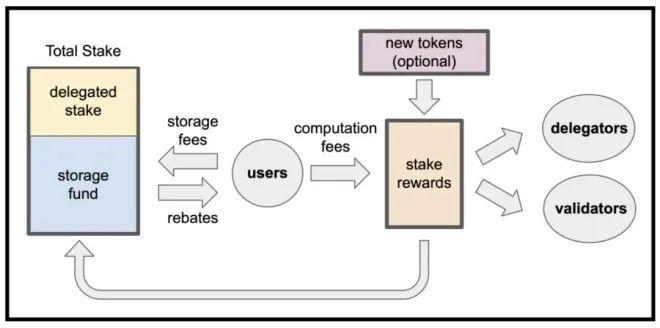
The network economic model of Sui

In July, Mysten Labs was seeking to raise at least $200 million in Series B funding at a $2 billion valuation, led by FTX Ventures, which has already raised $140 million in that round.

At present, Sui Network has launched two encrypted wallets for testing: Sui Wallet, an official Chrome plug-in Wallet, and Ethos Wallet, a third-party wallet that allows users to experience the Sui Network for transferring and casting NFTs. Sui will launch the motivation test network in August.

The key to Sui performance is transaction Parallelization. In most blockchains, transactions must be ordered and placed in blocks for sequential execution. Sequential execution unnecessarily limits throughput on these chains, since most transactions are independent of each other. Because Sui requires the subordination of the transaction to be explicitly stated, it is able to process them in conjunction with each other. In cases where a few transactions are intertwined, Sui can still sort them and execute them sequentially.

In terms of technology, Sui uses Move language to realize smart contract, ensuring standardization and security. In terms of consensus protocol, Sui uses BFT consensus for affiliated transactions and uses Byzantine broadcast algorithm for parallel verification of independent transactions. Therefore, high TPS is guaranteed while communication between nodes is reduced to achieve extremely low latency. Simple transactions can be verified immediately, and complex transactions take less than 3 seconds.

2. Aptos

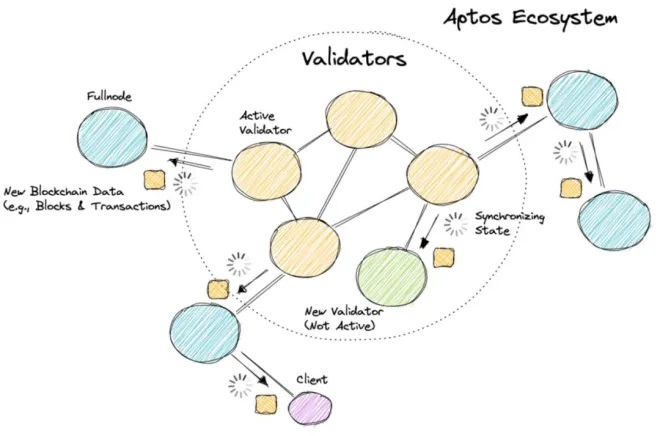
Aptos is the fastest growing public chain of the three in terms of development progress and the start of the ecosystem. Technically, Aptos also uses the Byzantine Fault Tolerance (BFT) consensus protocol and the Move programming language to build a more scalable blockchain.

Source: Aptos Blog

In March, 2022, Aptos closed a $200 million round of funding led by A16Z, Tiger Global, Katie Haun, Multicoin Capital, Three Arrows Capital, FTX Ventures, Coinbase Ventures and other prominent VCs. Since then, Binance Labs has announced an investment in Aptos Labs. Payment giant PayPal also said it was involved in the venture, which is PayPal Ventures’ first Layer1 public chain project.

In May, Aptos launched its Incentive Test Net registration. The Incentive Test network has four rounds in Aptos roadmap and is currently in the second aIT-2 pledge testing phase.

In a blog post, Aptos said its test network has reached more than 20,000 nodes, making it the largest community of proof-of-stake nodes. At the same time, the test network can validate and synchronize over 10,000 transactions per second (TPS) with sub-second latency, and is on its way to reach over 100,000 TPS. Aptos expects to launch the Aptos mainnet by the end of September.

In terms of eco-incentives, Aptos has hosted a hackathon and also launched an eco-funding program in late June to grow its ecosystem, which according to Aptos has over 100 projects built on the web with use cases covering DeFi, NFT, games, and more. In addition, Austin, the former head of marketing at Solana, recently announced that he will officially join Aptos in August as the ecosystem director. Austin spent most of his web3 career focusing on incubating and expanding the global community, and his experience may be of great help to Aptos’ ecological expansion.

3. Linera

Linera is the latest to get off the ground compared to the other two projects and is still in the early stages of development. Its goal is to create a low-latency blockchain that can scale as easily as Web2 applications, enabling most account-based operations to be confirmed in a fraction of a second.

Linera founder Mathieu Baudet previously worked as an engineer at Meta and helped create the Diem blockchain. As a principal researcher and engineer at Novi, he was a central figure in inventing the FastPay and Zef protocols These two protocols speed up transactions by completely removing memory pools and minimizing interactions between authenticators, and Linera continues to build on these two protocols. In addition, Linera’s founding team is comprised primarily of former Zcash and former Meta/Novi engineers and researchers.

On June 29, Linera completed a $6 million seed round led by A16Z, with the participation of Cygni Capital, Kima Ventures and Tribe Capital.

As mentioned above, Linera’s name is a direct indication of its characteristics; Linera will develop and promote new execution models for “linear scaling”. Linear scaling means that it is always possible to double the capacity of a system by doubling the number of machines. Currently, blockchains give preference to a model of “sequential” execution, which allows an account and a smart contract to interact arbitrarily in a series of transactions, but prevents linear scaling.

In Linera’s linear model, operations for different user accounts run simultaneously in different threads of execution, by which execution can always be scaled by adding new processing units to each verifier. At present, Linera has not explicitly developed in Move language in its the public documentation, only stated that it is based on Rust language. But from the technical characteristics of Linera, the logic of the two is very similar.

Meta Reportedly Paying Huge Sums of Money to Developers Building Its Metaverse

0

Facebook parent company Meta is reportedly paying huge sums of money to developers building its Metaverse.

Sources close to the company reveal that Meta’s programmers working on the company’s virtual reality suite earn a total compensation from $600,000 to packages approaching $1 million.

The tech giant which has been eyeing expansion into the metaverse for some time now, however, had a rough start, incurring billions in losses. Last February, Meta’s CEO Mark Zuckerberg revealed that the company has spent more than 10 billion dollars in the process of developing the Metaverse.

It includes a variety of products which includes Reality Labs Division, which makes virtual reality goggles, and smart glasses, all of these products are key to Zukerberg’s vision of the Metaverse, a next generation of the internet where people would share virtual worlds and experiences across different software and hardware platforms.

Zuckerberg revealed that the investment in Metaverse so far is more than ten times the amount of money it paid to purchase Instagram in 2012. In the first three quarters of 2022, Meta lost more than $9.4 billion in the development of its Reality Labs. Somehow, between last year’s third and fourth quarters, the rate of VR spending increased even more. The company lost an additional $4.28 billion on its Reality Labs in the last three months of 2022, compared with about $3.67 billion in losses in the preceding three months.

Due to all the spending on Metaverse, it dragged down the company’s quarterly profits which fell by 8% to $10.3 billion in the three months that ended in December last year. Despite all the losses incurred, Mark Zuckerberg has kept pushing towards virtual reality, even with little to show for the efforts thus far. 

Regardless of all its investment in Metaverse which is yet to become a reality, Zuckerberg has disclosed that the company doesn’t have any plans to change its long-term vision for the Metaverse. It is also interesting to note that at the beginning of the year, Meta was approved by a judge in the U.S. to go ahead with acquiring a virtual reality company.

Before the ruling, Meta was slammed with a lawsuit from the Federal Trade Commission against Meta and the company’s CEO Mark Zuckerberg in an attempt to block its ultimate goal of owning the entire Metaverse.

In 2023, the company expects its total expenses to be lower than previously forecast. However, Meta didn’t specify if that means it will be backing off of Metaverse spending. In efforts to calm investors in November, Zuckerberg said that WhatsApp and Messenger would be the company’s future focal points for boosting income.

Nigerian Medical Practitioners Vow to Fight Bill Seeking to Stop Them from Emigrating

0

The Medical and Dental Consultants Association of Nigeria (MDCAN) has reacted to the move by the House of Representatives to enact legislation, prohibiting medical practitioners from moving abroad for work within five years after leaving school or training.

On Thursday, the amendment of the Medical and Dental Practitioners Act, sponsored by Ganiyu Johnson, (APC Lagos) passed second reading in the House of Representatives. The bill seeks to withhold practicing licenses from medical practitioners until they have worked for five years in Nigeria.

Its intent is to fight brain-drain in the health sector by limiting the number of healthcare workers moving abroad in search of better work conditions.

“The bill is titled ‘A Bill for an Act to Amend the Medical and Dental Practitioners Act, Cap. M379, Laws of the Federation of Nigeria, 2004’ is to mandate any Nigeria-trained medical or dental practitioner to practice in Nigeria for a minimum of five years before being granted a full license by the Council to make quality health services available to Nigeria; and for related matters (H B.2130),” Johnson, who represents Oshodi/Isolo Constituency, said.

But the amendment bill has triggered a backlash, with both the general public and medical professionals in Nigeria condemning it.

In a statement signed by its President, Dr Victor Makanjuola, and Secretary-General, Dr Yemi Raji, MDCAN described the bill as discriminatory, harsh and not in the people’s interest. The association said the bill is misdirected and ill-informed, adding that it was poorly thought through and serves an excellent example of modern-day slavery.

“In fact, this bill can do the exact opposite: aggravating the exodus which we have been working with the executive arm of government to mitigate. It is pertinent to state that none of the suggestions of the inter-ministerial committee on brain drain and bonding of health workers has been implemented to date.

“Perhaps, a simple consultation with the primary constituency affected by the bill would have afforded the honorable member a clearer understanding of the hydra-headed nature of the problem he is trying to solve.

“This bill, without making any assumptions about the ill intent of the proposer, simply lacks the basic ingredients of good faith in the sense that it is both discriminatory and harsh, to say the least, and not in the interest of the people,” MDCAN said in the statement.

Nigerian medical professionals have been leaving in droves, exacerbating the country’s poor healthcare system. While the reasons behind their exodus have been centered on poor pay, work tools and residency training, the lawmakers believe that passing the bill will force Nigeria-trained doctors to stay behind for 5 years and will stop them from mass-emigrating.

The President, Nigerian Association of Resident Doctors, Dr Emeka Orji, said the move is as selfish and anti-people, asking the House to withdraw it.

“Some people want to cause trouble for this government before they leave. NARD is averse to such an anti-people bill and it is unfortunate that an honorable member will be thinking about that. That is selfishness.

“Have they come up with bills to stop public officials from seeking medical services abroad at taxpayers’ expense? They will not do that because it is affecting them directly and instead of addressing the root causes of brain drain, they are going to the symptom, and that is totally unacceptable.

“We know that the Speaker of the House of Representatives is someone that reasons a lot and we intend to reach out to him, that bill needs to be withdrawn,” he said.

The medical practitioners said they’re ready to fight the bill using every legal means necessary, amid the rising controversy trailing it.