DD
MM
YYYY

PAGES

DD
MM
YYYY

spot_img

PAGES

Home Blog Page 4241

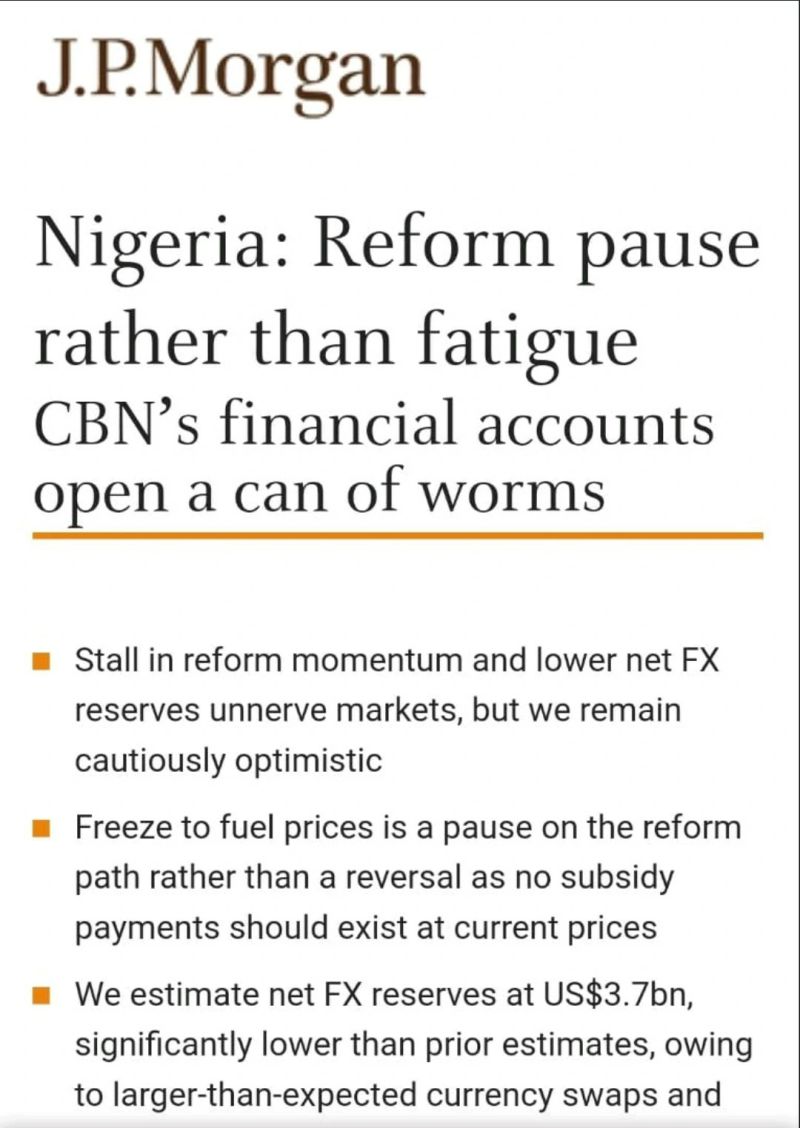
JP Morgan Estimates Nigeria’s Foreign Reserves At $3.7bn

0

Nigeria’s bad – Net FX reserves are “significantly lower” than previously estimated, according to a recent analysis by JPMorgan. The American multinational financial firm said the new information is based on partial information from the audited financial accounts of the Central Bank of Nigeria.

“We estimate that CBN’s net FX reserves were around US$3.7bn at the end of last year, from US$14.0bn at end-2021,” JPMorgan said.

Investors have expressed concern that Nigeria’s external reserve is far lower than what the central bank is presenting, referencing the apex bank’s inability to fulfill many of its financial obligations.

Nigeria’s central bank said the country’s foreign reserves stood at $37.09bn as at December 2022, and at $40.52bn as at the end of December 31, 2021

But information from the recent CBN audit reveals that Nigeria’s foreign reserves are far below what the central bank has been publishing for months because much of it has been used to securitize lending from foreign banks.

A statement posted on the CBN’s website said that “the Group entered into a securities lending agreement with Goldman Sachs and J. P. Morgan and as part of the agreement, the Group pledged its holdings on foreign securities in return for cash. The cash received from Goldman Sachs is N0.23 trillion ($500 million), 2021: N0.22 trillion ($500 million), and JP Morgan N3.23 trillion ($7 billion), 2021: N3.05 trillion ($7 billion) is recognized in other foreign securities.”

This revelation implies that the actual worth of current Nigeria’s foreign reserves, previously thought to be approximately $30 billion, going by the CBN’s figures, is in fact, around $17 billion.

Though JPMorgan said the $3.7bn net FX reserves estimate was done with a few assumptions, which if incorrect would substantially change the picture, the report paints a very gloomy picture for Nigeria’s FX market and explains, among other things, why the pegs on the dollar were removed.

“This settles the argument on why the dollar peg was removed; you CANNOT peg with $3.7b,” financial analyst, Kalu Aja, said.

JPMorgan listed the assumptions as follows: (i) an addition of US$5.0bn in IMF Special Drawing Rights (SDR) to external reserves in order to arrive at total gross FX reserves of US$37.8bn, broadly in line with the 30-day moving average of US$37.08bn previously published on the central bank’s website; (ii) 11 adjusting the gross external reserves with three key FX liability lines that include FX forwards (US$6.84bn), securities lending (US$5.5bn) and currency swaps (US$21.3bn); and (iii) estimating currency swaps by backing out FX forwards and outstanding OTC Futures balances from an overall aggregate published in the financial accounts.

Financial analysts believe that this new information confirms the fears of investors and will continue to deter foreign direct investments (FDIs) if not urgently addressed. 

“This is the main reason foreign investors have refused to bring in their funds,” Kelvin Emmanuel, Co-Founder and CEO at Dairy Hills said. “Principles work, so if you’re taking steps and things are not responding, then there’s something off somewhere, and this right here is the dead body in the woods.”

He explained that what is really remarkable is Nigeria’s Balance of Trade for 2022, which was $46.93bn for exports and $53.61bn for imports – putting the Balance of Trade at $6.68bn and outstanding forwards at $6.8bn. 

Citing the Guidotti-Greenspan Rule that measures the ratio of reserves (Balance of payment for 1-Year to external debt); Emmanuel noted that Nigeria’s External Debt position is at $43bn while the balance of payments for One Year is $6.68bn. Going by the Rule, Nigeria’s external reserves (currently at $3.7bn) must not drop below its balance of payments ($6.68bn) for one year.

“If the principle of a float is not working, and black market premium that measures fair value to spot rate is over 5% and is currently at 11.3%. Then it means that a fundamental principle has been violated,” he said.

JPMorgan said the situation has compounded the nation’s forex crisis, noting that the Net FX position makes an FX float less likely and halts Eurobond upward price momentum.
The bank also noted that lower net FX reserves reduce the ability and willingness to introduce a flexible exchange rate regime in the near term.

“Owing to a structural balance of payments deficit in Nigeria, and a worse starting point for net FX reserves than previously anticipated, authorities’ ability to transition to a significantly more flexible exchange rate regime is severely hampered,” it said.

The New York-based financial firm further noted that the process of rebuilding reserve buffers is likely to be protracted as significant reforms are needed to attract foreign direct (and portfolio) investment on a multi-year basis. 

“Perhaps short-term fixes could involve a swift improvement in oil output and significantly tighter monetary policy – authorities will have to increase the frequency of OMO auctions, which resumed last week. In the meantime, we remain on the sidelines, but on balance of risks we now believe selling USD/NGN NDFs may be the next trade given the reduced likelihood of further significant near-term FX adjustments,” it added.

Last week, the Nigerian government, through the Nigerian National Petroleum Company Limited (NNPCL) secured an emergency $3 billion crude oil repayment loan from Afreximbank. The loan, which has seen the naira up its performance in the FX market, was a big boost to the nation’s depleted foreign reserves. 

The loan was expected to hold off investors’ concerns in the short term. But JPMorgan’s report is believed to have shattered the expectation.

“The coordinating Minister of the economy should call a press conference and speak, the markets need confidence from an adult that understands a balance sheet,” Aja, said. 

“This JP Morgan report creates serious pressure on Nigeria’s ability to maintain a “strong” naira, and I fear it takes the winds away from the sails of that NNPC $3b. Nigerians want to know this, is the Naira safe to hold?” he added.

The JP Morgan’s Nigeria’s Vanishing $Billions

0

The revelation: JP Morgan posits that Nigeria’s FX Reserve to be in the neighbourhood of $3.7 billion instead of the $30 billion everyone has been using in reports. Why? Nigeria borrowed money on this reserve and has yet to return the money. In other words, when most fund managers refused to lend to us, we ransacked the reserve.

Nigeria’s bad – Net FX reserves are “significantly lower” than previously estimated, according to a recent analysis by JPMorgan. The American multinational financial firm said the new information is based on partial information from the audited financial accounts of the Central Bank of Nigeria.

“We estimate that CBN’s net FX reserves were around US$3.7bn at the end of last year, from US$14.0bn at end-2021,” JPMorgan said.

Investors have expressed concern that Nigeria’s external reserve is far lower than what the central bank is presenting, referencing the apex bank’s inability to fulfill many of its financial obligations.

Nigeria’s central bank said the country’s foreign reserves stood at $37.09bn as at December 2022, and at $40.52bn as at the end of December 31, 2021

But information from the recent CBN audit reveals that Nigeria’s foreign reserves are far below what the central bank has been publishing for months because much of it has been used to securitize lending from foreign banks.

This now explains why the government is largely probing the Central Bank of Nigeria (CBN). I hope they make the outcome public for We The People.

In the bank’s report – “Nigeria: Reform pause rather than fatigue” – you get a conflicting message from what other big banks have written, indicating that everyone is still trying to figure things out.

Good People, as that probe goes on, expect more revelations with cross-border implications. Everyone is going to publish a report because the searchlight is coming. Question: if this was not disclosed, what was the money used for? “Also, the CBN owes JP Morgan and Goldman Sachs a combined sum of $7.5bn as of the financial year ended December 2022. Included as part of its liabilities is another $6.3bn owned in foreign currency forwards.” – from CBN recent statement

Comment on Feed

Comment 1: I don’t understand much in economics but it means that naira will drop furthermore?

My Response: Not really immediately since Afreximbank gave us a loan ($3B) to support Naira in the export import window. That money should be enough for 30 days. So, there is nothing to worry about for the next 30 days. What happens after that time will decide the near-term trajectory of Naira

The Shredding of Meta’s Threads

1

“Threads was released in early July, and within five days, became the fastest app to reach 100 million downloads — but it has since lost about 85% of its daily active users, said digital analytics firm SimilarWeb. Threads now has fewer than 10 million daily active users; in contrast, X had nearly 238 million daily active users in July 2022”, notes LinkedIn News.

Indeed, the Threads hype went down. You hardly create a new tribe of customers when the product is a clone of a popular product (here, Twitter, now called X). Typically, creating fandom happens when you offer a new basis of competition, by offering something really new to users. Category-king companies pioneer new vistas in markets and chart their paths to financial glory. They go for the perceptions of customers, and not just the needs.

Remember: never scale a product until you have found a product-market fit. If you do not follow that, users will come, become disappointed, and then will leave. Advertising money does not retain customers; only products do!

Now that Meta wants to add a web version of Threads, the new app could become relevant to more users. Simply, this principle works, whether a big or small company: you must create a value proposition for users to win them in the market battle.

Meta Platforms  plans to launch a web version of microblogging app Threads early this week, the biggest new feature to be introduced on its competitor to Elon Musk’s X.

The desktop version would address one of the biggest of a long wish list of features users have sought for Threads. The text-first social-media app appeared on track to be a smash hit out of the gate when Meta launched a bare-bones version in early July, but use of it has plunged in recent weeks.

Users have been able to see specific Threads posts on the web but their access is limited, as the app is mostly geared for mobile phones.

Adam Mosseri, head of Instagram, said on Friday on his Instagram profile, that the web version of Threads would be launching soon and is already being tested internally at Meta. People familiar with Meta’s plans said it will launch early this week, although the launch plans aren’t final and could change.

“It’s a little bit buggy right now, you don’t want it just yet,” Mosseri said. “As soon as it is ready we will share it with everybody else.”

Meta rushed to launch Threads to take advantage of the growing interest for an alternative to X, formerly known as Twitter. Threads became the fastest app to reach 100 million downloads, hitting the mark in five days.

Yet, do not count out Threads because it is funded by a really deep pocket: Facebook’s Meta. They can decide to keep pumping money into it, just as they’re doing with WhatsApp which is amazing, and yet FREE in all sense of free. Just for that, I wish Threads well, and hopefully it can pick the shreds and thread back!

Comment on Feed

Comment 1: Your narrative is spot on, Scaling a product should only happen after achieving product-market fit. In my work with online businesses, I emphasize that they must initially gather a substantial customer base at a set acquisition cost. Additionally, those customers should actively use the product and it be something they are willing to share with their network before scaling becomes a consideration.

This was not really the case for ? threads, they never really got around getting people to use the app and what to use the app for exactly, I believe they will figure it out as they go along

Nice analysis

My Response: “I emphasize that they must initially gather a substantial customer base at a set acquisition cost. ” – a clinical great strategy which is like physics because it works.

Kenyan Fintech Zanifu, Secures $11.2 Million Dept-Equity Funding in A Pre-Series Round to Expand Offerings

0

Zanifu, a Kenyan fintech company that provides access to working capital for Micro, Small & Medium Enterprises (MSMEs) by providing short-term stock financing, has secured $11.2 million in a pre-series A round.

The funding round was led by Beyond Capital Ventures and Variant Investments, with participation from other investors which include; Founders Factory Africa, AAIC Investment, Google Black Founders Fund, and find from existing investor, Launch Africa.

Zanifu intends to use the new funding to enhance its offerings, and expand its inventory credit services from retailers to distributors.

Speaking on Zanifu’s expansion plan, the startup co-founder and CEO, Steve Biko said,

“We have decided to go deep into Kenya. We are focusing on serving more micro-SMEs and also getting more distributors into our fold, and ensuring the capital we are dispersing is generating returns for these businesses and helping them grow. So that’s really how we’re looking at it for now. We will, go to other markets once we get to profitability.”

The company’s CEO said that Zanifu targets businesses that find it hard to access credit from formal financial institutions for lack of structure, accounting books, and assets that can be used as collateral.

Biko noted that these businesses require credit to sustain their operations and to expand their businesses. “We found that most of these retailers, especially in this market, gave multiple distributors. And we increased their limits and allowed them to pay any of their distributors”, he said, adding that Zanifu is building a platform for distributors to update their stock-keeping units.

It is understood that following the raise of new funds, the startup is poised to deepen its operational presence within Kenya. This move involves redirecting its expansion plans away from Ghana and Uganda markets, where the challenge of sourcing adequate capital for operational and growth requirements mirrors that faced by small enterprises.

While MSMEs play a crucial role in driving economic growth and creating employment opportunities, these businesses in Kenya, often face difficulties in obtaining the necessary funds for their operations and expansion.

Zanifu alongside other startups and stakeholders therefore seeks to cater to the demands of MSMEs in the country, to close the credit gap faced by companies that have difficulty accessing traditional financial institutions.

Founded in 2016, Zanifu brings supplied and retailer inventory transactions online, enabling credit underwriting. Its customers use an Android application to know their credit limit, and make orders.

The fintech has integrated multiple payment channels into the app to facilitate swift repayments. It also enables retailers to pay for stock bought from other distributors not included in its database.

The startup has supported over 13,000 micro businesses and expanded its reach to encompass 500 distributors after the enlargement of its customer base. It has the mission to bridge the financial access gap in Sub-Saharan Africa and help bring millions out of poverty.

According to the World Bank, “Small and Medium Enterprises (SMEs) play a major role in most economies, particularly in developing countries.

Therefore, Zanifu has the vision to use technology to bring African MSMEs online, allowing them to grow their businesses and contribute to economic GDP growth.

Uwerx Proves Its Sustainability Post-Successful Launch As It Makes Moves To Overcome The Hack Hurdle

0

As blockchain and the freelance industry experience fast-paced adoption, it is bound to attract investors and, unfortunately, hackers too. Being aware of the activities of hackers over the years, Uwerx developers ensured they received audit approval from SolidProof and InterFi Network before even commencing presale activities.

After the recent hack following its successful launch on Uniswap, Uwerx has implemented plans for a full recovery to reclaim the trust of its investors and continue its goal of revolutionizing the freelance industry. Continue reading for more details on the Uwerx hack and the project’s plan for a full recovery.

Uwerx’s Successful Presale Ended On A High Note

The Uwerx presale, which began late March this year, finally ended on July 31st at 23:59 UTC. It enjoyed an influx of buyers and had to adjust its tokenomics to accommodate the new buyers. Its WERX token was sold at the final price of $0.05645, while last-minute buyers enjoyed a special final bonus of 27.5%.

The 5-phased presale attracted over 2,000 Twitter followers and 2,500 members on Telegram. This signifies users’ strong belief in Uwerx’s vision to empower the common man with the thriving gig economy.

Furthermore, remarkable progress has been made in the development of the Uwerx platform. The developers have already completed the design of some of the Core Functionality of the platform. These include the Application Preview, Chat System within job postings, Contract Preview, Message Search, Unlogged view for Agency, Freelancer, and Client, and Agency role selection.

Other completed pages are Settings, Help Center, Login, Create Account, Forgotten Password, Privacy Policy, Finished Payments, and Security Sections.

Meanwhile, the Core Functionality Designs that will be completed within the next two weeks include the Client Dashboard, Freelancer Dashboard, Agency Dashboard, Management of Ongoing Projects, and Additional Settings Pages. Once these designs are completed, the developers will commence the design of the premium elements of the Uwerx platform.

However, thanks to the commitment of the Uwerx team, the Uwerx Vault has been successfully completed and will complete its auditing process within the first week of August. Meanwhile, 84% of the Uwerx community has indicated their interest in utilizing the Vault to secure their funds and maximize their earnings.

On August 1st at 16:00 UTC, Uwerx performed its highly anticipated launch on Uniswap. The team revealed a 3% sell tax, 1% token burn, and 2% marketing. It also fulfilled its promise of locking deployed liquidity for 25 years, as previously announced during the presale. In addition, they reiterated their plan to renounce smart contract ownership soon after the CEX launch.

Finally, Uwerx announced its Buy-back program to provide additional support for the project. The campaign was designed to be executed weekly and will scale according to performance. However, the team withheld the specific dates for the buy-back to discourage bad actors. Given the recent hack, the buy-back funds will be channeled into liquidity provision.

Hacker Exploits Crypto-based Freelance Platform, Uwerx, Steals About $327K

While investors were anticipating the first WERX token airdrop scheduled for August 4th, Uwerx was hit with a flash loan exploit, resulting in the loss of 176 ETH (approximately $327,000) from its platform. The exploit occurred on August 2nd, a day after Uwerx launched on Uniswap. It was detected and recorded on Twitter by several crypto security platforms like PeckShield Alert and CertiK Alert.

According to CertiK Alert, the attacker flash-loaned 20,000 ETH ($36,726,400), which they exchanged for 5,053,637 WERX tokens. They created an imbalance in the Uniswap pool by sending 4,429,817 WERX tokens (about 10 times the initial amount).

By calling the skim() function of Uniswap with the 0x00…1 as the “to” address, they manipulated the token transfer to burn 1% of the initial amount resulting in an imbalance, which they exploited. In the end, the attacker gained 176 ETH ($327k).

Uwerx’s Sustainability Shines Through Its Strategic Steps Towards Overcoming The Hack

Following the unfortunate hacking, the Uwerx team has demonstrated immeasurable resolve by restrategizing to mitigate the effects of the hack. The team quickly contacted SolidProof and InterFi Network, alongside other security platforms that reported the incident. They also issued a message to the exploiter to consider returning 80% of the stolen funds, keeping 20% as a “white hat bounty.”

Meanwhile, the team has pushed forward the initial roadmap and announced their intention to relaunch the WERX token using the liquidity planned for the Buy-back program. The new WERX will be built on August 14th, while its details will be released on August 21st. The token’s new contract address will be audited twice to ensure better security.

The team plans to adjust the tokenomics, airdrop schedule, and the whitepaper. They also plan to include a new sell tax that will decrease throughout the new vesting period. 100% of the sell tax will be directed to the liquidity pool for Uwerx on Uniswap. Therefore, it is purely for the benefit of Uwerx. In addition, the team has assured users of the safety of their WERX tokens bought during the presale.

Furthermore, the Uwerx community has shown immense support for the Uwerx team. Members remained optimistic about the project’s vision. Today at 9:00PM UTC, the team will be unveiling the new smart contract and details of the newly created WERX token.

The team also encourages members to send their recommendations through their feedback email feedback@uwerx.network. Meanwhile, the dedicated developers continue to work diligently to ensure the timely completion of the Uwerx platform. Updates will be revealed through official press releases.

Due to Uwerx’s strategic recovery plan and the support of its community, the project has once again proven its viability as a long-term investment with high-yield potential. Therefore, there’s no doubt that it will emerge stronger than ever from this temporary setback.

To get more information about the project, click the following links:

Website: https://www.uwerx.network

Telegram: https://t.me/uwerx_network

Twitter: https://twitter.com/uwerx_network