Dear president Biden,
Something remarkable happened on the morning of February 25, the day of the Nigerian presidential election. Many Nigerians went out to vote holding in their hearts a new sense of trust. Cautious trust, but still trust. Since the end of military rule in 1999, Nigerians have had little confidence in elections. To vote in a presidential election was to brace yourself for the inevitable aftermath: fraud.
Elections would be rigged because elections were always rigged; the question was how badly. Sometimes voting felt like an inconsequential gesture as predetermined “winners” were announced.
A law passed last year, the 2022 Electoral Act, changed everything. It gave legal backing to the electronic accreditation of voters and the electronic transmission of results, in a process determined by the Independent National Electoral Commission (INEC). The chair of the commission, Professor Mahmood Yakubu, assured Nigerians that votes would be counted in the presence of voters and recorded in a result sheet, and that a photo of the signed sheet would immediately be uploaded to a secure server. When rumors circulated about the commission not keeping its word, Yakubu firmly rebutted them. In a speech at Chatham House in London (a favorite influence-burnishing haunt of Nigerian politicians), he reiterated that the public would be able to view “polling-unit results as soon as they are finalized on election day.”
Nigerians applauded him. If results were uploaded right after voting was concluded, then the ruling party, the All Progressives Congress (APC), which has been in power since 2015, would have no opportunity for manipulation. Technology would redeem Nigerian democracy. Results would no longer feature more votes than voters. Nigerians would no longer have their leaders chosen for them. Elections would, finally, capture the true voice of the people. And so trust and hope were born.
By the evening of February 25, 2023, that trust had dissipated. Election workers had arrived hours late, or without basic election materials. There were reports of violence, of a shooting at a polling unit, and of political operatives stealing or destroying ballot boxes. Some law-enforcement officers seemed to have colluded in voter intimidation; in Lagos, a policeman stood idly by as an APC spokesperson threatened members of a particular ethnic group who he believed would vote for the opposition.
Most egregious of all, the electoral commission reneged on its assurance to Nigerians. The presidential results were not uploaded in real time. Voters, understandably suspicious, reacted; videos from polling stations show voters shouting that results be uploaded right away. Many took cellphone photos of the result sheets. Curiously, many polling units were able to upload the results of the House and Senate elections, but not the presidential election. A relative who voted in Lagos told me, “We refused to leave the polling unit until the INEC staff uploaded the presidential result. The poor guy kept trying and kept getting an ‘error’ message. There was no network problem. I had internet on my phone. My bank app was working. The Senate and House results were easily uploaded. So why couldn’t the presidential results be uploaded on the same system?” Some electoral workers in polling units claimed that they could not upload results because they didn’t have a password, an excuse that voters understood to be subterfuge. By the end of the day, it had become obvious that something was terribly amiss.
No one was surprised when, by the morning of the 26th, social media became flooded with evidence of irregularities. Result sheets were now slowly being uploaded on the INEC portal, and could be viewed by the public. Voters compared their cellphone photos with the uploaded photos and saw alterations: numbers crossed out and rewritten; some originally written in black ink had been rewritten in blue, some blunderingly whited-out with Tipp-Ex. The election had been not only rigged, but done in such a shoddy, shabby manner that it insulted the intelligence of Nigerians.
Nigerian democracy had long been a two-party structure—power alternating between the APC and the Peoples Democratic Party—until this year, when the Labour Party, led by Peter Obi, became a third force. Obi was different; he seemed honest and accessible, and his vision of anti-corruption and self-sufficiency gave rise to a movement of supporters who called themselves “Obi-dients.” Unusually large, enthusiastic crowds turned up for his rallies. The APC considered him an upstart who could not win, because his small party lacked traditional structures. It is ironic that many images of altered result sheets showed votes overwhelmingly being transferred from the Labour Party to the APC.
As vote counting began at INEC, representatives of different political parties—except for the APC—protested. The results being counted, they said, did not reflect what they had documented at the polling units. There were too many discrepancies.
“There is no point progressing in error, Mr. Chairman. We are racing to nowhere,” one party spokesperson said to Yakubu. “Let us get it right before we proceed with the collation.” But the INEC chair, opaque-faced and lordly, refused. The counting continued swiftly until, at 4:10 a.m. on March 1, the ruling party’s candidate, Bola Tinubu, was announced as president-elect.
A subterranean silence reigned across the country. Few people celebrated. Many Nigerians were in shock. “Why,” my young cousin asked me, “did INEC not do what it said it would do?”
It seemed truly perplexing that, in the context of a closely contested election in a low-trust society, the electoral commission would ignore so many glaring red flags in its rush to announce a winner. (It had the power to pause vote counting, to investigate irregularities—as it would do in the governorship elections two weeks later.)
Rage is brewing, especially among young people. The discontent, the despair, the tension in the air have not been this palpable in years.
How surprising then to see the U.S. State Department congratulate Tinubu on March 1. “We understand that many Nigerians and some of the parties have expressed frustration about the manner in which the process was conducted and the shortcomings of technical elements that were used for the first time in a presidential election cycle,” the spokesperson said. And yet the process was described as a “competitive election” that “represents a new period for Nigerian politics and democracy.”
American intelligence surely cannot be so inept. A little homework and they would know what is manifestly obvious to me and so many others: The process was imperiled not by technical shortcomings but by deliberate manipulation.
An editorial in The Washington Post echoed the State Department in intent if not in affect. In an oddly infantilizing tone, as though intended to mollify the simpleminded, we are told that “officials have asserted that technical glitches, not sabotage, were the issue,” that “much good” came from the Nigerian elections, which are worth celebrating because, among other things, “no one has blocked highways, as happened in Brazil after Jair Bolsonaro lost his reelection bid.” We are also told that “it is encouraging, first, that the losing candidates are pursuing their claims through the courts,” though any casual observer of Nigerian politics would know that courts are the usual recourse after any election.
The editorial has the imaginative poverty so characteristic of international coverage of African issues—no reading of the country’s mood, no nuance or texture. But its intellectual laziness, unusual in such a rigorous newspaper, is astonishing. Since when does a respected paper unequivocally ascribe to benign malfunction something that may very well be malignant—just because government officials say so? There is a kind of cordial condescension in both the State Department’s and The Washington Post’s responses to the election. That the bar for what is acceptable has been so lowered can only be read as contempt.
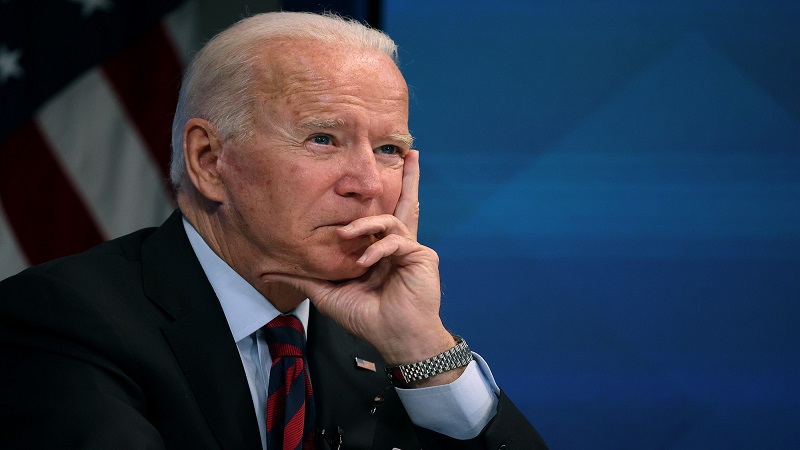
I hope, President Biden, that you do not personally share this cordial condescension. You have spoken of the importance of a “global community for democracy,” and the need to stand up for “justice and the rule of law.” A global community for democracy cannot thrive in the face of apathy from its most powerful member. Why would the United States, which prioritizes the rule of law, endorse a president-elect who has emerged from an unlawful process?
Compromised is a ubiquitous word in Nigeria’s political landscape—it is used to mean “bribed” but also “corrupted,” more generally. “They have been compromised,” Nigerians will say, to explain so much that is wrong, from infrastructure failures to unpaid pensions. Many believe that the INEC chair has been “compromised,” but there is no evidence of the astronomical U.S.-dollar amounts he is rumored to have received from the president-elect. The extremely wealthy Tinubu is himself known to be an enthusiastic participant in the art of “compromising”; some Nigerians call him a “drug baron” because, in 1993, he forfeited to the United States government $460,000 of his income that a Chicago court determined to be proceeds from heroin trafficking. Tinubu has strongly denied all charges of corruption.
I hope it will not surprise you, President Biden, if I argue that the American response to the Nigerian election also bears the faint taint of that word, compromised, because it is so removed from the actual situation in Nigeria as to be disingenuous. Has the United States once again decided that what matters in Africa is not democracy but stability? (Perhaps you could tell British Prime Minister Rishi Sunak, who quickly congratulated Tinubu, that an illegitimate government in a country full of frustrated young people does not portend stability.) Or is it about that ever-effulgent nemesis China, as so much of U.S. foreign policy now invariably seems to be? The battle for influence in Africa will not be won by supporting the same undemocratic processes for which China is criticized.
This Nigerian election was supposed to be different, and the U.S. response cannot—must not—be business as usual. The Nigerian youth, long politically quiescent, have awoken. About 70 percent of Nigerians are under 30 and many voted for the first time in this election. Nigerian politicians exhibit a stupefying ability to tell barefaced lies, so to participate in political life has long required a suspension of conscience. But young people have had enough. They want transparency and truth; they want basic necessities, minimal corruption, competent political leaders, and an environment that can foster their generation’s potential.
This election is also about the continent. Nigeria is a symbolic crucible of Africa’s future, and a transparent election will rouse millions of other young Africans who are watching, and who long, too, for the substance and not the hollow form of democracy. If people have confidence in the democratic process, it engenders hope, and nothing is more essential to the human spirit than hope.
Today, election results are still being uploaded on the INEC server. Bizarrely, many contradict the results announced by INEC. The opposition parties are challenging the election in court. But there is reason to worry about whether they will get a fair ruling. INEC has not fully complied with court orders to release election materials. The credibility of the Nigerian Supreme Court has been strained by its recent judgments in political cases, or so-called judicial coronations, such as one in which the court declared the winner of the election for governor of Imo State a candidate who had come in fourth place.
Lawlessness has consequences. Every day Nigerians are coming out into the streets to protest the election. APC, uneasy about its soiled “victory,” is sounding shrill and desperate, as though still in campaign mode. It has accused the opposition party of treason, an unintelligent smear easily disproved but disquieting nonetheless, because false accusations are often used to justify malicious state actions.
I supported Peter Obi, the Labour Party candidate, and hoped he would win, as polls predicted, but I was prepared to accept any result, because we had been assured that technology would guard the sanctity of votes. The smoldering disillusionment felt by many Nigerians is not so much because their candidate did not win as because the election they had dared to trust was, in the end, so unacceptably and unforgivably flawed.
Congratulating its outcome, President Biden, tarnishes America’s self-proclaimed commitment to democracy. Please do not give the sheen of legitimacy to an illegitimate process. The United States should be what it says it is.
Sincerely,
Chimamanda Adichie.
Like this:
Like Loading...